Category Archives: Decontamination Microbial

Research – Gaseous chlorine dioxide inactivation of microbial contamination on whole black peppercorns

Wiley Online

Black peppercorn is a common ingredient imported and used in uncooked or ready-to-eat foods in the United States. They might be exposed to fecal coliforms and other microbial contamination due to a lack of good agricultural and manufacturing practices in some developing countries under which they were grown and harvested, thus causing economic losses to the peppercorn industry in the United States. We investigated the effect of gaseous chlorine dioxide (ClO2) on reducing the microbial population levels of coliforms, aerobic bacteria, yeasts, and molds on unprocessed black peppercorns. Treatments on peppercorns were conducted in a 30-L airtight chamber, and equal amounts of dry media precursors were used to generate gaseous ClO2. Whole peppercorns (200 g) were exposed to 20, 30, and 40 g of precursor dose for up to 60 min at 21 ± 0.4°C and in combination with mild heat at 40 ± 2°C. Aerobic bacteria, coliforms, yeasts, and molds on peppercorns were enumerated before (7.4, 7.2, and 7.1 log CFU/g, respectively) and after treatments. Results after treatment demonstrated 0.8–1 log10 (90%) reduction for all the microbes post-treatment at 21 ± 0.4°C. The treatments conducted with a 30 g precursor dose for 60 min at 21 ± 0.4°C reduced statistically higher (p < .05) microorganisms than those at 40 ± 2°C. Our work demonstrated that gaseous ClO2 could be used as a part of an overall hurdle technology to reduce the coliforms, aerobes, yeasts, and molds on black peppercorns without affecting the visual quality.
USA – IDHP final report on Jackson County Shiga-toxin E. Coli / HUS cases

Food Safety News

The Iowa Department of Public Health (IDPH) has completed a final report on last May’s Shiga-toxin E. coli outbreak in a Jackson County childcare facility.  Pursuant to Iowa Open Records law, IDPH has shared its findings with Food Safety News

The onset of the E. coli illnesses occurred from May 6 to May 22.  IDPH and Jackson County Public Health learned, through the reportable disease system, of a Jackson County child suffering from Shiga-toxin E. coli.

“Local public health spoke to the healthcare provider and the case’s family to get information for IDPH’s Shiga-toxin investigation form,” according to the final report. “JCPH learned the child attended local childcare and placed the child under an exclusion order to exclude the child from childcare until resolution of diarrhea and two consecutive tested negative for Shiga-toxin E. coli.”

USA – Chicken and Salmonella Infantis, the Neverending Outbreak?

Food Poisoning Bulletin

When the CDC ended its investigation of a deadly Salmonella Infantis outbreak linked to raw chicken products in February 2019, it added an unusual note at the top of the posting. “This investigation is over. Illnesses could continue because this Salmonella strain appears to be widespread in the chicken industry,” it read in part.

Two and a half years later, the impact of that statement came into focus when an investigative report from ProPublica revealed that the outbreak, linked to a multidrug-resistant strain of Salmonella Infantis, has never ended.

“Many people are still becoming ill, and some of them gravely ill,” Robert Tauxe told ProPublica. Tauxe, who is the director of the Center for Disease Control and Prevention’s (CDC’s) Division of Foodborne, Waterborne, and Environmental Diseases, said the agency receives dozens of reports of illness linked to this strain each month, according to the report.

For every culture-confirmed Salmonella illness, the CDC uses a multiplier of 29 to account for undiagnosed infections. One internal CDC document that the ProPublica Team found estimated that this single strain of Salmonella Infantis is responsible for 11,000-17,000 illnesses per year.

And the strain is still frequently turning up in chicken.

Research – Research expands ability to detect, kill harmful biofilms

Food Safety News

Food safety practices evolve as new technology and knowledge of the pathogens that spread foodborne illnesses becomes available.

In recent years, researchers have increasingly focused efforts on biofilm and its ability to thrive in nature and in food production and processing facilities. Biofilm is formed by a pathogen — or more often, a mixture of different pathogens — that builds a protective layer using extracellular polymeric substances (EPS).

A majority of foodborne illnesses can be traced to pathogens housed in biofilms, according to food safety research. Academics and food trade associations have stepped up efforts in recent years to learn more about biofilm, which naturally fights efforts to sanitize food contact surfaces in processing and manufacturing facilities.

Recent studies have looked at products and practices to eradicate or control biofilms in different segments of the food industry, from produce to meat processing and poultry farms.

Denmark – Denmark aims to use education to reduce Norovirus risk when dining out

Food Safety News

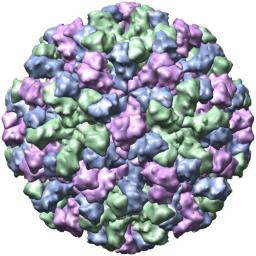
Norwalk_Caspid

The Danish Veterinary and Food Administration has launched a campaign to lower the risk of exposure to norovirus when dining out.

Ahead of Christmas, the Danish Veterinary and Food Administration (Fødevarestyrelsen) is focusing on how staff in professional kitchens, in cafés, canteens, restaurants and delicatessens can help to curb norovirus infections, which the agency said normally peak toward the end of the year.

Chefs and kitchen staff should stay home from work if they have symptoms of norovirus infection or have just had the disease. People can be infectious before feeling sick and at least 48 hours after having recovered.

Niels Ladefoged Nielsen, a consultant at the Danish Veterinary and Food Administration, said norovirus is extremely contagious, and there have been times when a single mistake in a professional kitchen has affected a large number of guests.

Nielsen said while the message of not cooking for others while feeling unwell is aimed at food professionals, it also applies to people at home in their own kitchen, and when preparing or serving food for family or friends.

USA – Shellfish growing area reopened after closure for link to outbreak

Food Safety News

A shellfish growing area has reopened for shellfish harvesting after a Camyboacter outbreak closed the pond two months ago.

Potter Pond is located in South Kingstown, RI, and was under investigation by the Rhode Island Department of Health (RIDOH), the Rhode Island Coastal Resources Management Council (CRMC), and Rhode Island of Environmental Management (DEM).

Potter Pond had been closed to shellfish harvesting because of bacterial contamination that was detected in early September. A RIDOH investigation indicated that eight people became ill after consuming raw shellfish harvested from Potter Pond and that the illnesses were because of Campylobacter bacterial contamination. The Campylobacter contamination has been linked to flocks of birds aggregating near shellfish growing areas.

Research – Israeli antimicrobial coating eliminates listeria 100% in factory pilot

Jpost

Israeli company Bio-Fence has created an antimicrobial coating that eliminated all traces of a deadly foodborne illness in a recent test.

An Israeli antimicrobial coating has managed to eliminate all traces of a deadly foodborne illness in a recent test conducted in a hot dog peeling room at a major sausage manufacturing facility in Israel.
The company, Bio-Fence, developed the coating, which was applied to the floor and lower part of the walls of the room which, despite repeated and strict disinfectant routines, had experienced high levels of listeria, particularly on the production floor.
Listeria is one of the deadliest foodborne illnesses. According to the US Food and Drug Administration, even if treated aggressively with antibiotics, as many as 30% of infected people die and more than 90% of people are hospitalized – often in intensive care units.
In the three weeks before the proof-of-concept (POC) pilot in which Bio-Fence’s coating was applied, listeria was detected in 21 out of 23 (91%) daily floor samples. After application, the bacteria were completely undetectable on the floor surface during day-to-day production.

Research – Transmission of Escherichia coli from Manure to Root Zones of Field-Grown Lettuce and Leek Plants

MDPI

Pathogenic Escherichia coli strains are responsible for food-borne disease outbreaks upon consumption of fresh vegetables and fruits. The aim of this study was to establish the transmission route of E. coli strain 0611, as proxy for human pathogenic E. coli, via manure, soil and plant root zones to the above-soil plant compartments. The ecological behavior of the introduced strain was established by making use of a combination of cultivation-based and molecular targeted and untargeted approaches. Strain 0611 CFUs and specific molecular targets were detected in the root zones of lettuce and leek plants, even up to 272 days after planting in the case of leek plants. However, no strain 0611 colonies were detected in leek leaves, and only in one occasion a single colony was found in lettuce leaves. Therefore, it was concluded that transmission of E. coli via manure is not the principal contamination route to the edible parts of both plant species grown under field conditions in this study. Strain 0611 was shown to accumulate in root zones of both species and metagenomic reads of this strain were retrieved from the lettuce rhizosphere soil metagenome library at a level of Log 4.11 CFU per g dry soil. View Full-Text

Research – The Bactericidal Efficacy and the Mechanism of Action of Slightly Acidic Electrolyzed Water on Listeria monocytogenes’ Survival

MDPI

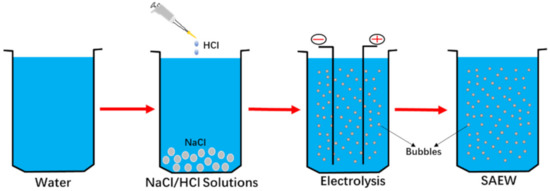
In the present work, the bactericidal efficacy and mechanism of slightly acidic electrolyzed water (SAEW) on L. monocytogenes were evaluated. The results showed that the strains of L. monocytogenes were killed completely within 30 s by SAEW whose available chlorine concentration (ACC) was higher than 12 mg/L, and it was confirmed that ACC is the main factor affecting the disinfection efficacy of SAEW. Moreover, our results demonstrated that SAEW could destroy the cell membrane of L. monocytogenes, which was observed by SEM and FT-IR, thus resulting in the leakage of intracellular substances including electrolyte, protein and nucleic acid, and DNA damage. On the other hand, the results found that SAEW could disrupt the intracellular ROS balance of L. monocytogenes by inhibiting the antioxidant enzyme activity, thus promoting the death of L. monocytogenes. In conclusion, the bactericidal mechanism of SAEW on L. monocytogenes was explained from two aspects including the damage of the cell membrane and the breaking of ROS balance. View Full-Text

Information – Spain – Omelette, yes. Salmonella, no

asca

Salmonella is a bacterium that causes one of the most common foodborne diseases: salmonellosis. In food it is found mainly in eggs and in raw pork and chicken. It can be spread to people through foods that contain Salmonella .

According to epidemiological data, salmonella causes a third of the food poisoning that occurs in Catalonia.

Thanks to the control measures applied at all stages of the food chain, from primary production until the food reaches the consumer, the number of salmonella cases and outbreaks in Catalonia has been considerably reduced.

Another essential element for the prevention of human salmonellosis is the improvement in food preparation practices in restaurants and at home.

Scientific knowledge supports that cooking is the only way to eliminate salmonella:

  • Food containing eggs must be cooked to a temperature that reaches 75 ° C in the center of the product.
  • The tortillas have to be well curdled.
  • Roasts of meat and chicken have to reach 75 ° C in the center of the piece. Make sure the juices are clear and not pink.

Click to access EFSA_Salmonela-no.pdf