Category Archives: Decontamination Microbial

CPS – Funded Projects 2022 –

CPS

Towards a holistic assessment of the food-safety risks imposed by wild birds

Birds introduce complex food-safety risks, as they carry multiple pathogens, are difficult to exclude from farms, and regularly defecate on crops. Yet very few wild bird species have been studied, and those that have form a minority of farm bird communities. Moreover, existing studies stop at examining pathogen prevalence in birds and do not holistically assess foodsafety risk. For a species to pose a significant risk, it must carry pathogens, visit fields, defecate on crops, and produce feces that support pathogen survival. Here, we propose to first identify species that carry pathogenic E. coliSalmonella, and Campylobacter by coupling existing studies with assays of field-collected feces. Second, we will survey birds and collect feces on 15-20 farms near rangeland, natural habitats, or produce farms to determine which species enter farms and defecate on crops and in which contexts. Third, we will compare E. coli survival between feces placed on different substrates (crops, organic/conventional soils, plastic mulch) and between feces from different species. Finally, we will compile holistic risk assessments for >50 species into a photographic guide to help growers identify and manage birds. Ultimately, we hope to help growers implement practices that bolster beneficial species without compromising food safety.

CPS – Funded Research Projects 2022 – Cyclospora

220px-Cyclospora_cayetanensis_stained

CPS

Cyclospora cayetanensis monitoring in agricultural water

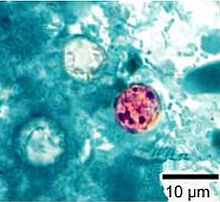
The parasite Cyclospora Cayetanensis is producing illness in people consuming infected produce. Because this pathogen is in very low concentrations on actual produce, which makes it close to impossible to detect, and for prevention reasons, it is more effective to check for its presence in irrigation water, from where it is typically transferred on produce. However, even in water, this parasite is very difficult to detect. It only can be detected by lengthy molecular laboratory procedures such as PCR. One major problem for scientists to develop better and faster detection methods is the fact that there is no antibody or other recognition molecule that would be able to bind to the surface of this intact parasite.

We propose to design and synthesize, for the first time, aptamers, molecules that will be able to bind to intact Cyclospora Cayetanensis oocysts, and use them to design simple paper based colorimetric tests that can detect it in the field without the need of sample preparation or specialized laboratories. The paper based test will turn from pink to purple to indicate the water sample being tested is positive for this parasite, making this a very simple and easy to use detection method for Cyclospora Cayetanensis.

CPS

AFECCT: Assessing filtration efficacy for Cyclospora control

The reputation of growers and the health of consumers suffer when people contract foodborne illness from fresh produce contaminated with Cyclospora cayetanensis. Because filtration has been established as effective in concentrating parasites for environmental surveillance, we propose to establish how effectively filters remove such parasites from irrigation water. To achieve this, we will first conduct a series of filtration experiments using abundant parasites (of chickens) that pose no risk to the study team. We’ll then assess how well these filters reduce water contamination with Cyclospora. We will also determine whether any parasites surviving filtration are harmed in the process. We hope these findings will directly benefit growers seeking tools to mitigate risk, and hasten future research progress by validating a needed surrogate system for studying other interventions against this dangerous and enigmatic human parasite.


New Zealand – Annual report concerning Foodborne Diseases in New Zealand 2020

MPI

New Zealand Food Safety, part of the Ministry for Primary Industries (MPI), leads New Zealand’s food safety system, protecting the health and wellbeing of consumers here and overseas. This includes reducing food-related risks to human health. Human health surveillance is an essential element of the monitoring and review component of New Zealand Food Safety’s risk management framework. In addition, evidence from notifications, case enquiries, outbreak investigations and other epidemiological studies of human enteric diseases are used as sources of data for risk profiles and assessments.

There is ongoing interest in foodborne disease statistics within New Zealand Food Safety and its stakeholders. This report for the calendar year 2020 is part of a series providing a consistent source of data and method of presentation to allow monitoring of foodborne illness in New Zealand. Human health surveillance data and foodborne disease The information in this report concerns reported cases of notifiable disease and reported outbreaks collected in the EpiSurv database.

Some notifiable illnesses may be caused by transmission of pathogens through foods, but it is important to remember that most of the information relates to the illness, not the mode of transmission.

The information needs to be considered with two caveats:

1. Notified cases of illness and reported outbreaks represent a subset of all the cases and outbreaks that occur in New Zealand each year. Many sick individuals do not visit a GP or otherwise come to the attention of the health system. By using these data as indicators, we are assuming that they are representative of all the cases and outbreaks that occur [1].

2. Foodborne transmission is only one of the routes by which humans are exposed to pathogens; other routes include water, animal contact and person to person. There are some indicators from which we can get information on the proportion of cases caused by foodborne transmission:

•Outbreak reports: the circumstances of an outbreak (multiple cases from a single event) mean that an investigation is more likely to identify a source of exposure to the pathogen than investigation of sporadic cases.

•Expert opinion: based on their experience in laboratories and epidemiological investigations, as well as knowledge of factors influencing the risk, experts can provide estimates of the proportion of cases caused by foodborne transmission.

Estimates for New Zealand have been developed for some foodborne diseases [2, 3], as presented in relevant report sections. These are not fixed values; future changes to the New Zealand food chain may require the values to be amended.

•Overseas analyses and estimates: information for countries with food supplies similar to New Zealand can be helpful, especially for illnesses where a foodborne estimate could not be developed f rom local studies. New Zealand estimates [2, 3] and published country-specific estimates, for the USA [4], Canada [5], Australia [6, 7], England and Wales [8] and the Netherlands [9] are given in Table 1.

In addition, a WHO project to estimate the global burden of foodborne diseases derived estimates for 14 international regions [10, 11]. The estimates for New Zealand, Australia, Canada, the Netherlands and the international WHO estimates are based on expert opinion, the estimates for England and Wales are based on outbreak analysis, while the US estimates are based on data from surveillance, risk factor studies and a literature review.

It is worth noting that, although for most of the diseases included in this report foodborne transmission is considered significant, there are several illnesses (shigellosis, giardiasis, cryptosporidiosis, hepatitis A) where foodborne transmission is considered to only contribute a small proportion of the total disease burden

Research – Main Groups of Microorganisms of Relevance for Food Safety and Stability

NCBI

Microbiology is important to food safety, production, processing, preservation, and storage. Microbes such as bacteria, molds, and yeasts are employed for the foods production and food ingredients such as production of wine, beer, bakery, and dairy products. On the other hand, the growth and contamination of spoilage and pathogenic microorganisms is considered as one of the main causes to loss of foodstuff nowadays. Although technology, hygienic strategies, and traceability are important factors to prevent and delay microbial growth and contamination, food remains susceptible to spoilage and activity of pathogen microorganisms. Food loss by either spoilage or contaminated food affects food industry and consumers leading to economic losses and increased hospitalization costs. This chapter focuses on general aspects, characteristics, and importance of main microorganisms (bacteria, yeasts, molds, virus, and parasites) involved in food spoilage or contamination: known and recently discovered species; defects and alterations in foodstuff; most common food associated with each foodborne disease; resistance to thermal processing; occurrence in different countries; outbreaks; and associated symptoms.

Research – Evaluation of microbial contamination in cold dishes and Prevalence of food-borne pathogens in the Jilin Province

Journal of Food Protection

In this study, we evaluated the microbial contamination status of cold dishes consumed by residents of Jilin Province and investigated to determine the incidence of four pathogenic bacteria in cold dishes. A total of 300 samples of cold dishes including meat, vegetable and mixed products, were collected from three different purchasing places: supermarkets, farmers’ markets and mobile vendors. Live bacteria were isolated using conventional culture methods. After separation, a quick and easy polymerase chain reaction (PCR) was used to detect Listeria monocytogenes , Staphylococcus aureus , Enterotoxic Escherichia coli and Salmonella . The results showed that the total number of microbial colonies in the vegetable samples exceeded the standard rate of 8%, and the total number of microbial colonies in the meat and mixed samples did not exceed the standard. The total microbial colony count exceeded the standard in all three different procurement sites, with the highest exceedance of 7.4% in the mobile vendor sites. The detection rates of Enterotoxigenic Escherichia coli , Staphylococcus aureus , L. monocytogenes and Salmonella among the four pathogenic bacteria detected in all samples were 4.3%, 3.3%; 3.0%; and 1.0%, respectively. This study can be used to qualitatively assess the microbiological quality associated with cold dishes. It provides data to support the detection of possible food safety problems.

Research – Controlling Listeria monocytogenes Growth and Biofilm Formation using Flavonoids

Journal of Food Protection

The aim of the present study was to investigate the ability of natural plant-derivate (flavonoid compounds) products to reduce and/or inhibit the biofilm-forming ability of Listeria monocytogenes. A collection of 500 synthetic and natural flavonoids were tested on strains of L. monocytogenes for their antimicrobial and anti-biofilm activity. L. monocytogenes biofilm inhibition by flavonoid compounds was tested on i) stainless steel coupons using crystal violet staining and ii) glass slides using confocal laser scanning microscopic (CLSM) imaging. The flavonoids were tested against a L. monocytogenes cocktail of 5 strains at a concentration of 100 µM to determine their effect on planktonic growth. A total of 17 flavonoids were chosen for further study due to their ability to significantly reduce the growth of L. monocytogenes in BHI broth, while 2 flavonoids were chosen because they actually increased growth. A lower concentration of flavonoid compounds (50 µM) was selected to investigate their effects on L. monocytogenes biofilm formation using i) stainless steel coupons to quantify biomass and ii) glass coupons to observe the biofilm architecture. The 19 flavonoids showed various levels of L. monocytogenes growth inhibition, ranging from 2% to 100%, as compared to the respective positive and negative controls on stainless steel, after 48 h of incubation at 22 o C. In addition, in comparison to the control, most of the 19 flavonoids significantly (p ≤ 0.05) inhibited biofilm formation, with at least one of the L. monocytogenes strains or at one of the tested temperatures. In fact, when grown in BHI broth with 50 µM of the 19 selected flavonoid compounds for 48 h at 22 o C, there were visible reductions in L. monocytogenes biofilm formation on the glass coupons. Overall, we found multiple flavonoid compounds to be promising anti-biofilm and antimicrobial agents against L. monocytogenes .

CPS – Funded Projects 2022 – Superheated Steam – Process Surface Decontamination

CPS

Practical application of superheated steam to harvesting, processing, and produce packing tools and equipment

Pathogens can contaminate environmental surfaces in produce handling operations. The industry uses sanitation programs to clean these surfaces and prevent product contamination. Highly effective sanitation procedures reduce the likelihood that pathogens will cross-contaminate products. In facilities that do not use water in their sanitation programs, tools like brushes and rags are used to clean. No-rinse sanitizers are sometimes used as well, but they cannot be used in organic operations. Superheated steam is a novel surface sanitizer that can kill pathogens on environmental surfaces. It is sometimes referred to as “dry steam” because it does not leave moisture or condensation on surfaces, making it a viable option for dry produce facilities. This project is designed to evaluate superheated steam use under industry relevant conditions. We will not only determine how well it works, but we will assess other key performance indicators including cost, range of appropriate applications, and the effect of extended use on equipment wear-and-tear and change to ambient relative humidity. This project will provide industry with the tools to comprehensively assess tradeoffs in superheated steam implementation. These resources will help improve the design of sanitation programs and enhance control over pathogen cross-contamination.

France- Large drop but France still records more than 1,000 outbreaks in 2020

Food Safety News

23311_lores

The number of outbreaks fell by more than 40 percent in France in 2020, largely because of COVID-19 measures, according to new numbers from the French public health agency.

Overall, 1,010 outbreaks were declared in 2020 affecting 6,814 people. Of these, 396 went to hospitals and nine died. Officials are compiling outbreak numbers for 2021.

In 2020, outbreaks went down by 43 percent from 1,783 in 2019 when 15,641 people were sickened, according to Sante publique France.

The drop in outbreaks is greater for those linked to commercial and catering settings but can be seen, to a lesser extent, for domestic outbreaks. The decrease is more marked during times of lockdown because of the pandemic but can also be noted outside these periods when social distancing measures, working from home and closure of restaurants were in place.

UK – Guidance on use of Alternative Sanitation Systems for the Disinfection of Cutting Tools in Slaughterhouses

FSS

This guidance is principally intended for food business operators (FBOs) in Slaughterhouses, Approved Game Handling Establishments (AGHE) and Cutting Plants.

This guidance sets out the process for implementing the use of alternative methods for the disinfection of tools in a Slaughterhouse, AGHE or Cutting Plant in England, Scotland, Wales and Northern Ireland. It provides an overview of the assessment processes for Officials and FBOs, including details of their roles and responsibilities. The guidance is not intended to detail all possible alternative disinfection methods or highlight how certain methods could be used on the wide variety of tools available.

It is ultimately the responsibility of the FBO to provide information on the method, the tools that will be disinfected, the validation data, the verification controls post- implementation and the standard operating procedure (SOP) for the use of the alternative method equivalent to the use of water above 82˚C.

FSA and FSS operations (and DAERA on behalf of FSA in Northern Ireland), in consultation with their Science colleagues, will assess the suitability of the alternative system and the validity of the SOP, when required.

Click to access FSA_FSANI_and_FSS_Guidance_for_Alternative_Systems_on_the_Disinfection_of_Tools_-_v6_final_-_October_2021.pdf

UK – Retailer’s Campylobacter results above FSA limit

Food Safety News

Marks and Spencer has again recorded the highest Campylobacter in chicken results in updated quarterly figures from the United Kingdom.

Campylobacter is the most common cause of bacterial food poisoning in the UK and the dose needed to make people sick can be as low as a few hundred cells. Marks and Spencer is the only retailer to publish data showing the percentage of chickens contaminated at 100 to 1,000 CFU/g and at under 100 CFU/g.

Contamination figures published by the retailer went down as the quarter went on. The latest data covers July to September 2021 for nine retailers on Campylobacter in fresh, shop-bought, UK-produced chickens.

The Food Standards Agency (FSA) maximum level is 7 percent of birds with more than 1,000 colony forming units per gram (CFU/g) of Campylobacter. Marks and Spencer results were also above this limit in May and June 2021.