Category Archives: Biofilm

Research – Occurrence, Antibiotic Resistance and Biofilm-Forming Ability of Listeria monocytogenes in Chicken Carcasses and Cuts

MDPI

A total of 104 samples of chicken meat acquired on the day of slaughter from two slaughterhouses in northwestern Spain were analyzed. These comprised 26 carcasses and 26 cuts from each of the two establishments. An average load of 5.39 ± 0.61 log10 cfu/g (total aerobic counts) and 4.90 ± 0.40 log10 cfu/g (psychrotrophic microorganisms) were obtained, with differences (p < 0.05) between types of samples and between slaughterhouses. Culturing methods involving isolation based on the UNE-EN-ISO 11290-1:2018 norm and identification of isolates by polymerase chain reaction (PCR) to detect the lmo1030 gene allowed the detection of Listeria monocytogenes in 75 samples (72.1% of the total; 50.0% of the carcasses and 94.2% of the cuts). The 75 isolates, one for each positive sample, were tested for resistance against a panel of 15 antibiotics of clinical interest by the disc diffusion method. All isolates belonged to the serogroup IIa (multiplex PCR assay) and showed resistance to between four and ten antibiotics, with an average value of 5.7 ± 2.0 resistances per isolate, this rising to 7.0 ± 2.1 when strains with resistance and reduced susceptibility were taken together. A high prevalence of resistance was observed for antibiotics belonging to the cephalosporin and quinolone families. However, the level of resistance was low for antibiotics commonly used to treat listeriosis (e.g., ampicillin or gentamicin). Nine different resistance patterns were noted. One isolate with each resistance pattern was tested for its ability to form biofilms on polystyrene during 72 h at 12 °C. The total biovolume of the biofilms registered through confocal laser scanning microscopy (CLSM) in the observation field of 16,078.24 μm2 ranged between 13,967.7 ± 9065.0 μm3 and 33,478.0 ± 23,874.1 μm3, and the biovolume of inactivated bacteria between 0.5 ± 0.4 μm3 and 179.1 ± 327.6 μm3. A direct relationship between the level of resistance to antibiotics and the ability of L. monocytogenes strains to form biofilms is suggested.

Research – Investigating the Potential of L(+)-Lactic Acid as a Green Inhibitor and Eradicator of a Dual-Species Campylobacter spp. Biofilm Formed on Food Processing Model Surfaces

MDPI

Abstract

Campylobacter spp. are prevalent foodborne bacterial enteric pathogens. Their inclusion in biofilms on abiotic surfaces is considered a strategy that facilitates their extraintestinal survival. Organic acid (OA) treatments could be used in a green approach to decontaminate various surfaces. This work aimed to evaluate the inhibitory and eradicative effects of L(+)-lactic acid (LA), a naturally occurring OA, on a dual-species biofilm formed on two food processing model surfaces (polystyrene and stainless steel) by three selected foodborne Campylobacter spp. isolates (two C. jejuni and one C. coli). The influence of aerobiosis conditions (microaerophilic, aerobic and CO2 enriched) on the resistance of the established biofilms to the acid was also tested. In parallel, the predominant metabolites contained in the planktonic media of biofilm monocultures and mixed-culture biofilm were comparatively analyzed by an untargeted metabolomics approach. Results revealed that LA inhibited mixed-culture biofilm formation by more than 2 logs (>99%) on both surfaces when this was applied at its highest tested concentration (4096 μg/mL; 0.34% v/v). However, all the preformed mixed-culture biofilms (ca. 106−7 CFU/cm2) could not be eradicated even when the acid was used at concentrations exceeding 5% v/v, denoting their extremely high recalcitrance which was still influenced by the abiotic substratum, and the biofilm-forming aerobiosis conditions. The metabolic analysis revealed a strain-specific metabolite production which might also be related to the strain-specific biofilm-forming and resistance behaviors and resulted in the distinct clustering of the different samples. Overall, the current findings provide important information on the effectiveness of LA against biofilm campylobacteria and may assist in mitigating their risk in the food chain.

Research – Identification of Biofilm-Forming Foodborne Pathogens and Development of Prevention Strategies

Food Safety.com

A recent study emerged from Penn State University about multispecies biofilms that provide Listeria monocytogenes with a strategy against sanitizers.1 This study brings much-needed attention to a persistent problem in the food safety community. Here, I provide several comments on this topic. Read More at the Link Above

A biofilm is a complex and dynamic community of microorganisms that adhere to surfaces and are encased in a matrix of extracellular polymeric substances (EPS). Biofilms can form on a wide range of surfaces, including natural substrates such as rocks and plant surfaces, as well as artificial surfaces such as medical implants, industrial equipment, and food processing equipment.

Research – Inhibitory Effects of Lactobionic Acid on Biofilm Formation and Virulence of Staphylococcus aureus

MDPI

Abstract

Staphylococcus aureus biofilm is a common bio-contaminant source that leads to food cross-contamination and foodborne disease outbreaks. Hence, there is a need for searching novel antibiofilm agents with potential anti-virulence properties to control S. aureus contamination and infections in food systems. In this study, the antibiofilm effects of lactobionic acid (LBA) against S. aureus and its influence on virulence were explored. The minimum inhibition concentration of LBA on S. aureus was 8 mg/mL. Viable count and crystal violet assays revealed that LBA inhibited and inactivated S. aureus biofilms. Microscopic observations further confirmed the antibiofilm activity of LBA on S. aureus that disrupted the biofilm architecture and inactivated the viable cells in biofilms. Moreover, LBA decreased the release of extracellular DNA (eDNA) and extracellular polysaccharide (EPS) in S. aureus biofilms. LBA suppressed biofilm formation by intervening metabolic activity and reduced virulence secretion by repressing the hemolytic activity of S. aureus. Furthermore, LBA altered the expressions of biofilm- and virulence-related genes in S. aureus, further confirming that LBA suppressed biofilm formation and reduced the virulence secretion of S. aureus. The results suggest that LBA might be useful in preventing and controlling biofilm formation and the virulence of S. aureus to ensure food safety.

Research – Innovative Hurdle Strategies for Listeria Control on Food-Contact Surfaces: A Peroxyacetic Acid–Steam Approach

MDPI

Abstract

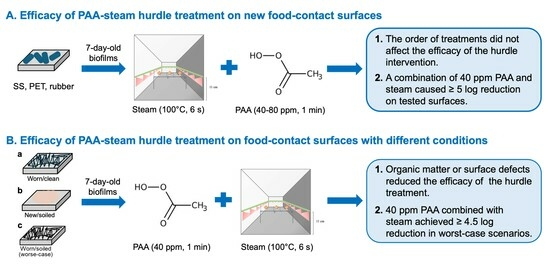
The persistence of Listeria monocytogenes biofilms on equipment surfaces poses a significant risk of cross-contamination, necessitating effective surface decontamination strategies. This study assessed the effectiveness of hurdle treatments combining peroxyacetic acid (PAA) and saturated steam against 7-day-old L. innocua (a non-pathogenic surrogate for L. monocytogenes) biofilms on stainless steel (SS), polyester (PET), and rubber surfaces. Results demonstrated >6 log10 CFU/coupon L. innocua reductions on SS and PET surfaces after PAA (40 ppm, 1 min) followed by steam treatment (100 °C, 6 s). On rubber surfaces, PAA (80 ppm, 1 min) followed by steam treatment (100 °C, 6 s) resulted in ~5 log10 CFU/coupon L. innocua reduction. The presence of apple juice soil reduced the efficacy of hurdle treatments, with PAA (40 ppm, 1 min) and steam exposure (6 s) resulting in 5.6, 5.8, and 4.2 log10 CFU/coupon reductions of L. innocua on SS, PET, and rubber, respectively. The efficacy of this antimicrobial combination was further reduced by surface defects, especially in the presence of organic matter. Nevertheless, the treatment still achieved >5 log10 CFU/coupon reductions of L. innocua on worn SS and PET soiled with apple juice and ~4.5 log10 CFU/coupon reduction on worn, soiled rubber surfaces. These findings highlight that PAA treatments followed by a brief steam exposure are effective strategies for controlling Listeria on food-contact surfaces.

Research – Interactive effects of osmotic, acid, heat, cold, and freezing stresses on the biofilm formation ability of Salmonella serotypes

Wiley Online

Abstract

Food-related stresses such as heating and freezing may influence the biofilm formation ability of bacteria. This study aimed to investigate the main and interactive effects of food-related stresses on the biofilm formation potential of Salmonella strains isolated from meat. Salmonella enteritidisSalmonella typhi, and Salmonella typhimurium were subjected to osmotic, acid, heat, cold, and freezing stresses. The colorimetric microtiter plate method was used to measure the biofilm formation ability as a response to the stresses. Among the main effects, freezing time had the most significant effect on the biofilm formation responses of three Salmonella serovars. Freezing reduced the biofilm formation ability of Salmonella typhimurium and Salmonella enteritidis but increased that of Salmonella typhi (p < 0.05). Among the interaction effects, the most significant effect on the biofilm formation response of Salmonella typhi was the interaction between pH and heat, which had a negative effect on the biofilm formation response. In contrast, the interaction between osmotic pressure and cold stresses was the most significant interactive effect on the biofilm formation responses of Salmonella enteritidis and Salmonella typhimurium, which had an increasing effect. This study concluded that the food-related stresses could change the biofilm formation capacity of Salmonella serotypes, and each serotype might show different biofilm formation abilities in response to different stresses.

Research – Battling bacterial biofilms: Winning the war against stubborn microbes

Food Safety News

Imagine a group of bacteria teaming up like a gang, creating a fortress around them. This is essentially what bacterial biofilms are – a tough, sticky barrier that makes them incredibly difficult to defeat. They form on medical devices, water pipes, kitchen surfaces, and even in our bodies, leading to persistent infections and contamination. In the food industry, bacterial biofilms formed on food and non-food contact surfaces are associated with many foodborne outbreaks.

Once attached to surfaces, biofilms can remain for long periods, ranging from days to years. A recent scientific study indicated that Listeria monocytogenes biofilms persisted for 17 years on contact surfaces in a seafood processing environment (see below for further reading). Although this formidable microbial community is resistant to chemical, physical, or biological treatments, there are proven ways to deal with them.

Research – Development of Predictive Modelling for Removal of Multispecies Biofilms of Salmonella Enteritidis, Escherichia coli, and Campylobacter jejuni from Poultry Slaughterhouse Surfaces

MDPI

Abstract

Salmonella Enteritidis, Escherichia coli, and Campylobacter jejuni are among the most common foodborne pathogens worldwide, and poultry products are strongly associated with foodborne pathogen outbreaks. These pathogens are capable of producing biofilms on several surfaces used in the food processing industry, including polyethylene and stainless steel. However, studies on multi-species biofilms are rare. Therefore, this study aimed to develop predictive mathematical models to simulate the adhesion and removal of multispecies biofilms. All combinations of microorganisms resulted in biofilm formation with differences in bacterial counts. E. coli showed the greatest ability to adhere to both surfaces, followed by S. Enteritidis and C. jejuni. The incubation time and temperature did not influence adhesion. Biofilm removal was effective with citric acid and benzalkonium chloride but not with rhamnolipid. Among the generated models, 46 presented a significant coefficient of determination (R2), with the highest R2 being 0.88. These results provide support for the poultry industry in creating biofilm control and eradication programs to avoid the risk of contamination of poultry meat.

Research – An In-Depth Study on the Inhibition of Quorum Sensing by Bacillus velezensis D-18: Its Significant Impact on Vibrio Biofilm Formation in Aquaculture

MDPI

Abstract

Amid growing concerns about antibiotic resistance, innovative strategies are imperative in addressing bacterial infections in aquaculture. Quorum quenching (QQ), the enzymatic inhibition of quorum sensing (QS), has emerged as a promising solution. This study delves into the QQ capabilities of the probiotic strain Bacillus velezensis D-18 and its products, particularly in Vibrio anguillarum 507 communication and biofilm formation. Chromobacterium violaceum MK was used as a biomarker in this study, and the results confirmed that B. velezensis D-18 effectively inhibits QS. Further exploration into the QQ mechanism revealed the presence of lactonase activity by B. velezensis D-18 that degraded both long- and short-chain acyl homoserine lactones (AHLs). PCR analysis demonstrated the presence of a homologous lactonase-producing gene, ytnP, in the genome of B. velezensis D-18. The study evaluated the impact of B. velezensis D-18 on V. anguillarum 507 growth and biofilm formation. The probiotic not only controls the biofilm formation of V. anguillarum but also significantly restrains pathogen growth. Therefore, B. velezensis D-18 demonstrates substantial potential for preventing V. anguillarum diseases in aquaculture through its QQ capacity. The ability to disrupt bacterial communication and control biofilm formation positions B. velezensis D-18 as a promising eco-friendly alternative to conventional antibiotics in managing bacterial diseases in aquaculture.

Research – Opportunistic Pathogens in Drinking Water Distribution Systems—A Review

MDPI

Abstract

In contrast to “frank” pathogens, like Salmonella entrocoliticaShigella dysenteriae, and Vibrio cholerae, that always have a probability of disease, “opportunistic” pathogens are organisms that cause an infectious disease in a host with a weakened immune system and rarely in a healthy host. Historically, drinking water treatment has focused on control of frank pathogens, particularly those from human or animal sources (like Giardia lambliaCryptosporidium parvum, or Hepatitis A virus), but in recent years outbreaks from drinking water have increasingly been due to opportunistic pathogens. Characteristics of opportunistic pathogens that make them problematic for water treatment include: (1) they are normally present in aquatic environments, (2) they grow in biofilms that protect the bacteria from disinfectants, and (3) under appropriate conditions in drinking water systems (e.g., warm water, stagnation, low disinfectant levels, etc.), these bacteria can amplify to levels that can pose a public health risk. The three most common opportunistic pathogens in drinking water systems are Legionella pneumophilaMycobacterium avium, and Pseudomonas aeruginosa. This report focuses on these organisms to provide information on their public health risk, occurrence in drinking water systems, susceptibility to various disinfectants, and other operational practices (like flushing and cleaning of pipes and storage tanks). In addition, information is provided on a group of nine other opportunistic pathogens that are less commonly found in drinking water systems, including Aeromonas hydrophilaKlebsiella pneumoniaeSerratia marcescensBurkholderia pseudomalleiAcinetobacter baumanniiStenotrophomonas maltophiliaArcobacter butzleri, and several free-living amoebae including Naegleria fowleri and species of Acanthamoeba. The public health risk for these microbes in drinking water is still unclear, but in most cases, efforts to manage Legionella, mycobacteria, and Pseudomonas risks will also be effective for these other opportunistic pathogens. The approach to managing opportunistic pathogens in drinking water supplies focuses on controlling the growth of these organisms. Many of these microbes are normal inhabitants in biofilms in water, so the attention is less on eliminating these organisms from entering the system and more on managing their occurrence and concentrations in the pipe network. With anticipated warming trends associated with climate change, the factors that drive the growth of opportunistic pathogens in drinking water systems will likely increase. It is important, therefore, to evaluate treatment barriers and management activities for control of opportunistic pathogen risks. Controls for primary treatment, particularly for turbidity management and disinfection, should be reviewed to ensure adequacy for opportunistic pathogen control. However, the major focus for the utility’s opportunistic pathogen risk reduction plan is the management of biological activity and biofilms in the distribution system. Factors that influence the growth of microbes (primarily in biofilms) in the distribution system include, temperature, disinfectant type and concentration, nutrient levels (measured as AOC or BDOC), stagnation, flushing of pipes and cleaning of storage tank sediments, and corrosion control. Pressure management and distribution system integrity are also important to the microbial quality of water but are related more to the intrusion of contaminants into the distribution system rather than directly related to microbial growth. Summarizing the identified risk from drinking water, the availability and quality of disinfection data for treatment, and guidelines or standards for control showed that adequate information is best available for management of L. pneumophila. For L. pneumophila, the risk for this organism has been clearly established from drinking water, cases have increased worldwide, and it is one of the most identified causes of drinking water outbreaks. Water management best practices (e.g., maintenance of a disinfectant residual throughout the distribution system, flushing and cleaning of sediments in pipelines and storage tanks, among others) have been shown to be effective for control of L. pneumophila in water supplies. In addition, there are well documented management guidelines available for the control of the organism in drinking water distribution systems. By comparison, management of risks for Mycobacteria from water are less clear than for L. pneumophila. Treatment of M. avium is difficult due to its resistance to disinfection, the tendency to form clumps, and attachment to surfaces in biofilms. Additionally, there are no guidelines for management of M. avium in drinking water, and one risk assessment study suggested a low risk of infection. The role of tap water in the transmission of the other opportunistic pathogens is less clear and, in many cases, actions to manage L. pneumophila (e.g., maintenance of a disinfectant residual, flushing, cleaning of storage tanks, etc.) will also be beneficial in helping to manage these organisms as well.