Tag Archives: science

New Zealand – Listeria Deaths – Charges Brought

Food Safety Newslisteria-hp

Bay Cuisine, a New Zealand food company, will face charges in the Napier District Court for a Listeria outbreak last year that killed one woman and contributed to the death of another, the Dominion Post reports.

Bay Cuisine was the sole supplier of ready-to-eat meats to Hawke’s Bay Hospital, where the two victims were patients. The outbreak strain of Listeria was isolated from the meats and found at Bay Cuisine’s facilities.

The outbreak sickened four. A 60 year-old woman died as a direct result of her infection, while the bacteria contributed to the death of an 81 year-old woman.

Earlier this week, the U.S. Centers for Disease Control and Prevention released a new report finding that Listeria monocytogenes killed roughly one in five Americans infected in recent years.

USA – Frozen Berries Outbreak – 79 Cases – Hepatitis A Virus

Food Safety News

The hepatitis A outbreak linked to a frozen berry mix sold at Costco and Harris Teeter stores has now sickened 79 people, 30 of whom were hospitalized, federal health officials reported Friday.

Cases have been reported in eight western states, including Arizona, California, Colorado, Hawaii, Nevada, New Mexico, Utah and Washington, according to the Centers for Disease Control and Prevention.

The illnesses have been linked to an organic mix of frozen berries and pomegranate seeds distributed by Oregon’s Townsend Farms. The berry blend was sold at Costco under the Townsend Farms brand and at Harris Teeter under the Harris Teeter brand.

To date, no cases have been reported on the East Coast, where Harris Teeter stores are located. CDC confirms that no cases have been linked to berries bought at Harris Teeter.

USA – Various Updates on the Berry Hepatitis A Outbreak

Food Poisoning Bulletin

The hepatitis A outbreak associated with Townsend Farms berries sold at Costco has sickened at least 37 people in six states and raised a lot of questions. One of them is how does food become contaminated with hepatitis A?

Food Poisoning Bulletin

The Centers for Disease Control and Prevention has updated the Hepatitis A outbreak associated with Townsend Farms Organic Anti-Oxdant Blend frozen berry and pomegranate mix. Now 49 people are sick with acute Hepatitis A in seven states. And eleven people have been hospitalized. The numbers are most likely going to change every day.

Food Poisoning Bulletin

Harris Teeter is recalling frozen mixed berries that may be contaminated with hepatitis A. The Matthews, NC-based grocery chain said Tuesday that it is removing  Harris Teeter Organics Antioxidant Berry Blend from its stores out of an abundance of caution because its berry supplier is Townsend Farms Inc. which has been associated with an outbreak of hepatitis A that has sickened 37 people in six states. That product contained mixed berrie and pomegranate seeds.

Research – Faster Salmonella ID – Mathematical Model Food Safety

Science CodexiStock_000008493122Small

A new approach may be able to reduce by more than half the time it takes health officials to identify Salmonella strains, according to researchers in Penn State’s College of Agricultural Sciences.

The finding may significantly speed up the response to many outbreaks of foodborne illness, allowing epidemiological investigators to identify the exact strains of Salmonella that make people sick and to more quickly find — and eliminate — the source of the disease.

Working in collaboration with Carol Sandt, a scientist with the Bureau of Laboratories, Division of Clinical Microbiology in the Pennsylvania Department of Health and Eija Trees, a microbiologist at the U.S. Centers for Disease Control and Prevention, Shariat used Salmonella samples supplied by the state health department. Results of the study were published online in May in the Journal of Clinical Microbiology.

“Compared to the current method being used nationally and internationally to subtype Salmonella, our approach is faster,” Shariat said. “The significance of that is you need to trace the source of an outbreak as quickly as you can before you start insisting on restaurant and farm closures. It is important to pinpoint the source of the bacteria — the quicker you do that the quicker you can respond to the disease outbreak.”

Ingenta Connect

This document describes the development of a tool to manage the risk of the transportation of cold food without temperature control. The tool uses predictions from ComBase predictor and builds on the 2009 U.S. Food and Drug Administration Model Food Code and supporting scientific data in the Food Code annex. I selected Salmonella spp. and Listeria monocytogenes as the organisms for risk management. Salmonella spp. were selected because they are associated with a wide variety of foods and grow rapidly at temperatures >17°C. L. monocytogenes was selected because it is frequently present in the food processing environment, it was used in the original analysis contained in the Food Code Annex, and it grows relatively rapidly at temperatures <17°C. The suitability of a variety of growth models under changing temperature conditions is largely supported by the published literature. The ComBase predictions under static temperature conditions were validated using 148 ComBase database observations for Salmonella spp. and L. monocytogenes in real foods. The times and temperature changes encompassed by ComBase Predictor models for Salmonella spp. and L. monocytogenes are consistent with published data on consumer food transport to the home from the grocery store and on representative foods from a wholesale cash and carry food service supplier collected as part of this project. The resulting model-based tool will be a useful aid to risk managers and customers of wholesale cash and carry food service suppliers, as well as to anyone interested in assessing and managing the risks posed by holding cold foods out of temperature control in supermarkets, delis, restaurants, cafeterias, and homes.

USA – FDA Recall – Seafood Products – Listeria monocytogenes

FDA

Prime Food USA, 50st & 1st Ave Building # 57, Brooklyn NY 11232, is recalling Latis Brand Seafood Products due to confirmed and suspected contamination with listeria monocytogenes.

Listeria can cause serious complications for pregnant women, such as stillbirth. Other problems can manifest in people with compromised immune systems. Listeria can also cause serious flu-like symptoms in healthy individuals.

The recalled Latis Brand Seafood products are packaged in various sizes plastic oval type containers. All container sizes are affected. The UPC numbers for the products begin with 75100407…. .The product was sold nationwide. They are products of Latvia

The recall was initiated after routine sampling by New York State Department of Agriculture and Markets Food Inspectors and subsequent analysis of the products by Food Laboratory personnel found various products to be positive for Listeria monocytogenes.

No illnesses have been reported to date in connection with this problem. Consumers who have purchased Latis Brand Seafood Products should not consume them, but should return them to the place of purchase.Consumers with questions may contact the company at 718-439-0376

Ireland – FSAI Recall – Smoked Mackerel – Listeria monocytogenes

FSAI

The implicated batch of Kari smoked mackerel is being recalled from consumers due to the detection of Listeria monocytogenes in a sample tested in Poland. The batch was sold nationwide, mainly in Eastern European supermarkets.  Shops which have sold this batch must display a point-of-sale notice advising customers not to consume the implicated batch.

Kari Smoked Mackerel (Makrela wedzona), in chilled vacuum packs. (Approval number: PL 02071801 EC)

USA- Hepatitis A in the News Again Worldwide

Food Safety NewsVirusds

Patrons of the 800 Degrees Three Fires restaurant in Fort Wayne, Indiana may be at risk for hepatitis A infection, warned health officials Friday.

A worker at the restaurant tested positive for the virus, prompting the Allen County Health  Department to issue a public health advisory.

The Department is urging customers who ate or drank at the 800 Degrees Three Fires restaurant on Illinois Road between May 18 and May 26, 2013 to get the hepatitis A vaccine if they have not already had it.

Food Safety News

new outbreak of a hepatitis A strain rarely seen in the Western Hemisphere is believed to be associated with frozen mixed berries purchased from Costco is being investigated by multiple agencies, including the federal Centers for Disease Control and Prevention in Atlanta.  At least 30 illnesses are involved, including  sicknesses in Arizona, California, Colorado, New Mexico, and Nevada.

According to the Colorado Department of Public Health & Environment, Townsend Farms Organic Antioxidant Blend frozen berries purchased from Costco appear to be the source of this outbreak.

The outbreak strain has  been identified by CDC as hepatitis A virus (HAV) genotype 1B, a strain that circulates in North Africa and the Middle East.  It was associated with last year’s outbreak in Europe involving frozen berries and another in British Columbia involving frozen berry blend with pomegranate seeds from Egypt.

Hong Kong – Australian Milk Recall – High Total Bacterial Count

Hong Kong Food Safety Center

The Centre for Food Safety (CFS) today (May 23) advised people not to consume a particular batch of Pura slim milk imported from Australia which was detected to have a total bacterial count exceeding the legal limit. The trade should also stop selling the affected product.

Details of the product concerned are as follows:

Product name: Pura slim milk
Place of origin: Australia
Expiry date: May 26, 2013
Packing size: 1 litre

“A sample of the milk was collected for testing under the regular Food Surveillance Programme. The test result showed that the total bacterial count of the sample was more than 30,000,000 per millilitre,” a CFS spokesman said.

“According to the Milk Regulation, milk after heat-treatment by means of pasteurization should not contain more than 30,000 bacteria per millilitre,” he said.

The CFS has issued a warning letter to the importer, Nowaday International Development Limited. Importation of the product concerned has been suspended and the trade has been alerted to the incident.

The importer is the sole importer of the milk product concerned. It has stopped sale and has initiated a recall of the affected product. According to the information provided by the importer, the affected product was available for sale at several supermarket chains. For enquiries about the product recall, consumers can call a hotline set up by the importer at 2882 2347 during office hours.

“The total bacterial count exceeding the legal limit indicates unsatisfactory hygienic conditions, but does not mean it would lead to food poisoning. Despite that, we think that it will be prudent for consumers who have bought the affected product to stop drinking it. The trade should also stop selling the affected product,” the spokesman said.

The CFS has informed the Australian authorities. We will monitor the recall of the affected product and the development of the incident. Appropriate actions will be taken whenever necessary.

USA – Raw Milk Issues Again – Campylobacter

Campylobacter BlogEurofins Food Testing

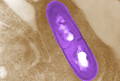
The Pennsylvania Departments of Agriculture and Health today advised consumers to discard raw milk produced by The Family Cow in Chambersburg, Franklin County, because of potential bacterial contamination.

Agriculture and Health Department laboratory tests and several recent illnesses indicate the raw milk may contain Campylobacter bacteria.

The Department of Health has confirmed five cases of confirmed Campylobacter infection in people who consumed milk from the farm at 3854 Olde Scotland Road.

Based on the reported illnesses, the Department of Agriculture collected samples of raw milk during an investigation of The Family Cow, on May 17. Positive tests for Campylobacter were confirmed Tuesday.

The packaged raw milk is sold under The Family Cow label in plastic gallon, half-gallon, quart and pint containers. It is labeled as “raw milk.” Raw milk is milk that has not been pasteurized

Research – Copper Kills Norovirus

Food Posioning BulletinNorwalk_Caspid

New research presented last week at the American Society for Microbiology’s 2013 general meeting showed that copper can destroy norovirus. The research was conducted at the University of Southampton. That virus causes more than 20 million illnesses in the United States every year, according to the Centers for Disease Control and Prevention, and norovirus causes 267 million infections worldwide every year.

Norovirus is extremely contagious and often affects people in contained situations, such as cruise ships and retirement homes. It is spread through person-to-person contact, contact with contaminated objects, and through food and drink.

Scientists discovered that norovirus is quickly destroyed on contact with copper.