Category Archives: Whole Genomic Sequencing

Research – Application of Whole Genome Sequencing to Understand Diversity and Presence of Genes Associated with Sanitizer Tolerance in Listeria monocytogenes from Produce Handling Sources

MDPI

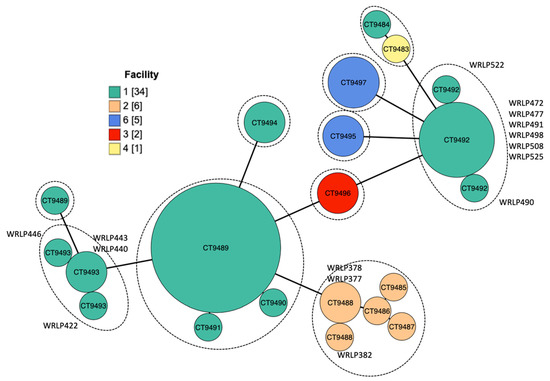
Recent listeriosis outbreaks linked to fresh produce suggest the need to better understand and mitigate L. monocytogenes contamination in packing and processing environments. Using whole genome sequencing (WGS) and phenotype screening assays for sanitizer tolerance, we characterized 48 L. monocytogenes isolates previously recovered from environmental samples in five produce handling facilities. Within the studied population there were 10 sequence types (STs) and 16 cgMLST types (CTs). Pairwise single nucleotide polymorphisms (SNPs) ranged from 0 to 3047 SNPs within a CT, revealing closely and distantly related isolates indicative of both sporadic and continuous contamination events within the facility. Within Facility 1, we identified a closely related cluster (0–2 SNPs) of isolates belonging to clonal complex 37 (CC37; CT9492), with isolates recovered during sampling events 1-year apart and in various locations inside and outside the facility. The accessory genome of these CC37 isolates varied from 94 to 210 genes. Notable genetic elements and mutations amongst the isolates included the bcrABC cassette (2/48), associated with QAC tolerance; mutations in the actA gene on the Listeria pathogenicity island (LIPI) 1 (20/48); presence of LIPI-3 (21/48) and LIPI-4 (23/48). This work highlights the potential use of WGS in tracing the pathogen within a facility and understanding properties of L. monocytogenes in produce settings. View Full-Text

Research -Application of Whole Genome Sequencing to Aid in Deciphering the Persistence Potential of Listeria monocytogenes in Food Production Environments

MDPI

Listeria monocytogenes is the etiological agent of listeriosis, a foodborne illness associated with high hospitalizations and mortality rates. This bacterium can persist in food associated environments for years with isolates being increasingly linked to outbreaks. This review presents a discussion of genomes of Listeria monocytogenes which are commonly regarded as persisters within food production environments, as well as genes which are involved in mechanisms aiding this phenotype. Although criteria for the detection of persistence remain undefined, the advent of whole genome sequencing (WGS) and the development of bioinformatic tools have revolutionized the ability to find closely related strains. These advancements will facilitate the identification of mechanisms responsible for persistence among indistinguishable genomes. In turn, this will lead to improved assessments of the importance of biofilm formation, adaptation to stressful conditions and tolerance to sterilizers in relation to the persistence of this bacterium, all of which have been previously associated with this phenotype. Despite much research being published around the topic of persistence, more insights are required to further elucidate the nature of true persistence and its implications for public health.

A Silver Lining of the Pandemic: Whole-Genome Sequencing and Food Safety

FAO

Zooming out and taking a broader perspective, WGS benefits are particularly visible in microbiology: WGS provides rapid identification and characterization of microorganisms with a level of precision that no tool has ever reached before. Through WGS, specific novel antibiotic targets (resistance genotypes) are being identified in the area of antimicrobial resistance (AMR)studies. It is a significant stepping-stone because more focused surveillance and more targeted diagnostics and drug development are made possible by identifying them and correlating them to the observed phenotypes. The level of detail provided by WGS makes it possible to refine case definitions precisely, which in turn allows for faster investigation of outbreak clusters, thus preventing additional cases of diseases sooner. For example, in 2014, a multinational Salmonella outbreak investigation was conducted in Europe where WGS was used to identify the root cause, and the data collected pointed to some egg farms in a specific location. While WGS was essential in the investigation, it was the international data-sharing efforts that made the investigation successful and conclusive. Another example is the outbreak investigation of Listeria linked to enoki mushrooms in Canada where the specific sequence of the Listeria strain was internationally shared, resulting in successfully tracing the multinational food safety outbreak and the rapid recall of the affected products.

Research – Economic evaluation of whole genome sequencing for pathogen identification and surveillance – results of case studies in Europe and the Americas 2016 to 2019 separator

Eurosurveillance

Whole genome sequencing (WGS) is transforming the work of microbiological reference laboratories across the globe. Complete genomic sequences from an isolate or sample have the potential to improve infectious disease surveillance programmes and strengthen epidemiological investigations. Examples include the potential to identify outbreaks earlier through the added value of genome-based cluster detection, the tracking of strains with specific markers relevant for health (for instance antigenicity, virulence, transmissibility, resistance markers) and the monitoring of effectiveness of control measures (for instance vaccination, elimination programmes) [1]. Development of pathogen genomics and the tools, infrastructure and necessary analytics for WGS can be used across sectors (public health, veterinary health or food safety) and pathogen types (viruses, bacteria or parasites), providing potential for further integration of surveillance activities and thus for economies of scale [1,2].

However, in practice, a model currently favoured involves the introduction of WGS into individual pathogen-focused programmes, where the costs of implementing WGS in routine diagnostics and surveillance remain high in comparison to the mainly phenotypic testing currently in use [2]. To better understand the cost differential between conventional methods and WGS in the context of pathogen identification and surveillance, and to identify the main factors affecting the costs and benefits of WGS-based surveillance systems, we conducted an economic evaluation in eight reference laboratories in seven countries (Argentina, Canada, Germany, Italy, the Netherlands, the United States (US) and two institutes from the United Kingdom (UK)). In a second step, we wanted to understand whether the benefits derived from the additional information obtained through the sequencing of pathogens is likely to balance out the additional cost of WGS. For this purpose, we estimated for the example of salmonellosis the number of cases of illness that would need to be prevented each year through the use of WGS in order to ‘break even’ on costs, i.e. in order to make the use of WGS cost-neutral.

UK – An outbreak of human listeriosis associated with frozen sweet corn consumption: Investigations in the UK

Science Direct

The use of Whole genome sequencing (WGS) identified a multi-country outbreak of human listeriosis associated with consumption of frozen sweet corn produced in Hungary. The purpose of this report was to summarise information on the cases occurring in the UK which were part of this outbreak and outline investigations on the presence of Listeria monocytogenes in the affected food chain.

Prior to the international recall of this product in 2018, 12 UK cases of listeriosis were identified as infected by the outbreak strain between 2015 and 18. Epidemiological and microbiological investigations confirmed these cases as belonging to the outbreak. A further case occurred in 2019 and a contaminated frozen pack from one of the implicated batches of sweet corn was recovered from the patient’s domestic freezer.

The outbreak strain was also detected in products from a sandwich manufacturer in 2018 which added frozen sweet corn directly to sandwich fillings. The sandwich manufacturer’s sweet corn was supplied by a distributor in England which obtained frozen products from the Hungarian manufacturer implicated in the outbreak. Within the distributor’s premises, 208 food and environmental samples were taken: L. monocytogenes was detected in 44% of 70 samples of frozen sweet corn and 5% of 79 other foods.

The outbreak strain was detected in the frozen sweet corn, in one other frozen food (mixed vegetables) and in the factory environment. The outbreak strain was also recovered from frozen beans on retail sale in the first four months of 2019. Five other L. monocytogenes strains together with two other Listeria species were detected in samples from the importer’s premises. One of the L. monocytogenes strains in the importer’s factory, which was distinct from the outbreak strain, was also recovered from sweet corn collected from the sandwich manufacturer, sweet corn tested in England in 2013 and 2016 and the blood of two cases of human listeriosis which occurred in England in 2014. This report shows how analysis by WGS provides evidence to understand complex food chains.

This report also highlights risks for transmission of human listeriosis from frozen sweet corn and the potential for misuse of this food as a ready-to-eat product.

Research – Scotland – WHOLE GENOME SEQUENCE TYPING AND ANALYSIS OF NON-O157 STEC

Click to access WGS_Typing_and_Analysis_of_Non-O157_STEC_-_Jan_2020_v3.pdf

Research – Changes detected in the genome sequences of Escherichia coli, Listeria monocytogenes, Vibrio parahaemolyticus, and Salmonella enterica after serial subculturing

Canadian Science Publishing

Whole genome sequencing (WGS) is rapidly replacing other molecular techniques for identifying and subtyping bacterial isolates. The resolution or discrimination offered by WGS is significantly higher than that offered by other molecular techniques, and WGS readily allows infrequent differences that occur between 2 closely related strains to be found. In this investigation, WGS was used to identify the changes that occurred in the genomes of 13 strains of bacterial foodborne pathogens after 100 serial subcultures. Pure cultures of Shiga-toxin-producing Escherichia coliSalmonella entericaListeria monocytogenes, and Vibrio parahaemolyticus were subcultured daily for 100 successive days. The 1st and 100th subcultures were whole-genome sequenced using short-read sequencing. Single nucleotide polymorphisms (SNPs) were identified between the 1st and final culture using 2 different approaches, and multilocus sequence typing of the whole genome was also performed to detect any changes at the allelic level. The number of observed genomic changes varied by strain, species, and the SNP caller used. This study provides insight into the genomic variation that can be detected using next-generation sequencing and analysis methods after repeated subculturing of 4 important bacterial pathogens.

Europe – ECDC – Multi-country cluster of Listeria monocytogenes ST1247 in five EU countries

ECDC

CDC has identified a microbiological link between an outbreak of nine Listeria monocytogenes ST1247 cases in Denmark and nine additional cases reported between 2014 and 2018 in Estonia (2 cases) Finland (2), France (1) and Sweden (4).

ECDC has identified a microbiological link between an outbreak of nine Listeria monocytogenes ST1247 cases in Denmark and nine additional cases reported between 2014 and 2018 in Estonia (2 cases) Finland (2), France (1) and Sweden (4).  In Denmark, the outbreak investigation is led by Statens Serum Institut (SSI), the Danish Veterinary and Food Administration and the DTU Food Institute.

Whole Genome Sequencing (WGS) analysis performed at the national level and by ECDC found all isolates from the 18 cases within two allelic differences from each other (core genome MLST using Moura scheme, 1540 of 1748 loci detected in all 18 isolates). The latest case was reported in Denmark in February 2019 (Figure 1).

Figure 1: Distribution of Listeria monocytogenes isolates by country and time of reporting 2014-2019 (n=18)

Figure 1: Distribution of Listeria monocytogenes isolates by country and time of reporting 2014-2019 (n=18)

A large-scale study led by ECDC on whole genome sequencing shows that most listeria outbreaks such as this one remain undetected. The study, published in 2018, suggests that more than half of the severe listeriosis cases in the European Union belong to clusters, many of which are not being picked up fast enough by the current surveillance system.

Listeria monocytogenes causes listeriosis, which primarily affects pregnant women, newborns, and adults with a weakened immune system. Listeriosis is a relatively rare but potentially severe food-borne disease that has been reported in increasing numbers in the EU/EEA countries since 2008. In 2016, 2 536 cases were reported, including 247 deaths.

Research – PopPUNK advances speed of bacterial pathogen surveillance

Science Daily

In a study published today in Genome Research, researchers developed PopPUNK (Population Partitioning Using Nucleotide K-mers), a computational tool for analyzing tens of thousands of bacterial genomes in a single run, up to 200-fold faster than previous methods. Researchers envision PopPUNK will expedite the identification of bacterial strains as the scale of bacterial genomes being sequenced increases and, importantly, allow public health agencies to quickly identify outbreak strains that pose a public health risk.

Research – Genomically Informed Strain-Specific Recovery of Shiga Toxin–Producing Escherichia coli during Foodborne Illness Outbreak Investigations

Journal of Food Protection

Next-generation sequencing plays an important role in the characterization of clinical bacterial isolates for source attribution purposes during investigations of foodborne illness outbreaks. Once an illness cluster and a suspect food vehicle have been identified, food testing is initiated for confirmation and to determine the scope of a contamination event so that the implicated lots may be removed from the marketplace. For biochemically diverse families of pathogens such as Shiga toxin–producing Escherichia coli (STEC), the ability to detect specific strains may be hampered by the lack of a universal selective enrichment approach for their recovery against high levels of background microbiota. The availability of whole genome sequence data for a given outbreak STEC strain prior to commencement of food testing may provide food microbiologists an opportunity to customize selective enrichment techniques favoring the recovery of the outbreak strain. Here we demonstrate the advantages of using the publicly available ResFinder tool in the analysis of STEC model strains belonging to serotypes O111 and O157 to determine antimicrobial resistance traits that can be used in formulating strain-specific enrichment media to enhance recovery of these strains from microbiologically complex food samples. The improved recovery from ground beef of model STEC strains with various antimicrobial resistance profiles was demonstrated using three classes of antibiotics as selective agents, suggesting the universal applicability of this new approach in supporting foodborne illness investigations.