Archives
-
Join 343 other subscribers
KSWFoodWorld
Blog Stats
- 429,665 Views
Category Archives: Vibrio vulnificans
Research – Pathogenic Vibrio bacteria in the current and future Baltic Sea waters: mitigating the problem
ContextVibrio – microbes that are part of the natural bacterioplankton in temperate marine waters – have in recent years flourished in the Baltic Sea, probably stimulated by elevated surface water temperatures. Several Vibrio species are human pathogens. It is hence of great concern that Vibrio-related wound infections and fatalities have increased dramatically along the Baltic coasts. Future climate change is predicted to escalate this problem, posing a significant threat to human health and the Baltic tourism industry.
However, the projections do not yet take into account the influence of ‘ecosystem engineers’ such as mussels and macrophytes on Vibriodiversity and abundance. Recent data indicate that in some of the ‘ecosystem engineers’ habitats the abundance of pathogenic Vibrio spp. is reduced. However, climate change will also affect the structure and functioning of the ecosystem engineers, with as yet unknown consequences for the Vibrio populations in the Baltic Sea.Main objectivesBaltVib aims to delineate the current and future Vibrio status, determine biotic and abiotic key factors regulating Vibrio prevalence, and identify nature-based solutions (NbS) to mitigate the problem.
This opens up the option for NbS strategies to control pathogenic vibrios in the nearshore habitat where humans interact with the sea.Main activitiesThe main activities will be understanding Vibrio – ecosystem engineer relations in the past, indexing the current distribution, regulation and pathogenicity of Vibrio, making a projection of Vibrio – ecosystem engineer relations in the future.
Further we will test the potential of underwater islands as an NbS to reduce pathogenic Vibrio spp.National authorities of the partner countries with responsibility for public health, bathing water quality, Marine Strategy Framework Directive and Water Framework Directive will be actively included in the decision-making process during the project through means of an advisory board. Additionally, politicians, stakeholders and the general public will be actively engaged to foster understanding of the need to protect and restore the biodiversity of seagrass meadow habitats as potential biofilters to conserve or reach a good ecological status and protect human health.
This will be achieved through a number of workshops, trainings, the provision of data and open web-GIS “BALTIC SEA ATLAS” maps and a website.BaltVib’s goals will be achieved through interdisciplinary integration of marine, microbiological, molecular and socio-ecological expertise carried by partners from seven Baltic nations.Seagrass meadows form a characteristic biotope type of shallow coastal waters of the Baltic Sea and have great ecological importance as potent biofilters
USA – Florida Vibrio vulnificus tally this year tops 2019

Florida state health officials have reported more Vibrio vulnificus cases and deaths than this year than was reported in 2019, according to the latest data.
Vibrio vulnificus can cause disease in those who eat contaminated seafood or have an open wound that is exposed to warm seawater containing the bacteria. Ingestion of Vibrio vulnificus can cause vomiting, diarrhea and abdominal pain. Vibrio vulnificus can also cause an infection of the skin when open wounds are exposed to warm seawater; these infections may lead to skin breakdown and ulcers.
Research – Effect of Ploidy on Vibrio parahaemolyticus and Vibrio vulnificus Levels in Cultured Oysters
HIGHLIGHTS
- Vibrio spp. abundances in oysters are not dependent on ploidy.
- Vibrio spp. abundances in oysters are dependent on handling treatment.
- Identification of occasional “hot” or “cold” oysters supports composite sampling.
Research – Presence of Foodborne Pathogens in Seafood and Risk Ranking for Pathogens
This study aims at examining the contamination of coliform bacteria, Escherichia coli, Listeria monocytogenes, Vibrio vulnificus, and Vibrio cholerae, which carry extremely serious risks to the consumer health, in 700 seafood belonging to 4 different (raw sea fish, raw mussels, raw shrimp, and raw squid) categories. The total number of samples was determined as 700. When the obtained results were viewed in total, they were found to be 48.14%, 18.71%, 8.57%, and 3.42% for coliform bacteria, E. coli, L. monocytogenes, and V. vulnificus, respectively. V. cholerae, one of the factors studied, was not found. Conventional microbiological cultivation methods were used in the analysis stage as well as the real-time PCR method. This study aims at making a risk ranking modeling for consumer health based on product category and pathogens by interpreting the results of the analysis with statistical methods. According to the statistical analysis, significantly binary correlations were determined among some parameters that stimulate one another for reproducing. In the light of the obtained results of the study, it has been concluded that the studies of the most detailed examinations of the microbiological risks associated with seafood, forms of microbial pollution and microorganisms that cause deterioration in seafood and threaten consumer health and the path that their epidemiologies follow, are of primary importance to both protecting consumer health and obtaining safe and quality seafood.
Posted in food contamination, Food Hygiene, Food Illness, Food Inspections, Food Micro Blog, Food Microbiology, Food Microbiology Blog, Food Microbiology Research, Food Microbiology Testing, Food Pathogen, Food Safety, Listeria, Listeria monocytogenes, Research, Vibrio cholera, vibrio cholerae, Vibrio parahaemolyticus, Vibrio vulnificans, Vibrio vulnificus
USA – Vibrio Vulnificus in Connecticut: Unusual number of infections prompt warning
Connecticut state health officials have issued a warning for the public in shoreline areas about the potential dangers of exposure to salt or brackish water along Long Island Sound, due to an unusually high number of Vibrio vulnificus infections.
Since July, five cases of Vibrio vulnificus infections have been reported to the Department of Public Health (one infection in July, four in August). The patients are from Fairfield (1), Middlesex (1), and New Haven (3) counties and are between 49 – 85 years of age (median 73); 4 are male, 1 female.
Two patients had septicemia (infection of the bloodstream) and three had serious wound infections. All five cases patients were hospitalized. No deaths have been reported.
All five cases reported exposure to salt or brackish water during activities such as swimming, crabbing, and boating. All five patients had pre-existing wounds or sustained new wounds during these activities which led to the Vibrio infections.
South Korea – Increase in Vibrio vulnificus Cases
The Korea Centers for Disease Control and Prevention (KCDC) has reported an increase in Vibrio vulnificus infections in the first eight months of 2020.
Epidemiological investigations of five patients who died from Vibrio vulnificus infection found that all of them were at high risk for the illness, with underlying conditions such as alcoholism, diabetes and liver disease, The Korea Times reports.
Vibrio vulnificus can cause disease in those who eat contaminated seafood or have an open wound that is exposed to warm seawater containing the bacteria. Ingestion of Vibrio vulnificus can cause vomiting, diarrhea and abdominal pain. Vibrio vulnificus can also cause an infection of the skin when open wounds are exposed to warm seawater; these infections may lead to skin breakdown and ulcers.
Posted in Bacteria, bacterial contamination, food contamination, Food Hygiene, Food Illness, Food Inspections, Food Micro Blog, Food Microbiology, Food Microbiology Testing, Food Pathogen, Food Poisoning, food recall, Food Safety, Food Testing, microbial contamination, Microbiology, Pathogen, pathogenic, Shellfish, Toxin, Vibrio, Vibrio vulnificans, Vibrio vulnificus
Research – Effect of Ploidy on Vibrio parahaemolyticus and Vibrio vulnificus Levels in Cultured Oysters
Vibrio parahaemolyticus and V. vulnificus are naturally occuring human pathogenic bacteria commonly found in estuarine environments where oysters are cultured. The use of triploid oysters has increased, due to their rapid growth rate and that they maintain a high quality throughout the year. Previous work suggested levels of Vibrio spp. may be lower in triploid oysters, as compared to diploids. Therfore, this study aimed to determine if there is a difference in the abundances of V. parahaemolyticus and V. vulnificus between half-sibling diploid and triploid oysters. In four trials, 100 individual oysters (either iced or temperature abused) were analyzed for V. parahaemolyticus and V. vulnificus using direct plating followed by colony hybridization. Mean levels of V. parahaemolyticus in iced and abused diploid oysters were 3.55 and 4.21 log CFU/g, respectively. Mean levels in iced and abused triploid oysters were 3.49 and 4.27 log CFU/g, respectively. Mean levels of V. vulnificus in iced and abused diploid oysters were 3.53 and 4.56 log CFU/g, respectively. Mean levels in iced and abused triploid oysters were 3.54 and 4.55 log CFU/g, respectively. The differences in Vibrio spp. abundances between diploid and triploid oysters was not significant (p>0.05). However, the differences across treatments were significant (p<0.05), with the exception of V. parahaemolyticus levels in trial 3 (p=0.83). Variation between individual oysters was also observed, with 12 of 808 measurements being outside of the 95 th percentile. This phenomenon of occasional statistical outliers (“hot” or “cold” oysters) has been previously described and supports the appropriateness of composite sampling to account for inherent animal variability. In summary, the data indicate that abundances of V. parahaemolyticus and V. vulnificus are not dependent on the ploidy of cultured oysters, but vary with the type of handling.
Research – The fate of cold‐stressed or tetracycline‐resistant Vibrio spp. in precooked shrimp during frozen storage

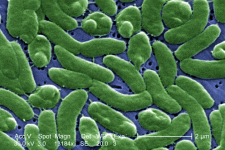
Image CDC
We compared the fate of cold‐stressed (CS) or tetracycline‐resistant (TR) Vibrio parahaemolyticus, Vibrio vulnificus , and Vibrio cholerae in precooked shrimp during frozen storage. The recovery ability of viable but nonculturable (VBNC) Vibrio cells was compared at 25°C. Each suspension of nonstressed (NS), CS, or TR Vibrio cells inoculated into cooked shrimps were subjected to frozen storage at −20°C or three freeze–thaw cycles. CS and TR cells were more rapidly converted to VBNC state than NS cells. Most of VBNC Vibrio cells were observed as viable cells after frozen storage. Although there were differences in the recovery extent of cells depending on the types of stress and strain, VBNC cells were resuscitated at 25°C. The most resistant to tetracycline and the lowest injury rate were observed in V. cholerae cells during frozen storage.
Research – Use of algal oil in shrimp diets shows sharp reduction in vibrio deaths, study finds
A study conducted by a team of shrimp disease experts from the US and Vietnam has found that the usage of algal oil in vannamei shrimp diets has a notable impact on survival rates among shrimp exposed to the bacterium vibrio, responsible for early mortality syndrome, or EMS, reports the Global Aquaculture Alliance.
Groups of specific pathogen-free 3-gram shrimp were fed different diets by the research team, before being exposed to shrimp broth inoculated with a consistently virulent strain of vibrio collected from a farm in Vietnam.
Research – The fate of cold‐stressed or tetracycline‐resistant Vibrio spp. in precooked shrimp during frozen storage
We compared the fate of cold‐stressed (CS) or tetracycline‐resistant (TR) Vibrio parahaemolyticus, Vibrio vulnificus, and Vibrio cholerae in precooked shrimp during frozen storage. The recovery ability of viable but nonculturable (VBNC) Vibrio cells was compared at 25°C. Each suspension of nonstressed (NS), CS, or TR Vibrio cells inoculated into cooked shrimps were subjected to frozen storage at −20°C or three freeze–thaw cycles. CS and TR cells were more rapidly converted to VBNC state than NS cells. Most of VBNC Vibrio cells were observed as viable cells after frozen storage. Although there were differences in the recovery extent of cells depending on the types of stress and strain, VBNC cells were resuscitated at 25°C. The most resistant to tetracycline and the lowest injury rate were observed in V. cholerae cells during frozen storage.