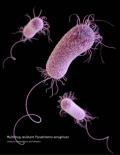
Category Archives: Pseudomonas

Research – Microbiological and real-time mechanical analysis of Bacillus licheniformis and Pseudomonas fluorescens dual-species biofilm

Microbiology Research

n natural habitats, bacterial species often coexist in biofilms. They interact in synergetic or antagonistic ways and their interactions can influence the biofilm development and properties. Still, very little is known about how the coexistence of multiple organisms impact the multispecies biofilm properties. In this study, we examined the behaviour of a dual-species biofilm at the air–liquid interface composed by two environmental bacteria: Bacillus licheniformis and a phenazine mutant of Pseudomonas fluorescens . Study of the planktonic and biofilm growths for each species revealed that P. fluorescens grew faster than B. licheniformis and no bactericidal effect from P. fluorescens was detected, suggesting that the growth kinetics could be the main factor in the dual-species biofilm composition. To validate this hypothesis, the single- and dual-species biofilm were characterized by biomass quantification, microscopy and rheology. Bacterial counts and microscale architecture analysis showed that both bacterial populations coexist in the mature pellicle, with a dominance of P. fluorescens . Real-time measurement of the dual-species biofilms’ viscoelastic (i.e. mechanical) properties using interfacial rheology confirmed that P. fluorescens was the main contributor of the biofilm properties. Evaluation of the dual-species pellicle viscoelasticity at longer time revealed that the biofilm, after reaching a first equilibrium, created a stronger and more cohesive network. Interfacial rheology proves to be a unique quantitative technique, which combined with microscale imaging, contributes to the understanding of the time-dependent properties within a polymicrobial community at various stages of biofilm development. This work demonstrates the importance of growth kinetics in the bacteria competition for the interface in a model dual-species biofilm.

Research – Limitation of microbial spoilage of rainbow trout fillets using characterized thyme oil antibacterial nanoemulsions

Wiley Online

Abstract

Thyme oil nanoemulsions (TONa and TONb), having 219 nm and 163 nm diameters, were successfully prepared by using sonication technique. Zeta potential (ZP) and polydispersity indexes (PDI) of TONa and TONb were defined to be 19.77, 0.24 and −24.80, 0.054, respectively. It was determined that zeta size values of TONs might have played a role on the inhibition of Pseudomonas aeruginosaEscherichia coliSalmonella typhimurium. All bacteria tested by agar diffusion method were gram‐negative bacteria that could be mostly found in fish fillets. Within 9 days cold storage period, TMAB growth in fish fillets treated with TONb was successfully reduced from 6.42 to 4.62 log CFU/g (change: 28%). In addition, as compared with control group samples, TPB growth of the same group was limited by 1.51 log CFU/g (from 7.93 to 6.42 log CFU/g). The results suggested that treatment of the fish fillets with the TONs would be a useful and practical nano application to delay microbial growth in fish fillets.

Practical applications

Thyme oil nanoemulsions (TONa and TONb) with a lower diameter than 219 nm have been successfully obtained. Antibacterial effects of TONa and TONb nanoemulsions have been revealed before treatment with fish fillets. The results revealed that TONs could be successfully used for the limitation of microbial spoilage of fish fillets stored at 4°C for 9 days. In this respect, the nano application with rapid and cost‐effective has been presented for the fishery processing industry.

Research – Bacteria partners with virus to cause chronic wounds

Science Daily


A common bacterial pathogen called Pseudomonas aeruginosa produces a virus that substantially increases the pathogen’s ability to infect us, according to a study by investigators at the Stanford University School of Medicine.

P. aeruginosa weaponizes its resident virus to exploit the immune system’s distinct responses to bacterial versus viral infections.

This marks the first time a bacteria-infecting virus, otherwise known as a bacteriophage or just phage, has been observed inducing the immune system to mount an antiviral response and, in doing so, causing it to ignore the bacterial infection. When the scientists generated a vaccine directed at the virus, they showed that it dramatically lowered the bacteria’s ability to infect wounds in mice.

USA – McDaniel Life-Line LLC Issues Voluntary Worldwide Recall of Life-Line Water – Pseudomonas aeruginosa

FDA

McDaniel Life-Line LLC is voluntarily recalling all lots of Life-Line Water to the consumer level. This product is being recalled because FDA analysis found the product to be contaminated with Pseudomonas aeruginosa.

Use of the contaminated product has a remote probability of necessitating medical or surgical intervention to preclude or reverse permanent damage to a body structure or function. To date, McDaniel Life-Line LLC has not received any reports of adverse events related to this recall.

The product can be taken internally or applied externally to the skin. The product is packaged in 1-gallon bottles. The affected Life-Line Water recall includes all lots.

The product was distributed in the United States and Canada to individuals via internet sales@lifelinewater.com.

McDaniel Life-Line LLC is notifying its customers, by press release, of the recalled product. Consumers that have product which is being recalled should stop using and discard.

Consumers with questions regarding this recall can contact McDaniel Life-Line by phone 806-647-1741, Monday thru Friday 8 AM-5 PM, Central Time or by e-mail lifeline@amaonline.com. Consumers should contact their physician or healthcare provider if they have experienced any problems that may be related to taking or using this product.

RASFF Alerts – Enterobacteriaceae – Pseudomonas – Chopped Beef and Turkey Skewers

RASFF-Logo

RASFF – high counts of Enterobacteriaceae (38000 CFU/g) and of Pseudomonas spp. (4000000 CFU/g) in frozen chopped beef and turkey skewers from Germany in Germany

Research -Identification and Spoilage Potential of the Remaining Dominant Microbiota on Food Contact Surfaces after Cleaning and Disinfection in Different Food Industries

Journal of Food Protection

After cleaning and disinfection (C&D), surface contamination can still be present in the production environment of food companies. Microbiological contamination on cleaned surfaces can be transferred to the manufactured food and consequently lead to foodborne illness and early food spoilage. However, knowledge about the microbiological composition of residual contamination after C&D and the effect of this contamination on food spoilage is lacking in various food sectors. In this study, we identified the remaining dominant microbiota on food contact surfaces after C&D in seven food companies and assessed the spoilage potential of the microbiota under laboratory conditions. The dominant microbiota on surfaces contaminated at ≥102 CFU/100 cm2 after C&D was identified based on 16S rRNA sequences. The ability of these microorganisms to hydrolyze proteins, lipids, and phospholipids, ferment glucose and lactose, produce hydrogen sulfide, and degrade starch and gelatin also was evaluated. Genera that were most abundant among the dominant microbiota on food contact surfaces after C&D were Pseudomonas, Microbacterium, Stenotrophomonas, Staphylococcus, and Streptococcus. Pseudomonas spp. were identified in five of the participating food companies, and 86.8% of the isolates evaluated had spoilage potential in the laboratory tests. Microbacterium and Stenotrophomonas spp. were identified in five and six of the food companies, respectively, and all tested isolates had spoilage potential. This information will be useful for food companies in their quest to characterize surface contamination after C&D, to identify causes of microbiological food contamination and spoilage, and to determine the need for more thorough C&D.


Research – Long-Term Depuration of Crassostrea virginica Oysters at Different Salinities and Temperatures Changes Vibrio vulnificus Counts and Microbiological Profile

Journal of Food Protection

Previous short-duration depuration studies with the eastern oyster (Crassostrea virginica) demonstrated difficulty in achieving significant naturally incurred Vibrio vulnificus population count reductions. The present study used long-duration depuration (14 days) at controlled temperatures (10 or 22°C) and salinities (12, 16, or 20 mg/g). All depuration temperature–salinity combinations significantly reduced V. vulnificus counts, with greatest reductions seen in 12 mg/g, 10°C seawater (2.7-log CFU/g reduction) and in 20 mg/g, 22°C seawater (2.8-log reduction). Mesophilic vibrios dominated the overall microflora of freshly harvested oysters, whereas refrigerated storage selected for psychrotrophic bacteria (Pseudomonas spp., Aeromonas spp., Shewanella spp., Psychrobacter spp.) as well as did depuration at 10°C (Pseudoalteromonas spp., Shewanella spp., Vibrio spp.). Depuration at 22°C retained dominance of mesophilic vibrios, including pathogenic species, followed by Shewanella spp., Pseudoalteromonas spp., and Photobacterium spp. Although aerobic plate counts were lower in 22°C depurated oysters (5.0 log versus 6.0 log) compared with 10°C, depuration at 10°C offered greater V. vulnificus population reductions than depuration at 22°C. This advantage was only seen at 12 mg/g salinity, with no impact at 16 and 20 mg/g salinities. No depuration treatment reduced V. vulnificus counts to nondetectable levels. Use of prolonged depuration may be a helpful intervention to control V. vulnificus populations in oysters.

USA -Product Quest Manufacturing LLC Recalls All Nasal Products and Baby Oral Gels Manufactured at Florida Facility Due to Possible Microbial Contamination

FDA CDC Pseudomonas

Product Quest Manufacturing (“Product Quest”) announced its voluntary recall of Lot# 173089J of CVS Health 12 Hour Sinus Relief Nasal Mist due to a finding of microbial contamination identified as Pseudomonas aeruginosa. Out of an abundance of caution, Product Quest has decided to expand the recall to include all lots of nasal products and baby oral gels currently within expiration that were manufactured at the company’s Florida facility. There is no known microbial contamination associated with the nasal products and baby oral gels that are the subject of this expanded recall. This recall should be carried out to the retail level.

Risk Statement: Repetitive use of a nasal spray or other nasal product containing a gram-negative pathogen can potentially lead to colonization and subsequent infection which can be life threatening in certain patient populations, such as those with cystic fibrosis or immune-compromised individuals. Similarly, repetitive use of an oral gel product containing a pathogen can potentially lead to colonization and subsequent infection which can be life threatening in certain patient populations, including babies or very young children. To the best of Product Quest’s knowledge, the company has not received any reports of adverse events related to this recall to date.

The additional nasal and baby oral gel products included as part of this expanded recall are listed below in Attachment A. The products can be identified by checking the item code, product description, lot #, and expiration date, as listed below in Attachment A.

Product Quest is notifying its customers by oral and written communication and is arranging for return/replacement etc. of all recalled products. Consumers/distributors/retailers that have product which is being recalled should stop using the product and return it to the place of purchase.

USA -Homeopathic products recalled due to multiple bacterial contamination

Outbreak News Today

King Bio is voluntarily recalling four lots of Aquaflora Candida HP9, Lymph Detox, and Baby Teething liquids to the consumer level. During a routine inspection by the U.S. Food and Drug Administration, the products were found to contain microbial contaminants Pseudomonas brenneri, Pseudomonas fluorescens and Burkholderia multivorans.

Administration or use of drug  products with microbial contamination could potentially result in increased infections that may require medical intervention, and could result in infections that could be life threatening to certain individuals. King Bio has not received reports of injury or illness.

The Aquaflora HP9 product is used as a Candida control product. The Lymph Detox product is used for symptoms associated with lymphatic toxicity. The Baby Teething product is used for symptoms of teething pain, irritated gums, delayed teething, etc.

Product; UPC Lot Numbers Expiration Date Distribution
Aquaflora
Candida HP9 8
oz. liquid in a
carton
3-57955-80018-7 120217R
102017C
101017G
111417C
12/02/19
10/20/19
10/10/19
11/14/19
8,000 bottles
nationwide to
retail stores and
websites
King Bio
Lymph Detox
2 oz. liquid in a
carton
3-57955-50632-4 010118BE 01/01/20 276 bottles
nationwide to
retail stores and
websites
King Bio Baby
Teething 2 oz
liquid in a
carton
020118F 13 bottles
marked NOT
FOR RESALE

King Bio is notifying its distributors and customers by letter and is arranging for return and/or replacement. of all recalled products.  Consumers/distributors/retailers that have product which is being recalled should stop using/and contact King Bio prior to returning the product.

Research – Kitchen Towel As Risk Factor for Home Based Food Poisoning

Abstracts Online

Background: Cross contamination in the kitchen could contribute to home-based food poisoning. This study aimed at investigating the potential role of kitchen towels in cross contamination in the kitchen. Methods: A total of 100 kitchen towels were collected after one month of use. The bacteria were cultured and identified by standard biochemical tests. A questionnaire was also designed to investigate the potential risk factors which could affect the result. Results:  Bacterial growth was found in 49% of the kitchen towels and significantly increased by size of family, extended family and presence on children. Multipurpose towels had higher CFU than single use towels (1.31 x 10⁷ vs 6.60 x 10⁴; p<0.05) and humid towels had higher CFU than dry ones (4.8 x 10⁵ vs 0.5x 10⁵; p<0.05). The mean CFU from the towels was found to be 2.76 x 10⁵ and was significantly higher from the cotton towels (4.98 x 10⁵) compared to the nylon (1.64 x 10⁵) and mixture of both towels (1.89 x 10⁵). Out of the 49 samples which were positive for bacterial growth, 36.7% grew coliforms, 36.7% Enterococcus spp., 30.6% Pseudomonas spp., 28.6% grew Bacillus spp., 14.3% S. aureus, 4.1% Proteus spp., 2.0% coagulase negative Staphylococcus. Furthermore, S. aureus was isolated at higher rate from families of lower socio-economic status (p<0.05) and those with children (p<0.05). The risk of having coliforms was twice on humid towels than the dried ones. It was also noted that as the CFU increased, the detection rate of coliform, Enterococcus spp., Proteus spp. and Bacillus spp. also increased significantly. Furthermore, Enterococcus spp. and S. aureus were isolated at higher prevalence in bigger families (p<0.05). Diet was also found to be an important factor. Coliform and S. aureus were detected at significantly higher prevalence from families on non-vegetarian diets while a higher prevalence of Enterococcus species from the kitchen towels of vegetarian families. Conclusions: This study conclude that kitchen towels could be very important source bacterial contamination which could contribute to food poisoning. The multipurpose usage of kitchen towels should be discouraged.