Category Archives: Protozoan

Research – USA -FDA -Cyclospora cayetanensis in Produce

FSIS USDA

Executive Summary of Findings
Cyclospora cayetanensis (C. cayetanensis) is a coccidian protozoan parasite, belonging
to the phylum Apicomplexa, order Eucoccidiorida, family Eimeriidae, described between 1993 to 1994 as a newly identified human gastrointestinal pathogen.

Within the genus Cyclospora, only C. cayetanensis is known to infect humans. However, recent advances in genomics separated C. cayetanensis into 3 proposed species, with the two new proposed species also considered parasitic to humans (Cyclospora ashfordi sp. nov. and Cyclospora henanensis sp. nov.).

For the purpose of this document and to reflect the proposed status of the new
nomenclature “C. cayetanensis” refers to all three species of Cyclospora parasitic in humans.
The parasite produces oocysts that are resistant to harsh environmental conditions and many
chemical treatments commonly used to reduce the presence of bacterial pathogens in the
specialty crop production environment and in agricultural inputs (e.g., agricultural water). C.
cayetanensis is the etiologic agent of cyclosporiasis, its host range is limited to humans.
Detected in association with human illness in many parts of the world, C. cayetanensis
previously was considered to be a pathogen acquired during childhood in developing nations.

In the United States, cyclosporiasis was previously associated with international travel or
consumption of contaminated imported foods. In recent years, the U.S. has seen an increase in cases and positive samples associated with domestically grown produce, both as raw
agricultural commodities and fresh cut. Laborers with the history of recent travel to countries
where C. cayetanensis is endemic have not been ruled out as the sources of the pathogen in
these outbreaks. Since 2016, the number of cyclosporiasis cases has increased approximately
3-fold, often linked to the consumption of leafy herbs and ready-to-eat salads. Fecal
contamination from symptomatic or asymptomatic carriers is, ultimately, the only known source of C. cayetanensis. The hypothesis that C. cayetanensis has become endemic in the production regions of the U.S. remains to be robustly supported. The hypothesis that farm workers with a history of recent travel to areas where the parasite is common are the likeliest source of the pathogen has not been ruled out. C. cayetanensis likely spreads via the fecal-environment-oral route when sanitation controls break down. Efforts have been made to develop molecular detection methods for C. cayetanensis in both food and environmental samples.

However, due to the high degree of genome-level conservation between C. cayetanensis and its close relatives that are not pathogenic in humans, results of some environmental surveys that relied solely on the PCR-based detection of ribosomal RNA genes likely overestimated the prevalence of C. cayetanensis. There remain significant knowledge and data gaps that hamper the implementation of effective measures to prevent the contamination of produce with the oocysts of this parasite. Awareness of the factors that can contribute to C. cayetanensis contamination of domestically grown and imported produce is key to developing an effective prevention and management strategy.
Research – Cyclospora cayetanensis: A Perspective (2020–2023) with Emphasis on Epidemiology and Detection Methods

MDPI

Abstract

Cyclospora cayetanensis infections are prevalent worldwide, and the parasite has become a major public health and food safety concern. Although important efforts have been dedicated to advance toward preventing and reducing incidences of cyclosporiasis, there are still several knowledge gaps that hamper the implementation of effective measures to prevent the contamination of produce and water with Cyclospora oocysts. Some of these data gaps can be attributed to the fact that access to oocysts is a limiting factor in C. cayetanensis research. There are no animal models or in vivo or in vitro culture systems to propagate the oocysts needed to facilitate C. cayetanensis research. Thus, researchers must rely upon limited supplies of oocysts obtained from naturally infected human patients considerably restricting what can be learnt about this parasite. Despite the limited supply of C. cayetanensis oocysts, several important advances have happened in the past 3 years. Great progress has been made in the Cyclospora field in the areas of molecular characterization of strains and species, generation of genomes, and development of novel detection methods. This comprehensive perspective summarizes research published from 2020 to 2023 and evaluates what we have learnt and identifies those aspects in which further research is needed.

Canada reports nearly 200 non-travel related Cyclospora infections

Outbreak News Today

The Public Health Agency of Canada (PHAC) reports investigating 185 non-travel related Cyclospora illnesses as of July 18, 2023.

170 cases, or 92 percent of the cases have been reported in Ontario with the other 15 cases reported from Quebec (9) and British Columbia (6).

Four people were hospitalized for their illnesses.

Ireland – Mayo’s Clare Island Hit with Cryptosporidium in Public Water Supply

Afloat.ie

Mayo’s Clare island has been hit with a “boil water” notice after the detection of cryptosporidium in the public water supply.

The “boil water” notice takes immediate effect, Uisce Éireann (Irish Water) and Mayo Council have said.

This follows consultation with the Health Service Executive (HSE) to protect the health of approximately 160 people on the island’s public water supply scheme.

The two bodies have said they are “working to implement solutions to lift the notice as quickly and as safely as possible in consultation with the HSE”.

Research – Project looks for cost-effective ways to monitor Cyclospora in agricultural water

Food Safety News

Research funded by the Center for Produce Safety is looking for a cost-effective method to detect Cyclospora in irrigation water, including a paper-based in-field water test.

The project seeks to use short strands of synthesized DNA, or aptamers, to bind to the target of interest — in this case, Cyclospora’s transmission stage.

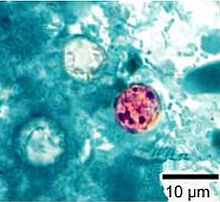
Cyclospora cayetanensis is a protozoan parasite, that is nearly impossible to culture in the laboratory and requires complicated microscopy for detection in samples.

Lia Stanciu, Ph.D., with Purdue University, lead researcher on the project said,  “We were able to identify certain proteins on the cell membrane of Cyclospora that are unique only to Cyclospora and to which we can bind some DNA sequences.”

“We can synthesize those DNA-specific molecules. The next step would be to integrate those DNA molecules into something similar to a rapid COVID test or pregnancy test.”

Research – Studies Aim to Improve Detection, Control Methods for Cyclospora

Food Safety.Com

Two ongoing studies funded by the Center for Produce Safety (CPS) are looking to improve detection and control methods for Cyclospora cayetanensis. A complex protozoan parasite, C. cayetanensis is extremely challenging to culture in a laboratory setting, and requires complicated microscopy for detection in samples.

The first project, led by Purdue University’s Lia Stanciu, Ph.D., seeks to use “aptamers”—or short strands of synthesized DNA—to bind to C. cayetanensis. The aptamers would then be used to create a paper-based, low-cost, and easy-to-use water test for the parasite, similar to rapid COVID-19 or pregnancy tests.

The second study is exploring the use of zero-valent iron (ZVI) sand filters to remove C. cayetanensis from water, evaluating the basic principle that physical exclusion might be an option to reduce parasite burdens.

Research – Toxoplasma gondii in Foods: Prevalence, Control, and Safety

MDPI

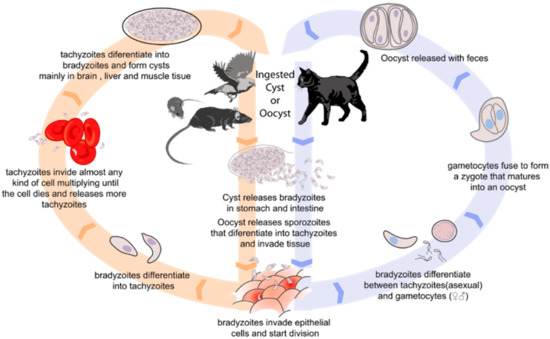
Toxoplasma gondii is an obligate intracellular parasite that causes toxoplasmosis, with approximately one third of the population around the world seropositive. The consumption of contaminated food is the main source of infection. These include meat products with T. gondii tissue cysts, and dairy products with tachyzoites. Recently, contamination has been detected in fresh products with oocysts and marine products. Despite the great health problems that are caused by T. gondii, currently there are no standardized methods for its detection in the food industry. In this review, we analyze the current detection methods, the prevalence of T. gondii in different food products, and the control measures. The main detection methods are bioassays, cell culture, molecular and microscopic techniques, and serological methods, but some of these do not have applicability in the food industry. As a result, emerging techniques are being developed that are aimed at the detection of multiple parasites simultaneously that would make their application more efficient in the industry. Since the prevalence of this parasite is high in many products (meat and milk, marine products, and vegetables), it is necessary to standardize detection methods, as well as implement control measures. View Full-Text

Canada – Mystery Cyclospora Outbreak spreads to Canada

Food Poison Journal

Public Heath Canada is working with its public health and food safety partners to identify possible ways non-travel related Cyclospora infections are occurring in Canada.

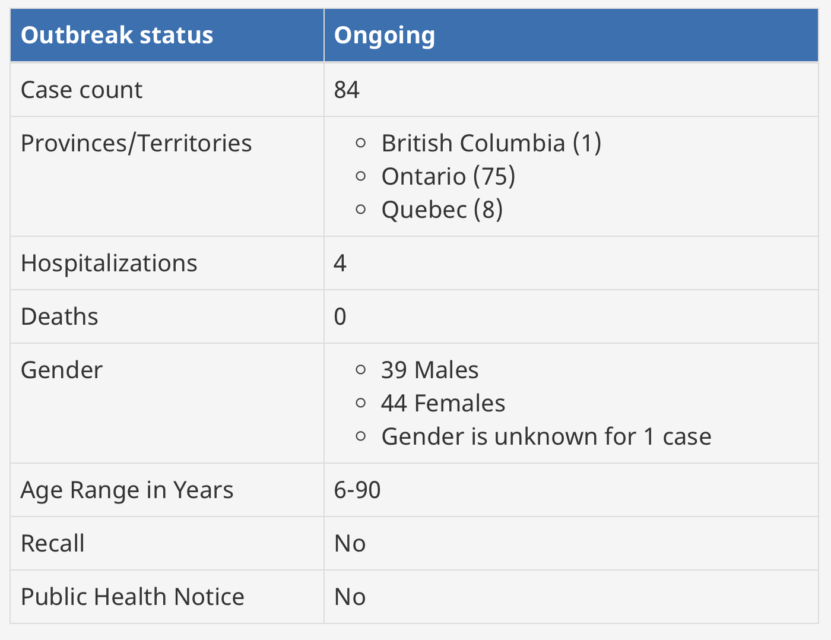
As of June 30, a total of 84 cases of Cyclospora infections were reported in the following provinces: British Columbia (1), Ontario (75), and Quebec (8). 4 individuals have been hospitalized and no deaths have been reported. To date, there is no recall or Public Health Notice, the investigation is ongoing.

In case you are experiencing Cyclosporiasis symptoms such as watery diarrhea (most common), cramping, bloating, increased gas, nausea, fatigue, and possibly vomiting and low-grade fever, it is important to report it. It can help to detect & resolve outbreaks early and prevent others from being harmed, and it enables better surveillance. If symptoms persist, seek medical care.

USA – Domestically Acquired Cases of Cyclosporiasis — United States, May–June 2022

CDC

LAST UPDATED JUNE 30, 2022 4:00 PM EDT

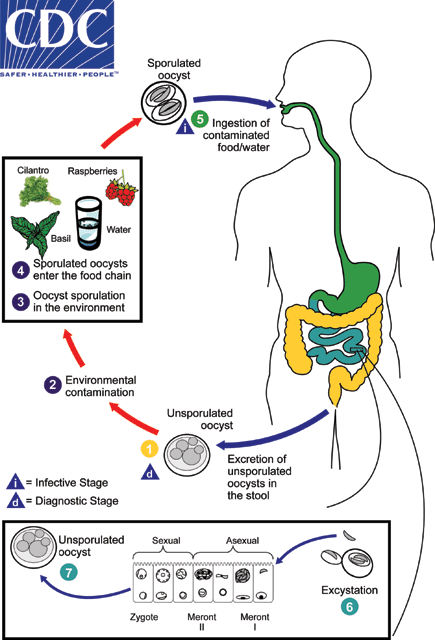
Cyclosporiasis illnesses are reported year-round in the United States. However, during the spring and summer months there is often an increase in cyclosporiasis acquired in the United States (i.e., “domestically acquired”). The exact timing and duration of these seasonal increases in domestically acquired cyclosporiasis can vary, but reports tend to increase starting in May. In previous years the reported number of cases peaked between June and July, although activity can last as late as September. The overall health impact (e.g., number of infections or hospitalizations) and the number of identified clusters of cases (i.e., cases that can be linked to a common exposure) also vary from season to season. Previous U.S. outbreaks of cyclosporiasis have been linked to various types of fresh produce, including basil, cilantro, mesclun lettuce, raspberries, and snow peas.

At a Glance
  • Illnesses: 61
  • Hospitalizations: 6
  • Deaths: 0
  • States reporting cases: 13

CDC, along with state and federal health and regulatory officials, monitor cases of cyclosporiasis in the United States in the spring and summer months to detect outbreaks linked to a common food source. However, many cases of cyclosporiasis cannot be directly linked to an outbreak, in part because of the lack of validated laboratory “fingerprinting” methods needed to link cases of Cyclospora infection. Officials use questionnaires to interview sick people to determine what they ate in the 14-day period before illness onset. If a commonality is found, CDC and partners work quickly to determine if a contaminated food product is still available in stores or in peoples’ homes and issue advisories.

Latest Information

  • This is the first monthly report on the number of domestically acquired cyclosporiasis illnesses with onset on or after May 1, 2022. Cases continue to be reported.
  • As of June 28, 2022, 61 laboratory-confirmed cases of cyclosporiasis in people who had no history of international travel during the 14-day period before illness onset have been reported to CDC by 13 states since May 1, 2022.
    • The median illness onset date is May 31, 2022 (range: May 3–June 20, 2022).
    • At least 6 people have been hospitalized; no deaths have been reported.

USA – Will There Be a Cyclospora Outbreak in the U.S. This Summer?

Food Poisoning Bulletin

Will there be a cyclospora outbreak in the United States this summer? There have been multiple cyclospora outbreaks in the past nine years, including in 2013, 2014, 2015, 2016, 2017, 2018, 2019, 2020, and 2021. This year may be no exception.

In the past, Cyclospora outbreaks have been linked to fresh produce, including cilantro, raspberries, basil, mesclun, vegetable trays, bagged salad mixes, and snow peas. The cyclospora parasite is transmitted through human feces. The oocyst must mature, or sporulate, outside of the body before it becomes infectious. This infection is not passed person-to-person.

It is very difficult to protect yourself against this parasite, since it can cling to produce, especially produce such as leafy greens and herbs, and is not easily washed or rinsed off. And since most of the foods it contaminates are eaten without being heated, there is no kill step to destroy the parasite.