Category Archives: Pathogen

USA – Recall Meatballs – Listeria monocyotgenes

USDAEurofins Food Testing UK

E. & F. Inc., a St. Louis establishment, is recalling approximately 123
pounds of frozen, ready-to-eat meatballs due to possible contamination with
Listeria monocytogenes, the U.S. Department of Agriculture’s Food
Safety and Inspection Service (FSIS) announced today.

Research – High-Pressure Processing and Boiling Water Treatments for Reducing Listeria monocytogenes, Escherichia coli O157:H7, Salmonella spp., and Staphylococcus aureus During Beef Jerky Processing

Science Direct

Beef jerky is a convenient, ready-to-eat meat product, but requires processing lethality steps to ensure the safety of the product. Previous outbreaks involving various jerky products have highlighted the risks associated with jerky and the importance of utilizing pathogen interventions during processing. In this study, two alternative interventions were evaluated for reducing pathogen populations during jerky processing. Results demonstrated that high pressure processing (HPP; two treatments of 550 MPa, 60 s) could produce significant (p < 0.05), but variable reductions (6.83 and 4.45 log10 CFU/strip) of Salmonella spp. and Escherichia coli O157:H7, respectively, on resulting beef jerky. HPP treatments, however, produced minor reductions (p < 0.05) of Gram-positive pathogens, resulting in reductions of 1.28 and 1.32 log10 CFU/strip of Listeria monocytogenes and Staphylococcus aureus, respectively. Alternatively, boiling water (100 ± 2 °C) treatments (20–30 s) used after marination and prior to dehydration, reduced Salmonella spp., E. coli O157:H7, L. monocytogenes, and S. aureus populations >5.0 log10 CFU/strip in resulting beef jerky. Thus, 20 or 30 s boiling water (100 ± 2 °C) treatments could be effective interventions for commercial jerky processors or home food preservers. Future validation of these processes in-plant could provide processors and regulators with alternative strategies for safe and shelf-stable jerky products.

Research – Effect of Temperatures on the Growth, Toxin Production, and Heat Resistance of Bacillus cereus in Cooked Rice

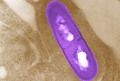
Mary Ann LeibertBacillus_cereus_01

Bacillus cereus is capable of producing enterotoxin and emetic toxin, and Bacillus foodborne illnesses occur due to the consumption of food contaminated with endospores. The objectives of this study were to investigate the growth and toxin production of B. cereus in cooked rice and to determine the effect of temperature on toxin destruction. Cooked rice inoculated with B. cereus was stored at 15, 25, 35, and 45°C or treated at 80, 90, and 100°C. The results indicated that emetic toxin was produced faster than enterotoxin (which was not detected below 15°C) at all the storage temperatures (15–45°C) during the first 72 h. Emetic toxin persisted at 100°C for 2 h, although enterotoxin was easily to be destroyed by this treatment within 15 min. In addition, B. cereus in cooked rice stored at a warm temperature for a period was not inactivated due to survival of the thermostable endospores. These data indicate that the contaminated cooked rice with B. cereus might present a potential risk to consumers. Results from this study may help enhance the safety of such food, and provide valuable and reliable information for risk assessment and management, associated with the problem of B. cereus in cooked rice.

Europe EFSA – EFSA Evaluates Molecular Typing Methods for Food-Borne Pathogens

EFSAimagesCAUH2MPP

Molecular typing methods are  laboratory techniques, such as whole genome sequencing, that enable the  classification and comparison of strains of disease-causing bacteria. EFSA’s  Panel on Biological Hazards (BIOHAZ) has reviewed the methods for typing the  food-borne pathogens Salmonella, Escherichia coli, Listeria and Campylobacter, and has evaluated the effectiveness of these methods for:

  • Detecting and  identifying food-borne outbreaks;
  • Estimating the  contribution of various sources to food-borne illnesses;
  • Predicting which  strains of food-borne pathogens may potentially cause epidemics.

RASFF Alert – Norovirus – Frozen Raspberries

RASFF -norovirus in frozen raspberries from Poland, via Belgium in Finland

RASFF Alert – Listeria monocytogenes – Cheese

RASFF – Listeria monocytogenes in cheese from France in Luxembourg

RASFF Alerts – E.coli – Chilled Beef Carpaccio – Warty Venus – Clams

RASFF-shigatoxin-producing Escherichia coli in chilled beef carpaccio from Italy in Germany

RASFF-too high count of Escherichia coli (330 MPN/100g) in warty venus (Venus verrucosa) from Croatia in Italy

RASFF -too high count of Escherichia coli (930 MPN/100g) in chilled clams from Spain in France

RASFf Alerts – Salmonella – Paan Leaves – Poultry – Rucola – Frozen Clams

RASFF -Salmonella spp. (presence /25g) in frozen clams from Vietnam in Portugal

RASFF -Salmonella spp. in frozen clams (Meretrix spp.) from Vietnam in Portugal

RASFF -Salmonella spp. (presence /25g) in frozen clams (Meretrix spp.) from Vietnam in Portugal

RASFF -Salmonella infantis and Salmonella Mbandaka in chilled boneless chicken thighs from Poland in Italy

RASFF -Salmonella spp. in paan leaves from Bangladesh in the UK

RASFF -Salmonella spp. (presence /25g) in frozen basted chicken breast from Poland

RASFF -Salmonella Newport (present /25g) in frozen turkey meat from Poland in Denmark

RASFF -Salmonella enterica in frozen turkey meat preparation from Brazil in the Netherlands

RASFF -Salmonella infantis (in 5 out of 12 /25g) in chilled chicken breasts from Italy in Denmark

RASFF -Salmonella spp. (presence /25g) in frozen poultry meat preparations from Brazil in the Netherlands

RASFF -Salmonella szentes (present /25g) in rucola from Spain in Sweden

RASFF -Salmonella Heidelberg (presence /25g) in frozen salted chicken breast fillets (Gallus gallus) from Brazil in the Netherlands

RASFF -Salmonella (presence /25g) in paan leaves from Bangladesh in the UK

RASFF -Salmonella (present/25g) in paan leaves from India in the UK

RASFF -Salmonella spp. (presence /25g) in paan leaves from Bangladesh in the UK


RASFF Alerts – Animal Feeds – Salmonella – Protein – Soy – Muesli – Soybean – Aflatoxin – Maize

RASFF -Salmonella anatum (in 1 out of 4 samples /25g) in processed animal proteins (chicken) from the Netherlands in Sweden

RASFF -Salmonella Mbandaka (presence /25g) in soy expller from Brazil, via the Netherlands in Belgium

RASFF -Salmonella Senftenberg (presence /25g) in muesli for calves from Germany in Finland

RASFF -Salmonella Agona (present /25g) in non GMO soybean meal from Italy in Austria

RASFF -Salmonella Mbandaka (in 1 out of 99 samples /25g) in GMO soybean meal from Germany, via Switzerland in Finland

RASSF – aflatoxins (B1 = 75.2 / B1 = 12.7 / B1 = 20.1 µg/kg – ppb) in maize from Hungary in Germany


Research – Current Intervention Strategies for the Microbial Safety of Sprouts

Ingenta Connect

Sprouts have gained popularity worldwide due to their nutritional values and health benefits. The fact that their consumption has been associated with numerous outbreaks of foodborne illness threatens the $250 million market that this industry has established in the United States. Therefore, sprout manufacturers have utilized the U.S. Food and Drug Administration recommended application of 20,000 ppm of calcium hypochlorite solution to seeds before germination as a preventative method. Concentrations of up to 200 ppm of chlorine wash are also commonly used on sprouts. However, chlorine-based treatment achieves on average only 1- to 3-log reductions in bacteria and is associated with negative health and environmental issues. The search for alternative strategies has been widespread, involving chemical, biological, physical, and hurdle processes that can achieve up to 7-log reductions in bacteria in some cases. The compilation here of the current scientific data related to these techniques is used to compare their efficacy for ensuring the microbial safety of sprouts and their practicality for commercial producers. Of specific importance for alternative seed and sprout treatments is maintaining the industry-accepted germination rate of 95% and the sensorial attributes of the final product. This review provides an evaluation of suggested decontamination technologies for seeds and sprouts before, during, and after germination and concludes that thermal inactivation of seeds and irradiation of sprouts are the most practical stand-alone microbial safety interventions for sprout production.