Category Archives: outbreak

Research – Salmonella Berta outbreak being traced in Seattle.

Food Safety News

Officials in the Seattle/King County area of Washington are investigating an outbreak of infections from Salmonella Berta. One-third of the patients have required hospitalization.

Public Health Seattle & King County announced the investigation into the outbreak on July 10. All six outbreak patients have been tested using whole genome sequencing and have shown infection from a specific type of Salmonella. The testing shows that all of the patients were likely infected from the same source,

According to the health department, patients’ symptom onset ranges from April 12 through June 5.

“Public Health conducted interviews with the people sick with salmonellosis to identify potential common exposures and identified that some common exposures were pork and seafood. Environmental Health Investigators began traceback of meat products on June 21, 2023. They collected invoices from different places where some people got food and conducted inspections. A common location or source has not been identified,” according to the department’s outbreak notice.

The investigation is ongoing.
Research -E. coli food infections: how to further protect consumers?

ACSA

Document published this year by the French Agency for Food, Environmental and Occupational Safety and Health (ANSES).

Focused on enterohaemorrhagic Escherichia Coli (STEC), producer of shigatoxin and responsible for serious foodborne infections in young children, the elderly and immunosuppressed people.

In this report, ANSES classifies the strains of bacteria responsible for severe forms of infection. It also issues recommendations to improve monitoring of the risks of contamination of products before they are placed on the market.

Enterohaemorrhagic Escherichia coli are responsible for a number of disorders, ranging from mild diarrhea to more severe forms, such as bloody diarrhea and severe kidney damage called hemolytic-uremic syndrome (HUS). Infections mainly affect young children, especially those under 5 years of age, the elderly, and immunosuppressed people. Approximately 140 cases of childhood HUS are identified each year.

In France, the foods most often implicated in outbreaks of EHEC infections are minced meat fillets, eaten raw or undercooked, and raw milk cheeses. The flours can also be contaminated, so the consumption of raw or undercooked pizza dough was the origin of an epidemic in 2022.

Among the advice addressed to consumers we find that of not eating raw or undercooked foods when they are intended to be eaten cooked. In addition, for more sensitive populations such as children, it is recommended to thoroughly cook (70 °C) minced meat and minced meat products, avoid consumption of raw milk and raw milk products (with the exception of cooked pressed cheeses). ) and avoid eating raw or undercooked flour-based products (cookie dough, etc.).

Multinational outbreak of Salmonella virchow ST16 infections associated with consumption of meat products containing chicken meat

ACSA

Since June 2017, there is a persistent cross-border outbreak of Salmonella virchow ST16 to five countries in the European Union/European Economic Area (EU/EEA), the United Kingdom (UK) and the United States (US). .

A total of 210 cases have been reported to the following countries: Denmark (2), France (111), Germany (26), Ireland (4), the Netherlands (34), the United Kingdom (32) and the United States (1) . Hospitalization rates range from 16.7% (2/12) in the UK, to 29.4% (5/17) and 38.5% (10/26) in France and Germany, respectively.

No deaths have been reported. Most of the cases have been linked to local restaurants serving kebab meat. The number of confirmed cases represents only a small proportion of all infections in the EU/EEA, partly because of different genome sequencing (WGS) capacities by countries.

New infections are likely to occur in the EU/EEA affecting any age group, until further investigation is carried out to identify the sources and points of contamination along the chicken meat production chain.

Indai – 40 People Hospitalized After Food Poisoning in Assam’s Sivasagar

Pratidin Time

As many as 40 people were hospitalized following an incident of food poisoning at Sivasagar’s Bokota Kaivarta village, reports emerged on Monday.

The doctors have assumed the poisoning to be caused due to consumption of food at a religious ceremony held at the village.

The affected persons reportedly showed symptoms of diarrhea, vomiting and fever after consuming the food.

USA – More than 100 infected in new outbreak from Cyclospora; source under investigation

Food Safety News

More than 100 people are sick in a new outbreak of infections caused by the microscopic Cyclospora parasite, but federal officials have not yet determined the source.

As of July 6, the Food and Drug Administration reported 105 patients had been confirmed in the outbreak. The agency has not reported where the patients live.

Public health officers from the FDA have begun sample collection and analysis, but the agency has not reported what food or foods are being tested.

The new outbreak of Cyclospora infections is the third the FDA has reported so far this year. One of the investigations has been closed without the agency determining the source of the microscopic parasite.

The Centers for Disease Control and Prevention is tracking another outbreak that has sickened 210 people across 22 states as of its most recent update in June. Thirty people in the outbreak have been so sick they required hospitalization.

USA – Secret 2022 Cyclospora Outbreak in Florida Sickened 161

Food Poisoning Bulletin

In the Center for Disease Control’s weekly Morbidity and Mortality Weekly Report (MMWR) for the week of July 7, 2023, a cyclospora outbreak “partially attributable” to a Caesar salad kit was revealed. This secret 2022 cyclospora outbreak sickened at least 161 people in the state of Florida.

USA- CDC – Notes from the Field: Doubling of Cyclosporiasis Cases Partially Attributable to a Salad Kit — Florida, 2021–2022

CDC

Cyclosporiasis is a gastrointestinal infection caused by a protozoan parasite, Cyclospora cayetanensis. This species is only known to infect humans and is acquired when oocysts are ingested through food or water contaminated with feces that contain the parasite. The illness was first reported in 1979, and the organism was identified and named in 1994 (1). Historically, infections were typically acquired outside of the United States or from produce that was imported into the United States (1). In recent years, the number of reported U.S. cases has been increasing: cases more than doubled from 537 in 2016 to 1,194 in 2017, and then nearly tripled, to 3,519 cases in 2018; in 2019, 4,703 cyclosporiasis cases were reported.* Recently, the parasite has been found on domestically grown produce (2), and infections have been attributed to these foods (3). Produce washing will decrease but not eliminate the parasite (1).

USA – Investigations of Foodborne Illness Outbreaks

FDA

What’s New

  • A new outbreak of Cyclospora cayetanensis (ref #1163) in a not yet identified product has been added to the table. FDA has initiated sample collection and analysis.
  • For the outbreak of Cyclospora cayetanensis (ref #1159), the case count has increased from 36 to 37 cases.
Date
Posted
Ref Pathogen
or
Cause of
Illness
Product(s)
Linked to
Illnesses

(if any)
Total
Case
Count

Status
7/6/2023 1163 Cyclospora
cayetanensis
Not Yet
Identified
105 Active
6/14/2023 1157 Salmonella
Paratyphi B
var. L(+)
tartrate+
Not Yet
Identified
34 Active
6/14/2023 1159 Cyclospora
cayetanensis
Not Yet
Identified
37 Active
5/24/2023 1156 Salmonella
Enteritidis
Raw
Cookie
Dough
See
Advisory
Active
4/26/2023 1152 Not Yet
Identified
Morel
Mushroom
See
Advisory
Active
3/1/2023 1143 Hepatitis
A Virus
Frozen
Strawberries
See
Advisory
Active

Research – Local Salmonella Enteritidis restaurant outbreak investigation in England provides further evidence for eggs as source in widespread international cluster, March to April 2023

Eurosurveillance

An outbreak of food-borne infection linked to a restaurant was reported to the UK Health Security Agency (UKHSA) East of England Health Protection Team (HPT) in early April 2023. Whole genome sequencing (WGS) results indicated  Enteritidis infection, with all cases in a 5-single nucleotide polymorphism (SNP) cluster falling into a wider genomically diverse 10-SNP cluster investigated in several countries. We identified additional cases in the 5-SNP cluster with no known links to the restaurant, and historical cases reported since July 2022.

Our investigations aimed to define common exposures for cases in the 5-SNP cluster to determine the likely source of infection and implement control measures.

A confirmed case was defined as a person with laboratory-confirmed  Enteritidis infection belonging to the 5-SNP cluster 1.2.3.18.180.7268.% [1] in England since 1 March 2023. A probable case was defined as a person with gastroenteritis or confirmed  spp. infection in England who dined at the restaurant of interest from 1 March to 1 April 2023. Confirmed cases were further categorised as having known, unknown or no exposure to the restaurant.

In early April 2023, UKHSA was notified via Accident and Emergency doctors, general practitioners, and a local authority environmental health (EH) department of multiple cases of gastroenteritis following food consumption at a restaurant, with attendance or take-away dates in late March. We identified  Enteritidis as the causative organism.  isolates are routinely sent to the UKHSA Gastrointestinal Bacteria reference unit (GBRU) for sequencing [2]. The outbreak cases were confirmed to be within a 5-SNP cluster defined at UKHSA as 1.2.3.18.180.7268.% matching the Enterobase cgMLST hierarchical cluster HC2_316378 [3], falling into a wider genomically diverse cluster 1.2.3.18.180.%/HC5_2301 that is subject to several national and international investigations.

Cases identified through initial case notifications were interviewed using generic food history questionnaires; for cases notified since 2 May 2023, a bespoke menu-based questionnaire was used. Early cases were re-interviewed with the bespoke questionnaire completed by telephone or online. Additional cases identified through WGS were contacted to establish whether they were linked to the restaurant, and if so, asked to complete the bespoke questionnaire by telephone or online. Cases who did not reveal exposure to the restaurant completed a modified  trawling questionnaire focussed on poultry products.

Sweden – Increase in cases of illness with Campylobacter infection

Folkhalsomyndigheten

Campylobacter kswfoodworld

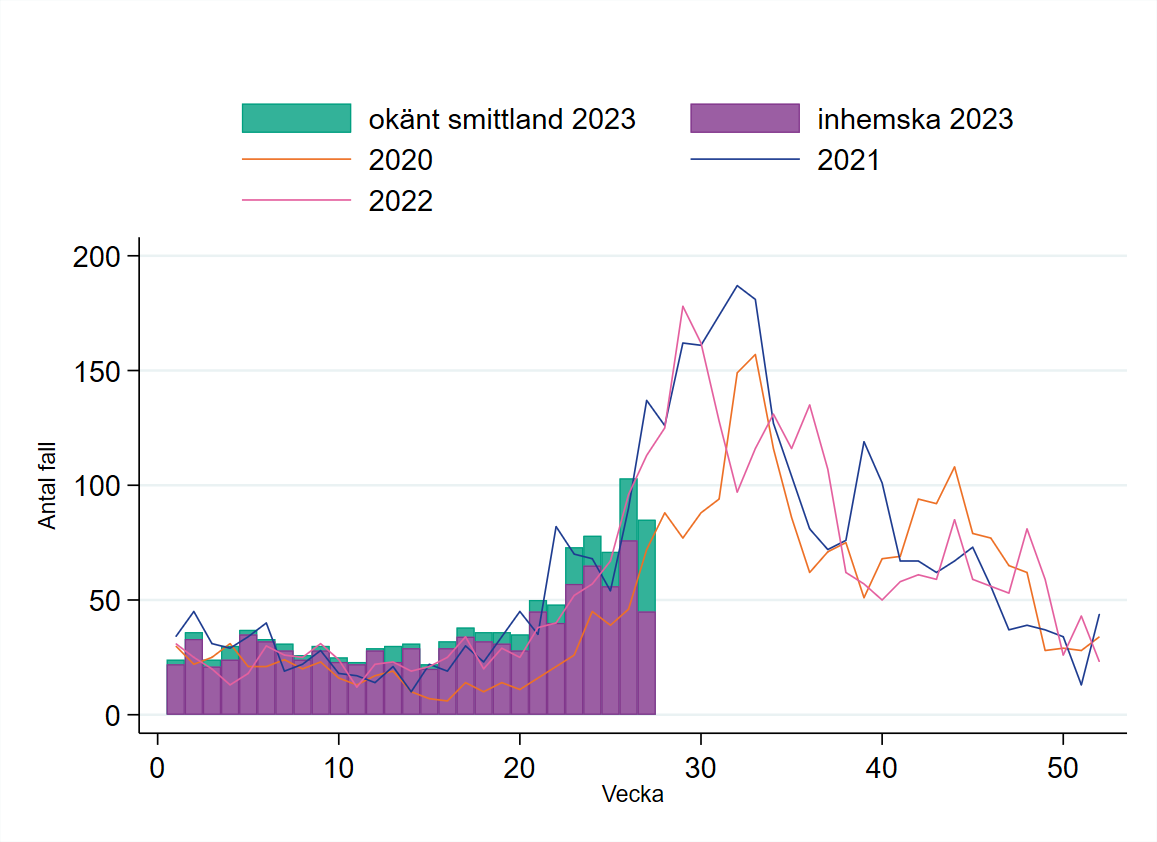
In recent weeks, there has been an increase in the number of people who have contracted campylobacter infection. The rise in the number of cases is preceded by an increase in campylobacter in broiler flocks. Good hygiene when handling raw chicken reduces the risk of becoming infected.

There has been an increase in the number of people who have been infected by the intestinal bacteria campylobacter in recent weeks. During week 26, the number of reported cases increased further compared to previous weeks and the increase looks set to continue.

Figure: The number of reported cases of campylobacter per week infected in Sweden or with an unknown country of infection (230706). Week 27 is not yet complete.

The number of sick people increased from week 21 to 60 cases per week from 30 cases.  In week 26, the cases increased further, a similar increase is seen in 2020-2022.

From mid-June, an increase in the occurrence of campylobacter in Swedish broiler flocks has also been observed. Previous studies have shown a connection between campylobacter infection and the consumption of fresh chicken, where around a third of those who have contracted the disease have been linked to fresh chicken. Campylobacter infection in humans is more common in summer as is the presence of campylobacter in broiler flocks.