Category Archives: Microbiology

Information – PETTING ZOO GERM SAFETY: WHAT YOU NEED TO KNOW

Parentology


Petting zoos may seem like the perfect opportunity to introduce kids to farm animals, but these creatures may possibly putting them in harm’s way of… germs. To what degree should parents be concerned? This past summer, a two-year-old child died after coming into contact with animals at the San Diego County Fair. Three other children under 13 reported contracting illnesses from the same location.

The source of the illness? E.Coli linked to contact with the fair’s animals.

Petting zoos are fairly popular. In summer and fall months, they’re a highlight at local fairs. Later in the year, they’re featured in festivals, pumpkin patches, schools, aquariums, even farmers’ markets. This family-friendly activity can turn dangerous when children come into contact with bacteria that causes serious illness.

According to the Centers for Disease Control and Prevention (CDC), “Every year, many people get sick after visiting an animal exhibit. From 2010-2015, about 100 outbreaks of illness in people linked to animals in public settings like zoos, fairs, and educational farms were reported to public health officials.”


RASFF Alert – Animal Feed -Salmonella – Pet Food

RASFF-Logo

RASFF – Salmonella enterica ser. Gaminara (presence /25g) in pet food from Thailand in the Netherlands

RASFF Alerts- Animal Feed – Aflatoxin – Wildlife Feed – Groundnut Kernels – Blanched Groundnuts

RASFF-Logo

RASFF – aflatoxins (B1 = 77.6 µg/kg – ppb) in wildlife feed from the United States in the UK

RASFF – aflatoxins (B1 = 65.3; Tot. = 92.4 µg/kg – ppb) in groundnut kernels from Argentina in Germany

RASFF – aflatoxins (B1 = 61.6 µg/kg – ppb) in blanched groundnuts for birdfeed from Argentina in Germany

RASFF – aflatoxins (B1 = 49 µg/kg – ppb) in groundnuts from Bolivia in Belgium

Research – Outbreak of Escherichia coli O157:H7 Infections Linked to Mechanically Tenderized Beef and the Largest Beef Recall in Canada, 2012

Journal of Food Protection

ABSTRACT

Contaminated beef is a known vehicle of Escherichia coli O157:H7 infection, although more attention is given to the control of E. coli O157:H7 in ground, rather than whole-cut, beef products. In September 2012, an investigation was initiated at an Alberta, Canada, beef plant after the detection of E. coli O157:H7 in two samples of trim cut from beef originating from this plant. Later in September 2012, Alberta Health Services identified five laboratory-confirmed infections of E. coli O157:H7, and case patients reported eating needle-tenderized beef steaks purchased at a store in Edmonton, Alberta, produced with beef from the Alberta plant. In total, 18 laboratory-confirmed illnesses in Canada in September and October 2012 were linked to beef from the Alberta plant, including the five individuals who ate needle-tenderized steaks purchased at the Edmonton store. A unique strain of E. coli O157:H7, defined by molecular subtyping and whole genome sequencing, was detected in clinical isolates, four samples of leftover beef from case patient homes, and eight samples of Alberta plant beef tested by industry and food safety partners. Investigators identified several deficiencies in the control of E. coli O157:H7 at the plant; in particular, the evaluation of, and response to, the detection of E. coli O157 in beef samples during routine testing were inadequate. To control the outbreak, 4,000 tons of beef products were recalled, making it the largest beef recall in Canadian history. This outbreak, in combination with similar outbreaks in the United States and research demonstrating that mechanical tenderization can transfer foodborne pathogens present on the surface into the interior of beef cuts, prompted amendments to Canada’s Food and Drug Regulations requiring mechanically tenderized beef to be labeled as such and to provide safe cooking instructions to consumers. A detailed review of this event also led to recommendations and action to improve the safety of Canada’s beef supply.

HIGHLIGHTS
  • Mechanically tenderized beef steaks linked to E. coli O157 illnesses in Canada.

  • Largest beef recall in Canada underscores importance of plant-level E. coli controls.

  • Outbreak of E. coli O157 infections prompts food safety improvements in Canada.

Research – Microbial Status of White Asparagus Spears during Storage in Moist Packages

Journal Food Protection

ABSTRACT

White asparagus is a high-value commodity of large economic importance in Germany. Its harvest period lasts only a limited part of the year, during which daily yield and also market demand are highly variable. Harvested asparagus is perishable; thus, quality control and shelf life must be ensured by proper handling, e.g., avoiding fresh weight losses and, at the same time, limiting microbial growth. The aim of this study was to determine the effect of moist asparagus packaging on unpeeled white asparagus (cv. Gijnlim). Water was added to some of the packages to reduce fresh weight losses and to study the consequences for microbial growth. Polythene bag packaging, lined inside with cellulose fleece, was used to hold 500-g bunches of spears, covered partly (open bag) or totally (closed bag). Storage duration was 7 days, at temperatures of 2°C, 8°C, and a combination of 2 and 22°C, simulating retail conditions. Using a standardized cultivation method for food assessment, CFU counts (5.20 to 7.95 log CFU), number of pseudomonads (4.79 to 7.90 log CFU), lactic acid bacteria (<3.00 to 3.94 log CFU), Enterobacteriaceae (4.26 to 7.15 log CFU, including Escherichia coli <1.00 log CFU), yeasts (<2.30 to 3.15 to 3.53 log CFU), and molds (<2.30 log CFU), as well as sulfite-reducing clostridia (<1 log CFU) were determined. Temperature was the most important factor for microbial growth. Additional water had no effect in most cases; it inhibited most of the fresh weight losses compared to dry treatments in this study but led to 2% weight increase in closed bags. Our results point to the conclusion that moist packaging would be a feasible alternative to dry wrapping with regard to weight retention, and it did not increase growth of the analyzed microbial groups to an unacceptable value.

HIGHLIGHTS
  • Moist packaging of white asparagus does not necessarily increase microbial load after storage.

  • Microbial counts were lower after 1 week of storage in a closed versus open package.

  • Microbial growth did not exceed tolerable values.

USA – All ‘Berkley & Jensen’ pig ear treats sold at BJ’s Wholesale Clubs recalled

Food Safety News

Dog Goods has expanded an existing recall to include all 30-packs of “Berkley & Jensen” brand pig ears sold at BJ’s Wholesale Club stores.

Dog Goods purchased the pig ears from a single supplier in Brazil from September 2018 through August 2019. The U.S. Food and Drug Administration, together with the Centers for Disease Control and Prevention and state partners, is investigating a link between pig ear pet treats and human cases of salmonellosis.

This recall is being expanded after Rhode Island Department of Health testing found Salmonella in “Berkley & Jensen” brand pig ear pet treats.

Research – Inactivation of Staphylococcus aureus Biofilms on Food Contact Surfaces by Superheated Steam Treatment

Journal of Food Protection Staph

ABSTRACT

The objective of this study was to compare the inactivation efficacy of saturated steam (SS) and superheated steam (SHS) on Staphylococcus aureus biofilms on food contact surfaces, including type 304 stainless steel coupons with No. 4 finish (STS No. 4), type 304 stainless steel coupons with 2B finish (STS 2B), high-density polyethylene (HDPE), and polypropylene (PP). In addition, the effects of the surface characteristics on the inactivation efficacy were evaluated. Biofilms were formed on each food contact coupon surface using a three-strain cocktail of S. aureus. Five-day-old biofilms on STS No. 4, STS 2B, HDPE, and PP coupons were treated with SS at 100°C and SHS at 125 and 150°C for 2, 4, 7, 10, 15, and 20 s. Among all coupon types, SHS was more effective than SS in inactivating the S. aureus biofilms. S. aureus biofilms on steel coupons were more susceptible to most SS and SHS treatments than the biofilms on plastic coupons. S. aureus biofilms on HDPE and PP coupons were reduced by 4.00 and 5.22 log CFU per coupon, respectively, after SS treatment (100°C) for 20 s. SS treatment for 20 s reduced the amount of S. aureus biofilm on STS No. 4 and STS 2B coupons to below the detection limit. With SHS treatment (150°C), S. aureus biofilms on HDPE and PP needed 15 s to be inactivated to below the detection limit, while steel coupons only needed 10 s. The results of this study suggest that SHS treatment has potential as a biofilm control intervention for the food industry.

HIGHLIGHTS
  • SHS was more effective than SS for inactivating biofilm cells of S. aureus.

  • Biofilms on steel coupons were more susceptible than those on plastic coupons.

  • The thermal conductivity of the coupon was an important factor in SHS treatment.

  • Biofilm; Saturated steam; Staphylococcus aureus; Superheated steam

Research -The combined effect of high pressure processing and dimethyl dicarbonate to inactivate foodborne pathogens in apple juice

Research Gate

Novel processing technologies can be used to improve both the microbiological safety and quality of food products. The application of high pressure processing (HPP) in combination with dimethyl dicarbonate (DMDC) represents a promising alternative to classical thermal technologies. This research work was undertaken to investigate the combined effect of HPP and DMDC, which was aimed at reaching over 5-log reduction in the reference pathogens Escherichia coli O157:H7, Salmonella enterica, and Listeria monocytogenes inoculated in apple juice. Different strains of each species were tested. The pressure (ranging from 100 to 600 MPa), dwell time (from 26 to 194 s), and DMDC (from 116 to 250 mg/L) were tested based on a central composite rotatable design. The dwell time, in the studied range, did not have a significant effect (p > 0.1) on the pathogens´ reduction. All treatments achieved a greater than 5-log reduction for E. coli O157:H7 and L. monocytogenes. The reductions for S. enterica were also greater than 5-log for almost all tested combinations. The results for S. enterica suggested that it is more resistant to HPP and DMDC compared with E. coli O157:H7 and L. monocytogenes. The findings of this study showed that DMDC at low concentrations can be added to apple juice to reduce the parameters conventionally applied in HPP. The combined use of HPP and DMDC was highly effective under the conditions of this study.

USA – FDA alerts public about Listeria, Salmonella in some raw pet food

Food Safety News

Consumers should not feed their pets certain Aunt Jeni’s frozen raw pet foods because samples have tested positive for Listeria, which can cause life-threatening illness in humans. The food has also tested positive for Salmonella.

In a public alert this afternoon, the Food and Drug Administration said the implicated raw pet food poses a “serious threat” to human and animal health. People who handle the pet food can become infected. Cross contamination of countertops and other surfaces, as well as pet bowls and utensils, can also transfer the bacteria to people and pets. 

To determine whether they have the implicated pet food in their homes consumers should look for the following label information:

Aunt Jeni’s Home Made, Turkey Dinner Dog Food, 5 lb (2.3kg), lot 175199 JUL2020

Aunt Jeni’s Home Made, Chicken Dinner Dog Food, 5 lb (2.3kg), lot 1152013 JUL2020.

If you have any of the affected Aunt Jeni’s Home Made products, throw them away, the FDA alert says.

USA – Outbreaks of Salmonella Infections Linked to Backyard Poultry

CDC

Latest Outbreak Information
Illustration of a megaphone.
At A Glance
  • Reported Cases: 1003
  • States: 49
  • Hospitalizations: 175
  • Deaths: 2

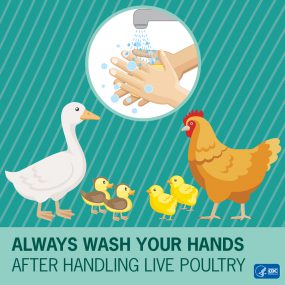
Infographic with baby chickens on it reading Always wash your hands after handling live poultry.

  • Since the last update on July 19, 2019, illnesses in an additional 235 people and one state have been added to this investigation.
  • A total of 1003 people infected with the outbreak strains of Salmonella have been reported from 49 states.
    • Of 605 people with hospitalization information available, 175 (29%) have been hospitalized. Two deaths have been reported, one from Texas and one from Ohio.
    • Of 850 ill people with age information available, 192 (23%) are children younger than 5 years.
  • Epidemiologic and laboratory evidence indicate that contact with backyard poultry, such as chicks and ducklings, from multiple hatcheries are the likely source of these outbreaks.
    • In interviews, 343 (67%) of 511 ill people reported contact with chicks or ducklings.
    • People reported getting chicks and ducklings from several sources, including agricultural stores, websites, and hatcheries.
    • Six of the outbreak strains making people sick have been identified in samples collected from backyard poultry environments at people’s homes in California, Minnesota and Ohio and from poultry environments at retail stores in Michigan and Oregon.
  • Poultry can carry Salmonella germs that can make people sick. Backyard poultry owners should always follow steps to stay healthy around their poultry.