Category Archives: Microbiology Risk

USA – Man dies after contracting Vibrio vulnificus bacteria from fresh oysters in Texas restaurant

Detroit Free Press

Food Illness

The consumption of raw oysters at a Texas restaurant led to the untimely death of a relatively healthy man in his 30s.

The man, contracted a bacterial infection known as Vibrio vulnificus that thrives in warm coastal waters. Bacterial infections like this one are on the rise as water temperature continues to increase in response to climate change.

Vibrio vulnificus bacteria can be found in raw or undercooked seafood, but also naturally occurs in saltwater and brackish water.

You can be infected with Vibrio when an open wound comes into contact with raw or undercooked seafood, its juices, or its drippings or with saltwater or brackish water, the CDC reported.

Microbiology Professor Brett Finlay on the process of lab testing with food safety investigations

CBC

Parents affected by the Calgary area daycare E. coli outbreak continue to be frustrated with the lack of information from health officials and how long it’s taking for results to be published from AHS’s investigation into the central kitchen. University of British Columbia Microbiology Professor Brett Finlay talks about the process.

Canada- Patient count exceeds 225 in E. coli O157 outbreak linked to daycare centers

Food Safety News

The patient count in an E. coli outbreak linked to daycare centers in Calgary, Canada, now stands at 231.

Alberta Health Services officials say 26 of the sick are currently hospitalized, 25 of them children and one adult. Eleven other children have already been discharged from hospitals. Twenty-one children have hemolytic uremic syndrome (HUS) which is a type of kidney failure that also affects other organs.

A specific food has not been identified as the source of the E. coli O157:H7, but investigators have collected samples of leftovers and frozen food for testing. Eleven daycare centers that share a common kitchen were closed.

The central kitchen that serves the 11 daycare centers remains closed.

Four daycare centers were given permission to reopen Monday. The four centers did not have any illnesses linked to the outbreak. The remaining seven will be allowed to reopen Tuesday. Staff and daycare attendees from those seven centers must test negative before returning to any daycare center, according to Alberta Health Services.

Alberta Premier Danielle Smith has asked the provincial health minister and the provincial minister for children and family services to investigate the outbreak and provide a full assessment of the situation.

Critical food-handling violations found at Fueling Minds central kitchen in Calgary—Updated – STEC E.coli O157

EFOOD ALERT

The central kitchen that supplied food to eleven daycare centers in Calgary, Alberta, Canada, was in violation of several fundamental safe food-handling practices, according to a report released by Alberta Health Services (AHS).

The kitchen was ordered closed on September 4, 2023, and was inspected by the AHS the following day.

The KidsU Centennial – Fueling Minds Inc. central kitchen was linked to an outbreak of E. coli O157 infections that has infected at least 264 individuals as of September 12, 2023, and sent 37 of them to hospital.

Eleven of the hospitalized victims have been released. Twenty-five individuals remain in hospital, and 22 of those patients are suffering from haemolytic uremic syndrome, or HUS. Six patients are receiving peritoneal dialysis.

The Fueling Minds kitchen supplied food to eleven daycare centers in the Calgary area. All of the centers were ordered closed pending cleaning, sanitation and inspection. All of them have now been allowed to reopen.

Research – Microbiological Quality of Polish Artisanal Varietal Honeys

MDPI

Abstract

On the basis of routine microbiological tests and selected physicochemical parameters, the quality and food safety of Polish varietal honeys were evaluated. The study included 21 honey samples from 5 varieties (multifloral, honeydew, rapeseed, buckwheat and linden), in which the moisture and extract content, water activity, pH and free acids were determined, and the colony count, the presumptive Bacillus spp., the total fungal count and the presence of anaerobic spore-forming bacilli were examined. More than half (52%, 11/21) of the analyzed honeys contained fewer microorganisms than 10 cfu/g, and in the remaining samples, their numbers ranged from 5 × 101 cfu/g to 4.5 × 10² cfu/g. In all the honeys, the number of presumptive Bacillus spp. in 1 g was less than 10 cfu. In 81% (17/21) of the samples, the total count of fungi in 1 g of honey was less than 10 cfu, and the most contaminated was buckwheat honey (3 samples). The anaerobic spore-forming bacteria was detected in 0.1 g only in one sample of buckwheat honey. The values of the physicochemical parameters did not exceed the accepted limits, which indicated that the honey environment was unfavourable for the development of the tested microbial profile.

Research – First Report of Food Poisoning Due to Staphylococcal Enterotoxin Type B in Döner Kebab (Italy)

MDPI

Abstract

Staphylococcal food poisoning results from the consumption of food contaminated by staphylococcal enterotoxins. In July 2022, the Turin local health board was notified of a suspected foodborne outbreak involving six children who had consumed döner kebab purchased from a takeaway restaurant. The symptoms (vomiting and nausea) were observed 2–3 h later. A microbiological analysis of the food samples revealed high levels (1.5 × 10⁷ CFU/g) of coagulase-positive staphylococci (CPS). The immunoassay detected a contamination with staphylococcal enterotoxins type B (SEB). The whole genome sequencing of isolates from the food matrix confirmed the staphylococcal enterotoxin genes encoding for type B, which was in line with the SEB detected in the food. This toxin is rarely reported in staphylococcal food poisoning, however, because there is no specific commercial method of detection. The involvement of enterotoxin type P (SEP) was not confirmed, though the corresponding gene (sep) was detected in the isolates. Nasal swabs from the restaurant food handlers tested positive for CPS, linking them to the likely source of the food contamination.

Research – Listeria monocytogenes Biofilms in Food-Associated Environments: A Persistent Enigma

MDPI

Abstract

Listeria monocytogenes (LM) is a bacterial pathogen responsible for listeriosis, a foodborne illness associated with high rates of mortality (20–30%) and hospitalisation. It is particularly dangerous among vulnerable groups, such as newborns, pregnant women and the elderly. The persistence of this organism in food-associated environments for months to years has been linked to several devastating listeriosis outbreaks. It may also result in significant costs to food businesses and economies. Currently, the mechanisms that facilitate LM persistence are poorly understood. Unravelling the enigma of what drives listerial persistence will be critical for developing more targeted control and prevention strategies. One prevailing hypothesis is that persistent strains exhibit stronger biofilm production on abiotic surfaces in food-associated environments. This review aims to (i) provide a comprehensive overview of the research on the relationship between listerial persistence and biofilm formation from phenotypic and whole-genome sequencing (WGS) studies; (ii) to highlight the ongoing challenges in determining the role biofilm development plays in persistence, if any; and (iii) to propose future research directions for overcoming these challenges.

Research – Studying bacteriophage therapy in chickens

DVM360

Salmonella Campylobacter

Fowl typhoid (FT) is among the most significant poultry bacterial diseases worldwide, mostly affecting developing countries.1 The causal agent of FT is Salmonella enterica Gallinarum. Although S enterica Gallinarum is egg-transmitted and produces lesions in chicks and poults, there is a much greater tendency to spread among growing or mature flocks. Mortality in young birds is possible but tends to be higher in older birds.2

In a poster presentation at the 2023 World Anti-Microbial Resistance Congress in Philadelphia, Pennsylvania, researchers from Purdue University in West Lafayette, Indiana, and the University of Veterinary and Animal Sciences (UVAS) Lahore, Pakistan, stated that, “Antibiotics are often used to prevent or control fowl typhoid; however, such practices contribute to the continually global challenge of antibiotic resistance.”1

“In previous studies, we developed a polyphage prototype that significantly reduced Salmonella Gallinarum in experimentally challenged chickens. Here, we evaluated the pact of treatment with the polyphage prototype on microbial communities surrounding the targeted bacteria.”1

Research -Effect of Sodium Nitrite, Nisin and Lactic Acid on the Prevalence and Antibiotic Resistance Patterns of Listeria monocytogenes Naturally Present in Poultry

MDPI

Abstract

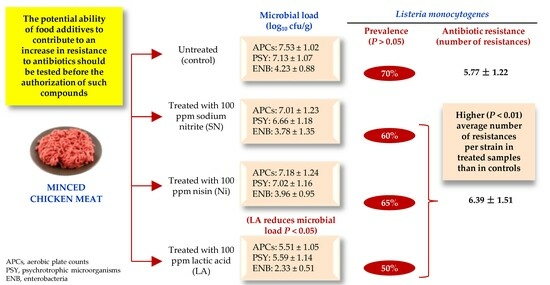
The impact of treating minced chicken meat with sodium nitrite (SN, 100 ppm), nisin (Ni, 10 ppm) and lactic acid (LA, 3000 ppm) on the levels of some microbial groups indicating hygiene quality were investigated. Specifically, aerobic plate counts and culture-based counts of psychrotrophic microorganisms and enterobacteria were obtained. Additionally, the prevalence of Listeria monocytogenes and the resistance of 245 isolates from this bacterium to 15 antibiotics were documented. L. monocytogenes was isolated using the ISO 11290-1:2017 method and confirmed with polymerase chain reaction using the lmo1030 gene. Antibiotic resistance was established using the disc diffusion technique (EUCAST and CLSI criteria). Twenty-four hours after treatment, the microbial load (log10 cfu/g) was reduced (p < 0.05) relative to controls in those samples treated with LA, with counts of 5.51 ± 1.05 (LA-treated samples) vs. 7.53 ± 1.02 (control) for APC, 5.59 ± 1.14 (LA) vs. 7.13 ± 1.07 (control) for psychrotrophic microorganisms and 2.33 ± 0.51 (LA) vs. 4.23 ± 0.88 (control) for enterobacteria. L. monocytogenes was detected in 70% (control samples), 60% (samples receiving SN), 65% (Ni) and 50% (LA) (p > 0.05) of samples. All strains showed resistance to multiple antimicrobials (between 3 and 12). In all, 225 isolates (91.8%) showed a multi-drug resistant (MDR) phenotype, and one isolate (0.4%) showed an extensively drug-resistant (XDR) phenotype. The mean number of resistances per strain was lower (p < 0.01) in the control samples, at 5.77 ± 1.22, than in those receiving treatment, at 6.39 ± 1.51. It is suggested that the use of food additives might increase the prevalence of resistance to antibiotics in L. monocytogenes, although additional studies would be necessary to verify this finding by analyzing a higher number of samples and different foodstuffs and by increasing the number of antimicrobial compounds and concentrations to be tested.

Research – Microbiological Quality and Safety of Fresh Quail Meat at the Retail Level

MDPI

Abstract

The objective of this study was to evaluate the microbiological quality and safety of 37 fresh quail meats. Mesophiles, Pseudomonas spp., Enterobacteriaceae, and staphylococci counts were 5.25 ± 1.14, 3.92 ± 1.17, 3.09 ± 1.02, and 2.80 ± 0.64 log CFU/g, respectively. Listeria monocytogenes was detected in seven samples (18.92%). Campylobacter jejuni was detected in one sample (2.70%). Clostridium perfringens was not detected in any sample. The dominant bacteria were Pseudomonas spp. (30.46%), Micrococcaceae (19.87%), lactic acid bacteria (14.57%), and Enterobacteriaceae (11.92%). Brochotrix thermosphacta and enterococci were isolated to a lesser extent, 7.28% and 1.99%, respectively. The dominant Enterobacteriaceae found were Escherichia coli (42.53%). ESBL-producing E. coli was detected in one sample (2.70%), showing resistance to 16 antibiotics. Sixteen different Staphylococcus spp. and three Mammaliicoccus spp. were identified, the most common being S. cohnii (19.86%) and M. sciuri (17.02%). S. aureus and S. epidermidis were also found in one and four samples, respectively. Methicillin-resistant M. sciuri and S. warneri were found in 13.51% and 10.81% of quail samples, respectively. These bacteria showed an average of 6.20 and 18.50 resistances per strain, respectively. The high resistance observed in ESBL-producing E. coli and methicillin-resistant S. warneri is of special concern. Measures should be adopted to reduce the contamination of quail meat.