Category Archives: microbial contamination

Research- Securely Studying Salmonella to Advance Produce Safety

Mirage News

Among the extensive facilities at NC State’s Phytotron is a secure greenhouse that is specially designed to allow scientists to study bacteria, fungi and viruses that infect plants – or contaminate produce causing foodborne illness – in a safe and secure manner.

Kellie Burris, former postdoctoral scholar now turned staff fellow microbiologist with the U.S. Food and Drug Administration (FDA), who is based in the department of Food, Bioprocessing and Nutrition Science, is using NC State’s secure greenhouse to study how fresh fruits and vegetables become contaminated with foodborne pathogens before harvesting.

“NC State’s Phytotron greenhouse is unique in that it is BSL-3 certified, one of only a handful of such facilities in the U.S.,” said Burris. “The FDA wanted to better understand how outbreak-related Salmonella strains can contaminate fresh produce, but they needed access to a high-containment facility to isolate the microbes from the natural environment. And that’s how my project started.”

 

Research – The fate of cold‐stressed or tetracycline‐resistant Vibrio spp. in precooked shrimp during frozen storage

Wiley Online

We compared the fate of cold‐stressed (CS) or tetracycline‐resistant (TR) Vibrio parahaemolyticus, Vibrio vulnificus, and Vibrio cholerae in precooked shrimp during frozen storage. The recovery ability of viable but nonculturable (VBNC) Vibrio cells was compared at 25°C. Each suspension of nonstressed (NS), CS, or TR Vibrio cells inoculated into cooked shrimps were subjected to frozen storage at −20°C or three freeze–thaw cycles. CS and TR cells were more rapidly converted to VBNC state than NS cells. Most of VBNC Vibrio cells were observed as viable cells after frozen storage. Although there were differences in the recovery extent of cells depending on the types of stress and strain, VBNC cells were resuscitated at 25°C. The most resistant to tetracycline and the lowest injury rate were observed in V. cholerae cells during frozen storage.

Research – Campylobacteriosis, consumer’s risk perception, and knowledge associated with domestic poultry handling in Ireland

Wiley Online Library

Campylobacter is the chief cause of bacterial gastroenteritis in developed countries and poultry is considered as the main cause of infection. Nonetheless, of extensive scientific efforts to exterminate the Campylobacter and numerous measures currently implemented, it has not been successful to provide Campylobacter‐free poultry. Therefore, this study aimed to depict the level of perceived risk and identify the target groups who exhibit particularly unsafe behavior by surveying the general public residing in Ireland. A total of 1,171 participants from all over the Republic of Ireland contributed to the survey. Result reveals that a substantial number of consumers still lacks awareness. Not more than 9.5% were very knowledgeable, that is, those who attained 70% passing score and 30.7% attain a score between 50 and 70%. A total of 40.2% overall pass rate. Significant differences were found in their risk perception and gender (p ≤ .05), age (p ≤ .05), and education level (p ≤ .05). This study observed that male, age between 18 and 25 with primary or no qualification and living alone are the group who exhibit particularly unsafe behavior when preparing poultry and are require most in risk communication effort. By informing, elevating the awareness, and affirming the severity of the risk to the consumer, subsequently, the incidents of Campylobacteriosis can be reduced in the Irish population.

Research – What You Need to Know About Salmonella and Eggs

Food Poisoning Bulletin Salmonella Eggs Food Poisoning Food Safety

With the coronavirus pandemic forcing more people to cook at home, many consumers need reminders about food safety. If you haven’t cooked in a long time, you should know that there are some foods that are considered high risk and need to be handled with care. One of those foods is eggs, more specifically Salmonella and eggs.

Many Salmonella outbreaks have been linked to raw and under cooked eggs. Eggs should be cooked to a final temperature of 160°F, as measured with a reliable food thermometer. That means that sunny side up and over-easy eggs are not safe to eat, especially if anyone in your family is in a high risk group for food poisoning.

Research – Metabolic diversity of the ‘big six’ of E. coli strains

Phys Org

NUS food scientists have discovered that the six major strains of Escherichia coli (E. coli) that cause foodborne illnesses have different metabolisms and tolerance towards acidic conditions.

Pathogenic E. coli are responsible for a number of foodborne disease outbreaks. Among the hundreds of E. coli serogroups (strains), pathogen E. coli O157:H7 is the most widely recognised due to the severity of the  it causes. Apart from E. coli O157, there are another six serogroups that are identified by the United States Food and Drug Administration as emerging pathogens commonly found in foodborne disease outbreaks. These are known as the “big six.” As part of food safety, it is important to be able to characterise these pathogens and understand their behaviour so that proper measures can be developed to keep them at bay.

Research – Reducing the risk of Salmonella re-contamination in feed

Poultry World

Deploying risk mitigation strategies across the feed-to-food production chain can help assure safe animal feed and poultry production. However, certain processes, such as the desiccation (drying out) of salmonella cells, can circumvent routine cleaning and hygiene practices.

During certain phases of feed production, salmonella cells may become dormant only to re-activate later in the production process. The inability to detect dormant salmonella cells may undermine routine hygiene checks and threaten feed safety. This risk demands strategies that go beyond hydrothermal treatment. Research has shown that preservation strategies, including the application of potent buffered and synergistic blends of organic acids and surfactants, can significantly reduce ­contamination risk during animal feed processing.

Information – 10 Items Dirtier Than A Toilet Seat

World Atlas

If someone asked you to name a place or an item that you think has a lot of germs, a toilet seat would probably be one of the first things that come to mind, right? You would not be wrong either, toilet seats do contain a large number of germs and bacteria.

However, there are many things that are dirtier than toilet seats, some of which might surprise you. We have collected a list of 10 items that contain more germs than you were probably aware of, but all of these can and should be cleaned, so there is no reason to worry too much about them.

Research – Now metal surfaces can be instant bacteria killers

Science Daily

Bacterial pathogens can live on surfaces for days. What if frequently touched surfaces such as doorknobs could instantly kill them off?

Purdue University engineers have created a laser treatment method that could potentially turn any metal surface into a rapid bacteria killer — just by giving the metal’s surface a different texture.

In a study published in the journal Advanced Materials Interfaces, the researchers demonstrated that this technique allows the surface of copper to immediately kill off superbugs such as MRSA.

“Copper has been used as an antimicrobial material for centuries. But it typically takes hours for native copper surfaces to kill off bacteria,” said Rahim Rahimi, a Purdue assistant professor of materials engineering.

“We developed a one-step laser-texturing technique that effectively enhances the bacteria-killing properties of copper’s surface.”

The technique is not yet tailored to killing viruses such as the one responsible for the COVID-19 pandemic, which are much smaller than bacteria.

Research – Salmonella Dublin Threat May Be Growing

Dairy Herd

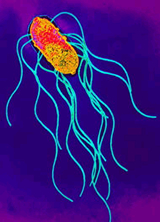
Salmonella kswfoodworld

Image CDC

Salmonella is a common and bothersome disease organism in livestock production. But the species Salmonella Dublin is of particular concern.

Cattle are the host species for S. Dublin, which is highly contagious and difficult to treat. On dairy farms, it is most likely to cause severe clinical disease in calves. It also is classified as a zoonotic disease, meaning it can be transferred from animals to humans through consumption of raw milk and undercooked meat (and accidentally ingested faeces and saliva) from infected animals.

Michigan State University Veterinary and Extension educators Angel Abuelo and Faith Cullens recently published a new bulletin on Salmonella Dublin in dairy calves. They noted that this particular strain of Salmonella has typically been thought of as a problem primarily on dairies in the western United States, but it is gaining a foothold in the Midwest and Northeast. For example, from 2015 to 2019, S. Dublin represented 20.8% of all Salmonella species isolates in bovine samples at Michigan State’s veterinary diagnostic laboratory.

RASFF Alerts – Animal Feed -Enterobacteriaceae – Dog Chews

RASFF-Logo

RASFF – high count of Enterobacteriaceae (1, 7.7, 18, 84, 25 CFU/g) in dog chews from China in Spain