Category Archives: foodborne disease

USA – Outbreak of Multidrug-Resistant Salmonella Infections Linked to Raw Turkey Products – Update

CDC

Latest Outbreak Information

Illustration of a megaphone.

At A Glance

  • Since the last update on November 8, 2018, 52 ill people from 26 states and the District of Columbia have been added to this investigation.
  • As of December 18, 2018, 216 people infected with the outbreak strain of SalmonellaReading have been reported from 38 states and the District of Columbia.
    • 84 people have been hospitalized, and one death has been reported from California.
  • Epidemiologic and laboratory evidence indicates that raw turkey products from a variety of sources are contaminated with Salmonella Reading and are making people sick.
  • In interviews, ill people report eating different types and brands of turkey products purchased from many different locations. Three ill people lived in households where raw turkey pet food was fed to pets.
  • The outbreak strain has been identified in samples taken from raw turkey pet food, raw turkey products, and live turkeys.
    • On November 15, 2018, Jennie-O Turkey Store Sales in Barron, Wisconsin recalled approximately 91,388 pounds of raw ground turkey products.
    • On December 21, 2018, Jennie-O Turkey Store Sales, LLC, in Faribault, Minnesota recalled approximately 164,210 pounds of raw ground turkey products.
    • On January 28, 2019, Woody’s Pet Food Deli in Minnesota recalled raw turkey pet food. The recalled product was sold in 5-pound plastic containers labeled “Woody’s Pet Food Deli Raw Free Range Turkey” and was sold in Minnesota.
    • A single, common supplier of raw turkey products or of live turkeys has not been identified that could account for the whole outbreak.
  • The Public Health Agency of Canada has identified ill people infected with the same DNA fingerprint of Salmonella Reading bacteria in Canada.
  • The outbreak strain of Salmonella Reading is present in live turkeys and in many types of raw turkey products, indicating it might be widespread in the turkey industry. CDC and USDA-FSIS have shared this information with representatives from the turkey industry and asked about steps that they may be taking to reduce Salmonella contamination.

USA – Outbreak of Listeria Infections Linked to Pork Products Final Update

CDC

This outbreak appears to be over. In general, people who are at higher risk for Listeria infection should avoid eating hot dogs, lunch meats, cold cuts, other deli meats (such as bologna), or fermented or dry sausages unless they are heated to an internal temperature of 165°F or until steaming hot just before serving. Learn more about how you can take steps to prevent Listeria infection.

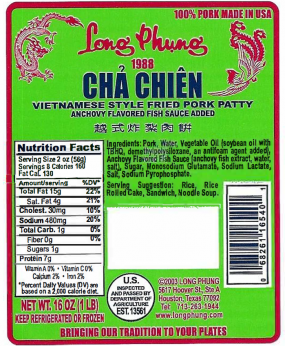
Label of packaging

CDC, public health and regulatory officials in several states, and the U.S. Department of Agriculture’s Food Safety and Inspection Service (USDA-FSIS) investigated a multistate outbreak of Listeria monocytogenes infections linked to pork products produced by Long Phung Food Products. As of January 29, 2019, this outbreak appears to be over.

Indonesia – Palu earthquake victims suffer food poisoning at shelter

The Jakarta Post

Dozens of people from Kabonena and Tipo subdistricts in Palu, Central Sulawesi, who were displaced by a recent earthquake, have been hospitalized for reported food poisoning after consuming donated food on Saturday.

Badrun, one of the food poisoning victims, said the food was distributed to the shelter at around 11 a.m. local time. The displaced people did not feel anything strange as they ate the food but an hour later they started to feel dizzy and nauseous, he said.

The victims – mostly children – were rushed to Anutapura Palu Hospital.

Anutapura Palu Hospital deputy director for medical services Herry Mulyadi said his office had recorded that at least 38 people had been admitted to the hospital, while others were taken to other hospitals.

UK and Ireland -Norovirus oyster outbreak

Food Safety News


Authorities in the United Kingdom and Ireland are investigating a foodborne outbreak suspected to be caused by norovirus in live oysters.

The oysters are thought to have come from Ireland and been purified in the UK and it is believed they are no longer on the market.

Harvesting records and purification operations at the unnamed implicated business in Ireland have been checked with nothing proving that oysters harvested at the time were contaminated.

A number of people fell ill in England and the investigation has pointed towards a potential norovirus outbreak linked to one restaurant.

The Food Safety Authority of Ireland (FSAI) told Food Safety News that it has sought detailed clarification on traceability and delivery channels.

Information – The Contagion® Outbreak Monitor

Contagion Live

I came across this which is quite an interesting tool for looking at outbreaks.

cm


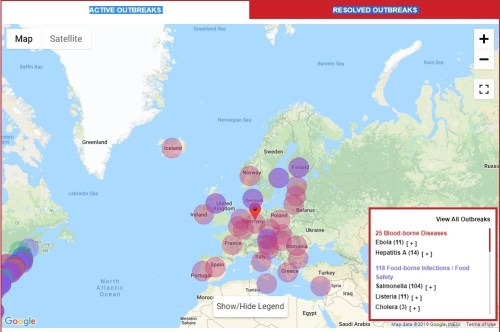
The Contagion® Outbreak Monitor provides details on the number of confirmed cases, deaths, and recent website articles on infectious disease outbreaks.
Use the Contagion® Outbreak Monitor to learn about infectious disease outbreaks in your geographical region and manipulate the map to find out the latest information on global outbreaks. Click on “Trends” to learn more about trends in the number of cases and deaths.

USA – FDA Investigating Multistate Outbreak of E. coli O157:H7 Infections Likely Linked to Romaine Lettuce Grown in California

FDA Eurofins Food Testing UK

Update: December 17, 2018

The FDA, along with CDC, state and local agencies, is investigating a multistate outbreak of E. coli O157:H7 illnesses linked to romaine lettuce grown in California this fall. The Public Health Agency of Canada (PHAC) and Canadian Food Inspection Agency (CFIA) are also coordinating with U.S. agencies as they investigate a similar outbreak in Canada.

On December 13, 2018, Adam Bros. Farming, Inc., in Santa Barbara County, recalled products that may have come into contact with water from the water reservoir where the outbreak strain was found. The firm recalled red leaf lettuce, green leaf lettuce and cauliflower harvested on November 27 through 30, 2018. According to the firm, cauliflower was distributed to wholesalers in the U.S. Mexico, and Canada.

The Adam Bros. recall has prompted a sub-recall by Spokane Produce Inc. of Spokane, WA. The firm recalled sandwiches and other products under the Northwest Cuisine Creations and Fresh&Local labels.

Recommendation:

Consumers:

Consumers should not eat recalled products and should throw them away. Consumers also should not eat romaine from Monterey, San Benito, and Santa Barbara counties in California.

Based on discussions with producers and distributors, romaine lettuce entering the market will now be voluntarily labeled with a harvest location and a harvest date or labeled as being hydroponically- or greenhouse-grown. Romaine lettuce with the new labeling is available in stores. Consumers should look for signs in stores where labels are not an option. If signs or labels do not have this information, you should not eat or use it.

If it does have this information, we advise avoiding romaine from Monterey, San Benito, and Santa Barbara counties in California. Romaine from outside those regions need not be avoided. Additional counties may be added or subtracted as FDA traceback investigation continues.

For example, romaine lettuce harvested from areas that include, but are not limited to, the following do not appear to be related to the current outbreak:

  • the desert growing region near Yuma, Arizona
  • the California desert growing region near Imperial County and Riverside County
  • the counties of Ventura, San Luis Obispo, and Santa Cruz in California
  • the state of Florida
  • Mexico

Additionally, there is no evidence hydroponically- and greenhouse-grown romaine is related to the current outbreak, and there is, also, no recommendation to avoid romaine from these sources.

Restaurants and Retailers:

Restaurants and retailers should not serve or sell romaine from Monterey, San Benito, and Santa Barbara counties in California. Romaine from outside those regions need not be avoided. See the list above of examples of growing areas not related to the current outbreak. Retailers and restaurants should discard any recalled product.

Retailers should ensure that there is labeling with the harvest date and location on each bag of romaine, or that there is signage when labels are not an option.

Suppliers and Distributors:

Suppliers, distributors and others in the supply chain should not ship or sell romaine from Monterey, San Benito, and Santa Barbara counties in California. Romaine from outside those regions need not be. Distributors and suppliers should discard any recalled product.

FDA recommends that labels are placed on romaine lettuce entering the market to help consumers, restaurants and retailers determine that the romaine is from unaffected growing regions outside of Monterey, San Benito, or Santa Barbara counties in California.


USA – E. coli O157:H7 Romaine Outbreak Increases With 52 Sick and 19 Hospitalized

Food Poisoning Bulletin

E. coli O157:H7 Romaine Outbreak 12618

The E. coli O157:H7 romaine outbreak has grown, according to an update posted by the Centers for Disease Control and Prevention (CDC). Since the last update posted in November 26, 2018, an additional nine patients have been added to the total for 52 sick. Those patients live in 15 states. Nineteen people have been hospitalized.

Singapore – 131 fall ill in third mass food-poisoning case this month

Yahoo News

In the third case of mass food poisoning this month, 131 people – including kindergarten pupils and teachers – fell ill on Monday (26 November) after consuming food from a caterer while attending a learning camp.

In a joint statement released on Tuesday, the National Environment Agency (NEA), Ministry of Health (MOH) and Agri-Food and Veterinary Authority (AVA) said they are investigating an outbreak of gastroenteritis – inflammation of the stomach and intestines which causes vomiting and diarrhoea.

The outbreak was traced to the consumption of food prepared by FoodTalks Caterer & Manufacturer, located at Shimei East Kitchen along Bedok North Street 5. The three authorities carried out a joint inspection of the premises on Tuesday, with food and environmental samples taken for testing and food handlers being sent for stool screening.

According to Chinese daily Lianhe Zaobao, the food poisoning victims had attended a learning camp organised by Busy Bees Asia. Organisers said that the camp was stopped immediately upon the outbreak of food poisoning.

As of Tuesday, 131 cases of gastroenteritis had been reported. None of the victims have been hospitalised.

USA – CDC – Outbreak of Multidrug-Resistant Salmonella Infections Linked to Raw Turkey Products – One Death

CDC

CDC and public health and regulatory officials in several states are investigating a multistate outbreak of multidrug-resistant Salmonella infections linked to raw turkey products. The U.S. Department of Agriculture’s Food Safety and Inspection Service (USDA-FSIS) is monitoring the outbreak.

  • Seventy-four more ill people from 26 states were added to this investigation since the last update on July 19, 2018.
  • As of November 5, 2018, 164 people infected with the outbreak strain of Salmonella Reading have been reported from 35 states.
    • 63 people have been hospitalized, and one death has been reported from California.
  • Epidemiologic and laboratory evidence(https://www.cdc.gov/foodsafety/outbreaks/investigating-outbreaks/index.html) indicates that raw turkey products from a variety of sources are contaminated with Salmonella Reading and are making people sick.
  • In interviews, ill people report eating different types and brands of turkey products purchased from many different locations. Three ill people lived in households where raw turkey pet food was fed to pets.
  • The outbreak strain has been identified in samples taken from raw turkey pet food, raw turkey products, and live turkeys.
  • A single, common supplier of raw turkey products or of live turkeys has not been identified.
  • The outbreak strain of Salmonella Reading is present in live turkeys and in many types of raw turkey products, indicating it might be widespread in the turkey industry. CDC and USDA-FSIS have shared this information with representatives from the turkey industry and asked about steps that they may be taking to reduce Salmonella contamination.


Zambia – 38 QUARANTINED FOR FOOD BORNE DISEASE

ZNBC

Thirty-eight children from the Natebe Luvale Mukanda camp in Livingstone have been quarantined for a suspected food borne disease.

Livingstone District Health Director Tino Maliselo has confirmed to ZNBC news in Livingstone that most of the children are quarantined at the Namatama Health Post.

Dr. Maliselo said the situation is under control and that laboratory investigations are being carried out to ascertain the disease.

He adds that his team is assessing the health situation in the traditional initiation camp known traditionally as the Mukanda.

And some parents have called for the immediate release of their children from the traditional camp.