VISALIA, CA December 1, 2021 – Livia Global, Inc a health and wellness company that offers LiviaOne Liquid Probiotics & BioLifePet Liquid Probiotics, today announced that it is voluntarily recalling two lots of its liquid probiotics due to the possibility of contamination by Pseudomonas aeruginosa. Pseudomonas aeruginosa is a microorganism found in the environment that, if ingested, can cause life-threatening infection in immunocompromised individuals. P. aeruginosa infections are generally limited to hospital settings.
This recall only affects the following products with the Lot# 001005-1 Best by: 04/2023 & LiviaOne Nasal Probiotics with Lot# 010620-1 Best by 08/2023 with the following ship dates:
Lot numbers are located on the side of the bottle and on the bottom of the outer container in which the product is sold. (See below) No other lots or ship dates or any other LiviaOne products are affected by this recall. These products are distributed nationwide through Amazon, wholesale, and direct sales from the company’s website.
The company discovered the potential issue during routine 3rd party laboratory testing, which is part of Livia Global’s quality assurance procedures and safety protocols and decided to take this precautionary measure. Even though the company has not received a direct complaint from using their products, we felt compelled to do this out of abundance of caution.
“We apologize for any concern or inconvenience this situation causes our customers and are here to support them,” said Deborah Moreno, Chief Operations Officer. “Livia Global is dedicated to the safety, health and welfare of its customers above all else. We continue to invest in the safety and quality protocols to ensure we produce only the best products.”
The company is asking consumers who have product from the above-mentioned Lot and ship dates to dispose of products. Impacted consumers may contact Livia Global Customer Care to request a full refund (please have order # available), see contact information provided below.
For more information, please contact Deborah Moreno, Livia Global via phone, 1-559-372-8593 or email support@liviaglobal.com. Hours of operations are from 8:30AM – 4:30PM PST Monday – Friday.
Salmonella contamination of eggs and egg shells has been identified as a public health problem worldwide. Here, we reported an outbreak of severe gastrointestinal symptoms caused by Salmonella enterica serovar Enteritidis (S. enteritidis) in China. We evaluated the outbreak by using epidemiological surveys, routine laboratory testing methods, and whole genome sequencing (WGS). This outbreak occurred in a canteen in Beijing, during March 9–11, 2021, 225 of the 324 diners who have eaten at the canteen showed gastrointestinal symptoms. The outbreak had characteristical epidemiological and clinical features. It caused a very high attack rate (69.4%) in a short incubation time. All patients developed diarrhea and high fever, accompanied by abdominal pain (62.3%), nausea (50.4%), and vomiting (62.7%). The average frequency of diarrhea was 12.4 times/day, and the highest frequency of diarrhea was as high as 50 times/day. The average fever temperature was 39.4°C, and the highest fever temperature was 42°C. Twenty strains of S. enteritidis were recovered, including 19 from the patients samples, and one from remained egg fried rice. Antibiotic susceptibility test showed that the 20 outbreak strains all had the same resistance pattern. PFGE results demonstrated that all 20 strains bore completely identical bands. Phylogenetic analysis based on WGS revealed that all 20 outbreak strains were tightly clustered together. So the pathogenic source of this food poisoning incident may was contaminated egg fried rice. Resistance gene analysis showed that the outbreak strains are all multi-drug resistant strains. Virulence gene analysis indicated that these outbreak strains carried a large number of virulence genes, including 2 types of Salmonella pathogenicity islands (SPI-1 and SPI-2). Other important virulence genes were also carried by the outbreak strains, such as pefABCD, rck and shdA. And the shdA gene was not in other strains located in the same evolutionary branch as the outbreak strain. We speculated that this is a significant reason for the serious symptoms of gastroenteritis in this outbreak. This outbreak caused by S. enteritidis suggested government should strengthen monitoring of the prevalence of outbreak clone strains, and take measures to mitigate the public health threat posed by contaminated eggs.
Introduction
World Health Organization (WHO) estimated the global burden of foodborne diseases, the results showed that almost 1 in 10 people fall ill every year from eating contaminated food and 420,000 die as a result (Dewey-Mattia et al., 2018). Salmonellosis is one of the most frequently reported foodborne diseases worldwide. In particular, disease caused by non-typhoid Salmonella is a global public health problem, whether in a high-income country or a low-income country (Feasey et al., 2016). Each year, approximately 40,000 Salmonella infections are reported to the United States Centers for Disease Control and Prevention (CDCs) (Vaughn et al., 2020). Salmonella enterica serovar Enteritidis (S. enteritidis) is the predominant Salmonella serotype accounting for between 40 and 60% of laboratory-confirmed illnesses of salmonellosis in recent years (Quick et al., 2015). Salmonella enteritidis typically cause a self-limiting gastroenteritis with the symptoms of diarrhea, fever, abdominal cramps, and dehydration (Jiang et al., 2020). Salmonellosis is mainly caused by eating eggs and egg products contaminated with S. enteritidis (90%) and has become a serious health problem. It has been attributed to this serovar’s unusual ability to colonize ovarian tissue of hens and to be able to present within the contents of intact shell eggs (Chousalkar et al., 2018).
Here we reported a severe gastroenteritis outbreak of S. enteritidis linked to contaminated egg fried rice. There were 225 cases of diarrhea and fever in a short period of time in a canteen in Beijing within 3 days. Epidemiological investigations and laboratory tests confirmed that the outbreak was caused by S. enteritidis and was related to the undercooked egg fried rice. At present, such a large-scale outbreak with severe clinical symptoms of S. enteritidis caused by undercooked eggs is rarely reported (Li et al., 2020). Therefore, we reported the outbreak and examined its molecular characteristics using whole genome sequencing (WGS).
The ubiquity of Listeria monocytogenes in the environment affects the food industry and presents concerns for frozen food facilities. This study determined the prevalence and numbers of Listeria species and L. monocytogenes on raw produce arriving at frozen food facilities. Raw produce was collected using multilevel blinding protocols to ensure anonymity of participants and avoid traceback. Five raw vegetables were selected: corn, carrots, green beans, peas, and spinach. Raw products were collected after arrival at the facilities but before cleaning or other preprocessing steps that are typically performed inside the facility. The U.S. Food and Drug Administration’s Bacteriological Analytical Manual method for detection of Listeria spp. and L. monocytogenes was followed, with PCR screening followed by selective plating methods. Listeria numbers were estimated from positive samples using the most-probable-number (MPN) methodology. A total of 290 samples were collected, with 96 and 17 samples positive for Listeria spp. (33.1%) and L. monocytogenes (5.9%), respectively. Enumeration data for the 96 Listeria spp. samples indicated 82 samples had greater than 100 MPN of Listeria spp. per g and 14 samples had less than 100 MPN Listeria spp. per g. The prevalence of Listeria spp. varied by commodity: spinach (66.7%), peas (50%), corn (32.2%), green beans (22.2%), and carrots (13%). L. monocytogenes prevalence was determined in corn (13.6%), peas (6.3%), and green beans (4.2%) arriving at processing facilities. Such data were previously unavailable to frozen vegetable processors and are valuable in implementing process control standards. The prevalence and pathogen concentration data from raw commodities found in this study can provide the industry with information to conduct more accurate quantitative risk assessments and a baseline to model and target appropriate pathogen reduction steps during processing.
HIGHLIGHTS
Prevalence of Listeria spp. and L. monocytogenes in raw produce was determined.
96 Listeria spp. and 17 L. monocytogenes samples were found from 290 produce samples.
82 produce samples had >100 MPN/g and 14 samples had <100 MPN/g for Listeria spp.
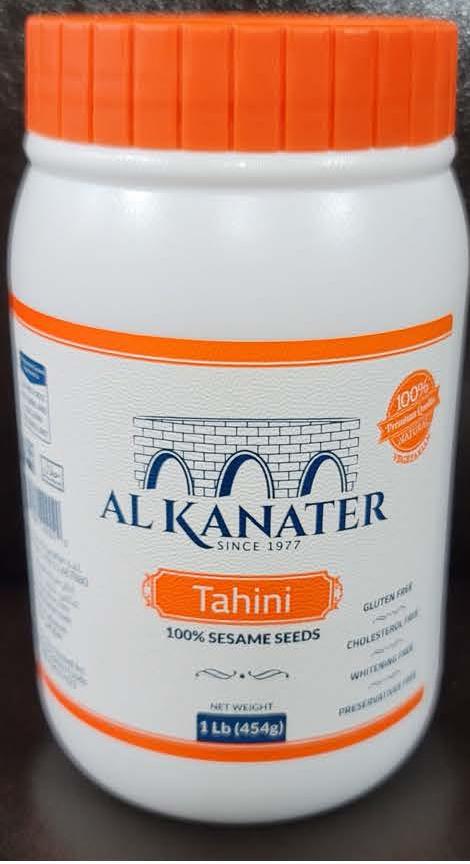
International Golden Foods, Inc (IGF) of Bensenville, IL is voluntarily recalling certain lot codes of the Al kanater brand tahini because it has the potential to be contaminated with Salmonella, an organism which can cause serious and sometimes fatal infections in young children, frail or elderly people and others with weakened immune system. Healthy persons infected with Salmonella often experience fever, diarrhea (which may be bloody), nausea, vomiting and abdominal pain. In rare circumstances, infection with Salmonella can result in the organism getting into the bloodstream and producing more severe illnesses such as arterial infections (i.e., infected aneurysms), endocarditis and arthritis.
The product was distributed nationwide and is sold in 16 Oz. jars. The jars are labelled “Al kanater Tahini.” Lot codes are printed on the jar. Product code, description, lot code, and UPC information are noted below.
Product Code
Product Description & Size
Lot #
UPC
AT1LB
Al kanater Tahini Sesame Paste 1 lb. (454 gr)
TT4N‐201127
6‐92551‐00002‐0
No illnesses have been reported to-date in connection with the Al Kanater Brand Tahini.
This problem was revealed as a result of a random sampling by the Michigan Department of Agriculture. Although we have not received the final laboratory reports, IGF is recalling product with the lot codes listed above. Consumers who have purchased Al kanater Tahini with these lot codes should discontinue use and return it to the store of purchase for a full refund. Retailers that may have further distributed the recalled lot codes should share this notice with their customers. Retailers or consumers with questions may contact IGF at 630-860-5552. Please see attached a sample product picture. Company Contact Information: ‐630‐860‐5552, 800‐343‐7423.,info@goldenfood.com,
Please return all product back to us.
Mansour Amiran 11/29/21 International Golden Foods, Inc. 819 Industrial Dr. Bensenville, IL 60106.