Category Archives: Food Hygiene

Information – Company, governments investigate contaminated infant formula powder – Cronobacter sakazakii

Food Safety News

The Danone company has been hit by several food safety issues recently, including a consumer reporting insects in a pack of its infant formula and another batch of baby formula testing positive for Cronobacter sakazakii bacteria.

Danone is the corporation behind many food and beverage brands sold in the United States, including Oikos, Activia, Silk, International Delight, Aptimel, and Evian.

USA – Fremont Bowl Associated with Salmonella Outbreak in Seattle, Washington

Food Poisoning Bulletin 

Salmonellaa

The Fremont Bowl restaurant in Seattle, Washington state has been associated with a Salmonella Enteritidis outbreak, according to the Seattle King County Health Department. At least four people are sick in this outbreak; one person has been hospitalized because their illness is so severe; that person has since recovered and has been released.

The Fremont Bowl is located at 4258 Fremont Avenue N. Ste. #4262 in Seattle. those sickened ate there on July 27 – July 29, 2018. The patients were part of three separate meal parties. The press release stated that there is no indication that any employees of the restaurant have been ill with symptoms that are consistent with salmonellosis.

USA – Lipari Foods Issues Voluntary Recall of Premo Brand Turkey & Cheese Wedge Sandwiches Because of Possible Health Risk – Listeria monocyotgenes

FDA

Lipari Foods, LLC has issued a voluntary recall of Premo Brand turkey and cheese wedge sandwiches produced and packaged by sister company JLM due to potential contamination of Listeria monocytogenes. Listeria monocytogenes is an organism, which can cause serious and sometimes fatal infections in young children, frail or elderly people, and others with weakened immune systems. Although healthy individuals may suffer only short-term symptoms such as high fever, severe headache, stiffness, nausea, abdominal pain and diarrhea, Listeria infection can cause miscarriages and stillbirths among pregnant women.

The products were produced on August 8, 2018 and distributed to food service and retail stores throughout Illinois, Indiana, Kentucky, Maryland, Michigan, Minnesota, Ohio, Pennsylvania, Tennessee, Wisconsin and West Virginia.

Brand Product Lipari Product # Weight Enjoy By Date Lot # UPC
Premo Brand Turkey & Cheese Wedge 915516 5 OZ 08/31/2018 08201808 612510002018

Products were distributed under the following brand names: Premo Brand. The affected products can be identified by:

Research – Retrospective validation of whole genome sequencing-enhanced surveillance of listeriosis in Europe, 2010 to 2015

Eurosurveillance

More than half of the severe listeriosis cases in the European Union belong to clusters, many of which are not being picked up fast enough by the current surveillance system, suggests a new article published in Eurosurveillance.

Invasive infection by () leads to relatively rare but serious food-borne disease mainly affecting elderly people, immunocompromised individuals and pregnant women. Clinical manifestations include sepsis and infection of the central nervous system, which can lead to lifelong sequelae or death [1,2]. Pregnancy-associated listeriosis can result in preterm birth, miscarriage or stillbirth [2,3]. In the European Union and European Economic Area (EU/EEA), 2,224 human cases of invasive listeriosis were reported in 2015, with an overall case fatality rate of 18.8% [4]. Reported numbers of cases of listeriosis suggest that the incidence of disease slightly increased over the period of 2010–15. The incubation period of listeriosis is usually 3 to 21 days, but can be as long as 67 days, depending on the clinical form of the disease [5]. Patients frequently have underlying conditions and/or are elderly, which limits the collection of exposure data in some cases. On epidemiological grounds, most cases are considered sporadic and detected outbreaks usually involve small numbers of patients, which limits statistical power in analytical epidemiological studies. As a result, most reported cases of listeriosis are difficult to link to a specific food product or food business operator.

is able to form biofilms, grow at refrigeration temperature, high salt and nitrite concentrations, and can be resistant to disinfectants [6,7]. These properties contribute to its ability to persist and multiply in the food-processing environment and make it difficult to control. In the United States (US), a nationwide subtyping of using pulsed-field gel electrophoresis (PFGE) was introduced in 1998. During the following 6 years, there was a more than fivefold increase in the number of outbreaks where a common food vehicle could be identified [8]. In the subsequent 10 years, the introduction of detailed food history gathering for all listeriosis patients resulted in a further increase in the number of solved outbreaks per year, as well as a reduction of the number of cases per outbreak [9].

PFGE is, however, time-consuming and difficult to standardise. In recent years, it has been demonstrated that whole genome sequence (WGS)-based subtyping can provide substantial additional discrimination and, consequently, can be of benefit to outbreak investigations [9–11]. Within the EU/EEA, listeriosis is one of the priority diseases for which supranational WGS-enhanced surveillance will be initiated in 2018 [12]. The work presented here supports the preparation for this surveillance system through a large-scale, retrospective, multi-centre study on isolates from human cases from EU/EEA countries by covering the comparison and validation of analytical pipelines, the assessment of the epidemiological concordance of the results and the potential impact on public health [13]. The analytical pipelines are based on the gene-by-gene approach recommended by the PulseNet International global consortium [14–17].

UK Scotland – Cyclospora in travellers returning from Mexico

HPS Cyclospora_LifeCycle201

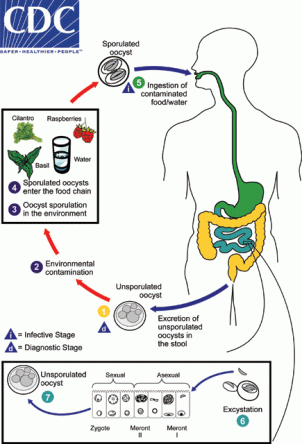
Public Health England (PHE), Public Health Wales (PHW), Health Protection Scotland (HPS) and the Health Protection Service Northern Ireland (HPSNI) are investigating an increase in cases of Cyclospora cayetanensis infection in travellers who have recently returned from Mexico. This is the fourth successive year since 2015 that cases of the infection have been reported in travellers returning from Mexico.

As of 3 August 2018, 63 laboratory-confirmed cases of Cyclospora cayetanensis have been reported in England, Scotland and Wales. Where information is available, 55 (87%) report travel outside the UK, of which 49 (89%) report recent travel to Mexico. Where information is available, cases have stayed at several different hotels in the Cancun and Riviera Maya region suggesting the source is likely to be a foodstuff that has been distributed to hotels throughout the region.

Cyclospora cayetanensis is a protozoan parasite that infects humans and other primates. Infection can cause diarrhoea, abdominal cramping, nausea, flatulence, loss of appetite, fatigue, low-grade fever and weight loss. Infection without symptoms is also reported. Infections in HIV positive people and those with other immune deficiencies can be more severe.

Infection is commonly derived from food or water contaminated by human faeces. The foods commonly involved are soft fruits such as raspberries and salad products such as coriander, basil and lettuce. The risk of infection presented by imported foods is considered to be low.

Advice for travellers on the prevention of Cyclospora is available from Health Protection Scotland: https://www.fitfortravel.nhs.uk/news/newsdetail.aspx?id=22743.

Poland – Shigella sonnei outbreak linked to Rainbow Gathering

Outbreak News Today 

Shigella - kswfoodworld

Image CDC

European health officials are reporting a Shigella sonnei outbreak among participants of a Rainbow Gathering in the south-east of Poland.

Between 5 and 10 August 2018, 45 participants presented with gastroenteritis symptoms, 14 of these tested positive for Shigella sonnei. The event took place between 13 July and 11 August and so it is likely that most participants, which come from many countries within the EU, have now left the area.

Last year, a typhoid outbreak was linked to the European Rainbow gathering that took place in Tramonti di Sopra, Friuli-Venezia Giulia region, Italy.


New Zealand – Campylobacter in raw milk prompts recall in New Zealand

Food Safety News 


Longhill Farms is recalling raw, unpasteurized milk in New Zealand because it has been found to be contaminated with Campylobacter bacteria.

The product is sold in 1 liter or 2 liter glass bottles or in customer supplied containers. Affected products have batch numbers: D-0608 to D-1508 inclusive and use-by dates of Aug. 10 to Aug. 19, inclusive.

It was sold from a vending machine at Longhill Farms in Kawakawa, Northland, and is not exported. There have been no reports of illness. Customers are advised to return the products to Longhill Farms for a full refund.

USA – Chipotle Update: Stool Sample Results Returned by CDC Test Positive for Clostridium perfringens

Delaware Health 

closta

Image CDC

  • Clostridium perfringens is a foodborne disease that occurs when food is left at an unsafe temperature.
  • Although food samples tested negative for C. perfringens bacteria, the stool samples tested positive for the toxin that C. perfringens forms in the gastrointestinal tract.
  • A specific food has not been able to be identified as the source of illness. Ongoing food and stool testing is being conducted by the CDC lab.
  • “I am extremely proud of our team! This investigation included countless hours of phone calls and interviews along with multiple inspections. We are also appreciative of our community for being very cooperative during this investigation and for understanding our work in protecting the public’s health. We are also thankful for the work of our partners at the Ohio Department of Health and the CDC,” said Delaware County Health Commissioner Shelia Hiddleson.
  • In response to this outbreak, Brian Niccol, CEO of Chipotle Mexican Grill stated that “Chipotle Field Leadership will be retraining all restaurant employees nationwide beginning next week on food safety and wellness protocols.” Click here for complete statement.
  • Health District staff identified 647 people who self-reported gastrointestinal symptoms after consuming food from the Chipotle on Sawmill Parkway between Thursday July 26 – Monday July 30, 2018.


India -Food poisoning in another Mumbai school; 16 children, teacher rushed to hospital

The Indian Express

In the second episode of mass hospitalisation from a school within a week, 16 children and a teacher were rushed to hospital after complaints of food poisoning.

According to Dr Usha Mohprekar, medical superintendent in MT Agrawal Hospital in Mulund, all the patients complained of vomiting and stomach pain but “all are stable”.

The incident occurred in a private organisation-run Sahyadri Vidyamandir school in Bhandup on Thursday around 12.35 pm.

“The children suffered from food poisoning,” a civic official said, adding that school staff and ward’s medical officer have reached the spot.

READ | Mumbai: 12-year-old girl dies, 197 hospitalised on suspicion of medicine poisoning in BMC school

USA – Health officials studying church picnic as Salmonella outbreak hits 50

SE Missourian 

kswfoodworld.com

CDC Image


Authorities are investigating a possible connection between an ongoing salmonella outbreak and a recent church picnic as the number of confirmed sick in Perry County has risen to 50.

Sheila Hahs, Perry County Health Department communicable-disease coordinator, said Friday no cause has been determined.

Hahs said the department continues to work with the Missouri Department of Health and Senior Services (DHSS), which has begun distributing a survey seeking in-depth information about the behavior of individuals who attended the St. Vincent de Paul Seminary Picnic Aug. 3, 4 and 5.

The introduction to the 45-question online survey, titled “Church Picnic Salmonella Outbreak 2018,” states at least some of the reported ill attended the picnic. The survey asks participants to detail any symptoms, treatments, whether they brought or prepared food at the picnic and which foods, if any, they consumed while there.

Hahs said the survey is a starting point, after which representatives from the Perry County Health Department will conduct individual follow-up interviews with people who were sickened.