Category Archives: food death

Sweden – Four Deaths – Listeria monocytogenes – Linked to Mashed Potato Machine

The Local

Products from a food producer in western Sweden have been recalled after they were linked to a deadly outbreak of listeria.

There have been four deaths in Västra Götaland, in western Sweden, that experts have linked to the listeria bacteria.

Experts at the Centre for Communicable Disease Control (Smittskydd) stressed that all those who passed away were elderly people or affected by other illnesses.

In other words, they said it was impossible to confirm that listeriosis, the disease caused by listeria bacteria, was responsible for the deaths.

But the group behind the meals and the local region are not taking any chances, issuing a recall for potentially contaminated products across the region.

The group behind the products, Food Company, released a statement with information about the items that were affected and their expiration dates. See the full list here.

The items have an expiration date between May 16th and 25th.

All items – single portion, pre-cooked and chilled packet meals – contained mashed potatoes, with the company explaining that the machine that made the mash was responsible for the bacteria outbreak.

It added that the machine has since been removed from the production factory.

“This machine has been discarded and is no longer at our factory. We take the event seriously and will implement a number of measures to prevent this from happening again,” the company said in a statement.

While listeria is typically harmless to the vast majority of the population, it can be dangerous for the elderly, pregnant women, or those suffering from illness.

Canada – E. coli Outbreak in Canada tied to Yuma Romaine – E.coli O157

Food Poison Journal 

As of May 9, 2018, there are six Canadian cases of E. coli O157 that are genetically similar to the U.S. outbreak linked to romaine lettuce coming from the Yuma growing region in the U.S. The six Canadian illnesses are reported in four provinces: British Columbia (1), Alberta (1), Saskatchewan (2), and Ontario (2). Individuals became sick between late March and mid-April 2018. One of the Canadian cases was hospitalized, and no deaths have been reported in Canada. Individuals who became ill were between 13 and 68 years of age. The majority of cases (67%) were female.In the Canadian investigation, among the six cases, most of the individuals who became sick reported having eaten romaine lettuce at home, or in prepared salads purchased at grocery stores, restaurants and fast food chains, before their illnesses occurred. Two Canadians did report traveling to the U.S. before getting sick and eating romaine lettuce while they were there.

South Africa – Listeriosis under control, says health minister

Health 24 


The listeriosis epidemic is under control after product recalls, Health Minister Aaron Motsoaledi said during his Budget Vote in Parliament.

Cape Town – The listeriosis epidemic is under control now that meat products from Enterprise and Rainbow Chicken have been recalled, Health Minister Aaron Motsoaledi told Parliament on Tuesday.

“Since the recall, we have had fewer than five cases a week in the past five weeks compared to 40 a week before the recall,” Motsoaledi said during his R205bn Budget Vote in Parliament

Health 24

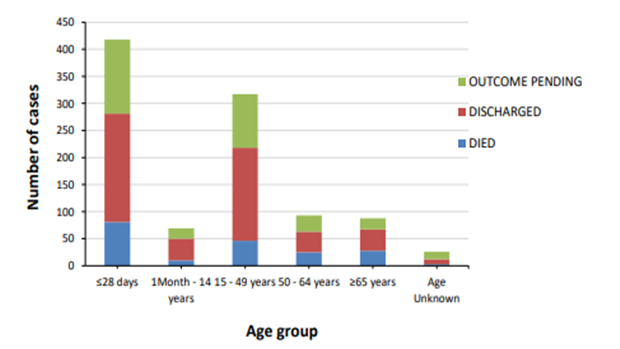
Health24 spoke to Dr Juno Thomas, the Head of the Centre for Enteric Diseases at the NICD, about the severity of the situation. She asserted that while the death toll has risen, it is important to look at the cases as they continue to decline: from 90 cases to 40 cases a week.

She also explained that Listeria affects people with weaker immune systems, making babies and the elderly more vulnerable to the illness. According to Dr Thomas, pregnant women with Listeriosis pass the illness on to the baby through the placenta, “hence the severity in the baby”.

Regarding the second highest group, Dr Thomas attributes this to two factors. “Firstly, women in that group are of childbearing age, and secondly this age group has the highest statistics for HIV, making them a risk factor.”

NICD – Listeria Outbreak Statistics

USA – Salmonella-Contaminated Eggs Sicken 35 People Across Nine States

Food Logistics 275px-Boiled_eggs_in_saucepan_by_Sarah_McCulloch

A salmonella outbreak attached to more than 200 million eggs has sickened 35 people, spreading across nine states.

NBC reports that 35 people across nine states have been sickened by a salmonella outbreak tied to a recall of more than 200 million eggs.

The eggs have been traced to egg-based producer Rose Acre Farms in Hyde County, North Carolina. Last month, the Centers for Disease Control and Prevention said that 23 people were sickened by the eggs, but since then the number has jumped to 35.

The 12 people that fell ill recently were in five different states along the East Coast.

According to NBC, the eggs were sold under different brands in a variety of retailers and restaurants. According to the CDC, 11 people have been hospitalized but no deaths have been reported.

USA – Why Are There So Many HUS Complications in the E. coli O157:H7 Romaine Outbreak? An Attorney Answers

Food Poisoning Bulletin 

The hospitalization rate and hemolytic uremic syndrome case count in the deadly E. coli O157:H7 HUS outbreak that is linked to romaine lettuce has been very high. Typically, in an E. coli outbreak, about 30% of patients are hospitalized, and about 5 to 10% develop hemolytic uremic syndrome (HUS).

But in this outbreak, the hospitalization rate is almost 50%, and 13% of those patients have developed HUS. Why is the hospitalization rate and the HUS rate so high in this particular outbreak?

Typically, the group most susceptible to developing HUS is children under the age of 5. The patient age range in this outbreak is from 1 to 88. There could be quite a few children sick, which may explain the high HUS rate.

Another explanation for the high HUS rate and the high hospitalization rate is the type of toxins the E. coli bacteria are producing. Shiga toxin-producing E. coli bacteria make two types of those toxins: Stx1 and Stx2. Unfortunately, the bacteria in this outbreak are making Stx2, which causes more damage to the body.

Another factor could be that the lettuce was contaminated with an unusually high number of bacteria. It takes just 10 E. coli bacteria to make someone sick. More bacteria can release more toxins and cause more damage.”

USA – North Dakota added to nationwide E. coli Outbreak linked to Romaine Lettuce from Yuma

Food Poison Journal Eurofins Food Testing UK

The North Dakota Department of Health (NDDoH) reports North Dakota’s first case of E. coli infection associated with romaine lettuce originating from the Yuma, Arizona growing region. The NDDoH has been working with the Centers for Disease Control and Prevention (CDC), the U.S. Food and Drug Administration (FDA), and other state and local health officials in this national investigation. A second case in ND possibly associated with the outbreak is still under investigation.

North Dakota Department of Health Reports Case of E. coli Linked to Romaine Lettuce

USA – Ten Minnesota illnesses linked to national E. coli outbreak associated with romaine lettuce

MN Health State Eurofins Food Testing UK

Health officials say do not eat romaine unless certain it is not from Yuma region

The Minnesota Department of Health (MDH) is working with the Minnesota Department of Agriculture (MDA), the Centers for Diseases Control and Prevention (CDC), the U.S. Food and Drug Administration (FDA), and public health agencies in other states to investigate an outbreak of E. coli O157 infections associated with eating romaine lettuce.

Information on the national outbreak can be found on CDC’s and FDA’s websites: CDC: E. coli and FDA Investigating Multistate Outbreak of E. coli O157:H7 Infections Likely Linked to Romaine Lettuce from Yuma Growing Region.

Ten cases of E. coli O157 infection in Minnesota residents have recently been identified and linked to the multi-state outbreak. Illness onset dates range from April 20 through May 2. The cases are from both metro and greater Minnesota counties; 90 percent are female. Three cases were hospitalized, and two developed hemolytic uremic syndrome (HUS), a potentially fatal complication that can include kidney failure and other severe problems.

All of the Minnesota cases interviewed by public health investigators reported exposure to romaine lettuce. Reported exposure locations include restaurants, grocery stores, and residential facilities. MDH is working with MDA to further investigate these exposures.

“Do not eat, buy, or sell romaine lettuce unless you can confirm it is not from the Yuma growing region,” said Kirk Smith, manager of the Foodborne, Waterborne, Vectorborne, and Zoonotic Diseases section. “The Yuma growing region includes part of western Arizona and extends into the Imperial Valley of southeastern California, but does not include Salinas Valley or other growing regions in California.” Product from the Yuma growing region should no longer be on sale; however, individuals should check their refrigerators for romaine lettuce that may have been grown in the Yuma region.

Symptoms of illness caused by E. coli O157 typically include stomach cramps and diarrhea, often with bloody stools, but only a low-grade or no fever. People typically become ill two to five days after exposure, but this period can range from one to eight days. Most people recover in five to 10 days. However, E. coli O157 infections sometimes lead to HUS. Those most at risk of developing complications from E. coli O157 include children younger than 10, the elderly, and those with weakened immune systems.

Diarrhea associated with E. coli O157 infections should not be treated with antibiotics, as this practice might promote the development of HUS. Anyone who believes they may have developed an E. coli O157 infection should contact their health care provider.

Approximately 135 cases of E. coli O157 are reported each year in Minnesota. More information on E. coli O157 and how to prevent it can be found on the MDH E. coli website.


USA – Ten People Sickened in Minnesota E. coli O157:H7 HUS Outbreak Linked to Romaine Lettuce: Lawsuits Possible

Food Poisoning Bulletin

Ten people are sick in a Minnesota E. coli O157:H7 HUS outbreak that is linked to romaine lettuce, according to a press release issued by the Minnesota Department of Health (MDH). Those patients are not counted in the 121 case count total sickened nationwide in the update that the CDC issued last week.

South Africa – Listeria Outbreak Update Report

NICD

  1. HIGHLIGHTS

 Phase 1 of the listeriosis emergency response plan (ERP) to strengthen the response to the listeriosis outbreak has been completed. This includes development of the ERP, obtaining approval for the ERP, communication of the plan with provincial and district stakeholders, development of a risk-assessment tool to identify high-risk food production facilities for inspection, development of training material and checklists to support inspections of facilities, capacitation of NHLS food testing laboratories. These activities build on the response activities conducted before 9 April 2018, which include identification of the source, product recall and risk communication.

 A meeting to orient the provincial communications, environmental health and communicable disease authorities to the ERP was held on 24-25 April at NICD in Johannesburg. Agreement was reached on the role of the provinces and the next steps to implement the ERP.

 The number of cases of laboratory-confirmed listeriosis reported per week has decreased since the implicated products were recalled on 04 March 2018, with five additional cases reported this week (epidemiological week 15).

 As of 24 April 2018, a total of 1 024 laboratory-confirmed listeriosis cases have been reported to NICD since 01 January 2017. Since the recall 7 weeks ago, a total of 55 cases have been reported, whereas for the 7 weeks prior to the recall, 169 cases were reported. All cases that have been identified after the recall are being fully investigated.

  1. BACKGROUND

Prior to 2017, an average of 60 to 80 laboratory-confirmed listeriosis cases per year (approximately 1 per week), were reported in South Africa. In July 2017, an increase in laboratory-confirmed cases of listeriosis was reported to National Institute for Communicable Diseases (NICD) which was followed by investigations into the reported increase. On 05 December 2017, the listeriosis outbreak was declared by the Minister of Health, Dr. Aaron Motsoaledi. The source of the outbreak was identified as ready-to-eat processed meat products

manufactured at Enterprise Foods’ Polokwane production facility. A recall of affected products was initiated on 04 March 2018.

USA – Multistate Outbreak of E. coli O157:H7 Infections Linked to Romaine Lettuce

CDC

What’s New?

  • Twenty-three more ill people from 10 states were added to this investigation since the last update on April 27, 2018. One death was reported from California.
  • Three more states have reported ill people: Kentucky, Massachusetts, and Utah.
  • The most recent illness started on April 21, 2018. Illnesses that occurred in the last two to three weeks might not yet be reported because of the time between when a person becomes ill with E. coli and when the illness is reported to CDC.