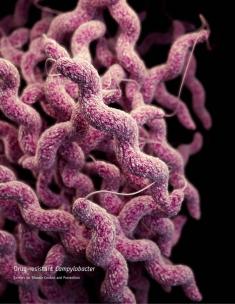
Category Archives: Campylobacter

Research – Migratory birds along the Mediterranean – Black Sea Flyway as carriers of zoonotic pathogens

NRC

At the crossroad between Europe, Asia, and Africa, Bulgaria is part of the Mediterranean – Black Sea Flyway (MBSF) used by millions of migratory birds. In this study, bird species migrating through Bulgaria were investigated as carriers of zoonotic pathogens. In total, 706 birds belonging to 46 species were checked for the presence of various bacterial pathogens (Campylobacter, Yersinia, Salmonella, Listeria, Escherichia coli, Staphylococcus aureus, Francisella tularensis, Coxiella burnetii, Borrelia burgdorferi, and Brucella spp.). From 673 birds we investigated fecal samples, from the remaining 33, blood samples. We detected Campylobacter 16S rDNA gene in 1.3% of birds, but none were of pathogenic Campylobacter jejuni and Campylobacter coli species. Escherichia coli 16S rDNA gene was found in 8.8% of the birds. Out of 34 birds that transported Yersinia enterocolitica strains (5.05%), only 1 carried a pathogenic isolate. Three birds (0.4%) were carriers of nonpathogenic Salmonella strains. Four avian samples (0.6%) were positive for Listeria monocytogenes and 1 (0.15%) was positive for Brucella spp. None of the birds tested carried the tick-borne pathogens C. burnetii or B. burgdorferi sensu lato. Antibiotic-resistant strains were detected, suggesting that migratory birds could be reservoirs and spreaders of bacterial pathogens as well as antibiotic resistance genes.

RASFF Alerts – Campylobacter – Chilled Chicken Thighs

RASFF-Logo

RASFF-Campylobacter coli (up to 1100 CFU/g) and Campylobacter jejuni (up to 1000 CFU/g) in chilled chicken thighs from France in Denmark

Research -Adoption of Neutralizing Buffered Peptone Water Coincides with Changes in Apparent Prevalence of Salmonella and Campylobacter of Broiler Rinse Samples

Journal of Food Protection

Buffered peptone water is the rinsate commonly used for chicken rinse sampling. A new formulation of buffered peptone water was developed to address concerns about the transfer of antimicrobials, used during poultry slaughter and processing, into the rinsate. This new formulation contains additives to neutralize the antimicrobials, and this neutralizing buffered peptone water replaced the original formulation for all chicken carcass and chicken part sampling programs run by the Food Safety and Inspection Service beginning in July 2016. Our goal was to determine whether the change in rinsate resulted in significant differences in the observed proportion of positive chicken rinse samples for both Salmonella and Campylobacter. This assessment compared sampling results for the 12-month periods before and after implementation. The proportion of carcass samples that tested positive for Salmonella increased from approximately 0.02 to almost 0.06. Concurrently, the proportion of chicken part samples that tested for Campylobacter decreased from 0.15 to 0.04. There were no significant differences associated with neutralizing buffered peptone water for the other two product-pathogen pairs. Further analysis of the effect of the new rinsate on corporations that operate multiple establishments demonstrated that changes in the percent positive rates differed across the corporations, with some corporations being unaffected, while others saw all of the establishments operated by the corporation move from passing to failing the performance standard and vice versa. The results validated earlier concerns that antimicrobial contamination of rinse samples was causing false-negative Salmonella testing results for chicken carcasses. The results also indicate that additional development work may still be required before the rinsate is sufficiently robust for its use in Campylobacter testing.

Research – Traveler’s diarrhoea: Researchers develop 3-in-1 vaccine

Outbreak News Today 


A first-ever vaccine designed to deliver a one-two-three punch against the main causes of traveller’s diarrhea worldwide may result from new research published by a University of Guelph chemist.

Prof. Mario Monteiro says his novel three-in-one approach to developing a new vaccine could also save lives in developing countries, where it’s estimated that these three common pathogens kill more than 100,000 children under age five each year.

His research was recently published in the journal Vaccine.

The paper discusses Monteiro’s so-called conjugate vaccine that yokes together proteins from pathogenic E. coli with sugars from Shigella and Campylobacter jejuni. All three bugs are major causes of bacterial diarrhea globally.

RASFF Alerts – Backdated 22/9/18-05/10/18 – Campylobacter – Chilled Chicken Products

RASFF-Logo

RASFF-Campylobacter jejuni (upto 2200 CFU/g) in chilled chicken products from Poland in Denmark

Research – Prevalence of Salmonella, Campylobacter, and Shiga Toxin–Producing Escherichia coli on the Surfaces of Raw Poultry Packages

Journal of Food Protection

Images CDC

Contamination on the exterior surfaces of raw poultry packages can be transmitted to hands and food contact surfaces during shopping and handling. This study compared the level of microbial contamination and prevalence of foodborne pathogens on the surfaces of raw poultry packages as related to the types of products, types of packaging, and packaging conditions. Packages of whole chicken, cut-up chicken (breast and leg quarter), and ground turkey were purchased from retail stores. Aerobic plate counts (APCs) were significantly different (P < 0.05) among types of products and packaging materials, with ground turkey packages and the heat-sealed, high-walled containers being the lowest. APCs were significantly lower (P < 0.05) when the packages were intact and tight compared with intact and loose. Of the 105 packages, there were 10 (9.5%) with the presence of either Shiga toxin–producing Escherichia coli (STEC) or Campylobacter; of those packages, 6 (5.7%) were positive for STEC, 7 (6.7%) were positive for Campylobacter, and 3 (2.9%) were positive for both pathogens on the surfaces. Salmonella was not detected on the surfaces of all tested packages. Surfaces of whole chicken packages were significantly (P < 0.001) more likely to have detectable levels of Campylobacter and STEC than those of cut-up chicken packages. Packages that were positive for Campylobacter and/or STEC had significantly (P < 0.005) higher APCs than negative packages. The results suggested that STEC is another significant pathogen present on the surfaces of poultry packages in addition to Campylobacter. The presence of STEC on the external packaging of raw poultry raises a concern because consumers may not expect such pathogens on the surfaces of poultry packages.

UK – Campylobacter levels hold steady

Food.Gov UK  

campy2

Major retailers publish April – June 2018 campylobacter results for fresh shop-bought UK-produced chickens.
13 September 2018

The top nine retailers across the UK have today published their latest testing results on campylobacter contamination in UK-produced fresh whole chickens (covering samples tested from April to June 2018).

The latest figures show that on average, across the major retailers, 3.7% of chickens tested positive for the highest level of contamination; these are the chickens carrying more than 1,000 colony forming units per gram (cfu/g) of campylobacter. The corresponding figure for the previous set of results (Jan-March 2018) was 3.8%, while for the first publication (July-September 2017) it was 4.6%.

Michael Wight, Director of Policy at the Food Standards Agency said:

‘These latest figures are consistent with previous results and show consolidation on the progress made so far in our mission to reduce Campylobacter levels to as low as reasonably achievable. Evidence has shown that Campylobacter tends to be more prevalent during warmer times of the year; so, to have seen the results holding steady during this period is encouraging.

‘I would like to thank the major retailers, processors and poultry producers for their efforts in tackling campylobacter and for working alongside the FSA to coordinate the publication of results.’
RASFF Alerts – Campylobacter – Chilled Chicken Breast – Chilled Chicken Thighs – Chilled Chicken Meat

RASFF-Logo

RASFF -Campylobacter coli (up to 3200 CFU/g) and Campylobacter jejuni (up to 65000 CFU/g) in chilled chicken breast from France in Denmark

RASFF-Campylobacter jejuni (200-24000 CFU/g) in chilled chicken thighs from the Netherlands, via Germany in Denmark

RASFF-Campylobacter (1100, 20000, 3200, 6400, 58000, 2600, 600, 3500, 7000, 500, 30000, 4800 CFU/g) in chilled chicken meat from France in Denmark

UK – Publication of survey of antimicrobial resistance in bacteria in chicken and pork

FSA

We have today published the results of a survey we commissioned to assess the amount of antimicrobial resistance (AMR) in bacteria in fresh pork mince and fresh and frozen chicken on sale in shops in the UK. These findings will help to establish a baseline of the occurrence, types and levels of AMR in bacteria found in these UK retail meats which will inform future surveillance on AMR in these foods.

This survey follows on from an authoritative report by a group established by the Advisory Committee on Microbiological Safety of Food (ACMSF) to advise us on research questions and potential approaches to AMR in the food chain.

The survey involved the testing of Campylobacter in chicken samples and Salmonella in pork mince samples for the occurrence of antimicrobial resistant bacteria. The survey also looked for AMR in other bacteria in both types of meat including Enterococci, Klebsiella and Escherichia coli.  Read the final report of the survey.

Information – Prevent Food Poisoning

Food Safety.Gov 

kswfoodworld mrsa


Anybody can get food poisoning, but some people are more likely to get seriously ill.

Every year, an estimated 1 in 6 Americans (or 48 million people) get sick, 128,000 are hospitalized, and 3,000 die of foodborne diseases. However, certain groups of people are more likely to get a foodborne illness (also called food poisoning) or get seriously ill. Learn why certain groups have a higher chance for food poisoning and what steps they can take to protect themselves.

People more likely to get a foodborne illness are:

  • Children younger than 5 years of age
  • Adults aged 65 and older
  • People with weakened immune systems from medical conditions or their treatment, such as cancer, HIV/AIDS, or diabetes
  • Pregnant women

Some People are at Higher Risk

Some people are more likely to get food poisoning because their ability to fight germs and sickness is not as effective as other people’s for a variety of reasons.

Young children have immune systems that are still developing, so their ability to fight germs and sickness isn’t as strong. Food poisoning can be particularly dangerous for them because illness can lead to diarrhea and dehydration. Children younger than 5 are three times more likely to be hospitalized if they get a Salmonella infection. And kidney failure strikes 1 out of 7 children under age 5 who are diagnosed with E. coli O157 infection.

Older adults have a higher risk because as people age, their immune systems and organs don’t recognize and get rid of harmful germs as well as they once did. Nearly half of people aged 65 and older who have a lab-confirmed foodborne illness from Salmonella, CampylobacterListeria or E. coli are hospitalized.

People with weakened immune systems can’t fight germs and sickness as effectively. People on dialysis are 50 times more likely to get a Listeria infection.

Pregnant women are more likely than other people to get sick from certain germs. For example, pregnant women are 10 times more likely to get a Listeria infection.