Category Archives: Campylobacter

UK – Aldi Tackling Campylobacter

Aldi

Facing up to the challenge

We understand that we have a role to play to reduce the level of Campylobacter in the supply chain and to help raise awareness with our customers as to how they can handle fresh poultry in a safe manner.

The Food Standards Agency (FSA) has identified Campylobacter as a key priority and is working with those directly in the industry to tackle it. Aldi is dedicated to supporting the FSA in this goal, which is why we are a signatory of the Acting on Campylobacter Together (ACT) campaign.

As well as working with the FSA (and other industry bodies), we understand that we need to take a lead with our suppliers to deliver against the FSA target.

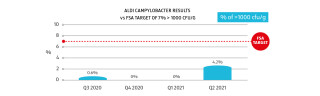
Aldi monitors the levels of Campylobacter carefully by compiling regular sets of independently verified data which is shared with the FSA via the BRC for the purposes of industry reporting. The results for Q2 2021 (April to June) show that 4.2% of birds were in the >1,000 cfu/g category. Our results are below the FSA target of less than 7% of birds in the >1,000 cfu/g category.
UK – Tesco Plan to Tackle Campylobacter

Lasted updated: August 2021

Campylobacter is a naturally occurring bacterium found in raw poultry that has the ability to cause food poisoning if the product is not cooked or handled correctly. Customers can keep safe by following the handling and cooking instructions provided on all Tesco raw poultry.

Providing high quality, safe food is always our absolute priority. It has long been our commitment to reduce levels of Campylobacter in our poultry and we are now seeing real progress at all stages of the supply chain, in tackling the issue through the work we have done with our suppliers.

Our Plan

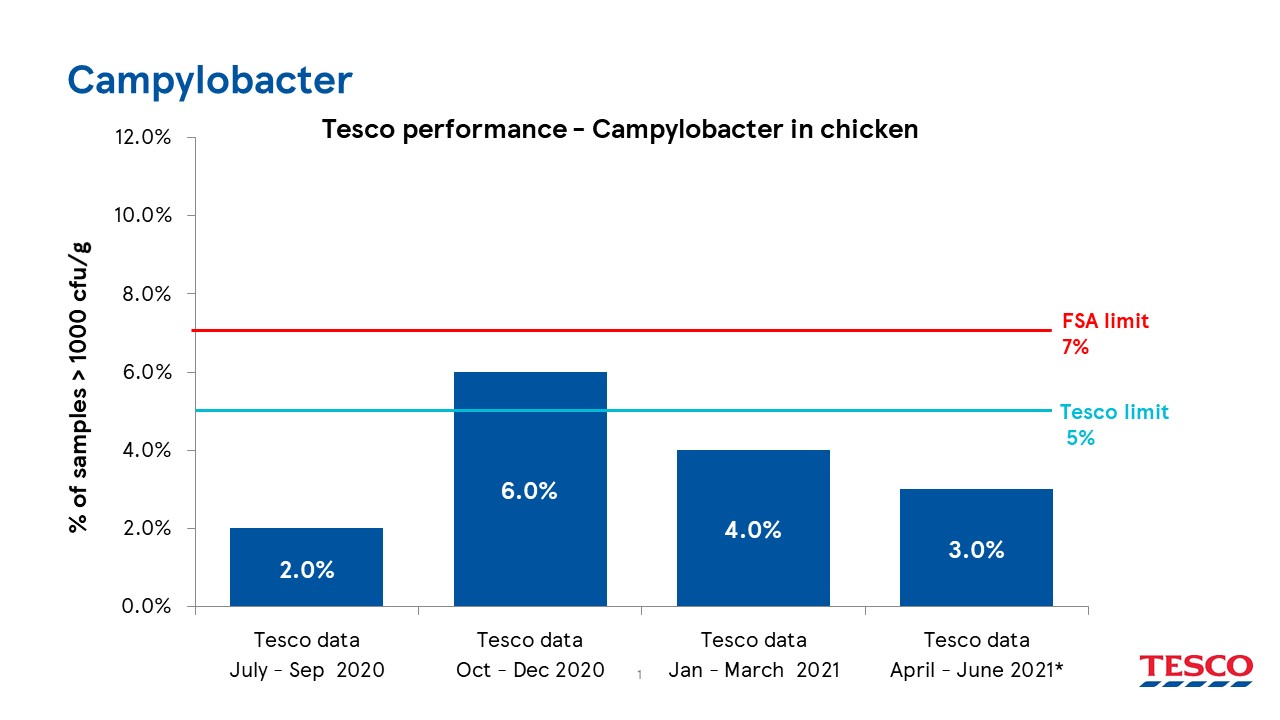
We aim to remain at the forefront of progress on Campylobacter reduction and to ensure we deliver this we have introduced our own industry leading target- that at least 95% of chickens supplied to Tesco will have minimal levels of Campylobacter (less than 1000 cfu/g). This will enable us to help our customers be a safe as possible, whilst handling and cooking poultry.

  • All of our raw poultry contains safe handling information on packaging and cooking instructions are checked to ensure thorough cooking. For further information please visit our Real Food website: Food Safety in the Home

Our Performance

UK – Lidl Tackling Campylobacter

Lidl

Safety and satisfaction are close to our hearts, which is why our quality assurance team accepts nothing short of perfection. Food safety is at the heart of what we do and underpins our purchasing policy across food and non-food items.

We work hard to ensure our suppliers meet national, European and Global safety standards and implement a strict internal Quality Management System comprising of rigorous product testing and supplier auditing.

Campylobacter

Food safety is the highest priority at Lidl UK, and together with our suppliers and the Food Standards Agency (FSA) we are committed to tackling Campylobacter in chicken. This is being achieved through several initiatives throughout the process, from the farm and processing stages to supply chain and in-store, too. These initiatives are demonstrated in our plan below.

What is Campylobacter?

Campylobacter is the most common cause of food poisoning in humans. Campylobacter is naturally occurring in the environment and lives inside many animals including chickens.

The most common ways Campylobacter is spread is through cross-contamination and undercooked chicken.

Customer advice

Lidl strongly advises all our customers to follow the FSA’s advice when handling and cooking raw chicken:

  • Cover and chill raw chicken, store it at the bottom of the fridge so juices cannot drip on to other foods.
  • Don’t wash raw chicken.
  • Thoroughly wash and clean all utensils, chopping boards and surfaces used to prepare raw chicken. Wash hands thoroughly with soap and warm water after handling raw chicken.
  • Cook chicken thoroughly, making sure it is steaming hot throughout, with no pink meat and all the juices running clear.

Lidl UK’s actions on Campylobacter

  • Lidl joined the new Acting on Campylobacter Together (ACT) board in 2015 as a joint way of tackling Campylobacter between retailers, processors and the FSA.
  • Our poultry suppliers are working hard on increased bio-security on-farm to reduce Campylobacter in poultry flocks.
  • Our poultry suppliers have implemented innovative factory interventions to reduce Campylobacter through the process of slaughtering and production.
  • All of our flavoured birds are sold as roast-in-bag, reducing the need for customers to touch raw chicken.
  • All of our raw poultry contains hygiene information on the packaging advising customers of good practice.

Lidl Campylobacter Results > 1000 cfu/g

Lidl Campylobacter Results

UK – Campylobacter chicken levels still high at small UK retailers

Food Safety News

The percentage of chicken sold at smaller retailers that is contaminated with high levels of Campylobacter remains above a Food Standards Agency target.

A UK-wide survey sampled 1,008 chickens from August 2019 to October 2020. It looked at levels of Campylobacter on whole fresh retail chickens from independent shops, butchers and smaller chains such as Iceland, McColl’s, Budgens, Nisa, Costcutter and One Stop.

Campylobacter was detected in 59.6 percent of the chicken skin samples from non-major retailers, and 12.8 percent of them were above 1,000 colony forming units per gram (CFU/g) of chicken skin. This continues to be higher than levels found in samples from the nine major retailers.

The highest single count was 89,000 CFU of Campylobacter per gram of skin. The proportion of highly contaminated chickens was the most for butchers compared to the stores that are part of smaller retail chains.

Rise from last survey
The Food Standards Agency (FSA) has a maximum acceptable level of no more than 7 percent of birds with more than 1,000 CFU/g of Campylobacter. In 2019, the UK reported 58,718 cases of campylobacteriosis with raw chicken meat identified as a key vehicle of infection.

USA – Preparing Your Holiday Turkey Safely

CDC

Are you preparing a turkey for your holiday meal? Turkey and its juice can be contaminated with germs that can make you and your family sick. For example, turkey can contain SalmonellaClostridium perfringensCampylobacter, and other germs. Whether you’re cooking a whole bird or a part of it, such as the breast, you should take special care. Follow the steps below to safely store, thaw, handle, and cook your turkey.

1. Store Turkey Properly

  • Frozen raw turkey should be stored in the freezer until you are ready to thaw it. Make sure your freezer is at 0˚F or below. Don’t store a turkey in a place where you can’t closely monitor the temperature, such as in a car trunk, a basement, the back porch, or in snow.
  • Fresh raw turkey can be stored in the refrigerator 1 to 2 days before cooking.

2. Thaw Turkey Safely

Use one of these methods to thaw your turkey.

  • Thaw your turkey in the refrigerator.
    • Keep your turkey in its original wrapping and place it in a container before putting it in the refrigerator. The container will prevent the turkey’s juice from dripping on other food.
    • Allow about 24 hours of thawing for each 4 to5 pounds of turkey.
    • A turkey thawed in the refrigerator can remain in the refrigerator for 1 to 2 days before cooking.
  • Thaw your turkey in cold water.
    • Be sure your turkey is in a leak-proof plastic bag before you place it in the sink. The bag will prevent the turkey’s juice from spreading in the kitchen. It will also prevent the turkey from absorbing water, which can make your cooked turkey runny.
    • Make sure your turkey is fully covered with the cold tap water.
    • Change the water every 30 minutes.
    • Allow about 30 minutes of thawing for each pound of turkey.
    • A turkey thawed in cold water must be cooked immediately after thawing.
  • Thaw your turkey in the microwave.
    • Follow the microwave manufacturer’s instructions for thawing turkeys.
    • A turkey thawed in the microwave must be cooked immediately after thawing.

Never thaw your turkey by leaving it out on the counter. A turkey must thaw at a safe temperature. When a turkey stays out at room temperature for more than 2 hours, its temperature becomes unsafe even if the center is still frozen. Germs can grow rapidly in the “danger zone” between 40°F and 140°F.

Get more information about thawing turkeys.external icon

3. Handle Turkey Correctly to Prevent the Spread of Germs

Raw turkey and its juice can contaminate anything they touch. Be sure to handle your turkey correctly to prevent harmful germs from spreading to your food, family, and friends.

  • Wash your hands with soap and water for 20 seconds before and after handling turkey.
  • Use a separate cutting board for raw turkey.
  • Never place cooked food or fresh produce on a plate, cutting board, or other surface that held raw turkey.
  • Wash cutting boards, utensils, dishes, and countertops with hot soapy water after preparing raw turkey and before you prepare the next item.

Learn more about the four steps to food safety: clean, separate, cook, and chill.

Do not wash or rinse raw turkey. Federal food safety advice has recommended against washing turkey or chicken since 2005, but some habits are hard to break. A 2020 survey* found that 78% of participants reported washing or rinsing turkey before cooking. Old recipes and family cooking traditions may tempt you to keep this practice going, but it can make you and your family sick. Poultry juices can spread in the kitchen and contaminate other foods, utensils, and countertops.

∗Source: 2020 Porter Novelli Consumer Stylesexternal icon Survey of 3,625 U.S. adults

4. Cook Stuffing Thoroughly

It’s safest to cook stuffingexternal icon in a casserole dish instead of inside your turkey. Cooking stuffing in a casserole dish makes it easy to be sure the stuffing is thoroughly cooked. If you do cook stuffing in the turkey, put the stuffing in the turkey just before cooking.

With either cooking method, use a food thermometer to make sure the stuffing’s center reaches 165°F. Germs can survive in stuffing that has not reached 165°F. If you cooked the stuffing in your turkey, wait 20 minutes after taking the bird out of the oven before removing the stuffing. This allows the stuffing to cook a little longer.

5. Cook Turkey Thoroughly

To roast a turkey in your oven, set the oven temperature to at least 325°F. Place the completely thawed turkey in a roasting pan that is 2 to 2-1/2 inches deep. Cooking timesexternal icon depend on the weight of the turkey and whether it is stuffed.

Use a food thermometer to make sure the turkey has reached a safe minimum cooking temperature of 165°F. Check by inserting a food thermometer into the center of the stuffing and the thickest part of the breast, thigh, and wing. Even if your turkey has a pop-up timer, you should still use a food thermometer to check that it is safely cooked. Let the turkey stand 20 minutes before removing all stuffing from the cavity and carving the meat. This will let the stuffing cook a little longer and make the turkey easier to carveexternal icon.

If you are cooking your turkey using another method, such as smoking or frying it, or roasting a turkey that is not fully thawed, follow these guidelinesexternal icon for cooking your bird safely.

Learn more about safe minimum cooking temperaturesexternal icon for other foods and how to use a food thermometerexternal icon.

6. Take Care of Leftovers

Refrigerate leftoversexternal icon at 40°F or colder within 2 hours of cooking to prevent food poisoning. Slice or divide big cuts of meat, such as a roast turkey, into small quantities for refrigeration so they can cool quickly. Reheat all leftovers to at least 165°F before serving.

Cooked turkey and dishes made with turkey, such as a casserole, can be stored in the refrigerator for 3 to 4 days or can be frozen to store longer.

Always refrigerate leftovers within 2 hours, or 1 hour if exposed to temperatures above 90°F (like a hot car or picnic).

The bacteria Clostridium perfringens grows in cooked foods left at room temperature. It is the second most common bacterial cause of food poisoning. The major symptoms are vomiting and abdominal cramps within 6 to 24 hours after eating.

  • Clostridium perfringens outbreaks occur most often in November and December.
  • Many of these outbreaks have been linked to foods commonly served during the holidays, such as turkey and roast beef.

USA – Shellfish growing area reopened after closure for link to outbreak

Food Safety News

A shellfish growing area has reopened for shellfish harvesting after a Camyboacter outbreak closed the pond two months ago.

Potter Pond is located in South Kingstown, RI, and was under investigation by the Rhode Island Department of Health (RIDOH), the Rhode Island Coastal Resources Management Council (CRMC), and Rhode Island of Environmental Management (DEM).

Potter Pond had been closed to shellfish harvesting because of bacterial contamination that was detected in early September. A RIDOH investigation indicated that eight people became ill after consuming raw shellfish harvested from Potter Pond and that the illnesses were because of Campylobacter bacterial contamination. The Campylobacter contamination has been linked to flocks of birds aggregating near shellfish growing areas.

Sweden – Sweden searches for source of Salmonella outbreak; Campylobacter stats released

Food Safety News

kswfoodworld salmonella

More than 30 people have been confirmed sick in Sweden with Salmonella infections since early October.

The national monophasic Salmonella Typhimurium outbreak has affected 33 people. Whole genome sequencing has shown that patients have the same strain of Salmonella Typhimurium, so are suspected of having been infected by a common source of infection.

Affected local infection control units, the Swedish Food Agency (Livsmedelsverket) and the Public Health Agency of Sweden (Folkhälsomyndigheten) are investigating the outbreak.

The source of infection has not been found but is believed to be a food with a wide distribution in Sweden.

Cases range in age from 2 to 89 years old with a median age of 29. They live in seven different regions of Sweden.

Sixteen people younger than age18 and 13 more older than 60 have been infected. Women make up 21 cases and 12 men are ill.

Monophasic Salmonella Typhimurium was in the top three for the causes of Salmonella patients infected in Sweden in 2020.

Research – Irradiation to tackle foodborne bacteria

Food Manufacture

Alison Johnson, managing director at Food Forensics, discusses the use of irradiation in the fight against salmonella, campylobacter and E.coli.

Research – Germany – Infectious Disease Epidemiology Annual Report – 2020

RKI

Compared to the period before the COVID-19 pandemic, the number of cases of almost all notifiable infectious diseases reported in 2020 decreased substantially. The most notable reduction was observed for human to human communicable diseases.

There was also a large reduction in gastrointestinal diseases. This was especially pronounced for rotavirus gastroenteritis, shigellosis and norovirus gastroenteritis

Despite the large decrease in the number of cases the gastrointestinal diseases norovirus, gastroenteritis, Campylobacter enteritis and rotavirus gastroenteritis, these infectious diseases continue to remain among the most frequently notified.

Sequencing helped to identify several listeriosis outbreaks across federal states through foodborne outbreak investigations. By comparing the isolates from the affected individuals and from the contaminated food, the probable vehicle of the outbreak could be identified.

Full Report in German

Research – The Persistence of Bacterial Pathogens in Surface Water and Its Impact on Global Food Safety

MDPI

Water is vital to agriculture. It is essential that the water used for the production of fresh produce commodities be safe. Microbial pathogens are able to survive for extended periods of time in water. It is critical to understand their biology and ecology in this ecosystem in order to develop better mitigation strategies for farmers who grow these food crops. In this review the prevalence, persistence and ecology of four major foodborne pathogens, Shiga toxin-producing Escherichia coli (STEC), SalmonellaCampylobacter and closely related Arcobacter, and Listeria monocytogenes, in water are discussed. These pathogens have been linked to fresh produce outbreaks, some with devastating consequences, where, in a few cases, the contamination event has been traced to water used for crop production or post-harvest activities. In addition, antimicrobial resistance, methods improvements, including the role of genomics in aiding in the understanding of these pathogens, are discussed. Finally, global initiatives to improve our knowledge base of these pathogens around the world are touched upon.