Category Archives: Uncategorized

Information -Surveillance for Foodborne Disease Outbreaks — United States, 2009–2015

CDC

Abstract

Problem/Condition: Known foodborne disease agents are estimated to cause approximately 9.4 million illnesses each year in the United States. Although only a small subset of illnesses are associated with recognized outbreaks, data from outbreak investigations provide insight into the foods and pathogens that cause illnesses and the settings and conditions in which they occur.

Reporting Period: 2009–2015

Description of System: The Foodborne Disease Outbreak Surveillance System (FDOSS) collects data on foodborne disease outbreaks, which are defined as the occurrence of two or more cases of a similar illness resulting from the ingestion of a common food. Since the early 1960s, foodborne outbreaks have been reported voluntarily to CDC by state, local, and territorial health departments using a standard form. Beginning in 2009, FDOSS reporting was made through the National Outbreak Reporting System, a web-based platform launched that year.

Results: During 2009–2015, FDOSS received reports of 5,760 outbreaks that resulted in 100,939 illnesses, 5,699 hospitalizations, and 145 deaths. All 50 states, the District of Columbia, Puerto Rico, and CDC reported outbreaks. Among 2,953 outbreaks with a single confirmed etiology, norovirus was the most common cause of outbreaks (1,130 outbreaks [38%]) and outbreak-associated illnesses (27,623 illnesses [41%]), followed by Salmonella with 896 outbreaks (30%) and 23,662 illnesses (35%). Outbreaks caused by Listeria, Salmonella, and Shiga toxin-producing Escherichia coli (STEC) were responsible for 82% of all hospitalizations and 82% of deaths reported. Among 1,281 outbreaks in which the food reported could be classified into a single food category, fish were the most commonly implicated category (222 outbreaks [17%]), followed by dairy (136 [11%]) and chicken (123 [10%]). The food categories responsible for the most outbreak-associated illnesses were chicken (3,114 illnesses [12%]), pork (2,670 [10%]), and seeded vegetables (2,572 [10%]). Multistate outbreaks comprised only 3% of all outbreaks reported but accounted for 11% of illnesses, 34% of hospitalizations, and 54% of deaths.

Interpretation: Foodborne disease outbreaks provide information about the pathogens and foods responsible for illness. Norovirus remains the leading cause of foodborne disease outbreaks, highlighting the continued need for food safety improvements targeting worker health and hygiene in food service settings. Outbreaks caused by Listeria, Salmonella, and STEC are important targets for public health intervention efforts, and improving the safety of chicken, pork, and seeded vegetables should be a priority.

Public Health Action: The causes of foodborne illness should continue to be tracked and analyzed to inform disease prevention policies and initiatives. Strengthening the capacity of state and local health departments to investigate and report outbreaks will assist with these efforts through identification of the foods, etiologies, and settings linked to these outbreaks.

Ireland -PepsiCo Recalls a Batch of Tropicana Trop50 Multivitamins Juice Due to Fermentation

FSAI

Summary
Category 2: For Information
Alert Notification: 2018.27
Product: Tropicana Trop50 Multivitamins Juice; pack size: 1 Litre
Batch Code: ‘Best-before’ date: 14/10/18 CHO
Country Of Origin: United Kingdom

Message:

As a precautionary measure, PepsiCo is initiating a recall of its Tropicana Trop 50 Multivitamins Juice, due to fermentation. This is causing spoilage of the implicated batch. Bottles may appear bloated, sediment may be present, or the juice may appear fizzy. The flavour of the product is also likely to be noticeably impacted. Point-of-sale recall notices will be displayed in stores that sold the implicated batch.

Research -Cooking oil coating prevents bacteria from growing on food processing equipment, study suggests

Science Daily

Many foods produced on an industrial scale include raw ingredients mixed together in enormous stainless steel machines that can be difficult to clean. A research team proposes a simple new solution: trapping a thin layer of cooking oil at the metal surface to fill in microscopic scrapes, cracks and fissures and create a barrier to bacterial attachment. This solution resulted in a 1,000x reduction in bacterial levels inside the industrial machines tested.

UK -PepsiCo recalls Tropicana Trop 50 Multivitamins Juice

FSA

As a precautionary measure, PepsiCo is undertaking a recall of its Tropicana Trop 50 Multivitamins Juice, due to fermentation. This is causing spoilage of the implicated batch.

Product details

Tropicana Trop 50 Multivitamins Juice

Pack size 1 litre
Best before 14/10/2018

No other PepsiCo products are known to be affected.

Research -Biocontrol of Salmonella Typhimurium in Raw Salmon Fillets and Scallop Adductors by Using Bacteriophage SLMP1

Journal of Food Protection 

Salmonella

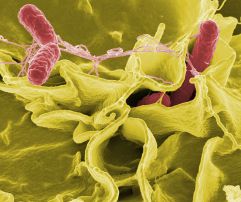
Image CDC Enter a caption

The aim of this study was to evaluate the effectiveness of bacteriophage (phage) SLMP1 to reduce Salmonella Typhimurium on contaminated raw salmon fillets and scallop adductors as a function of Salmonella inoculum level, phage dose, storage temperature, and storage time. Samples were inoculated with 102 and 104 CFU/g Salmonella and then treated with different concentrations of phage SLMP1, followed by incubation at 4, 15, and 25°C, respectively. The results showed that 108 PFU/g was the optimal concentration of phage for the control of Salmonella, which was applied in the following storage experiments over a 7-day period at 4°C, a 4-day period at 15°C, and a 2-day period at 25°C. For the salmon fillets samples, 102 CFU/g Salmonella could be reduced below the detection limit at all three temperatures, whereas 104 CFU/g Salmonella was first decreased and then increased at 15 and 25°C. For the scallop adductors samples, 102 CFU/g Salmonella could be reduced below the detection limit first and then increased after a certain period at 15 and 25°C. The variation trends of 104 CFU/g Salmonella in scallop adductors were similar to those in salmon fillets. The results also showed that the Salmonella counts of both inoculum levels on samples could be reduced below the detection limit or maintained at a low level by phage SLMP1 during storage at 4°C. Phage SLMP1 remained stable on raw salmon fillets and scallop adductors. This study indicated that phage SLMP1 has potential effectiveness as a biocontrol agent of Salmonella in seafood.

Research -Antibacterial Effect of Essential Oils against Spoilage Bacteria from Vacuum-Packed Cooked Cured Sausages

Journal of Food Protection

Nonfermented sausages, which have a pH of around 6.0, a low salt concentration, and high moisture with a water activity higher than 0.95, are highly perishable. In this study, culture-dependent techniques and 16S rDNA approaches were used to identify the presumptive spoilage lactic acid bacteria (LAB) in sliced vacuum-packed cooked sausage during storage at 4°C. The antibacterial properties of essential oils (EOs) from the medicinal plants Carum carvi, Cinnamomum zeylanicum, Curcuma longa, Citrus medica, and Eugenia caryophyllata against isolated LAB were also investigated. A total of 106 colonies were obtained on de Man Rogosa Sharpe medium after storage of sausages samples, and 16 isolates were identified from conventional morphological analysis of the bacterial populations. DNA extraction and 16S rDNA analysis indicated that Lactobacillus curvatus, Weissella viridescens, Leuconostoc mesenteroides, Enterococcus faecium, Lactobacillus reuteri, Lactobacillus dextrinicus, Lactobacillus sakei, and Pediococcus dextrinicus were the main spoilage LAB. The antibacterial properties of EOs against isolated LAB were indicated by inhibition zones on culture plates of 7.8 to 31 mm, depending on the susceptibility of the tested LAB strain. The MICs and MBCs of five EOs were determined. The most effective EO against the LAB was C. zeylanicum followed by C. carvi and C. medica, and the least effective EO was C. longa. The EO from C. zeylanicum had the highest antimicrobial activity (lowest MICs) against LAB, with EO MICs of 4.66 to 5.33 μL/mL. The most susceptible isolate was L. mesenteroides, with a MIC of 4.66 μL/mL for the C. zeylanicum EO. These data indicate that the EO from C. zeylanicum could be used as a natural preservative for vacuum-packed emulsion‐type sausage.

Research – Safety assessment and microbiological quality of homemade soy‐cheese in Nigeria

Wiley Online Library

Abstract

Fermented soy‐cheese is a popularly consumed food product in Nigeria. Its’ production is typically homemade, though it is generally retailed for commercial purpose. To investigate the microbiological quality and possible factors contributing to contamination at each phase of its’ production, soy‐beans, soy‐milk, and the resultant soy‐cheese were subjected to standard microbiological analyses. Candida sake and Saccharomyces cerevisiae were identified in soy‐milk and soy‐cheese. Raw materials and equipment were identified as sources of contamination. Presence of Staphylococcus spp. and Salmonella spp. were reported in the soy‐bean and soy‐milk. The occurrence of pathogen‐indicating microorganisms was observed in all the production stages. Hence, the consumption of freshly prepared soy‐cheese may not be encouraged except proper handling practices are incorporated during its’ production process. This calls for sensitization and training of local producers to curb possible outbreak of foodborne disease.

Practical applications

Microbiological analyses of soy‐cheese production process will help to recognize possible points of contamination. This will also help food safety/health organizations in educating small scale industries as well as home‐based soy‐cheese producers on the production phase(s) that could be nodes of contamination. Additionally, proper hygiene practices during handling could prevent possible outbreak of foodborne disease(s) through the consumption of such products.

RASFF Alertss -Aflatoxin -Groundnuts – Hazlenuts – Almonds -Pistachios – Dried Figs –

kswfoodworld food safety poisoning

RASFF -aflatoxins (B1 = >24; Tot. = >24 µg/kg – ppb) in shelled groundnuts from China in Spain

RASFF -aflatoxins (B1 = 13; Tot. = 14.9 µg/kg – ppb) in shelled hazelnuts from Turkey in Italy

RASFF-aflatoxins (B1 = 39; Tot. = 42.7 µg/kg – ppb) in shelled almonds from the United States in Italy

RASFF -aflatoxins (B1 = 15.2; Tot. = 17.2 µg/kg – ppb) in organic hazelnut kernels from Turkey in Italy

RASFF -aflatoxins (B1 = 3.61 µg/kg – ppb) in basmati rice from unknown origin, via the United Kingdom in Germany

RASFF-aflatoxins (B1 = 14; Tot. = 44 µg/kg – ppb) in unshelled pistachios from Iran, via Turkey in Portugal

RASFF-aflatoxins (B1 = 14.8; Tot. = 19.9 µg/kg – ppb) in diced dried figs from Turkey in France

RASFF-aflatoxins (B1 = 10.3; Tot. > 24 / B1 = 4.8; Tot. = 5.7 µg/kg – ppb) in groundnuts from China in Spain

RASFF-aflatoxins (B1 = 15.5; Tot. = 17.8 µg/kg – ppb) in pistachios from the United States in Belgium

RASFF Aletrt – Norovirus – Live Oysters

kswfoodworld food safety poisoning

RASFF -norovirus (GI /2g) in live oysters (Crassostrea gigas) from France in Italy

RASFF alert – Campylobacter -Chilled Chicken Meat

kswfoodworld food safety poisoning

RASFF -Campylobacter jejuni (between 1700 and 43000 CFU/g) in chilled chicken meat from Poland in Denmark