Category Archives: Salmonella

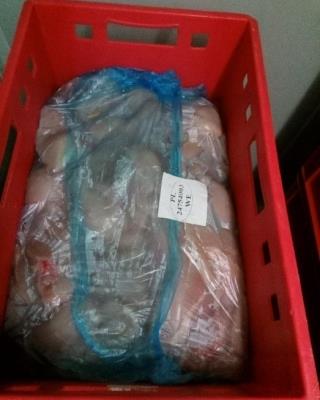
Czech Republic – Chilled chicken breast fillet – Salmonella

Potravinynapranyri

Illustration photo no. 1

Place of inspection:
Cesky Tesin ( Hrabinska 1930 / 28b, 73701 Cesky Tesin )
Company ID: 02179440
Food group: Meat and meat products Unpacked: meat, minced meat, meat preparations

Chilled chicken breast fillet
Category: Dangerous food
Unsatisfactory parameter:

Salmonella enterica serum. Enteritidis

The pathogenic bacterium Salmonella enterica serum was detected in chilled chicken breasts Enteritidis , which can cause a condition called salmonellosis.

Expiration date: 5/23/2021
Producer: PPHU Pawel Kaczorek Zaklad Rozbioru Drobiu, 42-500 Bedzin, Zawale 22, PL 24754003
Distributor: Kama trade CZ – re-dispatch meat warehouse
Country of origin:  Poland
Date of sampling: May 20, 2021
Reference number: 21-000019-SVS-CZ
The sample was found by official inspection of the State Veterinary Administration

UK – Almost half the adults (46%) who cook coated frozen chicken products do not always check cooking instructions on packaging before cooking

FSA

The Food Standards Agency (FSA), Food Standards Scotland (FSS) with Ipsos MORI have published a survey of consumer practices relating to coated frozen chicken products.

This survey identifies behaviours which could increase people’s risk to foodborne disease. It was commissioned as a result of a Salmonella incident linked to frozen chicken products such as nuggets, goujons, dippers, poppers and kievs. While these products may appear cooked on the outside, they often contain raw chicken and so they must be cooked thoroughly to help kill Salmonella bacteria.

Findings show that two thirds of adults aged 16-75 (67%) say they have recently cooked or eaten coated frozen chicken products at home. These products are particularly popular with younger adults, with 88% of those aged 16-24 having recently consumed them or cooked them at home. Participants were also more likely to have cooked or eaten these products if they have children aged 15 or under in their household (86%).

The survey also included questions on the storage and handling of these products pre and post-cooking:

  • Almost two thirds of those who cook these products (62%) say uncooked coated frozen chicken products at least sometimes come into contact with other surfaces such as worktops and plates
  • Over half of those who cook these products (58%) say they always wash their hands after handling coated frozen chicken products
  • Almost a quarter of consumers who personally cook products say they defrost them before cooking (23%), 62% say they do not. Among those who defrost products, half say they leave them at room temperature (53%)

Most participants who use an oven to cook coated frozen chicken products say they sometimes cook them together with other products, such as chips or vegetables (84%). Cooking these chicken products at a lower temperature or for a shorter time than advised may mean they are not thoroughly cooked before serving.

Narriman Looch, Head of Animal Feed and Foodborne Disease Control Branch said: ‘It’s important to understand that frozen chicken products often contain raw chicken, even though they may look pre-cooked on the outside. While additional measures have been put in place by food businesses to improve the safety of these products, consumers need to handle these products as they should other raw meat products. Cooking food at the right temperature and for the right amount of time will kill any Salmonella bacteria that may be in food. Therefore, we are urging consumers to follow cooking instructions for these products to protect themselves and their families.’

Food safety tips for frozen breaded chicken products:

  • Treat these products as raw chicken, ensuring they are steaming hot after cooking and surfaces they have touched are cleaned to avoid the spread of bacteria
  • Make sure the oven is up to temperature before cooking
  • Check the instructions on packaging and cook at the correct temperature and for the time stated
  • Wash your hands, utensils and clean surfaces after handling these products
  • If products require defrosting, follow the storage instructions on packaging and always defrost in the fridge

About this poll

The FSA and FSS commissioned an online survey via three waves of Ipsos MORI’s online omnibus of 5,599 adults (aged 16-75) living in the UK. Of these 3,740 had cooked or eaten coated frozen chicken products recently and went on to complete the full survey. The data was weighted to be representative of the UK adult population aged 16 – 75.

The full report is available in the research section of our website.

About the outbreak

FSA and FSS are continuing to work with Public Health England (PHE) and devolved public health authorities as well as our international food safety partners, via the United Nations’ World Health Organization, (WHO) and the Food and Agriculture Organization’s (FAO’s) International Food Safety Network (INFOSAN), to address the causes of the outbreak at source to prevent further cases of Salmonella Enteritidis.

Between January 2020 and May 2021 there have been 511 cases of Salmonellosis in the UK caused by two strains of Salmonella Enteritidis and linked to consumption of frozen, raw, breaded chicken products.

Authorities in Poland and UK retailers have taken action to reduce the risk from these products. Where non-compliant or unsafe food has been identified by the UK, action has been taken to protect consumers.

USA – After U.S. recall, firm initiates nationwide Canadian recall of cat food because of Salmonella concerns

Food Safety News

Natural Balance Pet Foods Inc. is recalling certain cat food products in Canada because of possible Salmonella contamination, which can be dangerous to pets and people who handle the food.

The company reported that 378 units of the affected product were sold in Canada from February to April 2021.

As of June 2, the company had not received any reports of illness, complaints or injuries in Canada.

The products are the same that were recalled in the United States in May.

In the U.S. the issue was found by the Minnesota Department of Agriculture during a routine state surveillance sample.

Norway – Handling of Salmonella in EU-EEA beef and pork (traded)

Mattilsynet

In the winter and spring of 2021, several Salmonella finds were made in meat from Germany. On the basis of this, in 2021 the Norwegian Food Safety Authority will prioritize inspections of establishments that handle meat from EU / EEA countries (traded meat). The Norwegian Food Safety Authority will require the company to be able to verify that consignments of traded meat meet the conditions in the salmonella guarantee.

Companies in Norway must be able to verify that consignments of traded meat from EU / EEA countries meet the conditions in the Animal Hygiene Regulations (salmonella guarantee). This can be done by either referring to good enough historical documentation about the shipping business abroad, or increasing the sampling of traded meat in Norway.

Read more about Salmonella, what requirements the Norwegian Food Safety Authority places on companies that use processed meat, and how the Norwegian Food Safety Authority will follow this up, here: Handling of Salmonella in beef and pork from the EU / EEA (traded)

The Norwegian Food Safety Authority has, among other things, accelerated an already planned inspection of companies that import meat from EU / EEA countries.

Italy – Salame Campagnolo 150g – Salmonella

Salute

Brand : Produced for Penny Market

Name : Salame Campagnolo 150g

Reason for reporting : Recall due to microbiological risk

Publication date : 18 June 2021

Documentation

Documentation

USA – Possible Salmonella Outbreak at Don Julio in North Branch, Minnesota

Food Poisoning Bulletin

A possible Salmonella outbreak at Don Julio restaurant in North Branch, Minnesota is being investigated by the Minnesota Department of Health, according to Information Officer Doug Schultz. He told Food Poisoning Bulletin that officials are investigating Salmonella cases that reported eating at that restaurant. Mr. Schultz added that there is not a risk to the general public from this outbreak.

Because the investigation is new and ongoing, there is no information about the number of patients, any hospitalizations, illness onset dates, the patient age range, or if the investigation is focusing on food or employees.

Belgium – Chinese dumplings “Chinese dumpling filled with pork and dill” from the Freshasia Dumplings brand (frozen product) – Salmonella

AFSCA

Communication from the AFSCA
Product: Chinese dumplings “Chinese dumpling filled with pork and dill” from the Freshasia Dumplings brand (frozen product).
Problem: possible presence of Salmonella.


The AFSCA is today recalling consumers of Chinese dumplings “Chinese dumpling filled with pork and dill” from the Freshasia Dumplings brand.

This recall follows a notification via the RASFF system (European Food and Feed Rapid Alert System) concerning the possible presence of Salmonella.

It was therefore decided to withdraw this product from sale and to recall it to consumers.
The AFSCA asks not to consume it and to bring it back to the point of sale where it was purchased.

Product description Product

category: Chinese dumplings (frozen) Product
name: Chinese dumplings “Chinese dumpling filled with pork and dill”
Brand: Freshasia Dumplings Best before
date (DDM): 04/07/2020
Content: 400g

This product has been sold in Belgium via:

– Asia Century BV (Asia & More, Aarschotsesteenweg 92 – 3012 Wilsele)
– Kam Yuen Supermarket NV (rue de La Vierge Noire 2-4 – 1000 Brussels)

For any further information, you can contact the AFSCA contact point for consumers: 0800 / 13.550 or pointdecontact@afsca.be .

RASFF Alerts – Salmonella – Polish Chicken – Curry Black Pepper – Fish Gourami – Minced Beef – Dried Oregano – Chicken Soup Mix

RASFF

Salmonella Enteritidis in official samples of chicken neck skins from Poland in Spain and France

RASFF

Salmonella Infantis in frozen fish (Gourami) from Vietnam in Norway

RASFF

Salmonella Enteritidis in chicken neck skins from Poland in Poland and France

RASFF

Salmonella Enteritidis and Salmonella group C (O:8) in official samples of chicken neck skins from Poland in France

RASFF

Salmonella in minced beef from Germany in the Netherlands

RASFF

Salmonella infantis incarne di pollame proveniente dalla Polonia//Salmonella infantis in frozen poultry meat from Poland in Italy

RASFF

Salmonella enteritidis in frozen chicken soup mix from Slovakia in Slovakia and Estonia

RASFF

Poultry meat skin from chicken necks salmonella -salmonella Salmonella Enteritidis from Poland in Poland and Lithuania

RASFF

Fresh poultry meat Salmonella enteritidis from Poland in Poland and Slovakia

RASFF

S. Javiana, S. Newport, S. Infantis in black pepper from Brazil in Germany

RASFF

Salmonella Rubislaw in black pepper from Brazil in Germany

RASFF

Salmonella Sandiego in black pepper from Brazil in Germany

RASFF

Salmonella enterica sér. Enteritidis in chilled chicken quarters from Poland in the Czech Republic

RASFF

Salmonella Infantis in fresh chicken broiler quarters from Poland in Lithuania

RASFF

Salmonella enterica ser. Infantis (in 1 out of 5 samples /25g) in chilled chicken breasts from Poland in the Czech Republic

RASFF

Salmonella Mbandaka in dried oregano from Chile in Germany and Sweden

RASFF

Salmonella in Curry from Turkey in Austria and Hungary

RASFF Alerts – Animal Feed – Salmonella – Meat Meal – Poultry Meal – Feed Material

RASFF

Salmonella in meat meal for pet food from Austria in Italy

RASFF

Salmonella enterica ser. anatum and Salmonella enterica ser. Infantis in poultry meal from the United Kingdom in Belgium and the Netherlands

RASFF

Salmonella Typhimurium in feed material from Belgium in the UK

Italy – Homemade Sweet Sausage Recall – Salmonella

Salute

Brand : De Luca Srl

Name : Homemade Sweet Sausage

Reason for reporting : Recall due to microbiological risk

Publication date : June 17, 2021

Documentation

Documentation