EXECUTIVE SUMMARY
The Drinking Water Quality Regulator for Scotland (DWQR) ensures that local authorities are meeting their regulatory duties in regard to the quality of private water supplies. DWQR also regulates the quality of water supplied by Scottish Water. The role of DWQR was created by the Water Industry (Scotland) Act 2002 (“the Act”), which gives the Regulator powers to obtain information. This report fulfils the requirement under the Act that the DWQR publishes a report
on the exercise of the Regulator’s functions during the previous year. This report relates to the calendar year 2019 and is for private water supplies. A similar report on the quality of water supplied by Scottish Water was published on Monday 10 August 2020. Private water supplies (PWS) are drinking water supplies that are not the responsibility of Scottish Water but of their owners and users. PWS regulations are enforced by local authorities. The regulations were revised in October 2017, bringing into force The Water Intended for
Human Consumption (Private Supplies) (Scotland) Regulations 2017 (“the 2017 regulations”). These cover large domestic or commercial supplies. Smaller household PWS (referred to as Type B supplies) continue to be governed by The Private Water Supplies (Scotland) Regulations 2006 (“the 2006 regulations”).
727 tied to Fresh Express bagged salads – 412 sick from unknown product.
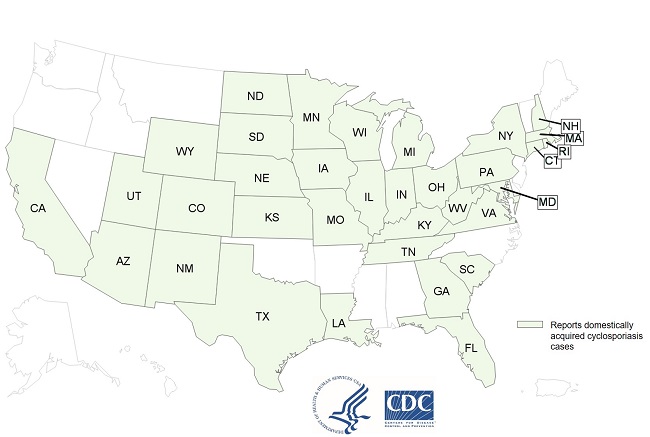
As of August 26, 2020, 1,102 laboratory-confirmed cases of cyclosporiasis in people who had no history of international travel during the 14-day period before illness onset have been reported to CDC by 35 jurisdictions, including 34 states and New York City, since May 1, 2020.
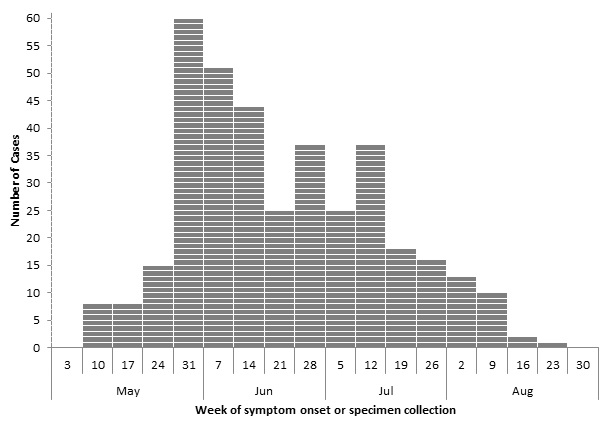
The median illness onset date is June 11, 2020 (range: May 1–August 15, 2020). At least 78 people have been hospitalized; no deaths have been reported.
In Canada, as of July 8, 2020, there are 37 confirmed cases of Cyclospora illness linked to this outbreak in three provinces: Ontario (26), Quebec (10) and Newfoundland and Labrador (1). Individuals became sick between mid-May and mid-June 2020. One individual has been hospitalized. No deaths have been reported. Individuals who became ill are between 21 and 70 years of age. The majority of cases (76%) are female.
The outbreak of parasitic infections linked to Fresh Express bagged salad mix has grown by 49 new laboratory-confirmed cases of Cyclospora, upping the total to 690 people, up from 641.
The latest report is current as of Aug. 12, 2020, and it updates the previous report of July 24, 2020.
Laboratory-confirmed Cyclospora infections associated with this outbreak have been reported from 13 states: Georgia (1), Illinois (209), Iowa (206), Kansas (5), Massachusetts (1), Minnesota (86), Missouri (57) Nebraska (55), North Dakota (6), Ohio (4), Pennsylvania (2), South Dakota (13), and Wisconsin (45). The ill person from Georgia purchased and ate a bagged salad product while traveling in Missouri.
Eighty-two individuals in Texas got sick after suffering from cyclosporiasis, a parasitic infection that causes a range of symptoms.
The Centers for Disease Control and Prevention (CDC) stated that cyclosporiasis is an illness caused by a microscopic parasite. Fox News reports that the symptoms of this infection include diarrhoea, frequent bowel movements, loss of appetite, bloating, weight loss, stomach cramps, fatigue, and nausea. These symptoms can take up to a week to appear following an infection.
The most common source of the parasite is water or food contaminated by feces. However, public health officials in Austin, Texas are still trying to find out where the intestinal illness came from, which affected Austin-Travis County.
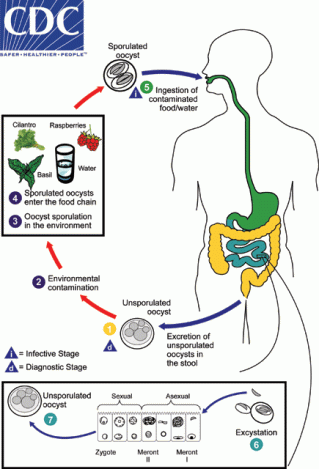
Health officials stated that previously, the source of such an outbreak would either be fruits or vegetables. The most common food sources include basil, cilantro, onions, and raspberries.
In July, the CDC warned multiple states of a cyclospora outbreak from bagged salads. However, Texas was not included in the list.
Toxoplasma gondii is a globally important zoonotic parasite ranked as one of the most significant causes of disease burden among the major foodborne pathogens. Consumption of undercooked meat is a well-known risk factor for infection so the aim of this study was to investigate the presence of T. gondii in meat samples from retail outlets in Scotland. In Sampling Period 1, 300 meat samples (39 beef, 21 chicken, 87 lamb, 71 pork and 82 venison) were purchased from butchers’, farmers’ markets, farm shops and supermarkets, and in Sampling Period 2, 67 pure venison samples only were purchased from farmers’ markets, farm shops and supermarkets. DNA was extracted and screened for T. gondii using a quantitative PCR targeting the 529 bp repeat element, and any positive samples were genotyped using PCR-RFLP targeting 10 markers. Meat juice was screened for T. gondii antibodies using a commercial ELISA or modified agglutination assay. Toxoplasma gondii DNA was detected in 0/39 (0%) beef samples, 1/21 (4.8%) chicken samples, 6/87 (6.9%) lamb samples, 3/71 (4.2%) pork samples and 29/82 (35.4%; Sampling Period 1) and 19/67 (28.4%; Sampling Period 2) venison samples. Partial PCR-RFLP genotyping revealed both clonal and non-clonal genotypes. Antibodies to T. gondii were detected in the meat juice of 2/38 (5.3%) beef samples, 3/21 (14.3%) chicken samples, 14/85 (16.5%) lamb samples, 2/68 (2.9%) pork samples and 11/78 (14.1%; Sampling Period 1) and 8/50 (16%; Sampling Period 2) venison samples. This is the first study to report the presence of T. gondii in retail meat products in Scotland and has highlighted venison as a potentially high risk meat. Further work is required to determine viability of parasites in this particular meat product.
More than 640 people in 11 US states have been diagnosed with Cyclospora, with the outbreak possibly related to bagged salad products. The bagged salads included iceberg lettuce, red cabbage, and carrots. Symptoms of cyclosporiasis, a disease caused by a microscopic parasite, include lack of appetite and weight loss, bloating, nausea, low-grade fever, weakness, and diarrhea. Cases have been recorded in almost a dozen states between May and this month. Of those infected with the multi-state outbreak of Cyclospora, 37 were hospitalized, the Food and Drug Administration said. There were no confirmed deaths.
The outbreak is being investigated by the FDA, the CDC, and the state and local authorities. Cyclospora infections may be linked to salad products manufactured by Fresh Express containing iceberg lettuce, red cabbage, and carrots and distributed in several regions of the United States.
Cyclospora, officially known as Cyclospora cayetanensis, is a type of parasite which uses the human gut as its host. The parasite enters the human body by being ingested with fresh fruits, vegetables, or water, at which point the parasite begins to live and multiply in the gut.
The U.S. Food and Drug Administration’s (FDA) reports that the investigation of the Fresh Express Bagged Salad Cyclospora Outbreak continues, as the CDC reports increasingly greater numbers of confirmed cases of infection. The last investigation report published by the FDA concerning the Fresh Express Cyclospora Outbreak, on June 28, 2020, accounted for 206 confirmed cases of Cyclospora infection. As of July 8, 2020, the FDA announced that the number of confirmed cases have jumped to a total of 509, across 8 states. Furthermore, health officials report that the outbreak has even stretched across the borders of the U.S. to three provinces of Canada, Ontario (26), Quebec (10) and Newfoundland and Labrador (1).
A troublesome Cyclospora outbreak continues to grow in North America with 37 confirmed cases in Canada added to 206 in the midwest United States. Cyclospora is a coccidian parasite that causes diarrheal disease in humans called cyclosporiasis.
The update today involves an outbreak of Cyclospora infections traced to Fresh Express bagged garden salad products containing lettuce, carrots, and red cabbage.
As of July 8 there are 37 confirmed cases of Cyclospora illness linked to this outbreak in three Canadian provinces: Ontario (26), Quebec (10) and Newfoundland and Labrador (1). Canadians became sick between mid-May and mid-June. One Canadian has been hospitalized. No deaths have been reported. Individuals who became ill are between 21 and 70 years of age. The majority of cases, 76 percent, are female.
The Public Health Agency of Canada (PHAC) is collaborating with provincial public health partners, the Canadian Food Inspection Agency (CFIA) and Health Canada to investigate an outbreak of Cyclospora infections occurring in three provinces. The outbreak appears to be ongoing, as recent illnesses continue to be reported to PHAC.
Based on the investigation findings to date, exposure to certain Fresh Express brand salad products containing iceberg lettuce, carrots and red cabbage, has been identified as a likely source of the outbreak. Some of the individuals who became sick reported having eaten Fresh Express brand salad products containing these ingredients before their illnesses occurred. The source of illness for the remaining individuals continues to be under investigation. The investigation is ongoing and this public health notice will be updated as the investigation evolves.
On June 28, 2020, the CFIA issued a food recall warning for certain Fresh Express brand salad products containing iceberg lettuce, carrots and red cabbage that were distributed nationally in Canada. The recalled salad products begin with lot code “Z177” or a lower number and have best before dates up to and including 20JUL08 – 20JUL14. For more information on the recalled product, please consult the CFIA’s website.
Canadians are advised not to eat the recalled products. Retailers and food service establishments are advised not to sell or serve the recalled products, or any items that may have been prepared or produced using these products.
The CFIA is continuing its food safety investigation, which may lead to the recall of other products. If additional products are recalled, the CFIA will notify the public through updated food recall warnings.
The U.S. Centers for Disease Control and Prevention and the U.S. Food and Drug Administration are also investigating a multi-state outbreak of Cyclospora infections that has been linked to bagged salad mixes containing iceberg lettuce, carrots, and red cabbage produced by Fresh Express.
Investigation summary
As of July 8, 2020, there are 37 confirmed cases of Cyclospora illness linked to this outbreak in three provinces: Ontario (26), Quebec (10) and Newfoundland and Labrador (1). Individuals became sick between mid-May and mid-June 2020. One individual has been hospitalized. No deaths have been reported. Individuals who became ill are between 21 and 70 years of age. The majority of cases (76%) are female.
Some of the individuals who became sick reported having eaten certain Fresh Express brand salad products containing iceberg lettuce, red cabbage and carrots before their illnesses occurred. The source of illness for the remaining individuals continues to be under investigation.
Cyclospora infections occur each summer in Canada. PHAC is working with provincial partners to determine if other recent cases of Cyclospora infection are linked to this outbreak.
It is possible that more recent illnesses may be reported in the outbreak because of the period between when a person becomes ill and when the illness is reported to public health officials. For this outbreak, the illness reporting period is between two and four weeks.
Epidemiological information
Figure 1 below is an epidemiological curve for this outbreak. Outbreak investigators use this information to show when illnesses begin, when they peak, and when they trail off. It can take several weeks from the time a person becomes ill to when the illness is reported and testing confirms a link to the outbreak. Data are available for 37 cases.
Figure 1: Number of people infected with Cyclospora



 FoodWorld