Category Archives: Microbiology

Research – Antibiotic Resitant Bacteria in Meats in the USA – E.coli Use Flagella as Anchors

Food Poisoning Bulletin

An analysis by the Environmental Working Group has found that antibiotic-resistant bacteria are common on meat for sale in American supermarkets. A government study published on February 5, 2012 without fanfare found that 81% of ground turkey, 69% of pork chops, 55% of ground beef, and 39% of chicken carried antibiotic-resistant bacteria.

The study, published by the National Antimicrobial Resistance Monitoring System (NARMS), which is a joint project by the FDA, CDC and USDA, found that the meat samples collected in 2011 harbored “significant amounts” of superbug versions of Salmonella and Campylobacter. Those two bacteria cause 3.6 million cases of foodborne illness every year in the United States.

In addition, 53% of raw chicken samples carried an antibiotic-resistant strain of E. coli, the bacteria found in feces. And the antibiotic resistance is growing fast. Of all Salmonella bacteria found on raw chicken in 2011, 74% were antibiotic resistant, compared to less than 50% in 2002.

Food Poisoning Bulletin

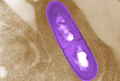
Flagella aren’t just for swimming. For E.coli, these long tails that propel them through liquid, also function as anchors, establishing a hold on surfaces that allow the bacteria to settle in and colonize, according to a new study from Harvard researchers.

“We demonstrate that flagella are able to reach into crevices, access additional surface area, and produce a dense, fibrous network,’” the researchers say in the abstract for the  study which was published in Proceedings of the National Academy of Sciences (PNAS) on March 18. The findings could lead to improved design of surfaces used in health care and food manufacturing settings.

RASFF Alerts – Aflatoxins – Groundnuts – Dried Figs – Pistachios

RASFF – Aflatoxins (B1 = 9.8; Tot. = 11.9 µg/kg – ppb) in groundnut kernels from India, via the Netherlands in Germany

RASFF – Aflatoxins (B1 = 10; Tot. = 10 µg/kg – ppb) in dried figs from Turkey in Denmark

RASFF – Aflatoxins (B1 = 21.0; Tot. = 23.2 / B1 = 8.5; Tot. = 19.5 µg/kg – ppb) in shelled pistachios from Turkey in Spain

RASFF – Aflatoxins (B1 = 4.7 µg/kg – ppb) in groundnuts from China in the Netherlands

RASFF – Aflatoxins (B1 = 12; Tot. = 31 µg/kg – ppb) in pistachios from Turkey in the Netherlands

RASFF – Aflatoxins (B1 = 16 µg/kg – ppb) in groundnuts from China in the Netherlands

RASFF – Aflatoxins (B1 = 5.3 µg/kg – ppb) in groundnuts from the United States in the Netherlands

RASFF – Ochratoxin – Dried Fruits – Sultanas – Nutmeg – Raisins – Paprika

RASFF – Ochratoxin A (99 µg/kg – ppb) in dried fruits from Afghanistan in Bulgaria

RASFF – Ochratoxin A (150 µg/kg – ppb) in sultanas from Afghanistan in Spain

RASFF – Ochratoxin A (105 µg/kg – ppb) in ground nutmeg from the Netherlands in Germany

RASFF – Ochratoxin A (12.9 µg/kg – ppb) in raisins from Turkey in Germany

RASFF – Ochratoxin A (49.44 µg/kg – ppb) in paprika powder from the Czech Republic, with raw material from Spain in Czech Republic


RASFF Alert – Norovirus – Oysters

RASFF – Norovirus (GII) in oysters from France in Italy

RASFF Alerts – Salmonella – Chicken – Sausages – Beef – Red Onions – Paan Leaves

RASFF – Salmonella (presence /25g) in frozen salted chicken breast fillets from Brazil in the Netherlands

RASFF – Salmonella typhimurium (presence /25g) in frozen beef trimmings from Poland, via Germany in Sweden

RASFF – Salmonella Minnesota (presence /25g) in frozen chicken (Gallus gallus) from Brazil in Spain

RASFF – Salmonella Derby (presence /25g) in sausages from Italy

RASFF – Salmonella (presence /25g) in dehydrated red onions from the United Kingdom in Belgium

RASFF – Salmonella spp. (present /25g) in paan leaves from Sri Lanka in the UK

RASFF Alerts – E.coli and STEC E.coli – Beef – Basil – Mussels

RASFF – Shigatoxin-producing Escherichia coli in beef fillets from Argentina in Germany

RASFF – High count of Escherichia coli (30000/9000/24000/10000/33000 CFU/g) in fresh sweet basil from Cambodia in Norway

RASFF – Too high count of Escherichia coli (7000/8000/10000/>150000/43000 CFU/g) in fresh sweet basil from Cambodia in Norway

RASFF – High count of Escherichia coli (>15000; >15000; 800; >15000; >15000 CFU/g) in fresh sweet basil from Cambodia in Norway

RASFF – Shigatoxin-producing Escherichia coli (presence /25g) in chilled boneless bovine meat from Brazil in tne Netherlands

RASFF – Shigatoxin-producing Escherichia coli (presence /25g) in chilled boneless beef meat from Argentina, via Germany in the Netherlands

RASFF – High count of Escherichia coli (1700 MPN/100g) in Mediterranean mussels (Mytilus galloprovincialis) from Spain in Italy

RASFF – Shigatoxin-producing Escherichia coli in chilled boneless beef from Uruguay in Germany

RASFF – High count of Escherichia coli (620<=>4400 CFU/g) in basil leaves from Cambodia in Norway

USA – Fruit Juice Recall Patulin – Mould

Food Poisoning Bulletin

Wegmans is recalling two types of its store brand fruit juices because they contain an unacceptable level of patulin, which is a by-product of mold. Patulin is a mycotoxin produced by molds such as Penicillium, Aspergillus, and Byssochylamys. An ingredient used to make the juices is the problem. Patulin is not Penicillin and it is not a mold. It’s not likely that exposure to patin at the low levels found in the juice would cause any symptoms, but you should not consume it because in laboratory animals it can cause DNA damage and damage the immune and nervous systems.

Research- Contamination on Sprouts – Food Packaging

Food Poisoning BulletinEurofins

A study published int he April issue of the Journal of Food Science looked at seed disinfection treatments of sprouts. In the last few years, there have been several major foodborne illness outbreaks linked to raw sprouts, including an E. coli outbreak linked to clover sprouts served at Jimmy John’s restaurants that sickened 29 people in 11 states. And there were seven recalls of sprouts for pathogenic bacterial contamination.

Sprouts are problematic for several reasons. First, the bacteria can be encapsulated inside the seed, making it impervious to physical disinfection such as the application of calcium hypochlorite. And the seeds are sprouted in warm, moist conditions, which are ideal for bacterial growth.

The FDA released guidelines in 1999 designed to limit this problem, including growing seeds using good agricultural practices, conditioning and storing seed under sanitary conditions, following GMPs at sprouting facilities, applying a disinfection treatment just before sprouting, and in-process testing of spent sprout irrigation water for pathogens before the product enters commerce. While sproutbreaks declined after these guidelines were released, the treatments are variable and food poisoning cases continue.

The study examined chemical disinfection with 20000 ppm calcium hypochlorite, and found that it does reduce microbial load on seeds. But there is a high variability in efficacy. Increasing treatment time did not improve the microbial load, but reduced germination rate of seeds. Other chemicals have not been adequately tested.

Food Poisoning Bulletin

Researchers at Rensselaer Polytechnic Institute (RPI) have found a way to kill Listeria and other pathogens without chemicals or antibiotics. Building on a method they developed to coat medical equipment with an agent that can kill antibiotic-resistant Staphylococcus aureus (MRSA), the researchers added lytic enzymes to nanoparticles of food-safe silica and to starch nanoparticles commonly used in food packaging.

“In this study, we have identified a new strategy for selectively killing specific types of bacteria. Stable enzyme-based coatings or sprays could be used in food supply infrastructure—from picking equipment to packaging to preparation—to kill Listeria before anyone has a chance to get sick from it,” said Ravi Kane, RPI’s  P.K. Lashmet Professor of Chemical and Biological Engineering, in a statement. “What’s most exciting is that we can adapt this technology for all different kinds of harmful or deadly bacteria.”

USA – Extended Recall of Meats – Listeria monocytogenes

Food Poisoning Journallisteria-hp

Manda Packing Company, a Baker, La., establishment, is expanding its recall to include approximately 468,000 pounds of roast beef, ham, turkey breast, tasso pork, ham shanks, hog head cheese, corned beef, and pastrami due to possible contamination with Listeria monocytogenes, the U.S. Department of Agriculture’s Food Safety and Inspection Service (FSIS) announced today.

Malta – Salmonella Outbreak Petting Farm

HACCP Europa

MALTA – Salmonella has been detected in peacocks and turkeys section in the popular “Petting Farm” in Ta’ Qali. The salmonella was picked up through regular tests on the animals.

“Petting Farm” is situated on the southern part of the Ta’ Qali National Park. It covers a footprint of circa 11,600m2. It is newly opened recreation facilities which offer a great interaction experience with farm animals for children in a beautifully landscaped and relaxing environment.

The area has been quarantined and cordoned off immediately as soon as the animals tested positive for salmonella enteritidis.

This particular strain of the salmonella bacterium affects and infects poultry – especially chicken flocks, without causing visible disease, spreading rapidly. When passed on to humans, usually through consumption of uncooked meat or eggs and contaminated food, it causes symptoms such as abdominal cramps, diarrhoea, nausea, vomiting and fever.