Category Archives: Microbiology

USA – Salmonella and Hepatitis A Outbreak at Crow Wing County Jail in MN

Food Poisoning Bulletin

A Salmonella and Hepatitis A outbreak at the Crow Wing County Jail in Minnesota has been announced by the Crow Wing County Sheriff’s Office. The number of those sickened has not yet been released. We also do not know the ages of patients or whether or not anyone has been hospitalized.

USA – Legionnaire’s disease: More than 100 cases reported in North Carolina outbreak

Outbreak News Today 

The number of Legionnaires’ disease cases linked to the NC Mountain State Fair continues to grow at a quick pace.

According to North Carolina health officials, as of Tuesday, 116 total Legionella infections have been reported, including 109 cases of Legionnaires’ disease and seven cases of the less serious Pontiac fever.

One death has been reported.

Seventy-five of the cases were reported from two counties–Buncombe and Henderson.

Europe – Multi-country cluster of Listeria monocytogenes ST1247 in five EU countries

ECDC

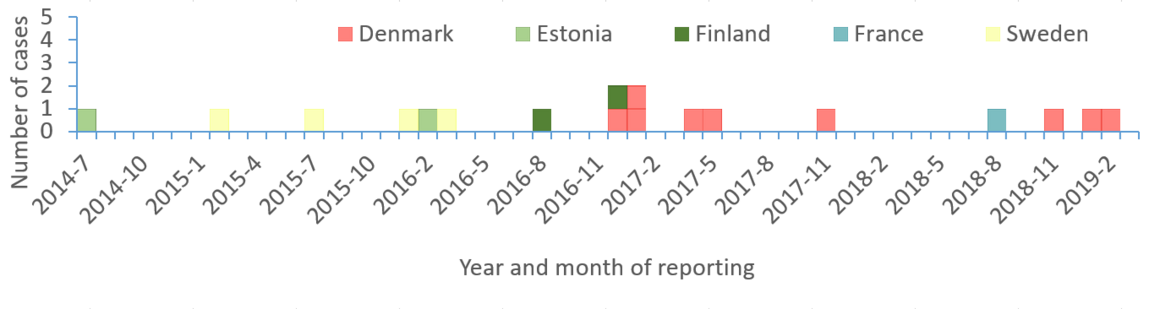
ECDC has identified a microbiological link between an outbreak of nine Listeria monocytogenes ST1247 cases in Denmark and nine additional cases reported between 2014 and 2018 in Estonia (2 cases) Finland (2), France (1) and Sweden (4).  In Denmark, the outbreak investigation is led by Statens Serum Institut (SSI), the Danish Veterinary and Food Administration and the DTU Food Institute.

Whole Genome Sequencing (WGS) analysis performed at the national level and by ECDC found all isolates from the 18 cases within two allelic differences from each other (core genome MLST using Moura scheme, 1540 of 1748 loci detected in all 18 isolates). The latest case was reported in Denmark in February 2019 (Figure 1).

Figure 1: Distribution of Listeria monocytogenes isolates by country and time of reporting 2014-2019 (n=18)

Figure 1: Distribution of Listeria monocytogenes isolates by country and time of reporting 2014-2019 (n=18)

A large-scale study led by ECDC on whole genome sequencing shows that most listeria outbreaks such as this one remain undetected. The study, published in 2018, suggests that more than half of the severe listeriosis cases in the European Union belong to clusters, many of which are not being picked up fast enough by the current surveillance system.

Listeria monocytogenes causes listeriosis, which primarily affects pregnant women, newborns, and adults with a weakened immune system. Listeriosis is a relatively rare but potentially severe food-borne disease that has been reported in increasing numbers in the EU/EEA countries since 2008. In 2016, 2 536 cases were reported, including 247 deaths.


RASFF Alerts – Animal Feed – Salmonella- Lamb Meal – Turkey Meat Meal – Rapeseed Meal

RASFF-Logo

RASFF – Salmonella (present /25g) in lamb meal from New Zealand in Belgium

RASFF – Salmonella (present /25g) in lamb meal from New Zealand in Belgium

RASFF – Salmonella enterica ser. Senftenberg (presence /25g) in turkey meat meal (processed animal protein) from Hungary in Hungary

RASFF – Salmonella (presence /25g) in rapeseed meal from Germany in Germany

RASFF – Salmonella (presence /25g) in rapeseed meal from Ukraine in Hungary

Research – Antifungal Activity of Selected Natural Preservatives against Aspergillus westerdijkiae and Penicillium verrucosum and the Interactions of These Preservatives with Food Components

Journal of Food Protection

ABSTRACT

The present study examined the influence of primary food components on the antifungal activity of the essential oil of Origanum vulgare, carvacrol, thymol, eugenol, and trans-cinnamaldehyde against Penicillium verrucosum and Aspergillus westerdijkiae. The MIC was determined in food model media enriched with proteins (1, 5, or 10%), carbohydrates (1, 4, or 6%), or oil (1, 5, or 10%). Proteins increased the antifungal activity of O. vulgare essential oil, carvacrol, thymol, and eugenol, whereas the effect of trans-cinnamaldehyde decreased with increasing protein content. The presence of carbohydrates diminished the inhibitory effect of the natural preservatives on A. westerdijkiae; for P. verrucosum, their inhibitory effect increased with carbohydrates. Only the antifungal activity of trans-cinnamaldehyde did not depend on the carbohydrate content. The presence of oil had the strongest influence. At a concentration of 1% oil, the antifungal activity decreased significantly, and at 10% oil, almost no inhibition was observed. To investigate the effect of the antifungal agents on the morphology of the target molds, they were grown on malt extract agar containing carvacrol and trans-cinnamaldehyde and were examined by scanning electron microscopy. The hyphae, conidiophores, vesicles, and phialides were severely altered and deformed, and spore formation was clearly suppressed.

HIGHLIGHTS
  • The antifungal activity of natural preservatives is influenced by the food matrix.

  • Proteins increase the impact of O. vulgare EO, carvacrol, thymol, and eugenol.

  • Carbohydrates diminish the inhibition of natural preservatives on A. westerdijkiae.

  • In the presence of oil, natural inhibitors lose their antifungal effect.

  • Carvacrol and trans-cinnamaldehyde lead to distorted hyphae and loss of sporulation.

Research – Inactivation of Listeria monocytogenes, Staphylococcus aureus, and Salmonella enterica under High Hydrostatic Pressure: A Quantitative Analysis of Existing Literature Data

Journal of Food Protection

ABSTRACT

High hydrostatic pressure processing (HPP) is a mild preservation technique, and its use for processing foods has been widely documented in the literature. However, very few quantitative synthesis studies have been conducted to gather and analyze bacterial inactivation data to identify the mechanisms of HPP-induced bacterial inactivation. The purpose of this study was to conduct a quantitative analysis of three-decimal reduction times (t3δ) from a large set of existing studies to determine the main influencing factors of HPP-induced inactivation of three foodborne pathogens (Listeria monocytogenes, Staphylococcus aureus, and Salmonella enterica) in various foods. Inactivation kinetics data sets from 1995 to 2017 were selected, and t3δ values were first estimated by using the nonlinear Weibull model. Bayesian inference was then used within a metaregression analysis to build and test several models and submodels. The best model (lowest error and most parsimonious) was a hierarchical mixed-effects model including pressure intensity, temperature, study, pH, species, and strain as explicative variables and significant factors. Values for t3δ and ZP associated with inactivation under HPP were estimated for each bacterial pathogen, with their associated variability. Interstudy variability explained most of the variability in t3δ values. Strain variability was also important and exceeded interstudy variability for S. aureus, which prevented the development of an overall model for this pathogen. Meta-analysis is not often used in food microbiology but was a valuable quantitative tool for modeling inactivation of L. monocytogenes and Salmonella in response to HPP treatment. Results of this study could be useful for refining quantitative assessment of the effects of HPP on vegetative foodborne pathogens or for more precisely designing costly and labor-intensive experiments with foodborne pathogens.

HIGHLIGHTS
  • A meta-analysis was performed to identify factors influencing HPP inactivation of pathogens.

  • Three-decimal reduction times following HPP were estimated from existing data.

  • Staphylococcus aureus is the most piezoresistant of the three pathogens studied.

  • These three foodborne pathogens are less HPP resistant in acidic products.

Research – Culture-Independent Evaluation of Bacterial Contamination Patterns on Pig Carcasses at a Commercial Slaughter Facility

Journal of Food Protection

ABSTRACT

Traditionally, the microbiological status of meat is determined by culture-based techniques, although many bacteria are not able to grow on conventional media. The aim of this study was to obtain quantitative data on total bacterial cell equivalents, as well as taxa-specific abundances, on carcass surfaces during pig slaughter using quantitative real-time PCR. We evaluated microbial contamination patterns of total bacteria, Campylobacter, Escherichia coli, Lactobacillus group, Listeria monocytogenes, Salmonella, and Pseudomonas species throughout slaughtering and on different carcass areas. In addition, we compared contamination levels of breeding sow carcasses with fattening pig carcasses, and we assessed the efficacy of carcass polishing machines under two water amount conditions. Our results demonstrate that relevant meat-spoilage organisms show similar contamination patterns to total bacteria. The highest bacterial load was detected in the stunning chute (4.08 × 10⁵ bacterial cell equivalents per cm2) but was reduced by 3 log levels after singeing and polishing (P < 0.001). It increased again significantly by a 4.73-fold change until the classification step. Levels of Campylobacter, Lactobacillus, and Pseudomonas species and of E. coli followed a similar trend but varied between 0 and 2.49 × 10⁴ bacterial cell equivalents per cm2. Microbial levels did not vary significantly between sampled carcass areas for any analyzed taxa. Running the polishing machine with a low water amount proved to be less prone to microbial recontamination compared with a high water amount (17.07-fold change, P = 0.024). In the studied slaughterhouse, slaughter of breeding sows did not produce microbiologically safe meat products (>104 cells per cm2) and the implementation of specific hazard analysis critical control point systems for the slaughter of breeding sows should be considered. A larger cohort from different abattoirs is needed to confirm our results and determine whether this is universally valid.

HIGHLIGHTS
  • Spoilage bacteria maintain consistent populations throughout slaughtering.

  • Greater water volume during polishing creates higher bacterial populations on carcasses.

  • Microbial populations on breeding sows are higher compared with fattening pigs.

Information – Washing poultry not worth the risk

Sabatha Herald Campylobacter kswfoodworld

The practice of washing or rinsing raw poultry can actually put you and others at a higher risk of foodborne illness. Quite simply, there’s no need to do this.

Participants in an observational study were observed in handling and preparation to see how bacteria moves from raw foods to other foods or surfaces. They were divided into a control group and a treatment group. Food safety messages were sent via email prior to observation sessions to learn how to effective those messages were in preparing chicken.

Some reasons consumers feel rinsing raw poultry is necessary is to remove blood/slime, because a family member said to do so, or it washes off the germs or bacteria. Most do this under the faucet with water running without any other container. Because of this, water splashes onto other items or food causing cross contamination. Then, many improperly washed their hands by not using water or soap, or did not rub their hands with soap at least 20 seconds. They also were ineffective at cleaning and sanitizing equipment and countertops.

Bottom line. There is no need to wash poultry or meat prior to cooking. Cooking to safe temperatures is the best and safest defense against foodborne illness. All poultry should reach 165 degrees Fahrenheit; ground meat should reach 160 degrees; and roasts, steak and chops should reach 145 degrees.

USA – Mavidon Issues Voluntary Worldwide Recall of LemonPrep® Tubes and Single Use Cups

FDA

LemonPrep tubes and cups

Company Announcement

Mavidon is voluntarily recalling 21 lots of LemonPrep® 4 ounce tubes and single use cups to user level. These products have been found to be contaminated with Burkholderia cepacia. The specific lots are listed below:

Product Product # Lot#
LemonPrep 4 oz Tubes MD0019-T 29824, 29901, 30006, 30145, 30236, 30352,
30675, 30729, 31138
LemonPrep Single Use Cups MD0019-SUP 29927, 30009, 30031, 30115, 30059, 30237,
30300, 30340, 30424, 30642, 30735, 31139

Burkholderia cepacia is a multi-drug resistant pathogenic microorganism. Contaminated products with Burkholderia cepacia can potentially result in serious infections, may be life-threatening for patients with compromised immune systems, such as neonates, elderly, pregnant women, cancer patients, but also in previously healthy individuals. To date, Mavidon has received one report of adverse event in a neonate related to this product in recall. Additional testing is ongoing to determine if there are other affected lots.

Research – Determination of Histamine in Japanese Spanish Mackerel (Scomberomorus niphonius) Meat Implicated in a Foodborne Poisoning

Journal of Food Protection

ABSTRACT

An incident of foodborne poisoning causing illness in seven victims due to ingestion of fried Japanese Spanish mackerel (JS mackerel; Scomberomorus niphonius) meat occurred in September 2014 in Hualien County, eastern Taiwan. Of the two suspected fish meats, one raw sample contained 3,318 ppm of histamine and one fried sample contained 1,906 ppm of histamine, levels which are greater than the potential hazard action level (500 ppm) in most illness cases. Given the allergy-like symptoms of the victims and the high histamine content in the suspected fish samples, this foodborne poisoning was strongly suspected to be caused by histamine intoxication. In addition, five histamine-producing bacterial strains isolated from suspected raw fish samples, capable of producing 152 to 1,020 ppm of histamine in Trypticase soy broth supplemented with 1.0% l-histidine, were identified as Hafnia alvei (one strain), Enterobacter aerogenes (two strains), Raoultella ornithinolytica (one strain), and Morganella morganii (one strain) by 16S rDNA sequencing with PCR amplification. Moreover, 12 raw fish samples and 39 fried fish samples from retail stores were collected and tested to determine the occurrence of histamine. Two of 12 commercial raw fish samples (16.7%) had histamine levels greater than the U.S. Food and Drug Administration guideline for decomposition of 50 ppm for scombroid fish or product or a combination of both. To our knowledge, this is the first report in Taiwan to demonstrate that the JS mackerel meat products could cause histamine intoxication.

HIGHLIGHTS
  • To our knowledge, this is the first report in Taiwan that JS mackerel causes histamine intoxication.

  • High histamine (>1,900 ppm) content found in both suspected fish samples.

  • Four prolific histamine-forming isolates produce >541 ppm of histamine in TSBH.

  • Higher levels of histamine, APC, TVBN, and coliforms found in some commercial fish samples.