Category Archives: Microbiological Risk Assessment

Ireland – Recall of Ballinwillin House Farm Venison, Wild Boar and Goat Minced Meat and Meat Preparations Due to Processing in an Establishment Not Approved for Production of Minced Meat or Meat Preparations

FSAI

Summary
Category 1: For Action
Alert Notification: 2021.23
Product: All products listed in the table below with an approval number of IE-2930-EC
Batch Code: All batch codes, all use by dates.
Country Of Origin: Ireland

Message:

All venison, wild boar and goat minced meat and meat preparations from Ballinwillin House Farm, Mitchelstown, Co. Cork are being recalled as they were processed in an establishment that is not approved for the production of minced meat or meat preparations. The products were produced without relevant HACCP based procedures and were not subject to official controls. See examples of some product labels below.

Action Required:

Manufacturers, wholesalers, distributors, caterers & retailers:

Retailers are requested to remove the implicated products from sale and to display a point-of-sale recall notice in stores where the affected products were sold.

Wholesalers/distributors are requested to contact their affected customers and recall the affected products and provide a point-of-sale recall notice to their retailer customers.

Caterers should not use the implicated products.

Consumers:

Consumers are advised not to eat the implicated products.

Ballinwillin House Farm Meat Products.JPG
Ballinwillin House Farm Example labels

Research – Short Wave Ultraviolet Light (UV-C) Effectiveness in the Inactivation of Bacterial Spores Inoculated in Turbid Suspensions and in Cloudy Apple Juice

MDPI

Liquid foods might present interferences in their optical properties that can reduce the effectiveness of short-wave ultraviolet radiation (UV-C) treatments used for sterilization purposes. The effect of turbidity as UV-C interference factor against the inactivation of bacterial spores was analysed by using phosphate-buffered saline solutions (PBS) of different turbidity values (2000, 2500, and 3000 NTU) which were adjusted with the addition of apple fibre. These suspensions were inoculated with spores of Bacillus subtilis and Alicyclobacillus acidoterrestris. While higher UV-C doses increased the inactivation rates of spores, these were reduced when turbidity values increased; a dose of 28.7 J/mL allowed inactivation rates of B. subtilis spores of 3.96 Log in a 2000-NTU suspension compared with 2.81 Log achieved in the 3000-NTU one. Spores of B. subtilis were more UV-C-resistant than A. acidoterrestris. Cloudy apple juice inoculated with A. acidoterrestris spores was processed by UV-C at different doses in a single pass and with recirculation of the matrix through the reactor. Inactivation increased significantly with recirculation, surpassing 5 Log after 125 J/mL compared with 0.13 Log inactivation after a single-pass treatment at the same UV-C dose. UV-C treatments with recirculation affected the optical properties (absorption coefficient at 254 nm and turbidity) of juice and increased browning as UV-C doses became higher.

Research – Hypo- and Hyper-Virulent Listeria monocytogenes Clones Persisting in Two Different Food Processing Plants of Central Italy

MDPI

A total of 66 Listeria monocytogenes ( Lm ) isolated from 2013 to 2018 in a small-scale meat processing plant and a dairy facility of Central Italy were studied. Whole Genome Sequencing and bioinformatics analysis were used to assess the genetic relationships between the strains and investigate persistence and virulence abilities. The biofilm forming-ability was assessed in vitro. Cluster analysis grouped the Lm from the meat plant into three main clusters: two of them, both belonging to CC9, persisted for years in the plant and one (CC121) was isolated in the last year of sampling. In the dairy facility, all the strains grouped in a CC2 four-year persistent cluster. All the studied strains carried multidrug efflux-pumps genetic determinants ( sugEmdrl , lde , norM , mepA ). CC121 also harbored the Tn 6188 specific for tolerance to Benzalkonium Chloride. Only CC9 and CC121 carried a Stress Survival Islet and presented high-level cadmium resistance genes ( cadA1C1 ) carried by different plasmids. They showed a greater biofilm production when compared with CC2. All the CC2 carried a full-length inlAwhile CC9 and CC121 presented a Premature Stop Codon mutation correlated with less virulence. The hypo-virulent clones CC9 and CC121 appeared the most adapted to food-processing environments; however, even the hyper-virulent clone CC2 warningly persisted for a long time. The identification of the main mechanisms promoting Lm persistence in a specific food processing plant is important to provide recommendations to Food Business Operators (FBOs) in order to remove or reduce resident Lm .

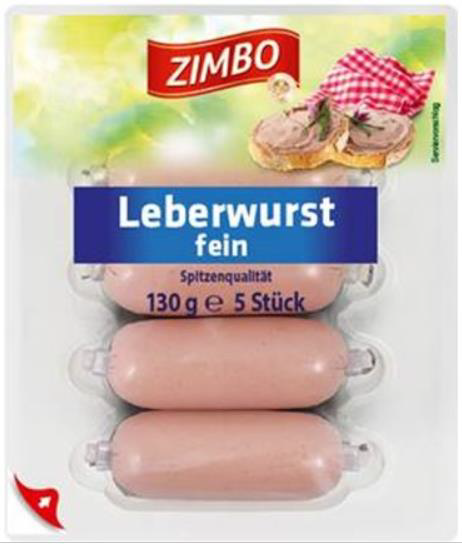
Germany – Zimbo liver sausage fine 130 g Distributed by Kaufland -Chill Chain Failure

LMW

Warning type:Food
Date of first publication:02/12/2021
Product name:Zimbo liver sausage fine 130 g Distributed by Kaufland
Product pictures:

Image.png

Press release

Manufacturer (distributor):Kaufland Service GmbH & Co. KG Neckarsulm
Reason for warning:

The cold chain of this food was interrupted for several days, so that the safety of the food is not guaranteed until the end of the best-before date.

Packaging Unit:130 g
Durability:with all best-before dates that were sold in our branches between February 5th and 10th, 2021.
Lot identification:

GTIN: 4006650017845

Further information:Reference is made to the company’s press release attached.
Contact to the responsible authorities:
Baden-Württemberg:poststelle@mlr.bwl.de
Bavaria:poststelle@lgl.bayern.de
Berlin:poststelle@senjustva.berlin.de
Brandenburg:Konsumenterschutz@Msgiv.Brandenburg.de
Bremen:Schnellwarnung@gesundheit.bremen.de
Hamburg:poststelle@justiz.hamburg.de
Hesse:Schnellwarnung@rpda.hessen.de
Mecklenburg-Western Pomerania:poststelle@lm.mv-regierung.de
Lower Saxony:poststelle@ml.niedersachsen.de
North Rhine-Westphalia:poststelle@mulnv.nrw.de
Rhineland-Palatinate:Poststelle.Referat22@lua.rlp.de
Saarland:poststelle-luv@lav.saarland.de
Saxony:poststelle@sms.sachsen.de
Saxony-Anhalt:poststelle@ms.sachsen-anhalt.de
Schleswig-Holstein:poststelle@jumi.landsh.de
Thuringia:LM-Ueberendung@tlv.thueringen.de

Research – Cross-Contamination on Atypical Surfaces and Venues in Food Service Environments

Journal of Food Protection

Cross-contamination of raw food to other surfaces, hands, and foods is a serious issue in foodservice.  With individuals eating more meals away from home, contracting a foodborne illness from a food service establishment is an increasing concern.  However, most studies have concentrated on hands or food contact surfaces and neglected atypical and unusual surfaces (surfaces that are not typically identified as a source of cross-contamination) and venues.  This review seeks to identify atypically cross-contaminated surfaces and atypical venues where cross-contamination could occur that have not been examined thoroughly in the literature.  Most surfaces that could be at risk for cross-contamination are frequently touched, rarely cleaned and sanitized, and can support the persistence and/or growth of foodborne pathogens.  These surfaces include, menus, spice and condiment containers, aprons and coveralls, mobile devices and tablets, and currency, among others.  Venues that are explored, temporary events, mobile vendors, and markets, are usually limited in space or infrastructure, have low compliance to proper handwashing, and provide the opportunity for raw and RTE foods to come into contact with one another. These factors all create an environment where cross-contamination can occur and potentially impact food safety.  A more comprehensive cleaning sanitizing regime encompassing these surfaces and venues could potentially help mitigate the cross-contamination described here.  This review highlights key surfaces and venues that have the potential to be cross-contaminated that have been underestimated in the past or are not fully explored in the literature.  These knowledge gaps demonstrate where further work is need to fully understand the role of these surfaces and venues in cross-contamination and how it can be prevented in the future.

USA – Mango Raspberry Cheesecake Smoothie Sour Ale Recalled For Safety

Food Poisoning Bulletin

Oakshire Brewing is voluntarily recalling the January 16, 2021 release of Theme From the Bottom Mango Raspberry Cheesecake Smoothie Sour Ale because there are visible signs of refermentation in some of the cans, making them bulge and they may burst. The beer does not meet Oakshire’s quality standards so they are issuing the recall.

USA – Feds plan to begin testing research program with romaine lettuce in Arizona

Food Safety News

The FDA is launching a new, temporary testing program for the romaine lettuce from commercial coolers in the Yuma, AZ, growing region. Romaine from the area has been linked to several foodborne illness outbreaks in recent years.

Samples will be tested for Shiga toxin-producing Escherichia coli (STEC) and Salmonella spp. as part of ongoing surveillance efforts following the spring 2018 multistate E. coli O157:H7 outbreak of foodborne illness. Since then there have been other outbreaks linked to romaine from the Yuma area and parts of California. Salmonella spp. also commonly causes foodborne illness outbreaks in the United States which have at times been linked to romaine lettuce consumption, according to a statement today from the Food and Drug Administration.

Research – Microbial load and Prevalence of Escherichia coli, and Salmonella spp. in Macadamia Nut Production Systems

Journal of Food Protection

This study evaluated the potential impact of environmental factors and harvesting practices on microbial load of macadamia nuts. Three farms located in the main macadamia nut production regions including Mbombela (A), Barberton (B) and White River (C) areas in Mpumalanga Province, South Africa were sampled over a ,rtwo-year period. A total of 264, irrigation water (54), soil (30) and macadamia nut (180) samples were collected and evaluated for microbial concentrations. All water samples had mean E. coli counts below 1000 CFU/100ml which is the standard regulatory requirement for agricultural water considered fit-for-purpose for irrigation of nut trees in south Africa. Mean total aerobic plate counts of on-tree nut-in-husk samples (3.91 log CFU/g; n=60) increased after harvesting (5.98 log CFU/g; n=60) but decreased with dehusking to 4.89 log CFU/g (n=60) on nut-in-shell. Salmonella spp. were only detected in water samples from two farm B (67 %; n=18) and C(15 %; n=18). However, neither Listeria monocytogenes nor Salmonella spp. were detected in any of the soil samples. Escherichia coli were only detected in 20 % (n=10) of soil samples collected from two farms (A and B). None of the E. coli isolated in this study were positive for the eae, stx 1, and stx 2, enterohaemorrhagic E. coli (EHEC), virulence genes. Information from this study provides basic data that can be used in the development of macadamia nut specific hazard assessment tools within primary production environments.

Research – Observed potential cross-contamination in retail delicatessens

Journal of Food Protection

Listeria monocytogenes (L. monocytogenes) is a persistent public health concern in the United States and is the third leading cause of death from foodborne illness. Cross-contamination of L. monocytogenes is common in delis (between contaminated and uncontaminated equipment, food and hands) and likely plays a role in the associated with retail deli meats. In 2012, EHS-Net conducted a study to describe deli characteristics related to cross-contamination with L. monocytogenes. The study included 298 retail delis in six state and local health departments’ jurisdictions and assessed how well deli practices complied with the Food and Drug Administration (FDA) Food Code provisions. Among delis observed using wet wiping cloths for cleaning, 23.6% did not store the cloths in a sanitizing solution between uses. Observed potential cross-contamination of raw meats and ready-to-eat foods during preparation (e.g., same knife used on raw meats and ready-to-eat foods, without cleaning in between) was present in 9.4% of delis. In 24.6% of delis with a cold storage unit, raw meats were not stored separately from ready-to-eat products in containers, bins, or trays. A proper food safety management plan can reduce gaps in cross-contamination and include the adoption of procedures to minimize food safety risks, training with instructions and in-person demonstrations and certifying staff on those procedures, and monitoring to ensure procedures are followed.

Research – Evaluation of a test method to detect hepatitis A virus in salted shellfish

Wiley Online

Contaminated salted shellfish were a suspected cause of the 2019 hepatitis A outbreak in Korea; however, no virus was detected in the shellfish by the virus detection tests used. In this study, we investigated the shortcomings of these detection tests for identifying hepatitis A virus in salted shellfish to serve as a guide for improvement of these tests. Salted shellfish were washed and desalted before collecting the mid‐guts for testing. For verification of the method, the mid‐guts were first inoculated with norovirus and then RT‐qPCR was performed to determine the presence of norovirus genes. The norovirus gene was amplified normally along with an internal positive control; however, when the nucleic acid was extracted to be concentrated, gene amplification was inhibited. Since NaCl was the suspected contaminant, RT‐qPCR was then performed on samples that had been desalinated for 2 days, and hepatitis A virus genes were successfully detected. Gene amplification enabled analyzing the relationship between patients in the outbreak and the distributed salted shellfish. To detect viral contamination in salted and fermented specimens such as salted shellfish, it is imperative to extract the mid‐gut intestinal tract and remove any PCR inhibitors (e.g., excess salt). In this study, desalting salted shellfish using sterile distilled water before harvesting the mid‐gut was effective in facilitating hepatitis A detection. Development of future test methods requires accurately determining the effect of PCR inhibitors through the incorporation of an IPC in genetic detection tests.