Category Archives: Microbiological Risk Assessment

Denmark – Bread products produced under unhygienic conditions

DVFA

Banin bread recalls various bread products because they are produced under unhygienic conditions and therefore are not suitable as food.

Recalled Foods , Published: January 28, 2021

 
What foods:
All breads from the brand Banin bread
Produced from 22.01.2021 until 27.01.2021
 
Sold in:
Various greengrocers and bazaars in Greater Copenhagen (10 Plus, Abu ali Hundige, Abu Salah, Al Abbasi, Ali Marked (Lyngbyvej), Alis Marked, Ali’s Market, Alzahra, Asia Bazar, Ayat Bazar, Bethlehem (Hundige center), Bethlehem (Hundige center) ), Bethlehem Market (Hundige), Brøndby Købmand, Gaana Frugt, Ian Bazar, Jaffa Marked, Karim Holbæk, Laith, LM Marked, Lygten Bazar, Mariam Maked, Miriam Lyngby, Mix Bazar, Roskilde Bazar, Shawi Foods, Super Center and Vatan Bazar).
 
Company recalling:
Banin bread
Hvidovrevej 90
2610 Rødovre
 
Cause:
The bakery is being established, and during the Danish Veterinary and Food Administration’s inspection, building materials, waste and tools were still in the production premises. The products are therefore produced under unhygienic conditions and are therefore not suitable as food.
 
Risk:
Due to the unhygienic production conditions, there is a risk that the bread products sold do not comply with food safety and hygiene requirements. 
 
Advice for consumers:
The Danish Veterinary and Food Administration advises consumers to deliver the product back to the store where it was purchased or to discard it.

UK – The co-location of food and pet food production Guidance and advice for Food Business Operators and their enforcement agencies Published: December 2020

FSA

Click to access guidance-on-co-location-of-food-and-pet-food-production.pdf

Research – Impact of a Combination of UV-C Irradiation and Peracetic Acid Spray Treatment on Brochothrix thermosphacta and Yersinia enterocolitica Contaminated Pork

MDPI

Efficient ways of decontamination are needed to minimize the risk of infections with Yersinia (Y.) enterocolitica, which causes gastrointestinal diseases in humans, and to reduce the numbers of Brochothrix (B.) thermosphacta to extend the shelf-life of meat. While many studies have focused on a single treatment of peracetic acid (PAA) or UV-C-irradiation, there are no studies about a combined treatment on meat. Therefore, in the present study, pork was inoculated with either Y. enterocolitica or B. thermosphacta, and was treated with a combination of 2040 mJ/cm2 UV-C irradiation followed by a 2000 ppm PAA spray treatment (30 s). Samples were packed under modified atmosphere and stored for 1, 7, or 14 days. The samples were examined for Y. enterocolitica and B. thermosphacta content, chemical and sensory effects, and meat quality parameters. For Y. enterocolitica, a significant reduction of up to 2.16 log10 cfu/cm2 meat and for B. thermosphacta, up to 2.37 log10 cfu/cm2 meat was seen on day 14 after UV-C/PAA treatment compared to the untreated controls.

Research – Research examines Listeria tolerance to sanitizers

CPS

With little data on whether Listeria monocytogenes develops tolerance to commonly used sanitizers, debates continue on whether or how frequently processing facilities should rotate sanitizing agents.
Xiangyu Deng, Ph.D., with the University of Georgia, said he hoped his research project will fill in knowledge gaps to help the industry make more informed decisions about the need for chemical rotation. Ultimately, the results may lead to development of a genetics-based tool to assess the risk of Lm developing sanitizer tolerance.
Currently, the Food and Drug Administration and the U.S. Department of Agriculture Food Safety and Inspection Service recommend rotating sanitizers in fresh-cut processing facilities to minimize the chances of pathogens – and particularly Lm – developing tolerance.
Key Take-Aways
• Researchers seek to fill in gaps about potential for Listeria monocytogenes to develop tolerance to commercial sanitizers.
• The research will evaluate how different sanitizer levels and lengths of exposure affect the degree of tolerance in selected Listeria strains.
• Researchers are collaborating with two produce processors to relate their lab results to real-world scenarios.
• Ultimately they hope their results lead to a genetics-based tool to assess the risk of Listeria developing sanitizer tolerance.
“I think those recommendations, because there’s not much data on the specifics of sanitizer tolerance in Listeria, are made out of an abundance of caution,” Deng said. But he has not heard of any confirmed case where the pathogen developed tolerance to commonly used sanitizers in produce processing facilities.
Even if the pathogen does develop tolerance through sublethal exposure to sanitizers, little data exists to predict how long tolerance will last before reverting to susceptibility, he said.
Joining Deng as co-principal investigator is Henk C. den Bakker, Ph.D., and also with the University of Georgia.
The project, titled “Possibility, duration and molecular predictors of sanitizer tolerance in Listeria monocytogenes,” is examining the potential for resistance to chlorine and quaternary ammonium compounds (quats).
Acquired resistance occurs when an organism is exposed to sublethal doses of a control agent. Those that survive phenotypically display, but don’t genetically acquire, elevated tolerance to the agent.
Conversely, if products are rotated and the tolerant organisms are no longer exposed to the original chemical, the population is unlikely to maintain the tolerance indefinitely. How long it takes for this return to susceptibility is one question Deng hopes to shed more light on.
As part of the project, the researchers screened over 33,000 publicly available Lm genomes for resistance to quats. The researchers found 21% of the isolates harbored quat-resistance genes.
But Deng said the high percentage is not necessarily cause for concern.
“It doesn’t necessarily mean reduced efficacy because the concentration of commercial sanitizer should be enough to kill even the ones with resistance genes,” he said.
Using a set of 359 isolates obtained from the FDA and Purdue University that covered a wide spectrum of sanitizer tolerance, the researchers also developed a high-throughput method to measure the minimum amount of chemical needed to inhibit the organism. Of those isolates, 126 originated from 22 produce commodities, 232 were from packinghouses and retailers, and one was a clinical sample.
The isolate collection and this method will be used to identify genetic markers that can predict sanitizer tolerance.
As part of the project’s second year, the researchers plan to evaluate how different sanitizer levels and lengths of exposure affect the degree and duration of acquired tolerance in selected Lm strains. They also plan to characterize the transcriptomic shifts that accompany the reversion to sensitivity.
In addition, Deng is collaborating with two produce processing companies – one in Texas and another with multiple locations in the United States. Although he would have liked to have visited at least some of the facilities during the fall season, his travel plans were delayed because of the ongoing COVID-19 pandemic.
But Deng still plans to visit the processors to collect samples to determine residual sanitizer concentrations between sanitizing shifts.
“I think it’s very important if we want to relate our findings to real-world situations,” he said. “We’ve used concentrations in the lab that will induce resistance, but are these concentrations relative to the real world?”

Research – Evaluation of sodium hypochlorite and peroxyacetic acid to prevent transfer of surface‐attached Listeria monocytogenes to produce

Wiley Online

kswfoodworld

Sporadic contamination of produce with Listeria monocytogenes (Lm) is a recurrent problem. Ways for contamination to occur include transfer of the pathogen to produce from processing surfaces or soil particles to which it has become attached. Since it is known that surface‐attached Lm is less susceptible to antimicrobials than Lm grown in liquid culture, the goal of the current study was to determine if Lm grown on surfaces and released into water retained its higher tolerance of antimicrobials. In addition, transfer of Lm from surfaces or soil particles to blueberries, mung beans and spinach leaves in the presence of the antimicrobials, sodium hypochlorite (NaOCl) adjusted to pH 6.8 and peroxyacetic acid (PAA), was studied. The experiments were carried out with a cocktail of six Lm strains and strains obtained from produce processing plants. Results indicated that Lm released from surfaces was as susceptible to the two antimicrobials as Lm grown in liquid culture and was inactivated within seconds by an initial concentration of 100 ppm of NaOCl or PAA. Transfer of Lm grown on stainless steel coupons to blueberries in wash water was not observed at NaOCl concentrations as low as 20 ppm. In contrast, transfer of Lm from washed soil particles (COD = 1.7 ± 0.89 mg/l) in contact with mung beans was observed even at initial NaOCl or PAA concentrations of 250 ppm. Lm released from washed soil particles to which it was attached to spinach leaves could be detected in the presences of 20 ppm of NaOCl and PAA and occasionally even in the presence of 100 and 250 ppm of the antimicrobials.

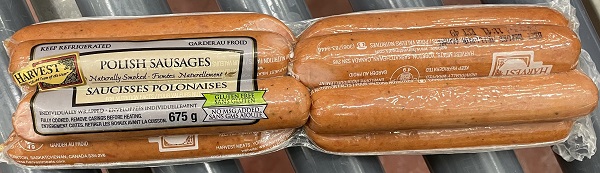
Canada – Harvest brand Polish Sausages may be unsafe due to undercooking

CFIA

Recall details

Ottawa, January 14, 2021 – Harvest Meats is recalling Harvest brand Polish Sausages from the marketplace due to undercooking. Consumers should not consume the recalled product described below.

Recalled product

Brand Product Size UPC Codes
Harvest Polish Sausages 675 g 0 57393 70017 8 BEST BEFORE 2021MR15

What you should do

Check to see if you have the recalled product in your home. Recalled products should be thrown out or returned to the store where they were purchased.

Undercooked food may contain bacterial pathogens which can make you sick.

Background

This recall was triggered by the company. The Canadian Food Inspection Agency (CFIA) is conducting a food safety investigation, which may lead to the recall of other products. If other high-risk products are recalled, the CFIA will notify the public through updated Food Recall Warnings.

The CFIA is verifying that industry is removing the recalled product from the marketplace.

Illnesses

There have been no reported illnesses associated with the consumption of this product.

Product photos

Printer ready version of photos

  • Harvest – Polish Sausages – 675 grams (front)
  • Harvest – Polish Sausages – 675 grams (back)

Public enquiries and media

Company information
Harvest Meats: 1-800-667-1496 ext. 358
Public enquiries
Toll-free: 1-800-442-2342 (Canada and U.S.)
Telephone: 1-613-773-2342 (local or international)
Email: cfia.enquiries-demandederenseignements.acia@canada.ca
Media relations
Telephone: 613-773-6600
Email: cfia.media.acia@canada.ca

Research – Possibility, duration, and molecular predictors of sanitizer tolerance in Listeria monocytogenes

Centre For Produce Safety

Summary

Due to concerns over bacterial tolerance to sanitizers, FDA and FSIS recommend rotating sanitizers in RTE food processing facilities to better control foodborne pathogens, in particular, Listeria monocytogenes (Lm). These recommendations are nonbinding; whether Lm develops tolerance to common sanitizers remains
inconclusive and debated. Even if Lm develops tolerance through sub-lethal exposure to sanitizers, how long and how strong the tolerance can last should be considered in determining whether sanitizer rotation is needed and how often it should be applied. Lack of consensus and quantitative data on possibility and duration of sanitizer tolerance creates confusions and dilemmas, especially when sanitizer rotation presents considerable challenges in training, compliance, and cost control to the industry. This proposal describes studies to help settle the debate and fill critical knowledge gaps regarding Lm tolerance to chlorine and quaternary ammonium compounds. We will measure residual sanitizer levels in produce processing facilities. We will perform laboratory assays to investigate tolerance development and persistence. We will explore machine-learning-aided tolerance prediction and identify evolutionary signals (or lack thereof) of tolerance development from whole genome sequencing data. Our results will provide the industry and regulators with scientific evidence for substantiating, better implementing, or justifiably shelving sanitizer rotational programs.

Technical Abstract

There is still no scientific consensus on whether Listeria monocytogenes (Lm) develops sanitizer tolerance. We hypothesize that development of two types of sanitizer tolerance may occur in Lm. First, short-term adaptation to sub-lethal levels of sanitizers induces acquired tolerance, which is transient and not hereditary. Second, long- term selection by sanitizers causes intrinsic tolerance, which is established in Lm populations by evolutionary changes to Lm genomes. To help settle the debate, we will test our hypothesis by distinguishing and investigating both types of tolerance in Lm using chlorine and a quaternary ammonium compound as example sanitizers.

In this study, we will survey residual sanitizer levels in a leafy green and a tomato processing facilities to evaluate if laboratory-derived sanitizer levels optimal for tolerance development are relevant to produce processors. We will assess the possibility of acquired tolerance by measuring the difference in minimum inhibition concentrations (MIC) before and after sanitizer adaptation. We will study how different sanitizer levels and exposure time affect the development of acquired tolerance, including how long the tolerance can last after exposure to sanitizers. We will explore the mechanisms behind the development of acquired sanitizer tolerance by characterizing temporal shifts in Lm transcriptome throughout the duration of the tolerance.

We will assess intrinsic tolerance in a collection of 200-300 strategically selected Lm strains using high-throughput growth kinetics assays. We will search for evolutionary evidence that suggests the development of intrinsic tolerance in recent history by analyzing whole genome sequencing (WGS) data of these strains. We
will build a machine-learning classifier to predict tolerance levels and identify key tolerance predictors from WGS.

This research will provide valuable prerequisite information for determining if sanitizer rotation is necessary for preventing the development of Lm tolerance to sanitizers. Scientific data from the project will also help optimize sanitation practices to mitigate tolerance development and determine frequency for sanitizer rotation if rotation is needed.

USA – 5 Ways to Prevent Salmonella from Backyard Chickens

Wide Open Pets

104px-More_chicks

More and more people are getting Salmonella from backyard chickens. Are you at risk?

This year there were more cases of Salmonella linked to backyard chickens than ever before recorded by the Centers for Disease Control and Prevention (CDC). In fact, there were over ten Salmonella outbreaks, and 1,100 cases in 48 states just this year so far!

We’ll tell you what Salmonella is, help you figure out if you’re at risk, and let you know the best practices for how to stay healthy. Having backyard chickens is fun, but getting Salmonella definitely isn’t!
 

CDC Report

Research – Exploring food safety perceptions and self-reported practices of pet owners, providing raw meat-based diets to pets.

Journal of Food Protection

The growing popularity of raw meat-based diets for pets is accompanied by an increasing concern regarding possible health implications of this practice to pet owners, due to the storage and preparation of raw meat. This study aimed to explore pet owners’ knowledge and perceptions about safety of raw meat-based feeding and determine self-reported food safety practices during raw meat-based pet food preparation. An online questionnaire was distributed via social media platforms was completed by pet owners practicing raw meat-based feeding ( n =174). Almost all participants (95%) reported confidence that their pets’ raw meat-based food is safe. Two thirds of respondents (67%) reported to have researched food safety information, regarding raw meat-based feeding, however only 8% asked a veterinarian for food safety advice. Respondents were aware of pathogens that may be present in raw meat-based diets, and of food safety practices, however, they did not report implementation of appropriate food safety practices consistently. Malpractices, such as rinsing raw meat (27%) and lack of segregation (52%) were reported. The risk of foodborne illness to pet owners associated with raw meat-based feeding was perceived to be ‘low’ by 89% of pet owners. Participants perceived low susceptibility to foodborne illness, but high self-efficacy, which may be an indication of ‘optimistic bias’. This study has identified the need for increasing pet owners’ awareness of the possible risks associated with raw meat-based feeding to human health. The provision of comprehensive food safety information, intended to target the perceptions of pet owners identified in this study, is needed to improve pet owners’ food safety practices, to reduce the potential food safety risks associated with raw meat preparation and storage in the domestic environment.

Norway – The Norwegian Food Safety Authority with an inspection campaign on Listeria measures in salmon slaughterhouses

Mattilsynet

In 2021, the Norwegian Food Safety Authority will carry out an inspection campaign in all salmon slaughterhouses where we will investigate measures and routines to prevent the fish from becoming contaminated with the listeria bacterium.

Listeria monocytogenes can cause listeriosis. Most of us do not get sick from the bacterium, but pregnant women, children, the elderly and people with weakened immune systems are vulnerable. Listeria multiplies at cooling temperature, survives freezing, salting and smoking, but is killed by adequate heat treatment.

– Since salmon and aura are largely eaten without heat treatment and used for ready-to-eat products such as sushi, sashimi, smoked and digged fish, it is important that producers have effective measures against Listeria, says Elisabeth Wilmann, director of fish and seafood at the Norwegian Food Safety Authority.

Several listeriosis outbreaks in EU countries a few years ago

In 2018 and 2019, there were serious outbreaks of listeriosis in several EU countries related to the consumption of smoked, grated and marinated fish products. The raw materials were Norwegian salmon and aura. The product was traced back to processing plants in Poland and Estonia, but one could not rule out that the raw materials from Norway were contaminated.

– The fact that Norwegian salmon and aura have been linked to serious disease outbreaks is one of the reasons why the Norwegian Food Safety Authority is carrying out the inspection campaign. Another reason is that more and more countries are making demands with regard to Listeria in Norwegian fish, Wilmann says.

The Norwegian Food Safety Authority’s experience is that Norwegian salmon slaughterhouses generally have good knowledge of microbiological hazards in fish, and that targeted work has been done on measures against Listeria.

– At the same time, we know that Listeria is regularly detected in the production environment in Norwegian slaughterhouses, says Wilmann.

The Norwegian Food Safety Authority will guide, clarify responsibilities and get an overview

In the campaign, the Norwegian Food Safety Authority will examine the slaughterhouse’s measures, sampling and routines for non-conformance treatment.

– We emphasize guidance. In addition, we will clarify the regulations and the responsibility of the slaughterhouse to prevent unsafe products from entering the market, says Wilmann.

The aim is to control all salmon slaughterhouses and vessels that slaughter salmonids. The campaign period is 15 January to 1 September, and the final report will be published towards the end of 2021. It may be relevant to carry out some of the inspections digitally due to coronary restrictions.

In 2020-2021, the Norwegian Food Safety Authority will also implement a monitoring and mapping program to map the status of Listeria.

– By obtaining a better overview of the status of Listeria in salmonids, we will be in a better position to contribute to the clarification of any future disease outbreaks, Wilmann concludes.

Read more on the website for the supervision campaign