Category Archives: Food Virus

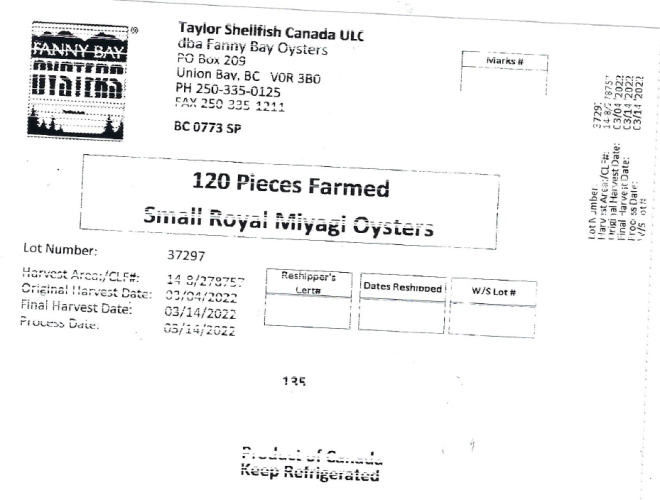
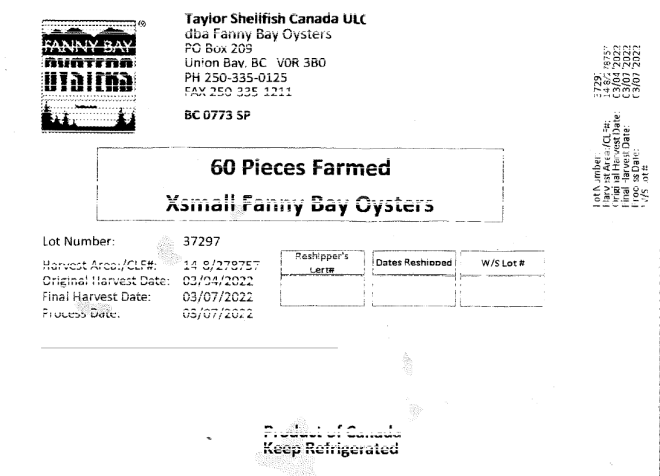
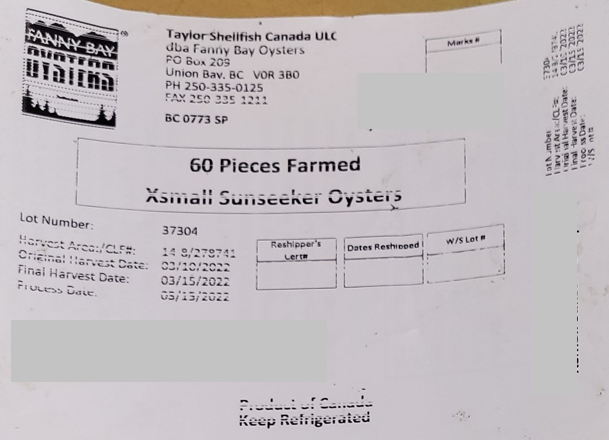
Canada – Certain Taylor Shellfish Canada ULC brand Oysters recalled due to Norovirus

CFIA

Summary

Product
Certain oysters
Issue
Food – Microbial Contamination – Norovirus
What to do

Do not consume, use, sell, serve, or distribute the recalled products
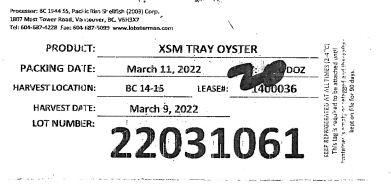
Canada – Pacific Rim Shellfish (2003) Corp brand Oysters recalled due to Norovirus

CFIA

ummary

Product
Oysters
Issue
Food – Microbial Contamination – Norovirus
What to do

Do not consume, use, sell, serve, or distribute the recalled products
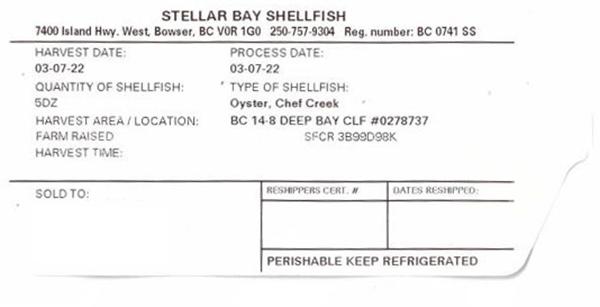
Canada – Certain Stellar Bay Shellfish brand Chef Creek Oysters recalled due to Norovirus

CFIA

Chef Creek Oysters - label

Last updated

Summary

Product
Oyster, Chef Creek
Issue
Food – Microbial Contamination – Norovirus
What to do

Do not consume, use, sell, serve, or distribute the recalled products.

Issue

Stellar Bay Shellfish is recalling certain Stellar Bay Shellfish brand Chef Creek Oysters from the marketplace due to possible norovirus contamination.

The recalled products have been sold in British Columbia and may have been distributed in other provinces and territories.

What you should do

  • If you think you became sick from consuming a recalled product, call your doctor
  • Check to see if you have the recalled products in your home or establishment
  • Do not consume the recalled products
  • Do not serve, use, sell, or distribute the recalled products
  • Recalled products should be thrown out or returned to the place of purchase
  • Consumers who are unsure if they have purchased the affected products are advised to contact their retailer

People with norovirus illness usually develop symptoms of gastroenteritis within 24 to 48 hours, but symptoms can start as early as 12 hours after exposure. The illness often begins suddenly. Even after having the illness, you can still become re-infected by norovirus. The main symptoms of norovirus illness are diarrhea, vomiting (children usually experience more vomiting than adults), nausea and stomach cramps. Other symptoms may include low-grade fever, headache, chills, muscle aches and fatigue (a general sense of tiredness).  Most people feel better within one or two days, with symptoms resolving on their own, and experience no long-term health effects. As with any illness causing diarrhea or vomiting, people who are ill should drink plenty of liquids to replace lost body fluids and prevent dehydration. In severe cases, patients may need to be hospitalized and given fluids intravenously.

Canada – Certain Stellar Bay Shellfish brand Oysters recalled due to Norovirus

CFIA

Summary

Product
Certain oysters
Issue
Food – Microbial Contamination – Norovirus
What to do

Do not consume, use, sell, serve, or distribute the recalled products

Issue

Stellar Bay Shellfish is recalling certain oysters from the marketplace due to possible norovirus contamination.

The recalled products have been sold in British Columbia, Alberta, Quebec and Ontario and may have been distributed in other provinces and territories.

What you should do

  • If you think you became sick from consuming a recalled product, call your doctor
  • Check to see if you have the recalled products in your home or establishment
  • Do not consume the recalled products
  • Do not serve, use, sell, or distribute the recalled products
  • Recalled products should be thrown out or returned to the place of purchase
  • Consumers who are unsure if they have purchased the affected products are advised to contact their retailer

People with norovirus illness usually develop symptoms of gastroenteritis within 24 to 48 hours, but symptoms can start as early as 12 hours after exposure. The illness often begins suddenly. Even after having the illness, you can still become re-infected by norovirus. The main symptoms of norovirus illness are diarrhea, vomiting (children usually experience more vomiting than adults), nausea and stomach cramps. Other symptoms may include low-grade fever, headache, chills, muscle aches and fatigue (a general sense of tiredness). Most people feel better within one or two days, with symptoms resolving on their own, and experience no long-term health effects. As with any illness causing diarrhea or vomiting, people who are ill should drink plenty of liquids to replace lost body fluids and prevent dehydration. In severe cases, patients may need to be hospitalized and given fluids intravenously.
RASFF Alert – Norovirus – Oysters

RASFF

Norovirus in oysters from France in Italy

Belgium – Geay brand oysters – Norovirus

AFSCA

Product: Geay brand oysters.
Problem: presence of Norovirus.
Following a notification via the RASFF system (European Food and Feed Rapid Alert System), the presence of Norovirus was detected in oysters (12 or 24 pieces) of the Geay brand.

The FASFC has therefore decided to withdraw this product from sale and to recall it from consumers.

The AFSCA asks not to consume this product and to bring it back to the point of sale where it was purchased.

Product Description :

– Product: Oysters (12 or 24 pieces)
– Brand: Geay
– Batch numbers/product code: 21/02/2022 to 28/02/2022

The product was distributed via several points of sale in Belgium.

For any additional information, you can contact the FASFC contact point for consumers: 0800/13.550 or pointdecontact@afsca.be .

Taiwan – Norovirus on the rise in Taiwan

Outbreak News Today

The Taiwan Centers for Disease Control and Prevention (CDC) reported Thursday that the number of hospital visits for diarrhea in the country has increased recently, and the pathogens detected in cluster incidents are mainly norovirus.

The public is advised to pay attention to food safety and hand hygiene. Seek medical attention as soon as possible and take rest at home if you are sick; catering and accommodation operators must strengthen environmental hygiene management and pay attention to the health status of employees. If you have suspected symptoms, please suspend work immediately to reduce the risk of virus transmission.

According to the monitoring data of the CDC, there were a total of 110,783 outpatient and emergency visits for diarrhea in Taiwan last week (February 20 to February 26), a slight increase from the number of visits in the past two weeks (109,522 in the 7th and 6th weeks, 109,289), but lower than the same period in recent years. In previous years, the number of patients with diarrhea was likely to increase after consecutive holidays. In the past four weeks (weeks 5 to 8), a total of 83 diarrhea cluster reports were received across the country. There were 49 positive cases of pathogen detection, mainly norovirus (46 cases, accounting for 94%).

UK – Norovirus outbreaks increasing in England

Gov UK

Norovirus outbreaks in care homes have risen in recent weeks, leading UKHSA to remind people of simple steps that can be taken to limit the spread of the bug.

The UK Health Security Agency (UKHSA) is reminding the public of simple actions that they can take to reduce the spread of norovirus. The advice comes after routine surveillance in England shows that the number of outbreaks caused by the vomiting bug has increased in recent weeks (4-week period from end January to February), initially in educational settings and now in care home settings.

Norovirus is highly infectious and causes vomiting and diarrhoea but usually passes in a couple of days. It is easily transmitted through contact with infected individuals or contaminated surfaces.

The increase in reported outbreaks was initially in educational settings, particularly in nursery and childcare facilities, with 48% more incidents reported to UKHSA than would be expected.

Reports of norovirus outbreaks in care home settings to UKHSA have also increased in recent weeks in 2022 – with a rise from 24 reported in week 6 (week commencing 7 February), to 40 reported in week 7 (week commencing 14 February).

While outbreaks reported in care home settings overall remain below pre-pandemic expected levels, it is likely they will continue to increase in the coming weeks and a rise in norovirus outbreaks in care home settings often precedes an increase in outbreaks in hospital settings. Therefore, it is important to take steps to limit the spread of norovirus.

Professor Saheer Gharbia, Gastrointestinal Pathogens and Food Safety Directorate, UKHSA, said:

Norovirus, commonly known as the winter vomiting bug, has been at lower levels than normal throughout the pandemic but as people have begun to mix more, the numbers of outbreaks have started to increase again.

Symptoms include sudden onset of nausea, projectile vomiting and diarrhoea but can also include a high temperature, abdominal pain and aching limbs. Stay at home if you are experiencing norovirus symptoms and do not return to work or send children to school or nursery until 48 hours after symptoms have cleared.

Please avoid visiting elderly relatives if you are unwell – particularly if they are in a care home or hospital. As with COVID-19 and other infectious illnesses, hand washing is really important to help stop the spread of this bug, but remember, unlike for COVID-19 alcohol gels do not kill off norovirus so soap and water is best.

How to reduce the spread of norovirus

  1. Stay at home if you are experiencing norovirus symptoms. Do not return to work or send children to school until 48 hours after symptoms have cleared. Also avoid visiting elderly or poorly relatives, particularly if they are in hospital or a care home.
  2. Wash your hands frequently and thoroughly with soap and warm water. Alcohol hand gels don’t kill norovirus.
  3. When an infected person vomits, the droplets contaminate the surrounding surfaces. A bleach-based household cleaner or a combination of bleach and hot water should be used to disinfect potentially contaminated household surfaces and commonly used objects such as toilets, taps, telephones, door handles and kitchen surfaces.
  4. If you are ill, avoid cooking and helping prepare meals for others until 48 hours after symptoms have stopped, as norovirus can be spread through food contaminated by the virus when food is handled by symptomatic people or infected individuals.
  5. Wash any contaminated clothing or bedding using detergent and at 60°C and, if possible, wear disposable gloves to handle contaminated items.

Norovirus activity has risen as people have begun to mix more – it is possible that unusual or out-of-season increases could be seen in the coming months.

UKHSA’s National Norovirus Surveillance Team will continue to closely monitor all available surveillance data to ensure early detection of any unusual norovirus activity and outbreaks.

You can view the National Norovirus and Rotavirus Bulletin here.

Those showing symptoms should avoid visiting their GP, but if they are concerned should contact NHS 111 or talk to their GP by phone.

RASFF Alerts – Norovirus – French Oysters

RASFF

Norovirus in oysters from France in Belgium, Denmark, Finland, Germany, Italy, Netherlands, Poland and Sweden

RASFF

Norovirus in oysters from France in the Netherlands

Research – France – Acute gastroenteritis: results of winter surveillance 2019-2020

Sante Publique

Food Borne Illness - Norovirus -CDC Photo

Public Health France publishes the 2019-2020 annual winter surveillance report for acute gastroenteritis in mainland France, marked by two major events and in particular a historic drop in AGEs never observed over the past 10 years. 

Acute winter gastroenteritis (AGE) is mainly of viral origin, with a dominant circulation of noroviruses and rotaviruses. Noroviruses are responsible for AGE in people of all ages, while rotaviruses mainly affect children under 5 years of age. A winter resurgence of cases is observed each year, in France, as in Europe, generating an increase in medical consultations for AGE usually between December and April. A peak is often observed during the first two weeks of January. 

Fluctuating activity for GEA over the 2019-2020 winter season

A significant peak observed in connection with an episode of collective food poisoning in several metropolitan areas

As in the two previous seasons, an increase in the number of AGE cases was observed at the start of the winter season, followed by a sharp increase in visits to hospital emergencies and general medicine at the end of December 2019 – beginning of January 2020, higher than the peaks of the 7 previous seasons in week 01-2020, and reaching 3.1% of total activity in hospital emergencies.

This upsurge in the number of AGE cases coincided with a significant and unusual occurrence of collective food poisoning that impacted several metropolitan areas in connection with the consumption of contaminated oysters that occurred in 2019* during the end-of-year celebrations. 

A sharp decrease in activity to historically low levels, most likely related to the measures put in place during the Covid-19 pandemic

Following the first confinement (March-April 2020) introduced as part of the Covid-19 pandemic , very low levels of activity for GEA were recorded from March and April 2020 in hospital emergencies and in general medicine (Sentinels Network and SOS Médecins).

Indeed, the proportion of emergency visits for gastroenteritis fell sharply at the start of 2020 to reach historically low levels and then stabilized at 0.5% of activity from April 2020 . According to data from the Sentinel Network, the 2019-2020 winter season was characterized by the lowest cumulative incidence rate of cases of acute diarrhea seen in general medicine consultations over the last 10 seasons .

This historic decrease in epidemic activity for acute gastroenteritis in France is most likely related to the measures introduced in the context of the COVID-19 pandemic (confinement, physical distancing, reinforcement of hand hygiene). Such levels have not been observed over 10 years of retrospective data for all monitoring indicators.

Key points 2019 – 2020 regarding acute gastroenteritis 

The analysis period corresponds to the winter monitoring period, from November 18, 2019 to April 13, 2020. 

  • 96,713 hospital emergency visits , i.e. 1.6% of emergency visits. 44.4% of visits for acute gastroenteritis concerned children aged under 5 years.
  • 144,499 SOS Médecins consultations for acute gastroenteritis, i.e. 8.7% of total consultations.
  • Cumulative incidence rate at the Sentinel Network: 
    • 2,963 cases per 100,000 inhabitants of all ages
    • 6,605 cases per 100,000 inhabitants, in children under 5 , the most affected population during this period.
  • Predominance of norovirus genotype GII.4 2012[P16], followed by genotype GII.17[P17].
  • Significant peak of activity observed at the end of December 2019-beginning of January 2020 , concomitant with a significant upsurge in collective food poisoning linked to the consumption of oysters
  • Following the first containment introduced as part of the Covid-19 pandemic, very low levels of activity were recorded from week 13-2020