Category Archives: food safety training

EFSA Research -Persistence of microbiological hazards in food and feed production and processing environments

EFSA

Abstract

Listeria monocytogenes (in the meat, fish and seafood, dairy and fruit and vegetable sectors), Salmonella enterica (in the feed, meat, egg and low moisture food sectors) and Cronobacter sakazakii (in the low moisture food sector) were identified as the bacterial food safety hazards most relevant to public health that are associated with persistence in the food and feed processing environment (FFPE). There is a wide range of subtypes of these hazards involved in persistence in the FFPE. While some specific subtypes are more commonly reported as persistent, it is currently not possible to identify universal markers (i.e. genetic determinants) for this trait. Common risk factors for persistence in the FFPE are inadequate zoning and hygiene barriers; lack of hygienic design of equipment and machines; and inadequate cleaning and disinfection. A well-designed environmental sampling and testing programme is the most effective strategy to identify contamination sources and detect potentially persistent hazards. The establishment of hygienic barriers and measures within the food safety management system, during implementation of hazard analysis and critical control points, is key to prevent and/or control bacterial persistence in the FFPE. Once persistence is suspected in a plant, a ‘seek-and-destroy’ approach is frequently recommended, including intensified monitoring, the introduction of control measures and the continuation of the intensified monitoring. Successful actions triggered by persistence of L. monocytogenes are described, as well as interventions with direct bactericidal activity. These interventions could be efficient if properly validated, correctly applied and verified under industrial conditions. Perspectives are provided for performing a risk assessment for relevant combinations of hazard and food sector to assess the relative public health risk that can be associated with persistence, based on bottom-up and top-down approaches. Knowledge gaps related to bacterial food safety hazards associated with persistence in the FFPE and priorities for future research are provided.
Hong Kong – Food Safety Tips for Chinese New Year

CFS

Choosing and handling Chinese New Year foods and snacks

While purchasing or preparing new year foods, purchase them from reputable retail outlets. Buy sweetened lotus seeds and pistachio with natural colour and avoid those looking extraordinarily white because they may have been bleached with chemicals. Avoid buying melon seeds that are too glossy as they may contain mineral oil, which may cause gastrointestinal discomfort.

You should check the expiry date before buying any pre-packaged festive items like puddings, sesame balls and sweets, and make sure the packaging is intact. Note the hygienic condition of the shop and the food containers and the hygiene practices of the staff, when buying unpackaged items like crispy triangles, sweetened dried fruits and melon seeds.

After purchase, pre-cooked foods like puddings should be stored in the refrigerator as soon as possible and be consumed before the “use by” date shown on the package. Fried festive foods such as sesame balls and crispy triangles should be kept in air-tight containers and stored in the refrigerator or in a cool, dry place.

Melon seeds and nuts are often served during the Chines Year. However, these foods contain hard hulls. Cracking melon seeds and nuts with your own teeth can result in tooth damage. Use a seed or nut cracker instead. Nut are also often used in making Chinese New Year foods. Should you be allergic to nuts or have other food allergy , read food allergen information on food labels to identify if any food or food ingredients of your allergic concern are present in the food. Avoid the food or food ingredients which you are allergic to.

Keep poon choi at safe temperatures

Chinese New Year is a great time of year to have ‘winter warmers’ such as poon choi when we host large gatherings. These dishes are often prepared through bulk cooking ahead of time, due to the large number of portions required. Poon choi contains various food ingredients and requires complicated and long preparation procedures such as cutting, marinating, precooking and cooling and finally re-heating. If the food is left at room temperature for too long after precooking, foodborne pathogens can multiply and some can even produce heat-stable toxins which are not readily eliminable by reheating.

Therefore, it is important to store food properly by storing precooked ingredients at 4°C or below to prevent the formation of toxins, cool down the precooked ingredients by dividing into small portions, placing in shallow containers or placing in ice bath. Reheating foods thoroughly to the core temperature of at least 75°C or above. Keep hot food above 60°C if it is not consumed immediately. Do not leave reheated food at room temperature for long, and discard it if held at room temperature for more than four hours. Of note, heat from the heat source may not be evenly distributed in a large poon choi during reheating, therefore requiring more time to bring poon choi to a boil before eating.

Research – Challenges with food safety adoption: A review

Wiley Online

Globally, the risk of foodborne diseases is high among the young, old, pregnant and immunocompromised groups. Strategies to improve safe food supply are poorly understood among stakeholders. In this paper, we discuss the importance of the adoption of food safety standards, the effects of non-compliance of food safety protocols, consumer-producer awareness of food safety, and the challenges involved in the adoption of food safety protocols. The major challenges include gaps in dissemination of relevant information, the cost involved in adoption of many food safety programs; low educational levels of food handlers, insufficient food testing laboratories; inadequate funding, equipment, and skilled personnel; and cost of training and education; and lack of coordination among organizations handling food safety issues. Building competencies of food safety personnel, inspectorates, national or regional laboratories and adequate resource support to industry and supporting agencies will enhance safety of the global food supply.

Research – Food Safety Aspects of Breeding Maize to Multi-Resistance against the Major (Fusarium graminearum, F. verticillioides, Aspergillus flavus) and Minor Toxigenic Fungi (Fusarium spp.) as Well as to Toxin Accumulation, Trends, and Solutions—A Review

MDPI

Abstract

Maize is the crop which is most commonly exposed to toxigenic fungi that produce many toxins that are harmful to humans and animals alike. Preharvest grain yield loss, preharvest toxin contamination (at harvest), and storage loss are estimated to be between 220 and 265 million metric tons. In the past ten years, the preharvest mycotoxin damage was stable or increased mainly in aflatoxin and fumonisins. The presence of multiple toxins is characteristic. The few breeding programs concentrate on one of the three main toxigenic fungi. About 90% of the experiments except AFB1 rarely test toxin contamination. As disease resistance and resistance to toxin contamination often differ in regard to F. graminearumF. verticillioides, and A. flavus and their toxins, it is not possible to make a food safety evaluation according to symptom severity alone. The inheritance of the resistance is polygenic, often mixed with epistatic and additive effects, but only a minor part of their phenotypic variation can be explained. All tests are made by a single inoculum (pure isolate or mixture). Genotype ranking differs between isolates and according to aggressiveness level; therefore, the reliability of such resistance data is often problematic. Silk channel inoculation often causes lower ear rot severity than we find in kernel resistance tests. These explain the slow progress and raise skepticism towards resistance breeding. On the other hand, during genetic research, several effective putative resistance genes were identified, and some overlapped with known QTLs. QTLs were identified as securing specific or general resistance to different toxicogenic species. Hybrids were identified with good disease and toxin resistance to the three toxigenic species. Resistance and toxin differences were often tenfold or higher, allowing for the introduction of the resistance and resistance to toxin accumulation tests in the variety testing and the evaluation of the food safety risks of the hybrids within 2–3 years. Beyond this, resistance breeding programs and genetic investigations (QTL-analyses, GWAM tests, etc.) can be improved. All other research may use it with success, where artificial inoculation is necessary. The multi-toxin data reveal more toxins than we can treat now. Their control is not solved. As limits for nonregulated toxins can be introduced, or the existing regulations can be made to be stricter, the research should start. We should mention that a higher resistance to F. verticillioides and A. flavus can be very useful to balance the detrimental effect of hotter and dryer seasons on aflatoxin and fumonisin contamination. This is a new aspect to secure food and feed safety under otherwise damaging climatic conditions. The more resistant hybrids are to the three main agents, the more likely we are to reduce the toxin losses mentioned by about 50% or higher.

USA – FDA – US Gulf Coast Trading Co., Inc. – Warning Letter

FDA

The United States Food and Drug Administration (FDA) inspected your refrigerated, frozen, and ambient food product warehouse located at 14100 Auto Park Way Ste. I, Houston, TX on August 7 through 15, 2023. During our inspection, FDA investigators found serious violations of the Current Good Manufacturing Practice, Hazard Analysis, and Risk-Based Preventive Controls for Human Food regulation (CGMP & PC rule) in Title 21, Code of Regulations, Part 117 (21 CFR part 117). At the conclusion of the inspection, FDA issued a Form FDA 483, Inspectional Observations, listing deviations found at your firm. In addition, during the inspection, FDA collected filth samples from various areas within your warehouse facility, and the analytical results revealed rodent filth present throughout your facility.

Based on FDA’s inspectional findings, we have determined that the food products warehoused in your facility are adulterated within the meaning of section 402(a)(3) of the Federal Food, Drug, and Cosmetic Act (the Act) [21 U.S.C. § 342(a)(3)] because they consist in whole or in part of any filthy, putrid, or decomposed substance, or are otherwise unfit for food, and section 402(a)(4) of the Act [21 U.S.C. § 342(a)(4)] because they were prepared, packed, or held under insanitary conditions whereby they may have become contaminated with filth, or whereby they may have been rendered injurious to health. You may find the Act and FDA regulations through links in FDA’s Internet home page at http://www.fda.gov.

Spain – Withdrawal of the alert due to the presence of Salmonella in frozen cooked crabs from Ireland (Ref. ES2023/306)

AESAN

The Spanish Agency for Food Safety and Nutrition (AESAN) announces the withdrawal of the alert due to the presence of Salmonella in frozen cooked crabs from Ireland (Ref. ES2023/306).

After carrying out new investigations and analyzes with satisfactory results for the detection of Salmonella in the batch that is the subject of the alert, the authorities of the Xunta de Galicia have determined that there are no reasons that justify maintaining the alert.

After the initial notification made by the authorities of the Autonomous Community of Madrid following the precautionary principle on November 24, 2023, the AESAN published an alert for the presence of Salmonella in frozen cooked crabs of the Pescanova brand, batch 40224 and date of expiration before the end of 10/2024.

Based on the investigations carried out and the performance of new analyzes for the detection of Salmonella on the batch that is the subject of the alert, all of them with satisfactory results, the authorities of the Xunta de Galicia have determined that there are no reasons to justify that the product may pose a risk to the health of the population.

For this reason, the alert has been withdrawn and communicated through the Coordinated System for Rapid Information Exchange (SCIRI), so that all contact points are aware.

Hong Kong – Roving Exhibitions on Food Safety in 2024

CFS

Roving Exhibitions on Food Safety in 2024

FIVE roving exhibitions will be held in the following venues in January 2024. Details are as follows:

Date Time Venue Theme
10/1 10am – 4pm Quarry Bay Market 5 Keys for Food Safety; Veterinary Drug Residues; Trans Fats
15/1 10am – 4pm Yeung Uk Road Market Nutrition Labelling; Genetically Modified Food; Trans Fats
19/1 10am – 4pm North Point Government Offices Acrylamide; Food Safety Advice for Pregnant Women; Enhance Food Traceability, Strengthen Food Safety
24/1 10am – 4pm Yee On Street Market Nutrition Labelling; Enhance Food Traceability, Strengthen Food Safety; Ciguatoxins
31/1  10am – 4pm Shek Wu Hui Market Enhance Food Traceability, Strengthen Food Safety; Pesticide Residues; Trans Fats

New arrangements of the exhibitions will be announced regularly and members of the public are welcome to visit the CFS website.  For any enquiries, please contact our Communication Resource Unit at 2381 6096.

Research – Machine learning is set to speed up the detection of contamination in food factories

Techcrunch

The factories that process our food and beverages (newsflash: no, it doesn’t come straight from a farm) have to be kept very clean, or we’d all get very ill, to be blunt. Ensuring that usually entails deploying petri-dish-based microbiological monitoring, hardware and waiting for tests to return from labs. A new startup has plans to use deep-learning algorithms to speed up this process.

Spore.Bio is a French startup that has developed a new pathogen-detection methodology. It works by shining an optical light on surfaces where clean food has been, and doing the same with unclean food. It then compares the two datasets to detect when a surface is not clean.

Off the back of this solution, it’s now raised €8 million in pre-seed funding led by London’s LocalGlobe VC. Also participating was EmergingTech Ventures, No Label Ventures, Famille C (Clarins Family Office), Better Angle, Plug & Play Ventures, Entrepreneur First, Kima Ventures, Raise Sherpas, Fair Equity, Sharpstone Capital and angels.

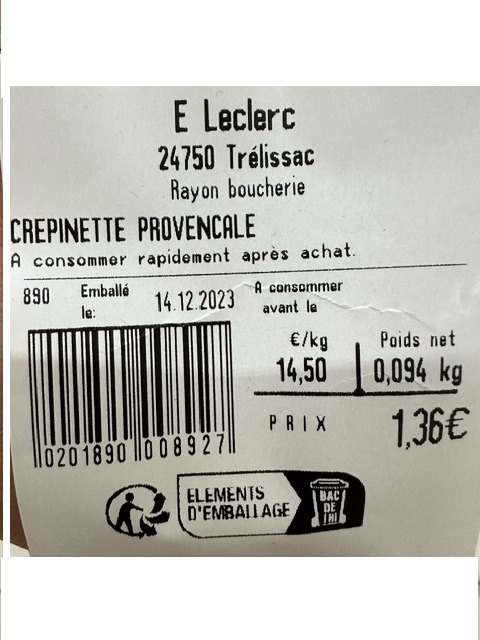
France – Provencal Pork Crepinette – Salmonella

Gov France

Product category
Food
Product subcategory
Meats
Product brand name
On-site manufacturing
Model names or references
Provencal pork crepinette
Product identification
GTIN
0201890000000
Packaging
Product sold individually in the Traditional butcher section
Start/end date of marketing
Of 08/12/2023 At 09/12/2023
Storage temperature
Product to keep in the refrigerator
Further information
Raw Provencal pork crepinette
Geographical sales area
Leclerc Trélissac
Distributors
Leclerc Trélissac

Australia and New Zealand – New FSANZ Website

FSANZ

Encourage stakeholder engagement through current information on FSANZ's  website and social media interactions