Category Archives: Food Microbiology Research

USA – IDHP final report on Jackson County Shiga-toxin E. Coli / HUS cases

Food Safety News

The Iowa Department of Public Health (IDPH) has completed a final report on last May’s Shiga-toxin E. coli outbreak in a Jackson County childcare facility.  Pursuant to Iowa Open Records law, IDPH has shared its findings with Food Safety News

The onset of the E. coli illnesses occurred from May 6 to May 22.  IDPH and Jackson County Public Health learned, through the reportable disease system, of a Jackson County child suffering from Shiga-toxin E. coli.

“Local public health spoke to the healthcare provider and the case’s family to get information for IDPH’s Shiga-toxin investigation form,” according to the final report. “JCPH learned the child attended local childcare and placed the child under an exclusion order to exclude the child from childcare until resolution of diarrhea and two consecutive tested negative for Shiga-toxin E. coli.”

USA – Chicken and Salmonella Infantis, the Neverending Outbreak?

Food Poisoning Bulletin

When the CDC ended its investigation of a deadly Salmonella Infantis outbreak linked to raw chicken products in February 2019, it added an unusual note at the top of the posting. “This investigation is over. Illnesses could continue because this Salmonella strain appears to be widespread in the chicken industry,” it read in part.

Two and a half years later, the impact of that statement came into focus when an investigative report from ProPublica revealed that the outbreak, linked to a multidrug-resistant strain of Salmonella Infantis, has never ended.

“Many people are still becoming ill, and some of them gravely ill,” Robert Tauxe told ProPublica. Tauxe, who is the director of the Center for Disease Control and Prevention’s (CDC’s) Division of Foodborne, Waterborne, and Environmental Diseases, said the agency receives dozens of reports of illness linked to this strain each month, according to the report.

For every culture-confirmed Salmonella illness, the CDC uses a multiplier of 29 to account for undiagnosed infections. One internal CDC document that the ProPublica Team found estimated that this single strain of Salmonella Infantis is responsible for 11,000-17,000 illnesses per year.

And the strain is still frequently turning up in chicken.

Research – Research expands ability to detect, kill harmful biofilms

Food Safety News

Food safety practices evolve as new technology and knowledge of the pathogens that spread foodborne illnesses becomes available.

In recent years, researchers have increasingly focused efforts on biofilm and its ability to thrive in nature and in food production and processing facilities. Biofilm is formed by a pathogen — or more often, a mixture of different pathogens — that builds a protective layer using extracellular polymeric substances (EPS).

A majority of foodborne illnesses can be traced to pathogens housed in biofilms, according to food safety research. Academics and food trade associations have stepped up efforts in recent years to learn more about biofilm, which naturally fights efforts to sanitize food contact surfaces in processing and manufacturing facilities.

Recent studies have looked at products and practices to eradicate or control biofilms in different segments of the food industry, from produce to meat processing and poultry farms.

Armenia – Apparent food poisoning at Yerevan’s Tashir Pizza leaves nearly 100 patrons hospitalized

Armen Press

YEREVAN, NOVEMBER 6, ARMENPRESS. The number of the apparent food poisoning victims at a Yerevan pizzeria reached 98, the health ministry said Saturday.

15 patrons of the Tashir Pizza restaurant – which operates more than 20 pizza shops in Yerevan – sought medical attention for “gastrointestinal infection” on November 5. The number of the food poisoning victims then increased, prompting Tashir Pizza to shut down all restaurants until further notice.

On November 6, the health ministry said 53 people – including 13 children – are hospitalized at the National Center of Infectious Diseases. Another 32 – including 1 child – are being treated at the Armenia Republican Medical Center, and 11 more at the Mikayelyan Institute of Surgery, and 2 at the Martuni Medical Center. All patients were patrons at various locations of Tashir Pizza.

Research- Cooccurrence of Five Pathogenic Legionella spp. and Two Free-Living Amoebae Species in a Complete Drinking Water System and Cooling Towers

MDPI

Pathogenic Legionella species grow optimally inside free-living amoebae to concentrations that increase risks to those who are exposed. The aim of this study was to screen a complete drinking water system and cooling towers for the occurrence of Acanthamoeba spp. and Naegleria fowleri and their cooccurrence with Legionella pneumophilaLegionella anisaLegionella micdadeiLegionella bozemanii, and Legionella longbeachae. A total of 42 large-volume water samples, including 12 from the reservoir (water source), 24 from two buildings (influents to the buildings and exposure sites (taps)), and six cooling towers were collected and analyzed using droplet digital PCR (ddPCR). N. fowleri cooccurred with L. micdadei in 76 (32/42) of the water samples. In the building water system, the concentrations of N. fowleri and L. micdadei ranged from 1.5 to 1.6 Log10 gene copies (GC)/100 mL, but the concentrations of species increased in the cooling towers. The data obtained in this study illustrate the ecology of pathogenic Legionella species in taps and cooling towers. Investigating Legionella’s ecology in drinking and industrial waters will hopefully lead to better control of these pathogenic species in drinking water supply systems and cooling towers. View Full-Text

Research – Vital Surveillances: Characteristics of Settings and Etiologic Agents of Foodborne Disease Outbreaks — China, 2020

China CDC

  • Abstract

    IntroductionFoodborne diseases are a growing public health problem and have caused a large burden of disease in China. This study analyzed epidemiological characteristics of foodborne diseases in China in 2020 to provide a scientific basis for prevention and control measures.

    MethodsData were collected from 30 of 31 provincial-level administrative divisions (PLADs) in the mainland of China, excluding Xizang (Tibet) Autonomous Region, via the National Foodborne Disease Outbreaks Surveillance System. The number and proportion of outbreaks, illnesses, hospitalizations, deaths by setting, pathogen-food category pairs and etiology were calculated.

    ResultsIn 2020, 7,073 foodborne disease outbreaks were reported, resulting in 37,454 illnesses and 143 deaths. Among the identified pathogens, microbial pathogens were the most common confirmed etiology, accounting for 41.7% of illnesses. Poisonous mushrooms caused the largest proportion of outbreaks (58.0%) and deaths (57.6%). For venues where foodborne disease outbreaks occur, household had the highest number of outbreaks (4,140) and deaths (128), and catering service locations caused the largest proportion of illnesses (59.9%). Outbreaks occurring between June and September accounted for 62.8% of total outbreaks.

    ConclusionsFoodborne disease outbreaks mainly occurred in households. Microbial pathogens remained the top cause of outbreak-associated illnesses. Poisonous mushrooms were ranked the top cause of deaths in private homes in China. The supervision and management of food safety and health education should be strengthened to reduce the burden of foodborne diseases. Publicity should be increased to reduce the incidence of mushroom poisonings in families, and supervision and management of food should be strengthened to reduce microbial contamination.

Research – How foodborne diseases protect the gut’s nervous system

Science Daily

A simple stomach bug could do a lot of damage. There are 100 million neurons scattered along the gastrointestinal tract — directly in the line of fire — that can be stamped out by gut infections, potentially leading to long-term GI disease.

But there may be an upside to enteric infection. A new study finds that mice infected with bacteria or parasites develop a unique form of tolerance quite unlike the textbook immune response. The research, published in Cell, describes how gut macrophages respond to prior insult by shielding enteric neurons, preventing them from dying off when future pathogens strike. These findings may ultimately have clinical implications for conditions such as irritable bowel syndrome, which have been linked to the runaway death of intestinal neurons.

“We’re describing a sort of innate memory that persists after the primary infection is gone,” says Rockefeller’s Daniel Mucida. “This tolerance does not exist to kill future pathogens, but to deal with the damage that infection causes — preserving the number of neurons in the intestine.”

Research – Biofilms are a concern across the entire food supply chain

Food Safety News

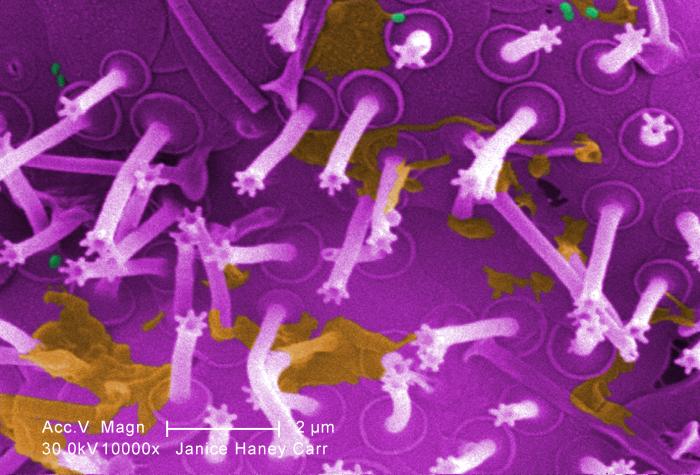
kswfoodworld biofilm

Biofilm, which is a cluster of pathogens encased in a protective matrix, is a common enemy across diverse food manufacturing industries.

From dairy, produce, meat, poultry, ready-to-eat deli foods and other products, biofilm is a concern at the farm level and at processing and manufacturing plants.

The protective layers generated by pathogens that create the biofilm, known as extracellular polymeric substances (EPS), resist sanitation efforts and are adept at spreading in moist environments, through a process known as “seeding dispersal.” According to Sterilex Industries, which offers products to treat biofilms and the pathogens they harbor, seeding dispersal is similar to a dandelion releasing seeds to encourage species growth.

Although forming biofilm is a natural process that pathogens — including those commonly leading to foodborne illness outbreaks, such as Shiga-toxin producing E. coli, Listeria monocytogenes and Salmonella — use to survive, industry food safety plans and government regulations don’t necessarily focus on biofilm and how to eradicate it.

Denmark – Denmark aims to use education to reduce Norovirus risk when dining out

Food Safety News

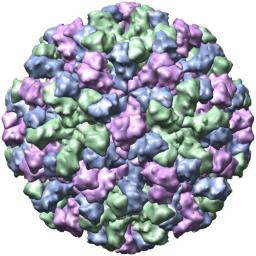
Norwalk_Caspid

The Danish Veterinary and Food Administration has launched a campaign to lower the risk of exposure to norovirus when dining out.

Ahead of Christmas, the Danish Veterinary and Food Administration (Fødevarestyrelsen) is focusing on how staff in professional kitchens, in cafés, canteens, restaurants and delicatessens can help to curb norovirus infections, which the agency said normally peak toward the end of the year.

Chefs and kitchen staff should stay home from work if they have symptoms of norovirus infection or have just had the disease. People can be infectious before feeling sick and at least 48 hours after having recovered.

Niels Ladefoged Nielsen, a consultant at the Danish Veterinary and Food Administration, said norovirus is extremely contagious, and there have been times when a single mistake in a professional kitchen has affected a large number of guests.

Nielsen said while the message of not cooking for others while feeling unwell is aimed at food professionals, it also applies to people at home in their own kitchen, and when preparing or serving food for family or friends.

Research – The Effective Use of HACCP for the Control of Environmental Microbial Contamination by the use of Operational Prerequisite Programs – Russell Berg – November 2021

LinkedIn

When the concept of prerequisites was first formulated in the late 1980s there was no distinction in importance between them. In many ways this goes against the principle of HACCP, in which resources should be allocated according to risk. Hence greater control should be imposed at Critical Control Points rather than Control Points. In the early days of HACCP (but unfortunately still is often the case) this principle has been applied to the direct product pathway, but barely to the processing environment. In this sense in the U.K. all fourteen allergens are treated the same way, as far as legislation, but many food manufacturers do not treat all the allergens the same as far as environmental control. Very food factories exclude staff from bringing any of the listed allergens on to site, but many exclude peanuts and tree nuts from site. Hence the risk from all the allergens is not considered the same, so as far as allergen control. In these circumstances peanuts and tree nuts could be considered and controlled by Operational Prerequisite Programs (OPRP), whilst other allergens would be controlled by Prerequisite Programs (PRP), to reflect the risk level.

The concept of OPRPs was first introduced in ISO 22000:2005 to address this problem with environmental controls but created some confusion in that they would bean intermediate control between Control Points and Critical Control Points along the direct product pathway. By this definition the main difference between CCPs and OPRPs is that CCPs are critical for safe food whilst OPRPs are essential for food safety. A better term for OPRP would be ECP (Essential Control Point).When this standard was updated in ISO 22000:2018 more details were included in the definition about controlling OPRPs (either by measurement or observation) but the use of OPRPs was not clarified to avoid the confusion.

However Ismail in his LinkedIn article of 15thNovember 2019(Ref. 1)gave a good resolution to the problem by splitting food safety hazards into two categories. Type A hazards are introduced with the raw materials and are best controlled by Critical Control Points and (Process) Control Points along the direct product pathway. Examples of these are Campylobacter in poultry or E. coli in raw meat. Type B hazards are introduced from the processing environment, usually due to poor or inadequate GMP (Good Manufacturing Practice). These hazards are controlled by (Environmental) Control Measures(as part of PRPs) and the ones essential to food safety should be controlled by OPRPs Examples of these hazards are Staphylococci aureus from food handler’s hands and pathogens(microbes with the potential to cause harm)spread by flies. Unlike CCPs, which deal with contamination, multiplication and survival of microbial hazards, environmental OPRPs are only concerned with contamination of food with microbial hazards.

For the rest of this article we will be concerned with Type B microbial hazards.