Category Archives: E.coli O157

Rsearch – Food residuals on the food‐contacting surfaces of stainless steel and polypropylene influence the efficacy of ultraviolet light in killing foodborne pathogens

Wiley Online

Abstract

This study was conducted to examine effects of food residues on the survivals of pathogens on stainless steel (SSS) and polypropylene (PPP) after ultraviolet‐radiation (UVR) surface decontamination. Cultures of Escherichia coli O157:H7, Salmonella enterica serovar Typhimurium, Staphylococcus aureus, and Listeria monocytogenes were inoculated on coupons containing deionized water, tryptic soy broth, pork, chicken, cabbage, and milk, respectively. The surface coupons were incubated at 100% relative humidity (RH) and 25°C for 24 hr to produce their own biofilms. UVR (=254 nm) surface decontamination for 120 min resulted in bacterial reductions in the levels of ≥2.5 log10 cfu/coupon. Populations of S. Typhimurium and L. monocytogenes within biofilms declined on SSS harboring chicken juice after UVR for 120 min, showing by <1.5 log10‐reductions. The presence of food residues on the food‐contacting surfaces would facilitate the strong adhesion of these organisms, indicating that bacteria enclosed in biofilms were more resistant to UVR sanitization.

Practical applications

In this study, it seemed to indicate that the incidence of varying food residues such as deionized water, tryptic soy broth, pork, chicken, cabbage, and milk could affect bacterial adhesion–attachment to the food‐contacting surfaces significantly. At least, some food residues such as pork, chicken, and milk would be supposed to provide a favorable environment where major foodborne pathogens are able to grow and produce their biofilms strongly. Especially, it was determined that the gram‐negative bacteria such as Escherichia coli O157:H7 and Salmonella typhimurium showed the higher sensitivity on coupons against ultraviolet‐radiation surface decontamination.
UK -Analysis shows source of E. coli outbreak was leafy greens – O157 – 2016

Food Safety News 

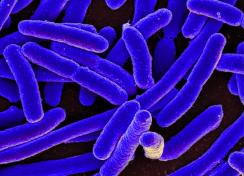
CDC E.coli

Image CDC Enter a caption

Increased use of ingredient-based analyses is being promoted by researchers after the method was used to identify the source of infection in an E. coli outbreak. 

Public Health England was alerted to an outbreak of Shiga toxin-producing E. coli (STEC) O157 phage type (PT) 34 in July 2016 involving 56 cases in England and Wales. The source of infection was baby-mixed leaf salad, which was an ingredient in multiple dishes.

“A traditional analysis may have resulted in multiple menu items being associated with illness, thereby failing to identify the true source of infection,” said researchers.


Research – Association of Escherichia coli O157:H7 with Houseflies on a Cattle Farm

American Society of Microbiology fly

The ecology of Escherichia coli O157:H7 is not well understood. The aims of this study were to determine the prevalence of and characterize E. coli O157:H7 associated with houseflies (HF). Musca domestica L. HF (n = 3,440) were collected from two sites on a cattle farm over a 4-month period and processed individually for E. coli O157:H7 isolation and quantification. The prevalence of E. coli O157:H7 was 2.9 and 1.4% in HF collected from feed bunks and a cattle feed storage shed, respectively. E. coli O157:H7 counts ranged from 3.0 × 101 to 1.5 × 10⁵ CFU among the positive HF. PCR analysis of the E. coli O157:H7 isolates revealed that 90.4, 99.2, 99.2, and 100% of them (n = 125) possessed the stx1, stx2, eaeA, and fliC genes, respectively. Large populations of HF on cattle farms may play a role in the dissemination of E. coli O157:H7 among animals and to the surrounding environment.

Norway – Norway reports E. coli outbreak: Investigation ongoing

Outbreak News Today 

Health officials in Norway are reporting an E. coli O157: H7 outbreak that has sickened six people since June.

The six patients reside in different counties–Akershus, Oslo, Vestfold, Hordaland and Trøndelag.

The Norwegian Institute of Public Health is cooperating with the municipal health service and the Norwegian Food Safety Authority and the Veterinary Institute to investigate whether the patients may have a common source of infection.

Interviews are conducted with the patients, and samples from the homes are taken to find the source of infection if possible. Investigative work can be complicated and take time, and in many cases it will not be possible to find the source of infection or to clarify whether it is a common source”, says Solveig Jore, senior adviser at the National Institute of Public Health.

UK- Scotland – No fatal accident inquiry over girl’s E. coli death

BBC News

There will not be a fatal accident inquiry (FAI) into the death of a three-year-old girl from Dunbartonshire following an E. coli outbreak in 2016.

The Crown Office had previously said South Lanarkshire-based Errington Cheese would not face prosecution over the child’s death.

The firm’s Dunsyre Blue was named the most likely source of the outbreak.

The Crown Office said it had considered “all the relevant matters” before ruling out an FAI.

A total of 26 cases of the same strain of E. coli O157 were identified between July and September 2016 as a result of the outbreak, which left 17 people requiring hospital treatment.


Research – A Novel Selective Medium for Simultaneous Enrichment of Shiga Toxin–Producing Escherichia coli and Salmonella in Ground Beef

Journal of Food Protection 


Microbiological analysis of ground beef for contamination by both Salmonella and Shiga toxin–producing Escherichia coli (STEC) is performed by the U.S. Department of Agriculture, Food Safety Inspection Service (FSIS), as part of its Performance Standards Verification Testing program. FSIS has established a zero tolerance for STEC serotype O157:H7 and serogroups O26, O45, O103, O111, O121, and O145 because they are regarded as adulterants. The detection and isolation of these specific serogroups presents a technical challenge necessitating time-consuming and costly laboratory procedures that often exceed the technical capabilities of many small internal and reference laboratories. We describe here a method using a novel STEC and Salmonella selective (SSS) broth that allows for simultaneous selective enrichment of STEC and Salmonella sp., providing isolation and detection from the same broth. The method only involves direct plating from beef enrichments to detect suspect isolates that can be easily confirmed by using immunoassays or PCR, rendering the isolation simpler and less costly than the current described methods. In a side-by-side comparison with modified tryptic soy broth (mTSB), the use of SSS broth resulted in primarily isolating STEC and Salmonella sp., while substantially suppressing the growth of other gram-negative Enterobacteriacae by 90%. Significantly more (χ2 < 3.84) samples containing E. coli O157:H7 and STEC O26, O111, O121, and O145 and a nondifferent (χ2 > 3.84) number of samples containing STEC O103 and O45 were identified when enriching in SSS broth. Coenrichment using six different Salmonella serovars showed numerically greater but not significant (χ2 < 3.84) positive samples by using SSS broth compared with mTSB for a majority of serotypes.

USA – Two E. coli Outbreaks in Tennessee Sicken 15

Food Poison Journal

The Knox County Health Department (KCHD) is concluding its investigation into a cluster of Escherichia coli (E. coli) O157 infections. Fifteen confirmed cases of E. coli O157 were reported to KCHD recently. All cases were among children, nine were hospitalized and seven developed a complication of the infection called Hemolytic Uremic Syndrome (HUS). Of the children who were hospitalized, one remains in fair condition at East Tennessee Children’s Hospital. Lab results from the Tennessee Department of Health have confirmed two different strains of E. coli O157 caused the children to become ill.


Research – Inactivation of Escherichia coli O157:H7 and Salmonella and Native Microbiota on Fresh Strawberries by Antimicrobial Washing and Coating

Journal of Food Protection Hepatitis A kswfoodworld

Antimicrobial washing (AW), antimicrobial coating (AC), and a combination of washing followed by coating (AW+AC) were evaluated for their ability to inactivate artificially inoculated foodborne pathogens and native microbiota on strawberries stored at 4°C. Strawberries were inoculated with a six-strain composite of Escherichia coli O157:H7 and Salmonella; treated by AW, AC, or AW+AC; and stored at 4°C for 3 weeks. The washing solution contained 90 ppm of peracetic acid, and the coating solution consisted of chitosan (1%, w/v), allyl isothiocyanate (1%, v/v), and corn-bio fiber gum (5%, w/v). The effectiveness of the antimicrobial treatments against E. coli O157:H7 and Salmonella pathogens and native microflora on strawberries and their impact on fruit quality (appearance, weight loss, color, and firmness) were determined. By the end of storage, pathogen populations on strawberries were 2.5 (AW+AC), 2.9 (AC), 3.8 (AW), and 4.2 log CFU for the positive (untreated) control. AW+AC treatments also inactivated the greatest population of native microflora, followed by the AC treatment alone. AW+AC treatments showed additional antimicrobial effectiveness against these two pathogens and native microflora. Both AW+AC and AC treatments preserved the color, texture, and appearance of strawberries throughout storage. The coating treatments (AW+AC and AC alone) further reduced the loss of moisture throughout storage. The AW treatment was the least effective in reducing populations of pathogens and native microflora and in maintaining the quality of strawberries throughout storage. This study demonstrates a method to improve the microbiological safety, shelf life, and quality of strawberries.

Research – Petting zoos as sources of Shiga toxin-producing Escherichia coli (STEC) infections

X-MOL

Despite their general low incidence, Shiga toxin-producing Escherichia (E.) coli (STEC) infections are considered an important public health issue due to the severity of illness that can develop, particularly in young children. We report on two Austrian petting zoos, one in Tyrol (2015) and one in Vorarlberg (2016), which were identified as highly likely infection sources of STEC infections. The petting zoo related cases involved a case of hemolytic uremic syndrome (HUS) due to STEC O157:HNM in 2015 and an outbreak of STEC O157:H7 infections affecting five young children and two adults in 2016. The HUS case accounted for 2.8% of the 36 STEC O157:HNM/H7 infections notified in Austria in 2015 (5,9% of 17 HUS cases). The seven cases described for 2016 accounted for 4.0% of the 177 human STEC infections documented for Austria in 2016, and for 19% of the 36 STEC O157:HNM/H7 infections notified that year. The evaluation of the STEC infections described here clearly underlines the potential of sequence-based typing methods to offer suitable resolutions for public health applications. Furthermore, we give a state-of-the-art mini-review on the risks of petting zoos concerning exposure to the zoonotic hazard STEC and on proper measures of risk-prevention.

A table of petting zoo outbreaks is available at http://www.barfblog.com/wp-content/uploads/2017/08/Petting-Zoo-Outbreaks-Table-7-26-17.xlsx

Canada – Food Recall Warning – Certain extra lean ground beef products recalled due to E. coli O157

CFIA

Recall details

Ottawa, June 29, 2018 – The Butcher’s Blend is recalling certain extra lean ground beef products from the marketplace due to possible E. coli O157 contamination. Consumers should not consume the recalled products described below.

Recalled products

Brand Name Common Name Size Code(s) on Product UPC
None Extra Lean Ground Beef Approx. 1 lb None – Sold by The Butcher’s Blend at the Western Fair District Farmer’s Market on June 16, 2018 None
Mitchell’s Butcher’s Blend / Old East Village Grocer Extra Lean Ground Beef Approx. 1 lb Best Before JUN 23/18 Starts with 0 200150
Mitchell’s Butcher’s Blend / Old East Village Grocer Extra Lean Ground Beef Approx. ½ lb Best Before JUN 23/18 Starts with 0 200150