Category Archives: Cyclosporiasis

CPS – Funded Research Projects 2022 – Cyclospora

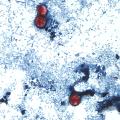
220px-Cyclospora_cayetanensis_stained

CPS

Cyclospora cayetanensis monitoring in agricultural water

The parasite Cyclospora Cayetanensis is producing illness in people consuming infected produce. Because this pathogen is in very low concentrations on actual produce, which makes it close to impossible to detect, and for prevention reasons, it is more effective to check for its presence in irrigation water, from where it is typically transferred on produce. However, even in water, this parasite is very difficult to detect. It only can be detected by lengthy molecular laboratory procedures such as PCR. One major problem for scientists to develop better and faster detection methods is the fact that there is no antibody or other recognition molecule that would be able to bind to the surface of this intact parasite.

We propose to design and synthesize, for the first time, aptamers, molecules that will be able to bind to intact Cyclospora Cayetanensis oocysts, and use them to design simple paper based colorimetric tests that can detect it in the field without the need of sample preparation or specialized laboratories. The paper based test will turn from pink to purple to indicate the water sample being tested is positive for this parasite, making this a very simple and easy to use detection method for Cyclospora Cayetanensis.

CPS

AFECCT: Assessing filtration efficacy for Cyclospora control

The reputation of growers and the health of consumers suffer when people contract foodborne illness from fresh produce contaminated with Cyclospora cayetanensis. Because filtration has been established as effective in concentrating parasites for environmental surveillance, we propose to establish how effectively filters remove such parasites from irrigation water. To achieve this, we will first conduct a series of filtration experiments using abundant parasites (of chickens) that pose no risk to the study team. We’ll then assess how well these filters reduce water contamination with Cyclospora. We will also determine whether any parasites surviving filtration are harmed in the process. We hope these findings will directly benefit growers seeking tools to mitigate risk, and hasten future research progress by validating a needed surrogate system for studying other interventions against this dangerous and enigmatic human parasite.
 

USA – Domestically Acquired Cases of Cyclosporiasis — United States, May–August 2021

CDC

cardcyclosporasme

LAST UPDATED SEPTEMBER 30, 2021 4:00 PM EDT

Cyclosporiasis illnesses are reported year-round in the United States. However, during the spring and summer months there is often an increase in cyclosporiasis acquired in the United States (i.e., “domestically acquired”). The exact timing and duration of these seasonal increases in domestically acquired cyclosporiasis can vary, but reports tend to increase starting in May. In previous years the reported number of cases peaked between June and July, although activity can last as late as September. The overall health impact (e.g., number of infections or hospitalizations) and the number of identified clusters of cases (i.e., cases that can be linked to a common exposure) also vary from season to season. Previous U.S. outbreaks of cyclosporiasis have been linked to various types of fresh produce, including basil, cilantro, mesclun lettuce, raspberries, and snow peas.

At a Glance
  • Illnesses: 1020
  • Hospitalizations: 70
  • Deaths: 0
  • States reporting cases: 36

CDC, along with state and federal health and regulatory officials, monitor cases of cyclosporiasis in the United States in the spring and summer months to detect outbreaks linked to a common food source. However, many cases of cyclosporiasis cannot be directly linked to an outbreak, in part because of the lack of validated laboratory “fingerprinting” methods needed to link cases of Cyclospora infection. Officials use questionnaires to interview sick people to determine what they ate in the 14-day period before illness onset. If a commonality is found, CDC and partners work quickly to determine if a contaminated food product is still available in stores or in peoples’ homes and issue advisories.

Final Update

  • In 2021, multiple outbreaks of cyclosporiasis cases associated with different restaurants or events were investigated by state public health authorities, CDC, and FDA.
    • CDC investigated two large multistate outbreaks of cyclosporiasisexternal icon, one including 40 illnesses and one with 130 illnesses, in which ill people reported eating various types of leafy greens. State officials and FDA conducted traceback investigations for these two outbreaks, but a specific type or grower of leafy greens was not identified as the source of either outbreak.
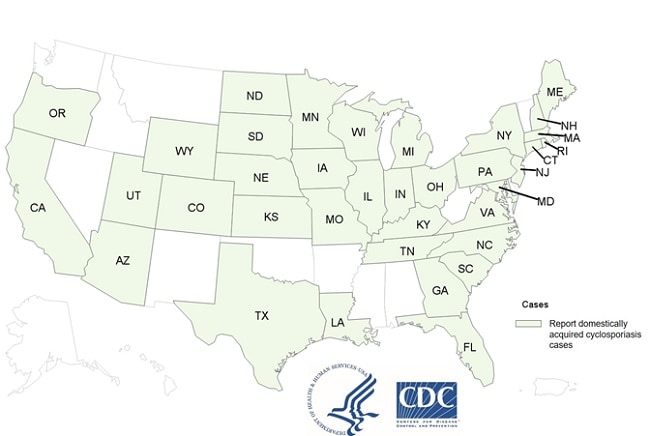
  • As of September 28, 2021, 1,020 laboratory-confirmed cases of cyclosporiasis in people who had no history of international travel during the 14-day period before illness onset have been reported to CDC by 37 jurisdictions, including 36 states and New York City, since May 1, 2021.
    • The median illness onset date is June 25, 2021 (range: May 1–August 31, 2021).
    • At least 70 people have been hospitalized; no deaths have been reported.

September 30, 2021

Geographic Distribution of Reported Cases of Domestically Acquired Cyclosporiasis—May 1 to August 31, 2021*

outbreak_map_season_9_30_21

* Data are current as of 09/28/2021 (9:00am EDT). States/jurisdictions highlighted on the map have each reported at least one case. New York State includes case reports from New York City. Data are preliminary and subject to change. For questions related to the number of cases reported in each state, contact that state’s health department.

USA – Cyclospora cases top 1000 in the US, 36 states reporting cases

Outbreak News Today

The Centers for Disease Control and Prevention (CDC) reported 156 additional Cyclospora cases in the past month, putting the total cases since May 2021.

The 1,020 laboratory-confirmed cases of cyclosporiasis were reported in people who had no history of international travel during the 14-day period before illness onset. Cases have been reported in 37 jurisdictions, including 36 states and New York City.

Seventy people required hospitalization for their illness.

USA- Core Investigation Table

FDA

4 Cases, Salmonella Oranienburg, Salmonella Thompson and two Cyclospora sources still unknown.

USA- FDA Core Investigation Table Updates

FDA

Cyclospora Increase

USA – Core Investigation Table Update

FDA

cyclo

Two Cyclospora outbreaks in the United States continue to grow, sickening at least 153 people, according to the FDA’s CORE Investigation Outbreak Table. Both investigations are active, but the government has not released any information about the outbreaks, including possible source, patient age range, illness onset dates, or if anyone has been hospitalised.

USA – Two Cyclospora Outbreaks Continue to Grow, Sickening 153

Food Poisoning Bulletin

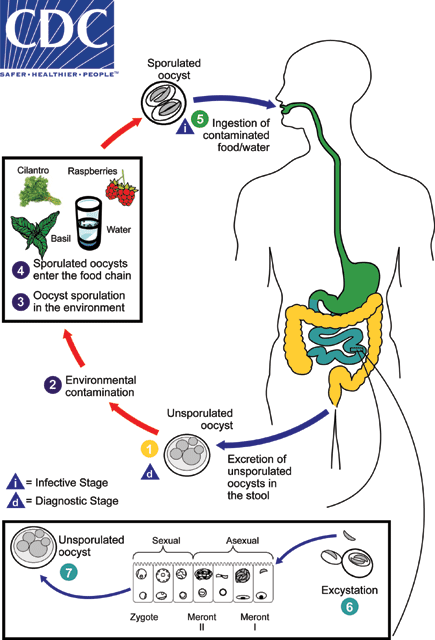
Cyclospora_LifeCycle201

Two cyclospora outbreaks in the United States continue to grow, sickening at least 153 people, according to the FDA’s CORE Investigation Outbreak Table. Both investigations are active, but the government has not released any information about the outbreaks, including possible source, patient age range, illness onset dates, or if anyone has been hospitalized.

USA – Core Table Update

FDA

Canada – Cyclospora investigation overview

PHAC

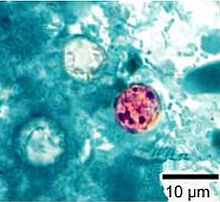
220px-Cyclospora_cayetanensis_stained

Cyclospora investigation overview (as of July 30, 2021)

Each spring and summer, Canada sees an increase in non-travel related Cyclospora illnesses reported to the Public Health Agency of Canada (PHAC). PHAC is working with its public health and food safety partners to identify possible ways infections are occurring in Canada. Previous Cyclospora illnesses have been linked to various types of imported fresh produce, including pre-packaged salad mix, basil, cilantro, berries, lettuce, and snow and snap peas. Learn more about the causessymptoms and risks of infection, as well as how to prevent and treat an illness.

At a glance
Investigation status Ongoing
Case count 48
Provinces/Territories
  • British Columbia (2)
  • Ontario (37)
  • Quebec (9)
Hospitalizations 1
Deaths 0
Gender 22 males
26 females
Age range in years 13 – 91
Recall NO
Public Health Notice NO

USA- US Cyclospora cases spike 254 to 462 – food source unknown

Food Poison Journal

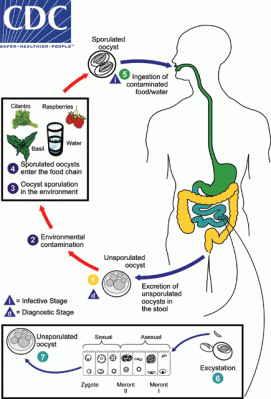
Cyclospora_LifeCycle201

The number of reported cases of domestically acquired cyclosporiasis illnesses has increased by 254 cases since the last update on July 14, 2021. Cases continue to be reported to CDC.

As of July 27, 2021, 462 laboratory-confirmed cases of cyclosporiasis in people who had no history of international travel during the 14-day period before illness onset have been reported to CDC by 29 jurisdictions, including 28 states and New York City.

At least 41 people have been hospitalized; no deaths have been reported.Cyclosporiasis illnesses are reported year-round in the United States; however, during the spring and summer months there is often an increase in cyclosporiasis acquired in the United States (i.e., “domestically acquired”).