Category Archives: Bacteria

Dairy Researchers Identify Bacterial Spoilers in Milk

Science Direct

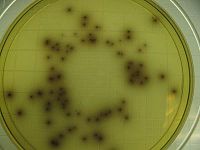
Milk undergoes heat treatment — pasteurization — to kill off microbes that can cause food spoilage and disease, but certain bacterial strains can survive this heat shock as spores and cause milk to curdle in storage.

Researchers in the Milk Quality Improvement Program at Cornell’s College of Agriculture and Life Sciences have identified the predominant spore-forming bacteria in milk and their unique enzyme activity, knowledge that can now be used to protect the quality and shelf life of dairy products.

“We studied 1,288 bacterial isolates in raw milk, pasteurized milk and the dairy farm environment; however, only a handful of strains accounted for 80 percent of the spore-formers present,” said Wiedmann. “They grow well in milk — and possibly other foods — at temperatures as low as 43 F, and we can identify Paenibacillus because of their uniquely high galactosidase enzyme activity at 32 C.”

Hong Kong – Infant Formula from Netherlands – Salmonella

Center for Food Safety

The Centre for Food Safety (CFS) today (July 19) urged parents not to let their toddlers consume a kind of powdered formula for young children manufactured in the Netherlands, which might contain Salmonella. The trade should also stop selling the product concerned.

“The CFS received notification from the Rapid Alert System for Food and Feed of the European Commission (EC) that a kind of dietary fibre (Galacto-oligosaccharide, GOS), produced in Korea, was detected with Salmonella by the Netherlands authorities,” a CFS spokesman said.

“Investigation revealed that the dietary fibre had been supplied to the manufacturers of powdered formula for infants/young children in the Netherlands. The powdered formula they produced may, therefore, also be contaminated,” he added.

Quoting the information provided by the EC, the spokesman said that one kind of powdered formula for young children, which might be affected, has been exported to Hong Kong. Details of the product concerned are as follows:

Product name: TwoBebes Growing up milk 3 (for children aged above 12 months)
Place of origin: Holland (The Netherlands)
Lot number: All batches
Net weight: 900g

“The CFS visited the offices of the importer for investigation and learnt that the retail outlets of the importer have stopped sale of the product concerned. The importer has also agreed to surrender all remaining stocks voluntarily for disposal,” the spokesman said.

“Staff from the CFS have also conducted checks at other retail outlets in the market and, so far, found no affected product available for sale,” he added.

The spokesman advised consumers who have bought the particular product, regardless of any batch, to stop consuming it. For enquiries about the recall, they may contact the importer, PrizeMart Limited, at 2406 8879. The trade should also stop selling the affected product.

People should seek medical treatment if they feel unwell after consuming the product. So far the CFS has not received any reports of persons feeling sick after consuming the product or complaints about it.

“Salmonella infection may cause fever and gastrointestinal upset such as vomiting, abdominal pain and diarrhoea. The effects on people with lowered immunity such as infants and young children could be more severe and sometimes may even lead to death,” the spokesman said.

“Caregivers should be aware that powdered formula for infants and young children is not a sterile product and can be contaminated with pathogens that can cause serious illness. Correct preparation and handling reduces the risk of illness. They should reconstitute milk powder with water not less than 70 degrees Celsius (water left for no more than 30 minutes after boiling) and then cool it down to a suitable temperature to feed infants and young children. Reconstituted milk should be consumed within two hours,” he added.

The trade has been alerted to the incident. The CFS will continue to monitor the situation and take appropriate follow-up action, the spokesman said.

RASFF – Euro Alerts – Salmonella/Listeria/Aflatoxins/Moulds

RASFF – Salmonella in Beefbugers in France sourced in Ireland.

RASFF – Listeria in Meat Spread in Poland

RASFF – Aflatoxin in instant cereals in the UK sourced in Nigeria.

Denmark – Moulds in Mayonnaise


CIFA – Recall – Onions – Listeria

CIFA

The Canadian Food Inspection Agency (CFIA) is warning the public not to consume the Gills Onions brand Fresh Diced Red Onions, Fresh Diced Yellow Onions, and Fresh Diced Celery & Onions because these products may be contaminated with Listeria monocytogenes.

There have been no reported illnesses associated with the consumption of these products.

NZ – Two Dead – Hospital Food – Listeria

NZHerald

Two people have died and three others have become ill in a listeria outbreak believed to have originated in hospital food in two different regions.The affected products have also been recalled from shops as they may contain the bacteria causing the disease.The two elderly women died after contracting listeria, a food-transmitted illness found in meat supplied to the Hawkes Bay Hospital.Two other people contracted the disease but recovered.

US – Non – O157 Testing Preliminary Results

Food Safety News

On June 4, food regulators began screening beef for six more strains of E. coli beyond the already-monitored E. coli O157:H7. Since that time, 110 samples of beef trim have been tested for non-O157 E. coli; 3 were found to be carrying these bacteria. 
 
USDA’s Food Safety and Inspection Service published these initial findings in a results chart this week. The three positive test results represented three different strains of E. coli: O45, O103 and O145, each of which was found once. No samples have yet tested positive for the other three strains: O26, O111 and O121.

CFIA – Salad Recall – Listeria monocytogenes

CFIA

The Canadian Food Inspection Agency (CFIA) and Sobeys Quebec Inc. are warning the public not to consume the Earth Greens brand Organic Italian Blend salad described below because the product may be contaminated with Listeria monocytogenes.

The affected product, Earth Greens brand Organic Italian Blend salad, product of USA, is sold in a 198 g plastic clamshell package bearing UPC 8 18431 00107 3, Best Before date 2012 JL 13, and lot code 2217915MI.

This product has been distributed in Quebec, New Brunswick, Nova Scotia, Newfoundland and Labrador, Ontario and Nunavut.

There have been no reported illnesses associated with the consumption of this product.

Poultry Irradiation ?

The Poultry Site

CANADA – A microbiologist with the University of Manitoba suggests the widespread adoption of irradiation of poultry could potentially reduce the number of incidents of foodborne illness in Canada by 25 per cent, writes Bruce Cochrane.

Food irradiation is the process of exposing food to ionizing radiation to kill any microorganisms or insects that might be present.

Dr Rick Holley, a food safety and food microbiology professor with the University of Manitoba, observes the association between poultry and campylobacter and salmonella is pretty significant.

FDA – Meatballs Recalled Listeria monocytogenes

FDA

SCARBOROUGH, Maine – Hannaford Supermarkets today alerted customers to a recall issued by New Jersey-based Buona Vita Inc. of three meatball products, due to possible contamination with Listeria monocytogenes.

The three products are all sold through the deli department: Homestyle Meatballs with Sauce, sold by the pound; Meatball Panini – cold, UPC # 941260723096; and Meatball Panini – hot, UPC # 94126072102.  Customers who purchased any of these products should not consume them, and may return the items to Hannaford for a full refund. Products subject to the recall have been removed from the shelves at Hannaford.

Buona Vita’s voluntary recall is part of a broader recall involving various frozen, ready-to-eat meat and poultry products produced by Buona Vita and sold to distributors nationwide.  The problem was discovered during microbiological testing by the Ohio Department of Agriculture and the U.S. Department of Agriculture’s Food Safety and Inspection Service.  No illnesses have been reported.

Oyster Bay Shellfish – Vibrio parahaemolyticus Outbreak

Food Poisoning Bulletin

The New York Department of Environmental conservation is advising food establishments to avoid using or selling shellfish harvested from areas in the town of Oyster Bay, N.Y. According to the Rhode Island Department of Health, harvesting is no longer allowed in that area because of an illness outbreak caused by Vibrio parahaemolyticus, a naturally occurring marine bacteria.