Category Archives: Research

Germany – E. coli in lamb and flour prompts warning in Germany

Food Safety News

Findings of E. coli in lamb and flour has triggered a warning from German authorities.

Basic rules of kitchen hygiene, such as using different cutting boards for raw meat and vegetables, should be followed. Proper cooking is one of the best ways to avoid food poisoning from E. coli.

As part of zoonosis monitoring in Germany in 2020, Shiga toxin-producing E. coli (STEC) were detected in 50 of 380 samples of fresh lamb.

Lamb from Germany was significantly more often STEC-positive than that from other countries with 36 of 190 samples positive compared to 12 of 177.

Consumers, especially small children, the elderly, the immunocompromised and pregnant women, should only consume lamb that has been well cooked, advised the Federal Office for Consumer Protection and Food Safety (BVL).

“An infection with STEC should not be underestimated. In children in particular, it can lead to the development of hemolytic uremic syndrome (HUS), which is often associated with acute kidney failure,” said Friedel Cramer, BVL president.

STEC was detected in 22 of 242 samples of wheat flour from milling operations. Consumers can minimize this risk by not eating raw dough, cake batter or other foods containing raw flour. E. coli was also found in six of 318 samples of raw milk soft cheese sold at retail, from wholesale and at import points.

In total, 94 isolates belonged to 28 different O serogroups with O146 as the most common while O157 was not detected.

UK – J Sainsbury Tackling Campylobacter

Sainsburys

12 January 2021

Our customers’ health and safety is of paramount importance to us. Working closely with our suppliers and farmers, we are committed to ensuring that levels of Campylobacter on our fresh chicken are kept as low as possible

Campylobacter is commonly found on chicken and can cause food poisoning if chicken isn’t prepared and cooked properly. It’s not yet possible to eliminate it from raw chicken, but we have been working hard to reduce levels.

From farm to fork

Smiley face

With our suppliers, we’ve been busy finding ways to tackle Campylobacter at every step of the food chain. This starts on the farm by trying to stop Campylobacter from colonising flocks, introducing novel thermal treatments in the factory as well as new convenient roast in the bag packaging.

Like other raw meats, chicken still needs to be handled with care, but lower levels of Campylobacter means improved safety for our customers when they are preparing chicken at home. We were the first retailer to include food safety advice on our products.

How are we doing?

We test nearly a thousand chickens a year to check on how we are doing, and we continue to make progress. We’ve achieved a target that was set by the UK Food Standards Agency (FSA), but are committed to continue making further improvements wherever we can. To do this, we need to find new solutions through further research and trials, working closely with our suppliers.

UK – M&S Campylobacter Results Q2 – 2021

Click to access campylobacter-q2-2021.pdf

Research – Reduction of Escherichia coli O157:H7, Listeria monocytogenes, and Salmonella on Whole Yellow Onions (Allium cepa) Exposed to Hot Water

Journal of Food Protection

In-home or food service antimicrobial treatment options for fresh produce are limited. Hot water treatments for whole (unpeeled) produce have been proposed, but data to support this practice for onions are not available. Separate cocktails of rifampin-resistant Escherichia coli O157:H7, Listeria monocytogenes, and Salmonella were cultured on agar and suspended in sterile water. The outer papery skin at the equator or root or stem ends of the whole yellow onions was spot inoculated at 6 log CFU per onion. After drying for 30 min and, in some cases, storage at 4°C for 6 days, onions were immersed in water at ca. 100°C for 5 s or 85°C for 10 to 180 s. No significant difference (P > 0.05) in the mean decline of Salmonella was found on onions that were exposed to hot water after drying the inoculum for 30 min or after storage at 4°C for 6 days. Exposure of whole onions at 100°C for 5 s reduced E. coli O157:H7 and L. monocytogenes populations by >5 log CFU per onion at all inoculum sites and Salmonella populations by >5 log CFU per onion at the stem end and equator but not consistently at the root end. Mean root-end reductions of ≥5 log CFU per onion of E. coli O157:H7, L. monocytogenes, and Salmonella were achieved consistently when the root end was fully immersed in 85°C hot water for 45 or 60 s except in a small number of cases (4 of 57; 7%) when the root end was oriented upward and above the water line during treatment. When onions were held at 85°C for 180 s with the root end above the water line in an uncovered water bath, no significant declines in Salmonella populations were observed; significant mean declines in Salmonella were achieved (mean, 5 log CFU per onion; range, 3.49 to 6.25 log CFU per onion) when the water bath was covered. Short exposure to hot water can significantly reduce pathogens on the surface of whole onions. Reductions are more consistent when the root end is submerged and when the water bath is covered.

HIGHLIGHTS
  • Short hot-water exposure significantly reduces pathogen populations on whole onions.
  • Salmonella reductions were greater at the stem and equator than at the root end.
  • Pathogen reduction was greater for fully submerged root ends in covered water baths.

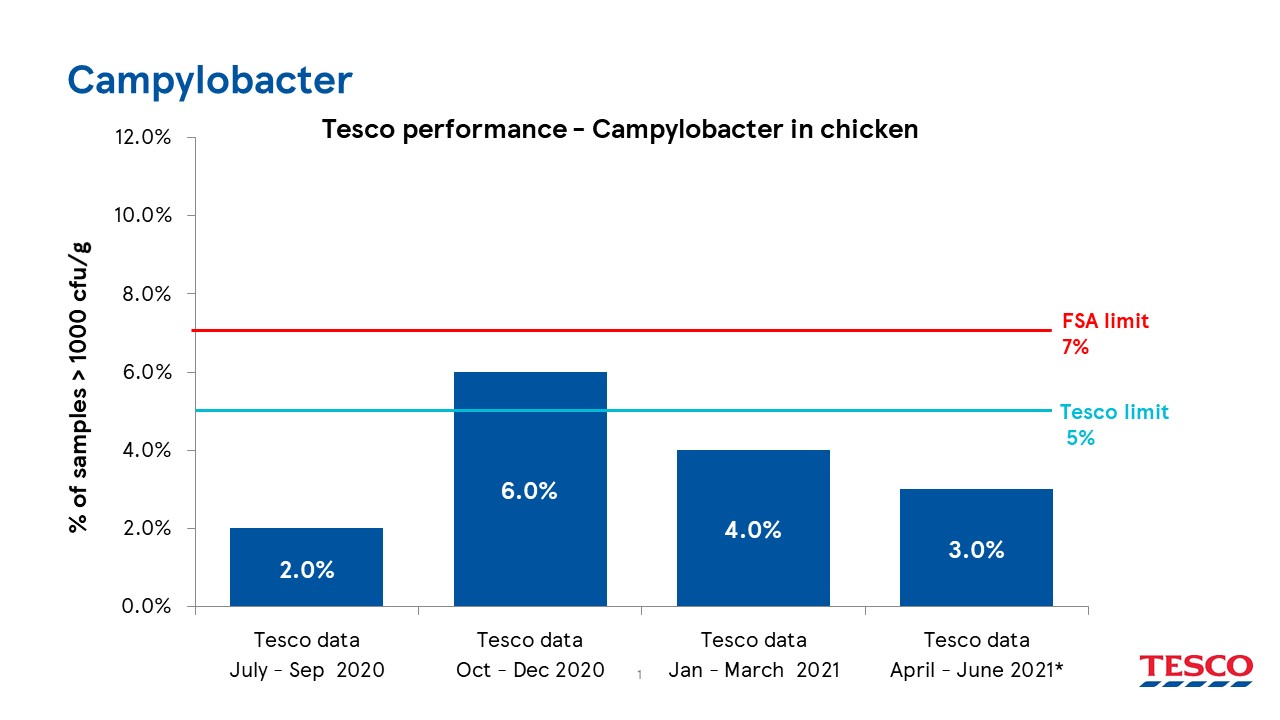
UK – Tesco Plan to Tackle Campylobacter

Lasted updated: August 2021

Campylobacter is a naturally occurring bacterium found in raw poultry that has the ability to cause food poisoning if the product is not cooked or handled correctly. Customers can keep safe by following the handling and cooking instructions provided on all Tesco raw poultry.

Providing high quality, safe food is always our absolute priority. It has long been our commitment to reduce levels of Campylobacter in our poultry and we are now seeing real progress at all stages of the supply chain, in tackling the issue through the work we have done with our suppliers.

Our Plan

We aim to remain at the forefront of progress on Campylobacter reduction and to ensure we deliver this we have introduced our own industry leading target- that at least 95% of chickens supplied to Tesco will have minimal levels of Campylobacter (less than 1000 cfu/g). This will enable us to help our customers be a safe as possible, whilst handling and cooking poultry.

  • All of our raw poultry contains safe handling information on packaging and cooking instructions are checked to ensure thorough cooking. For further information please visit our Real Food website: Food Safety in the Home

Our Performance

UK – Campylobacter chicken levels still high at small UK retailers

Food Safety News

The percentage of chicken sold at smaller retailers that is contaminated with high levels of Campylobacter remains above a Food Standards Agency target.

A UK-wide survey sampled 1,008 chickens from August 2019 to October 2020. It looked at levels of Campylobacter on whole fresh retail chickens from independent shops, butchers and smaller chains such as Iceland, McColl’s, Budgens, Nisa, Costcutter and One Stop.

Campylobacter was detected in 59.6 percent of the chicken skin samples from non-major retailers, and 12.8 percent of them were above 1,000 colony forming units per gram (CFU/g) of chicken skin. This continues to be higher than levels found in samples from the nine major retailers.

The highest single count was 89,000 CFU of Campylobacter per gram of skin. The proportion of highly contaminated chickens was the most for butchers compared to the stores that are part of smaller retail chains.

Rise from last survey
The Food Standards Agency (FSA) has a maximum acceptable level of no more than 7 percent of birds with more than 1,000 CFU/g of Campylobacter. In 2019, the UK reported 58,718 cases of campylobacteriosis with raw chicken meat identified as a key vehicle of infection.

Research – Prevalence of Listeria Species and Listeria monocytogenes on Raw Produce Arriving at Frozen Food Manufacturing Facilities

Journal of Food Protection

The ubiquity of Listeria monocytogenes in the environment affects the food industry and presents concerns for frozen food facilities. This study determined the prevalence and numbers of Listeria species and L. monocytogenes on raw produce arriving at frozen food facilities. Raw produce was collected using multilevel blinding protocols to ensure anonymity of participants and avoid traceback. Five raw vegetables were selected: corn, carrots, green beans, peas, and spinach. Raw products were collected after arrival at the facilities but before cleaning or other preprocessing steps that are typically performed inside the facility. The U.S. Food and Drug Administration’s Bacteriological Analytical Manual method for detection of Listeria spp. and L. monocytogenes was followed, with PCR screening followed by selective plating methods. Listeria numbers were estimated from positive samples using the most-probable-number (MPN) methodology. A total of 290 samples were collected, with 96 and 17 samples positive for Listeria spp. (33.1%) and L. monocytogenes (5.9%), respectively. Enumeration data for the 96 Listeria spp. samples indicated 82 samples had greater than 100 MPN of Listeria spp. per g and 14 samples had less than 100 MPN Listeria spp. per g. The prevalence of Listeria spp. varied by commodity: spinach (66.7%), peas (50%), corn (32.2%), green beans (22.2%), and carrots (13%). L. monocytogenes prevalence was determined in corn (13.6%), peas (6.3%), and green beans (4.2%) arriving at processing facilities. Such data were previously unavailable to frozen vegetable processors and are valuable in implementing process control standards. The prevalence and pathogen concentration data from raw commodities found in this study can provide the industry with information to conduct more accurate quantitative risk assessments and a baseline to model and target appropriate pathogen reduction steps during processing.

HIGHLIGHTS
  • Prevalence of Listeria spp. and L. monocytogenes in raw produce was determined.
  • 96 Listeria spp. and 17 L. monocytogenes samples were found from 290 produce samples.
  • 82 produce samples had >100 MPN/g and 14 samples had <100 MPN/g for Listeria spp.

Research – Impact of gas ultrafine bubbles on the potency of chlorine solutions against Listeria monocytogenes biofilms

Ultrafine bubble technology is a novel concept in food safety that can improve the potency of antimicrobials against biofilms. This study was conducted to evaluate the impact of gas (air, CO2, or N2) ultrafine bubbles incorporation in 100 and 200 ppm chlorine (Cl2) solutions to inactivate fresh Listeria monocytogenes biofilms on stainless steel. Listeria monocytogenes biofilms were grown on stainless steel coupons through static incubation at 37°C for 72 hr by immersing in L. monocytogenes inoculated brain heart infusion (BHI) broth. The coupons were treated by dipping in water or Cl2 solutions with or without ultrafine bubbles for 1 min. Random pre-determined areas on coupons were swabbed into Dey–Engley neutralizing broth before and after treatments and enumerated using BHI agar. Air and CO2 nanobubbles in 100 ppm Cl2 resulted in greater log reductions (5.0 and 4.9 log CFU/cm2, respectively) in L. monocytogenes biofilms compared with 100 ppm Cl2 without gas ultrafine bubbles (3.7 log CFU/cm2). Incorporation of air, CO2, and N2 ultrafine bubbles in water and 200 ppm Cl2 did not have any impact on the efficacy of biofilm inactivation.

Norway – Monitoring program 2021: Listeria in salmon slaughterhouses and on salmonids

Mattilsynet

The Norwegian Food Safety Authority has taken listeria samples from 60 slaughterhouses that the Institute of Marine Research has analyzed. The results show that Listeria is present in both the production environment and on fish in some salmon slaughterhouses.

Surveillance program is a measure that the Norwegian Food Safety Authority initiated to gain more knowledge about the segment following a salmonella outbreak in 2019 where 58 became ill after eating exotic dried fruit mixture.

What did we investigate? Listeria in the production environment in the salmon slaughterhouse and from fish that came in and went out of the slaughterhouse.

358 samples from 60 different salmon slaughterhouses (49 establishments and 11 boats):

  • 108 from the production environment
  • 47 from the surface to fish entering
  • 59 from the surface to fish at the last stage of production
  • 144 from raw material at the last stage of production
Period: September 1, 2020 – September 1, 2021
What were we looking for? Listeria monocytogenes
What did we find? Listeria monocytogenes was detected in 22 samples from nine of 49 salmon slaughterhouses (18%), of which 5 had several positive samples.

The 22 positive tests included:

  • 9 samples from the production environment
  • 4 samples of the surface of fish on their way into the slaughterhouse
  • 5 samples of the surface of fish
  • 4 product samples at the last stage of production.

Detection in end product at 6 of 49 (12%) salmon slaughterhouses. The product samples had low concentrations of L. monocytogenes (<10 CFU / g)

None of the slaughter boats had samples with findings of L. monocytogenes .

Norway – Audit of listeria measures in salmon slaughterhouse 2021


Mattilsynet


In 2021, the Norwegian Food Safety Authority carried out an inspection campaign in which establishments and vessels that slaughter salmonids were inspected for measures and routines to prevent the fish from becoming contaminated with the listeria bacterium.

What has been investigated? 63 establishments and vessels slaughtering salmonids.
Period: January 15 – September 1, 2021
What were we looking for?

Measures and routines to prevent the fish from becoming contaminated with the listeria bacterium.

The Norwegian Food Safety Authority’s checklist for the inspection contained these points:

  • Identify hazards
  • Management measures
  • Verification
  • Deviation treatment
  • Requirements for premises and equipment. Personal hygiene.
What did we find?

The inspection result shows that the hygienic standard in Norwegian salmon slaughterhouses is generally good.

  • 18 companies received a decision. These mainly concerned the management system, including hazard analysis, sampling plan and measures for the detection of Listeria.
  • One business was closed due to lack of reindeer husbandry and maintenance.
  • Otherwise, relatively few deficiencies were revealed in the hygienic practices of premises and equipment at the operations, where this was controlled.