Category Archives: LAB

RASFF Alert – Lactic Acid Bacteria – Tomato Ketchup

RASFF

Too high lactic acid bacteria in tomato ketchup from the Netherlands in Belgium, Curaçao, Germany, Suriname.

RASFF Alert- Lactic Acid Bacteria – Organic Follow on Formula

RASFF  – Organic follow-up formula containing non-authorized novel food lactic acid bacteria (Limosilactobacillus fermentum hereditum) from Germany

Research – Biocontrol of L. monocytogenes with Selected Autochthonous Lactic Acid Bacteria in Raw Milk Soft-Ripened Cheese under Different Water Activity Conditions

MDPI

Abstract

The effect of selected autochthonous Lactic Acid Bacteria (LAB) against Listeria monocytogenes was evaluated in two elaborations of soft-ripened cheese performed under high and low relative humidity (RH) elaborations, to achieve aw ranging from 0.97 to 0.94 in ripened cheeses. Two selected autochthonous strains of Lacticaseibacillus casei 31 and 116 were used. In each elaboration, 8 batches were physicochemically and microbiologically evaluated throughout the ripening process. The aw and pH decreased during ripening to final values ranging from 0.944 to 0.972 aw and 5.0 to 5.3 pH, respectively. LAB was the only microbial group that increased throughout the ripening in high and low RH elaborations. In batches that were uninoculated with LAB strains, L. monocytogenes was either maintained at the initial inoculation level or showed a slight reduction by the end of the ripening process. However, in LAB-inoculated batches in the two elaborations, steady decreases of L. monocytogenes were observed throughout maturation. L. casei 31 alone or in combination with strain 116 provoked reductions of 2 to 4 log CFU/g in L. monocytogenes over 60 days of ripening, which could be enough as a strategy for biocontrol to deal with the usual contamination by L. monocytogenes during cheese processing.

Research -The Impacts of Acidophilic Lactic Acid Bacteria on Food and Human Health: A Review of the Current Knowledge

Gov france

Abstract

The need to improve the safety/quality of food and the health of the hosts has resulted in increasing worldwide interest in acidophilic lactic acid bacteria (LAB) for the food, livestock as well as health industries. In addition to the use of acidophilic LAB with probiotic potential for food fermentation and preservation, their application in the natural disposal of acidic wastes polluting the environment is also being investigated. Considering this new benefit that has been assigned to probiotic microorganisms in recent years, the acceleration in efforts to identify new, efficient, promising probiotic acidophilic LAB is not surprising. One of these effots is to determine both the beneficial and harmful compounds synthesized by acidophilic LAB. Moreover, microorganisms are of concern due to their possible hemolytic, DNase, gelatinase and mucinolytic activities, and the presence of virulence/antibiotic genes. Hence, it is argued that acidophilic LAB should be evaluated for these parameters before their use in the health/food/livestock industry. However, this issue has not yet been fully discussed in the literature. Thus, this review pays attention to the less-known aspects of acidophilic LAB and the compounds they release, clarifying critical unanswered questions, and discussing their health benefits and safety.

Research – Meat Microflora and the Quality of Meat Products

MDPI

Meat and meat products are not only a source of nutrients for humans [1,2], but also an excellent substrate for the development of many microorganisms [3]. Fresh meat is always exposed to the action of many species of microorganisms, causing deterioration of its sensory quality and limiting its usefulness, both culinary and technological. The microbiological quality of meat is important both for consumers and from a safety point of view. Meat can be a habitat for saprophytic and pathogenic microorganisms that can deteriorate its quality or threaten the safety of consumers [1,4].
However, microorganisms present in meat products are not always a threat. Such microorganisms include lactic acid bacteria present in meat, which ferment sugars into lactic acid. This has a positive effect on the durability of the manufactured products. The presence and growth of lactic acid bacteria under controlled conditions have long been used in meat processing [5]. This enables the production of products with characteristic and desirable quality features, and at the same time with an extended shelf life. Running lactic acid fermentation processes in optimal conditions, however, often requires the use of highly selected microorganisms with precisely defined and stable characteristics. Such microorganisms are then deliberately introduced into meat in a certain amount during technological processes [5].
Due to the role played by starter cultures in meat products, they can be divided into the following groups: acidifying cultures, cultures supporting the curing process (denitrifying cultures) and stabilizing the curing color, cultures flavoring meat products and cultures stabilizing microbiological products (extending shelf life) [5,6].
A less durable raw material than the meat of animals is fish meat, which deteriorates faster and therefore should be frozen and stored at −20 °C. The cause of spoilage is most often psychrophilic microorganisms that develop at temperatures close to 0 °C. One way to improve the freshness and extend the shelf life of fish is multifunctional composite coatings. They are an interesting alternative to preserve the quality of fish fillets, but also to improve the quality of meat [7].
Appropriate use of selected strains of lactic acid bacteria may be useful in improving the microbiological quality of meat and meat products during storage. The purpose of this Special Issue was to compile original research and review papers covering various aspects of the impact of meat microflora on the quality characteristics and safety of meat and meat products.

Research – Special Issue: Beneficial Properties and Safety of Lactic Acid Bacteria

MDPI

The application of LAB in various sectors, including in the biotechnical and food industry, in human and veterinary practice, and in health-promoting practices and cosmetics, has been the subject of intensive research across the globe, with a range of traditional and innovative methods currently being explored. The rediscovery of old practices, the establishment of new processes based on the production and application of different metabolites produced by LAB, and the formation of novel perspectives on the fermentation processes initiated by LAB, have become areas of significant interest in recent years. Various antimicrobial peptides, including bacteriocins, have been proposed as alternatives to antibiotics or have been suggested for use as their synergistic “partners”. The application field of probiotics is being widened to encompass new innovative areas that are targeted towards personalized practice, with the aim of improving human health. An increasingly extensive understanding of bioactive peptides has heralded their application in practices that are alternative or complementary to Western medicine. Approaches to bio-preservation require fewer chemical preservatives and are, currently, thoroughly explored in food research. The enrichment and fortification of food products with biologically active metabolites, including vitamins, antimicrobials, and immunomodulators, are only some of the research areas that ought to be explored as options for the application of various LAB in the food industry.
The concepts associated with the beneficial properties and safety of LAB have been, and always need to be, jointly explored. Even if several LAB strains have been applied historically as safe and beneficial cultures, various other representatives of LAB have been documented as human and animal pathogens, as phytopathogens, and as also including strains associated with spoilage and deterioration [1]. LAB represent a universe of varied microorganisms, with all of them characterized as Gram-positive, catalase negative, as possessing a common metabolism and as initiating the formation of a similar end product (lactic acid) as a result of carbohydrate fermentation [2]. As a diverse group of microorganisms, they are adapted to various ecosystems and environmental conditions, and can grow at different temperatures and use a variety of carbon sources [1,2]. They are associated with virtually all living forms, from simple eukaryotic organisms and plant material, to the skin and GIT of vertebrates, insects, mollusks, crustaceans, etc. They may be described as either beneficial or as pathogens, but they always possess a clear ecological role in numerous life cycles [2]. Of particular note are species such as Enterococcus spp., some of which are unmistakably opportunistic pathogens and, when associated with vancomycin resistance, pose a serious health threat to humans and to animals [3]; these pathogens are typically associated with nosocomial infections [3]. Simultaneously, however, LAB also comprise species that play a beneficial role in the production of various plants, dairy and meat fermented food products [4], or even as probiotics [5]. It has been suggested that enterococci are producers of bacteriocins, some of which can be applied in the control of food-borne and hospital-associated (human and veterinary) pathogens [6]. However, before proposing a strain, even one belonging to a species with a history of safe application, its safety properties must be appropriately evaluated; this is a necessary and essential step that must be completed prior to its application in food fermentation, as a probiotic for human and animals, in human and veterinary medicine, or in agricultural practices. The novel tools utilized in the evaluation of the safety of microbial cultures, including DNA-associated experimental approaches, have become routine in the last two decades. Considering this, the validation of safety, both of new microbial and currently applied cultures, is now considered essential. In addition to “classical” PCR-based approaches, whole genome sequencing and the appropriate analysis of the generated data have become routine in the evaluation of the safety profile of microbial cultures [7,8,9].

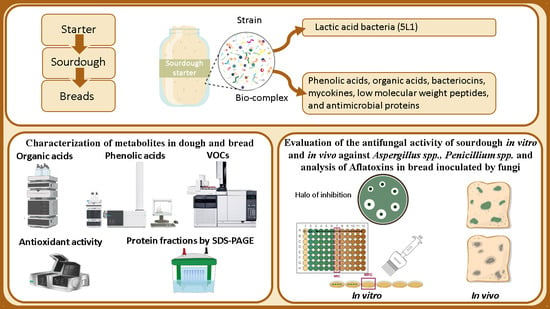
Research – Bread Biopreservation through the Addition of Lactic Acid Bacteria in Sourdough

MDPI

Abstract

Nowadays, the consumer seeks to replace synthetic preservatives with biopreservation methods, such as sourdough in bread. Lactic acid bacteria (LAB) are used as starter cultures in many food products. In this work, commercial yeast bread and sourdough breads were prepared as controls, as well as sourdough breads with L. plantarum 5L1 lyophilized. The impact of L. plantarum 5L1 on the properties of bread was studied. Antifungal compounds and the impact on the protein fraction by the different treatments in doughs and breads were also analyzed. In addition, the biopreservation capacity of the treatments in breads contaminated with fungi was studied and the mycotoxin content was analyzed. The results showed significant differences with respect to the controls in the properties of the bread and a higher total phenolic and lactic acid content in breads with higher amounts of L. plantarum 5L1. In addition, there was a higher content of alcohol and esters. Furthermore, adding this starter culture produced hydrolysis of the 50 kDa band proteins. Finally, the higher concentration of L. plantarum 5L1 delayed fungal growth and reduced the content of AFB1 and AFB2 compared to the control.

Research – Microbiological Changes during Long-Storage of Beef Meat under Different Temperature and Vacuum-Packaging Conditions

MDPI

Abstract

We evaluated a combination of two temperatures and two packaging materials for long-term storage of vacuum-packaged (VP) beef striploins. Microbial populations and microbiome composition were monitored during refrigerated storage (120 days between 0–1.5 °C) and refrigerated-then-frozen storage (28 days between 0–1.5 °C then 92 days at −20 °C) under low-O2 permeability VP and high-O2 permeability VP with an antimicrobial (VPAM). Pseudomonas (PSE) and Enterobacteriaceae (EB) counts in VPAM samples were significantly higher (p < 0.05) than in VP samples at 28, 45, 90, and 120 days of storage. Microbiome data showed that bacteria of the genera Serratia and Brochothrix were more abundant in VPAM samples at 120 days, while lactic acid bacteria (LAB) dominated in VP samples. Frozen temperatures inhibited microbial growth and maintained a relatively stable microbiome. Refrigerated and frozen VPAM samples showed the greatest difference in the predicted metabolic functions at the end of storage driven by the microbiome composition, dominated by PSE and LAB, respectively. Although no signs of visible meat deterioration were observed in any sample, this study suggests that VP meat refrigerated and then frozen achieved better microbiological indicators at the end of the storage period.

Research – Effects of UV-C Irradiation and Vacuum Sealing on the Shelf-Life of Beef, Chicken and Salmon Fillets

MDPI

Abstract

One-third of the world’s food supply is lost, with meat being a major contributor to this loss. Globally, around 23% of all meat and 35% of all seafood products are lost or wasted. Meats and seafood products are susceptible to microbial spoilage during processing, storage, and distribution, where microbial contamination causes significant losses throughout the supply chain. This study examined the efficacy of UV-C irradiation and vacuum-sealing in preventing microbiological deterioration in beef, chicken, and salmon fillets. The samples were sterilized using a constant UV-C irradiation dose of 360 J/m2 and stored under a reduced pressure of 40 kPa. A microbiological analysis was conducted daily to examine the microbial contamination, which included counting the colonies of Pseudomonas spp., aerobic bacteria, lactic acid bacteria (LAB), Salmonella, and Escherichia coli, as well as monitoring the increase in pH levels. The results demonstrated a statistically significant difference (p > 0.05) in the aerobic bacteria counts between the storage conditions and storage days in all samples, which is a primary indicator of microbial spoilage. In contrast, the differences varied in the Pseudomonas spp. and LAB counts between the storage conditions and storage days, and there was no significant difference (p < 0.05) in the pH levels between the storage conditions. The results indicate that the combination of UV-C irradiation and vacuum sealing effectively inhibits microbial growth and extends the shelf-life of beef, chicken, and salmon fillets by 66.6%.

Research – Bioprotective Lactic Acid Bacteria and Lactic Acid as a Sustainable Strategy to Combat Escherichia coli O157:H7 in Meat

MDPI

Abstract

Human infection by Enterohemorrhagic Escherichia coli (EHEC) constitutes a serious threat to public health and a major concern for the meat industry. Presently, consumers require safer/healthier foods with minimal chemical additives, highlighting the need for sustainable solutions to limit and prevent risks. This work evaluated the ability of two antagonistic lactic acid bacteria (LAB) strains, Lactiplantibacillus plantarum CRL681 and Enterococcus mundtii CRL35, and their combination in order to inhibit EHEC in beef (ground and vacuum sealed meat discs) at 8 °C during 72 h. The effect of lower lactic acid (LA) concentrations was evaluated. Meat color was studied along with how LAB strains interfere with the adhesion of Escherichia coli to meat. The results indicated a bacteriostatic effect on EHEC cells when mixed LAB strains were inoculated. However, a bactericidal action due to a synergism between 0.6% LA and LAB occurred, producing undetectable pathogenic cells at 72 h. Color parameters (a*, b* and L*) did not vary in bioprotected meat discs, but they were significantly modified in ground meat after 24 h. In addition, LAB strains hindered EHEC adhesion to meat. The use of both LAB strains plus 0.6% LA, represents a novel, effective and ecofriendly strategy to inactivate EHEC in meat.