Category Archives: food recall

USA – CDC Alert: Do Not Eat Romaine Lettuce, Throw It Out

CDC

Illustration with a triangle and exclamation mark and text reading Food Safety Alert

CDC, public health and regulatory officials in several states, Canada, and the U.S. Food and Drug Administration (FDA) are investigating a multistate outbreak of Shiga toxin-producing Escherichia coli O157:H7 (E. coli O157:H7) infections linked to romaine lettuce.

CDC is advising that U.S. consumers not eat any romaine lettuce, and retailers and restaurants not serve or sell any, until we learn more about the outbreak. This investigation is ongoing and the advice will be updated as more information is available.

  • Consumers who have any type of romaine lettuce in their home should not eat it and should throw it away, even if some of it was eaten and no one has gotten sick.
    • This advice includes all types or uses of romaine lettuce, such as whole heads of romaine, hearts of romaine, and bags and boxes of precut lettuce and salad mixes that contain romaine, including baby romaine, spring mix, and Caesar salad.
    • If you do not know if the lettuce is romaine or whether a salad mix contains romaine, do not eat it and throw it away.
    • Wash and sanitize drawers or shelves in refrigerators where romaine was stored. Follow these five steps(https://www.cdc.gov/foodsafety/communication/clean-refrigerator-steps.html) to clean your refrigerator.
  • Restaurants and retailers should not serve or sell any romaine lettuce, including salads and salad mixes containing romaine.
  • Take action(https://www.cdc.gov/vitalsigns/foodsafety-2015/index.html) if you have symptoms of an E. coli infection(https://www.cdc.gov/ecoli/ecoli-symptoms.html):
    • Talk to your healthcare provider.
    • Write down what you ate in the week before you started to get sick.
    • Report your illness to the health department.
    • Assist public health investigators by answering questions about your illness.

Advice to Clinicians

  • Antibiotics are not recommended(https://www.cdc.gov/ecoli/clinicians.html) for patients with E. coli O157 infections. Antibiotics are also not recommended for patients in whom E.coli O157 infection is suspected, until diagnostic testing rules out this infection.
  • Some studies have shown that administering antibiotics to patients with E. coli O157 infections might increase their risk of developing hemolytic uremic syndrome (a type of kidney failure), and the benefit of antibiotic treatment has not been clearly demonstrated.
 

Poland – Epidemiological update: Salmonella in eggs from Poland

ECDC

Since the joint ECDC-EFSA rapid outbreak assessment ’Multi-country outbreak of Salmonella Enteritidis infections linked to Polish eggs’ published on 12 December 2017, 15 EU/EEA countries (Belgium, Czech Republic, Denmark, France, Hungary, Iceland, Ireland, Italy, Luxembourg, Netherlands, Norway, Poland, Slovenia, Sweden and United Kingdom) have reported 336 confirmed, 94 probable and 3 new historical-confirmed cases associated with this ongoing multi-country outbreak of Salmonella Enteritidis in the EU/EEA. In the same period, seven historical probable cases were reclassified as excluded.

Overall, 1 412 cases have been found associated with this outbreak: 532 confirmed and 166 probable cases since 1 February 2017 and 343 historical-confirmed and 367 historical-probable cases between 2012 and 31 January 2017. In addition, no dates have been reported for four outbreak-confirmed cases, so they are unclassifiable as current or historical cases (Table 1).

Table 1. Distribution of cases by case classification and country, EU/EEA, February 2012 to November 2018 (n=1 420; 4 cases missing date of onset or sampling or receipt at reference laboratory), as of 12 November 2018

Reporting country Confirmed cases Probable cases Historical-confirmed cases Probable-confirmed cases Total number of cases
Belgium 0 46 14 127 187
Croatia 0 0 4 0 4
Czech Republic 0 6 0 3 9
Denmark 16 0 6 2 24
Finland 0 0 0 1 1
France 21 0 8 0 29
Greece 0 0 0 2 2
Hungary 0 29 0 5 34
Ireland 12 0 4 4 20
Ireland 1 0 0 0 1
Italy 0 12 1 19 32
Luxembourg 4 0 5 0 9
Netherlands 8 25 90 164 287
Norway 22 18 11 32 83
Poland 25 0 0 0 25
Slovenia 0 7 3 0 10
Sweden 11 20 12 2 45
United Kingdom 412 3 185 6 606
Total 532 166 343 367 1408
              698                 710


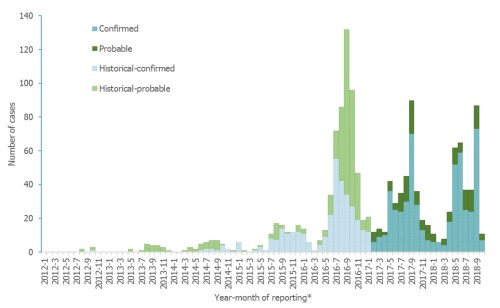
Most outbreak cases were reported during the summer months (Figure 1). Due to reporting delays, additional cases are expected to be reported with onset in recent months.

A total of 112 confirmed or historical-confirmed cases were reported with travel history in an EU country during the incubation period and therefore were likely infected there. Countries where infections likely took place were Poland (25 cases identified from 2016 to 2018), Bulgaria (22 cases from 2015 to 2018), Cyprus (14 cases in 2016 and 2018), Portugal (11 cases from 2015 to 2017) and Hungary (10 cases from 2016 to 2018). Additional travel-associated cases were also reported (<10 cases per country) with travel history to Austria, Belgium, Greece, Italy, the Netherlands, Romania, Slovenia and Spain.

Figure 1. Distribution of cases by month of onset* and case classification (n=1 412; 4 cases missing any date of report), EU/EEA, January 2012 to October 2018, as of 12 November 2018

aaaaa

The 2016 and 2017 European outbreak investigations identified eggs originating from Poland as the vehicle of infection in this outbreak (ECDC/EFSA rapid outbreak assessments published in March and December 2017). Outbreak-confirmed cases belong to four different WGS clusters.

Assessment

As reported in the previous ECDC/EFSA rapid outbreak assessment, in 2016 and 2017, evidence from epidemiological, microbiological, environmental and tracing investigations identified eggs originating from Poland as the vehicle of infections in this multi-strain outbreak. Control measures were implemented following these investigations. However, new outbreak cases were notified in 2017 and in 2018 with similar magnitude and temporal patterns. Based on the analysis of the travel-associated cases, it is likely that more countries where molecular typing is not performed routinely for human S. Enteritidis isolates are affected by the outbreak, including Bulgaria, Cyprus and Portugal.

Actions

ECDC monitors the occurrence of human cases associated with this threat and offers sequencing services for countries reporting probable cases of human S. Enteritidis isolates with MLVA profile 2-9-7-3-2 or 2-9-6-3-2 or
2-9-10-3-2 or 2-10-6-3-2 or 2-10-8-3-2 or 2-11-8-3-2. EU/EEA countries should consider interviewing new outbreak-confirmed cases.

USA – Green Cedar Ackawi Cheese Recalled for Possible Listeria

Food Poisoning Bulleting

Green Cedar Ackawi Cheese is being recalled for possible Listeria monocytogenes contamination. This cheese was distributed at retail locations in East Dearborn and Dearborn Heights, Michigan. No reports of illness connected to this issue have been received to date.

The Green Cedar Ackawi cheese is sold in a small clear plastic shrink wrapped package with a “sell by” date of March 26, 2019 or later. The “sell by” date is printed on a white sticker that is placed on the back of the product. The issue was discovered on November 9, 2018 during a routine inspection by the Michigan Department of Agriculture & Rural Development, Food & Dairy Division (MDARD) and the FDA.

If you bought this cheese, do not eat it, even if you plan to cook with it. Wrap the cheese in several layers of plastic wrap or foil so other people and animals can’t access it, and put it into a secure garbage can. You can take the cheese back to the store where you purchased it for a refund.

Pakistan – Karachi food poisoning: Sindh government takes charge after deceased’s family complains of inaction

Samaa TV

Sindh government swung into action after the parents of children who died after alleged food poisoning in Karachi complained that the government has done nothing for them.

On November 11, four-year-old Ahmad and one-and-an-half-year-old Muhammad died after eating ‘unhygienic food’ at Arizona grill – a restaurant in Karachi’s DHA.

USA – Clostridium perfringens in Brunswick Stew cause of Poplar Tent Presbyterian Church BBQ Outbreak

Food Poison Journal

South Africa – Durban eatery confirms Salmonella poisoned its patrons

Times Live

Old Town Italy confirms salmonella poisoning of more than 20 patrons two weeks ago .

A Durban eatery has confirmed that certain food samples submitted for laboratory testing have emerged positive for traces of salmonella.

Two weeks ago at least 20 people were hospitalised with suspected salmonella poisoning after eating at the popular Old Town Italy restaurant in Umhlanga.

Salmonella is most often contracted by eating raw or undercooked meat, poultry and eggs and causes diarrhoea, fever, chills and abdominal pain.

The restaurant has since completely removed hollandaise sauce – a mixture of egg yolk,melted butter and lemon juice – from its breakfast menu. In a statement posted on its Facebook page on Friday the restaurant said test results from two independent laboratories had been submitted to them.

“We can confirm the samples taken from our restaurant for the period 03 November 2018 to 09 November 2018 have tested positive for salmonella.

“However, it is important to highlight that the positive salmonella test results were limited to the hollandaise sauce, rocket and egg mix only.”

Ireland – Recall of a Batch of The Deli Green Pesto Due to Detection of Salmonella

FSAI

Summary
Category 2: For Information
Alert Notification: 2018.48
Product: The Deli Green Pesto; pack size: 140g
Batch Code: ‘Use-by’ date: 23.11.2018
Country Of Origin: Ireland

Message:

Aldi is recalling the above batch of its The Deli Green Pesto due to the detection of Salmonella. Point-of-sale recall notices will be displayed in Aldi stores.

Aldi The Deli Green Pesto

USA – Cap’n Crunch: Peanut Butter Crunch sold in select Target stores recalled due to Salmonella

Outbreak News Today

kswfoodworld Salmonella

The Quaker Oats Company, a subsidiary of PepsiCo, Inc., today announced a voluntary recall of a small quantity of Cap’n Crunch’s Peanut Butter Crunch cereal due to the potential presence of Salmonella.

While the potentially affected product only reached five specific Target stores and is limited to 21 boxes of one variety with two Best Before Dates, Quaker is initiating the voluntary recall to protect public health.

The recall was initiated as the result of a routine sampling program by the company, which revealed the finished product may contain bacteria.

For full details seethe link above

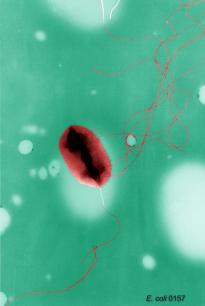
USA – Majestic Meat Company Recalls Ground Beef Products due to Possible E. Coli O157:H7 Contamination

FSIS USDA

kswfoodworld E.coli O157

Image CDC


WASHINGTON, Nov. 16, 2018 – Majestic Meat Company, a Salt Lake City, Utah establishment, is recalling approximately 532 pounds of ground beef products that may be contaminated with E. coli O157:H7, the U.S. Department of Agriculture’s Food Safety and Inspection Service (FSIS) announced today.

The bulk ground beef, ground beef patties, and meatballs were produced on November 8, 2018. The product list can be found here: [View Labels (PDF only)]

The products subject to recall bear establishment number “EST. 19915” inside the USDA mark of inspection. These items were shipped to restaurants in the state of Utah.

The problem was discovered on November 15, 2018 when FSIS identified that product associated with a sample that confirmed positive for E. coli O157:H7 had been shipped. The establishment held 2 of the 3 boxes of source material associated with the sampled product, however, the third box of source material was further processed and shipped.  There have been no confirmed reports of adverse reactions due to consumption of these products.

Anyone concerned about an injury or illness should contact a healthcare provider. E. coli O157:H7 is a potentially deadly bacterium that can cause dehydration, bloody diarrhea and abdominal cramps 2–8 days (3–4 days, on average) after exposure the organism. While most people recover within a week, some develop a type of kidney failure called hemolytic uremic syndrome (HUS). This condition can occur among persons of any age but is most common in children under 5-years old and older adults. It is marked by easy bruising, pallor, and decreased urine output. Persons who experience these symptoms should seek emergency medical care immediately.

USA – Swift Beef Company Recalls Ground Beef Products due to Possible E. Coli O157:H7 Contamination

FSIS USDA USDA

WASHINGTON, Nov. 17, 2018 – Swift Beef Co., a Hyrum, Utah establishment, is recalling approximately 99,260 pounds of raw non-intact ground beef products that may be contaminated with E. coli O157:H7, the U.S. Department of Agriculture’s Food Safety and Inspection Service (FSIS) announced today.

The bulk ground beef was produced on Oct. 24, 2018. The following products are subject to recall: [View Labels (PDF only)]

  • 2,000 lb. – bulk pallets of Swift Ground Beef 81/19 (81% lean) Fine Grind Combo bearing product code 42982.
  • 8-10 lb. – plastic wrapped chubs of “blue ribbon BEEF” Ground Beef 81/19 (81% lean) Coarse Grind bearing product code 42410.
  • 8-10 lb. – plastic wrapped chubs of “blue ribbon BEEF” Ground Beef 93/07 (93% lean) Coarse Grind bearing product code 42413.
  • 8-10 lb. – plastic wrapped chubs of “blue ribbon BEEF” Ground Beef 85/15 (85% lean) Coarse Grind bearing product code 42415.
  • 8-10 lb. – plastic wrapped chubs of “blue ribbon BEEF” Ground Beef 73/27 (73% lean) Coarse Grind bearing product code 42510.

The products subject to recall bear establishment number “EST. 628” inside the USDA mark of inspection. These items were shipped to retail distributors for further processing and food service distributors for institutional use in locations in California, Nevada, Oregon, Utah, and Washington.

The problem was discovered on November 15, 2018, when FSIS visited Swift Beef Company in response to a FSIS ground beef sample that was collected at a further processing establishment and was confirmed positive for E. coli O157:H7. FSIS confirmed that Swift Beef Company was the sole source supplier for the ground beef products. That affected product was recalled on Nov. 16 and information on that recall can be found here. There have been no confirmed reports of adverse reactions due to consumption of these products.