Category Archives: Food Microbiology Research

USA – 130 Las Vegas Elementary School Students ‘Projectile Vomiting’ After Mysterious Illness Outbreak

People

A gastrointestinal illness outbreak at a Las Vegas elementary school left at least 130 students “projectile vomiting”, according to local reports.

Teachers at the Wayne N. Tanaka Elementary School in Nevada asked the ill students to line up outside the school as they repeatedly “projectile vomited” during the incident on Jan. 27, according to 8 News Now.

Officials with the Clark County School District (CCSD) and Southern Nevada Health District (SNHD) have not said what caused the illness but confirmed they are investigating the incident.

A spokesperson for the Southern Nevada Health District (SNHD) told 8 News Now, “During a foodborne illness outbreak, people are interviewed about what they ate before they got sick when possible food contamination is confirmed using epidemiological and laboratory information.

“Gastrointestinal illnesses can have many causes,” the spokesperson added.

USA – Kerry Inc. Pleads Guilty and Agrees to Pay $19.228 Million in Connection with Insanitary Plant Conditions Linked to 2018 Salmonella Poisoning Outbreak

Justice

Food and ingredient manufacturing company Kerry Inc. pleaded guilty today to a charge that it manufactured breakfast cereal under insanitary conditions at a facility in Gridley, Illinois, that was linked to a 2018 salmonellosis outbreak.

Pursuant to a plea agreement filed with a criminal information in federal court in Peoria, Illinois, Kerry pleaded guilty to a misdemeanor count of distributing adulterated cereal marketed as Kellogg’s Honey Smacks. The company also agreed to pay a criminal fine and forfeiture amount totaling $19.228 million. If the guilty plea is accepted by the court, the $19.228 million fine and forfeiture will constitute the largest-ever criminal penalty following a criminal conviction in a food safety case.

“Consumers depend on food manufacturers to take appropriate steps to ensure food safety,” said Principal Deputy Assistant Attorney General Brian Boynton, head of the Justice Department’s Civil Division. “The Department is committed to holding accountable those who fail to meet this obligation.”

“Today’s announcement should serve as a reminder that food manufacturers have a critical responsibility to produce and sell food that is safe for American consumers to eat,” said Assistant Commissioner Justin D. Green for the Food and Drug Administration’s (FDA) Office of Criminal Investigations. “We will continue to pursue and bring to justice those who put the public health at risk by allowing contaminated foods to enter the U.S. marketplace.”

The criminal information unsealed today alleges that Kerry manufactured Kellogg’s Honey Smacks cereal under insanitary conditions and distributed it in violation of the Food, Drug, and Cosmetic Act. According to the plea agreement, tests performed as part of Kerry’s environmental monitoring program found numerous instances of Salmonella in the environment at the Gridley facility. During the time period June 2016 to June 2018, routine environmental tests detected Salmonella in the plant approximately 81 times, including at least one positive Salmonella sample each month. According to the plea agreement, employees at the Gridley facility routinely failed to implement corrective and preventative actions (CAPAs) to address positive Salmonella tests.

Research – Antibacterial and Anti-Biofilm Properties of Diopside Powder Loaded with Lysostaphin

MDPI

Abstract

Background: Diopside-based ceramic is a perspective biocompatible material with numerous potential applications in the field of bone prosthetics. Implantable devices and materials are often prone to colonization and biofilm formation by pathogens such as Staphylococcus aureus, which in the case of bone grafting leads to osteomyelitis, an infectious bone and bone marrow injury. To lower the risk of bacterial colonization, implanted materials can be impregnated with antimicrobials. In this work, we loaded the antibacterial enzyme lysostaphin on diopside powder and studied the antibacterial and antibiofilm properties of such material to probe the utility of this approach for diopside-based prosthetic materials. Methods: Diopside powder was synthesized by the solid-state method, lysostaphin was loaded on diopside by adsorption, the release of lysostaphin from diopside was monitored by ELISA, and antibacterial and anti-biofilm activity was assessed by standard microbiological procedures. Results and conclusions: Lysostaphin released from diopside powder showed high antibacterial activity against planktonic bacteria and effectively destroyed 24-h staphylococcal biofilms. Diopside-based materials possess a potential for the development of antibacterial bone grafting materials.

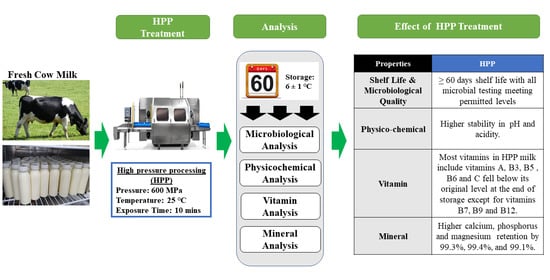
Research – Microbiological, Physicochemical and Nutritional Properties of Fresh Cow Milk Treated with Industrial High-Pressure Processing (HPP) during Storage

MDPI

Abstract

The safety, shelf life, and quality of fresh cow milk treated using industrial High-Pressure Processing (HPP) treatment at 600 MPa for 10 min was studied to identify the novelty of this non-thermal technology in milk processing. Changes in microbiological and physicochemical properties, including nutritional values of vitamins and amino acid profiles, were measured for a 60-day storage period at 6 °C +/− 1 °C. The HPP treatment produced milk that met all microbial safety requirements and exhibited a shelf life beyond 60 days in a hot and humid region. High physicochemical stability was achieved, with consistent pH and undetectable titratable acidity. The HPP treatment successfully retained all vitamins and minerals, including calcium (99.3%), phosphorus (99.4%), and magnesium (99.1%). However, the 60-day storage caused some degradation of Vitamin A (25%), B3 (91%), B5 (35%), B6 (80%), and C (85%), and minerals, including potassium (5%) and zinc (18%) when compared with fresh milk. This research has shown that the adoption of advanced treatment with HPP is very beneficial to the dairy industry in preserving milk quality in terms of its physicochemical and nutritional properties and extending its storage shelf life beyond 60 days.

Research – Far-UVC Radiation for Disinfecting Hands or Gloves?

MDPI

Abstract

(1) Background: Far-UVC radiation in the spectral range 200–230 nm has, according to previous findings, a strong antimicrobial effect on pathogens, but exhibits hardly any harmful effect on human skin. Therefore, the present study will discuss whether such radiation could also be suitable for hand disinfection in the healthcare sector. (2) Methods: Hands and gloves were microbially contaminated and exposed to radiation from a 222 nm krypton-chloride-excimer lamp. The applied doses were 23 mJ/cm2 and 100 mJ/cm2, respectively. Irradiated and non-irradiated hands and gloves were pressed onto agar plates and colonies were counted and compared after 24 h of incubation. For comparison, we also treated hands and gloves with a commercial liquid alcohol-based disinfectant. (3) Results: On the hand, the 23 mJ/cm2 resulted in the reduction of the observed colonies on the agar plates by one log level. For the gloves irradiated with 100 mJ/cm2, a colony reduction of 1.3 log levels was recorded. In the comparative experiments with the commercial disinfectant, a colony reduction of 1.9 and approximately one log level was observed on hand and gloves, respectively. (4) Conclusion: In both cases, far-UVC radiation provided a considerable reduction in microorganisms. However, compared to published far-UVC irradiation results in suspensions, the disinfection success on hands and gloves was rather low. With regard to the irradiation limits currently existing in the European Union, multiple daily hand disinfection with far-UVC radiation is actually legally not possible at present, but the thresholds are currently under discussion and could change in the future. Far-UVC disinfection of hands in gloves seems theoretically possible if attention is paid to potential perforations in the gloves.

Research – The Occurrence of Cryptosporidium spp. in Wild-Living Carnivores in Poland—A Question Concerning Its Host Specificity

MDPI

Abstract

Cryptosporidium is an apicomplexan protozoan parasite that primarily infects the gastrointestinal epithelium in humans and domestic and wild animals. The majority of studies have been focused on human, livestock, and pet infections. Hence, Cryptosporidium spp. in wildlife, including wild carnivores, remained neglected. There are several studies reporting the occurrence of Cryptosporidium spp. in wild foxes, but these are only a few molecular surveys; no data is available concerning the occurrence of this parasite in raccoon dogs and martens in Europe, and to the best of our knowledge to date, only one study has reported Cryptosporidium from badgers in Spain. Therefore, we used molecular analyses to identify and genotype Cryptosporidium spp. in wild-living mesocarnivores in Poland. A total of 322 individual fecal samples from six carnivore species, i.e., raccoon, raccoon dog, red fox, European badger, pine, and beech martens were collected and then analyzed for the presence of Cryptosporidium spp. using the nested PCR method. The appearance of PCR products in the reaction with Cryptosporidium-specific primers against the 18S rRNA and actin genes demonstrated that Cryptosporidium spp. occurred in 23.0% of all examined species of animals. Performed sequence analyses showed the presence of the Cryptosporidium skunk genotype, Cryptosporidium vole genotype II, Cryptosporidium canis dog and fox genotypes, as well as Cryptosporidium erinaceiCryptosporidium ditrichiCryptosporidium suis, and Cryptosporidium alticolis, in these hosts. Molecular data presented here indicate that examined mesocarnivores may be a significant reservoir of specific and non-specific Cryptosporidium species, including those with zoonotic potential. Most studies of carnivores have described the presence of non-specific Cryptosporidium spp. in carnivore hosts, and this is probably the result of the transfer of these parasites from prey species through the digestive tract or the transfer of the parasite from a contaminated environment.

Research – Impact of Pipe Material and Temperature on Drinking Water Microbiome and Prevalence of Legionella, Mycobacterium, and Pseudomonas Species

MDPI

Abstract

In drinking water distribution systems (DWDSs), pipe material and water temperature are some of the critical factors affecting the microbial flora of water. Six model DWDSs consisting of three pipe materials (galvanized steel, copper, and PEX) were constructed. The temperature in three systems was maintained at 22 °C and the other 3 at 32 °C to study microbial and elemental contaminants in a 6-week survey using 16S rRNA next-generation sequencing (NGS) and inductively coupled plasma-optical emission spectrometry (ICP-OES). Pipe material and temperature were preferentially linked with the composition of trace elements and the microbiome of the DWDSs, respectively. Proteobacteria was the most dominant phylum across all water samples ranging from 60.9% to 91.1%. Species richness (alpha diversity) ranking was PEX < steel ≤ copper system and elevated temperature resulted in decreased alpha diversity. Legionellaceae were omni-prevalent, while Mycobacteriaceae were more prevalent at 32 °C (100% vs. 58.6%) and Pseudomonadaceae at 22 °C (53.3% vs. 62.9%). Heterogeneity between communities was disproportionately driven by the pipe material and water temperature. The elevated temperature resulted in well-defined microbial clusters (high pseudo-F index) in all systems, with the highest impact in PEX (10.928) followed by copper (9.696) and steel (5.448). Legionellaceae and Mycobacteriaceae are preferentially prevalent in warmer waters. The results suggest that the water temperature has a higher magnitude of impact on the microbiome than the pipe material.

Research – Lysine-Derived Maillard Reaction Products Inhibit the Growth of Salmonella enterica Serotype Typhimurium

MDPI

Abstract

An emerging consumer trend to purchase minimally heated and ready-to-eat food products may result in processing methods that do not effectively reduce pathogenic populations. Crude Maillard reaction products (MRPs) are naturally generated compounds that have been shown to display antimicrobial effects against pathogens. Crude MRPs were generated from reducing sugars (fructose (Fru), glucose (Glc), ribose (Rib) or xylose (Xyl)) with lysine and the melanoidin equivalence was measured using an absorbance of 420 nm (Ab420). The relative antimicrobial activity of each MRP was measured by examining both the length of lag phase and maximum growth rate. MRPs were found to significantly shorten the lag phase and decrease the maximum growth rate of S. Typhimurium (p < 0.05). Glucose-lysine MRP (GL MRP) was determined to have the highest relative melanoidin (1.690 ± 0.048 at Ab420) and its efficacy against S. Typhimurium populations was measured at 37 °C and at pH 7.0 and estimated on xylose lysine deoxycholate (XLD) agar. GL MRP significantly reduced S. Typhimurium populations by >1 log CFU/mL at 8 and 24 h after inoculation (p < 0.05). GL MRPs also further decreased S. Typhimurium populations significantly under thermal stress condition (55 °C) compared to optimal (37 °C) by ~1 log CFU/mL (p < 0.05). Overall, GL MRP demonstrated effective antimicrobial activity against S. Typhimurium at 37 °C and 55 °C.

Research – Hurdle Technology Approach to Control Listeria monocytogenes Using Rhamnolipid Biosurfactant

MDPI

Abstract

This study evaluates the combination of mild heat with a natural surfactant for the inactivation of L. monocytogenes Scott A in low-water-activity (aw) model systems. Glycerol or NaCl was used to reduce the aw to 0.92, and different concentrations of rhamnolipid (RL) biosurfactant were added before heat treatment (60 °C, 5 min). Using glycerol, RL treatment (50–250 µg/mL) reduced bacterial population by less than 0.2 log and heat treatment up to 1.5 log, while the combination of both hurdles reached around 5.0 log reduction. In the NaCl medium, RL treatment displayed higher inactivation than in the glycerol medium at the same aw level and a larger synergistic lethal effect when combined with heat, achieving ≥ 6.0 log reduction at 10–250 µg/mL RL concentrations. The growth inhibition activity of RL was enhanced by the presence of the monovalent salts NaCl and KCl, reducing MIC values from >2500 µg/mL (without salt) to 39 µg/mL (with 7.5% salt). The enhanced antimicrobial activity of RL promoted by the presence of salts was shown to be pH-dependent and more effective under neutral conditions. Overall, results demonstrate that RL can be exploited to design novel strategies based on hurdle approaches aiming to control L. monocytogenes.

Research – Listeria monocytogenes, Escherichia coli and Coagulase Positive Staphylococci in Cured Raw Milk Cheese from Alentejo Region, Portugal

MDPI

Listeria monocytogenesEscherichia coli and Coagulase Positive Staphylococci in Cured Raw Milk Cheese from Alentejo Region, Portugal

Abstract

Traditional cheeses are part of the Portuguese gastronomic identity, and raw milk of autochthonous species is a common primary ingredient. Here, we investigated the presence of Listeria monocytogenes, Coagulase Positive Staphylococci (CPS) and pathogenic Escherichia coli, as well as of indicator microorganisms (E. coli and other Listeria spp.) in 96 cured raw milk cheeses from the Alentejo region. Whole genome sequencing (WGS) of pathogenic E. coli and Listeria spp. as well as antimicrobial resistance (AMR) screening of E. coli isolates was also performed. L. monocytogenes, CPS > 10cfu/g and Extra intestinal E. coli were detected in 15.6%, 16.9% and 10.1% of the samples, respectively. Moreover, L. monocytogenes > 102 cfu/g and Staphylococcal enterotoxins were detected in 4.2% and 2.2% of the samples, respectively. AMR was observed in 27.3% of the E. coli isolates, six of which were multidrug resistant. WGS analysis unveiled clusters of high closely related isolates for both L. monocytogenes and L. innocua (often correlating with the cheese producer). This study can indicate poor hygiene practices during milk collection/preservation or during cheese-making procedures and handling, and highlights the need of more effective prevention and control measures and of multi-sectoral WGS data integration, in order to prevent and detect foodborne bacterial outbreaks.