Category Archives: CDC

USA – CDC Now Tells Consumers to Avoid ALL Types of Romaine Lettuce Because of E. coli O157:H7 HUS Outbreak

Food Poisoning Bulletin Eurofins Food Testing UK

Consumers should now avoid all types of romaine lettuce, the CDC informed us, based on “new information” in the E. coli O157:H7 HUS outbreak that has sickened dozens in 16 states. That information came from Alaska, where an E. coli O157:H7 Outbreak at the Anvil Mountain  Correctional Center, which sickened 8 people, was linked to whole romaine lettuce heads.

USA – Multistate Outbreak of E. coli O157:H7 Infections Linked to Chopped Romaine Lettuce – CDC Update

CDC Eurofins Food Testing UK

What’s New?

  • Eighteen more ill people have been added to this investigation since the last update on April 13, 2018.
  • Five more states have reported ill people: Alaska, Arizona, California, Louisiana, and Montana.
  • Nine more hospitalizations have been reported, including two people who developed a type of kidney failure called hemolytic uremic syndrome.


Highlights

  • Information collected to date indicates that chopped romaine lettuce from the Yuma, Arizona growing region could be contaminated with E. coli O157:H7 and could make people sick.
    • At this time, no common grower, supplier, distributor, or brand has been identified.
  • Advice to Consumers(https://www.cdc.gov/ecoli/2018/o157h7-04-18/advice-consumers.html):
    • Consumers anywhere in the United States who have store-bought chopped romaine lettuce at home, including salads and salad mixes containing chopped romaine lettuce, should not eat it and should throw it away, even if some of it was eaten and no one has gotten sick. If you do not know if the lettuce is romaine, do not eat it and throw it away.
    • Before purchasing romaine lettuce at a grocery store or eating it at a restaurant, confirm with the store or restaurant that it is not chopped romaine lettuce from the Yuma, Arizona growing region. If you cannot confirm the source of the romaine lettuce, do not buy it or eat it.
  • Advice to Restaurants and Retailers(https://www.cdc.gov/ecoli/2018/o157h7-04-18/advice-consumers.html):
    • Restaurants and retailers should not serve or sell any chopped romaine lettuce, including salads and salad mixes containing chopped romaine lettuce, from the Yuma, Arizona growing region.
    • Restaurants and retailers should ask their suppliers about the source of their chopped romaine lettuce.
  • CDC, public health and regulatory officials in several states, and the U.S. Food and Drug Administration are investigating a multistate outbreak of Shiga toxin-producing Escherichia coli O157:H7 (E. coli O157:H7) infections.
  • 53 people infected with the outbreak strain of E. coli O157:H7 have been reported from 16 states.
    • 31 people have been hospitalized, including five people who have developed a type of kidney failure called hemolytic uremic syndrome.
    • No deaths have been reported.
  • This investigation is ongoing, and CDC will provide updates when more information is available.

USA – Timeline of Triple T and Fareway Salmonella Outbreak and Recall

Food Poison Journal

265 sick, 94 hospitalized and 1 death.

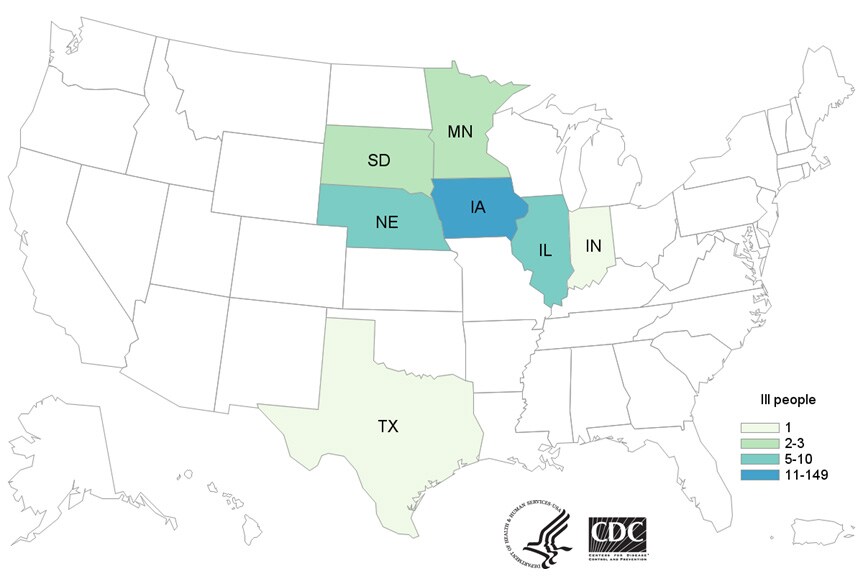
On February 21, 2018, Triple T Specialty Meats, Inc. recalled all chicken salad produced from January 2, 2018 to February 7, 2018. The recalled chicken salad was sold in containers of various weights from the deli at Fareway grocery stores in Illinois, Iowa, Minnesota, Nebraska, and South Dakota from January 4, 2018, to February 9, 2018.

The CDC recommends people do not eat any remaining recalled chicken salad sold at Fareway grocery stores, including any that has been frozen. Throw it away or return it to the place of purchase. Even if some of the chicken salad was eaten or served and no one got sick, throw the rest of it away, including any chicken salad in your freezer. Put it in a sealed bag in the trash so that children, pets or other animals can’t eat it. Wash and sanitize countertops as well as drawers or shelves in refrigerators or freezers where recalled chicken salad was stored. If you don’t remember the date when you purchased chicken salad from Fareway, don’t eat it. Throw it away or return it to the place of purchase.

USA – Salmonella Infections Linked to Chicken Salad – Case Count Maps

CDC

People infected with the outbreak strains of Salmonella Typhimurium, by state of residence, as of March 7, 2018 (n=170)

People infected with the outbreak strain of Salmonella Typhimurium, by state of residence, as of March 7, 2018


USA- Salmonella Infections Linked to Kratom – Case Count Maps

CDC

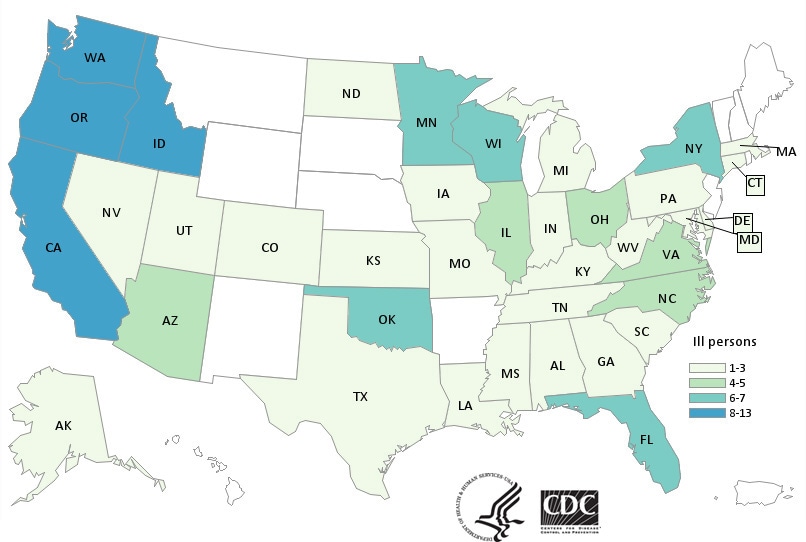
People infected with the outbreak strains of Salmonella I 4,[5],12:b:-, Javiana, Okatie, and Thompson, by state of residence, as of April 5, 2018 (n=132)

People infected with the outbreak strains of Salmonella, by state of residence, as of April 5, 2018


USA – UPDATE: Salmonella illnesses linked to recalled Natural Grocers organic coconut prompt suspension of production – Salmonella

Food Safety News

The CDC is working with several states to investigate an outbreak of Salmonella illnesses, an agency spokesperson said Monday evening. Earlier in the day the FDA posted a recall notice from Natural Grocers for its branded “Coconut Smiles Organic” because of Salmonella contamination.Six illnesses have been reported in connection with the Natural Grocers coconut, according to the company’s recall notice. The Lakewood, CO, company and the Food and Drug Administration both found Salmonella in packages of the coconut

Natural Grocers distributed the implicated “Coconut Smiles Organic” to 145 stores in 19 states.

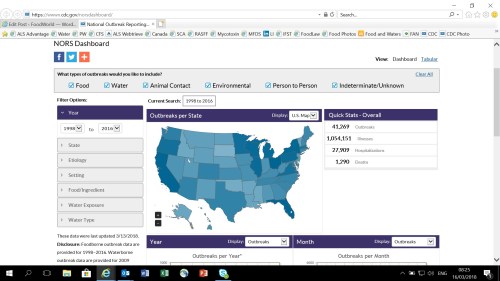
USA – CDC – National Outbreak Reporting System (NORS)

1aaa.jpgCDC


Research – New Norovirus Strain

Food Poisoning BulletinEurofins

Last year at this time we told you about a new strain of norovirus, called GII.4 Sydney that the CDC was tracking. Last week, the North Carolina Department of Health and Human Services issued a warning about an outbreak in that state.

The CDC has been studying this new strain. They now have information and statistics on the strain, and have analyzed data from outbreaks in five states.

USA – CDC New Tool For Food Safety in Restaurants

Food Poisoning BulletinE.coli O157

Almost half of all foodborne illness outbreaks that occur every year in the U.S. are associated with restaurants and delis. The CDC has released new findings and prevention tools to improve food safety in restaurants. Public health officials say that increased awareness and implementation of proper food safety in restaurants and delis may prevent many of the foodborne illness outbreaks reported every year in the U.S.

Education of restaurant workers and public health surveillance are two critical tools necessary in preventing these illnesses. Food preparation and handling practices, worker health policies, and hand-washing practices are some of the factors that are not reported during outbreaks. Carol Selman, head of the CDC’s Environmental Health Specialists Network team said, “inspectors have not had a formal system to capture and report the underlying factors that likely contribute to foodborne outbreaks or a way to inform prevention strategies and implement routine corrective measures to prevent future outbreaks.”

USA -CDC Update Foster Farms Salmonella Outbreak

CDCE.coli O157

As of November 15, 2013, a total of 389 persons infected with seven outbreak strains of Salmonella Heidelberg have been reported from 23 states and Puerto Rico.

40% of ill persons have been hospitalized, and no deaths have been reported.

Most ill persons (74%) have been reported from California.

Epidemiologic, laboratory, and traceback investigations conducted  by local, state, and federal officials indicate that consumption of Foster  Farms brand chicken is the likely source of this outbreak of Salmonella Heidelberg infections.