Monthly Archives: May 2018

Research – Good practices and microbiological quality of food contact surfaces in public school kitchens

Wiley Online

Abstract

The objective of this work was to analyze the hygienic and sanitary conditions of 52 school kitchens and to investigate the microbiological contamination of surfaces that contact food. A specific checklist was used to classify the units’ health risk. Microbiological samples were collected from utensils, bench, and equipment in 10 units to evaluate the contamination levels of these surfaces. In total, 3.8% of the evaluated units had a very low health risk, and 61.5% had a low sanitary risk, indicating that most of the sites were adequately sanitary. Important failures have been identified in the block of buildings and facilities. Inadequacies related to hand hygiene, the absence of the manual of good practices and environmental hygiene were also highlighted. Microbiological analyses resulted in high counts of aerobic mesophiles and enterobacteria. Intervention with the involvement of all the actors of the National School Feeding Program is suggested for improving the situation.

Practical applications

This study is important, since it carried out the survey of the information regarding the adoption of good practices and sanitary conditions in the food production in the school environment, considering the relevance of the subject and vulnerability of the attended public. In this way, such information may guide corrective and preventive actions in the face of observed situations.
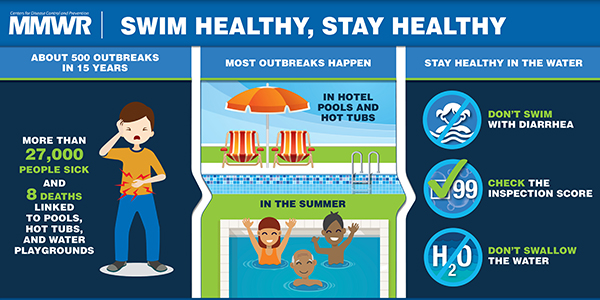
Research – Cryptosporidium, Pseudomonas and Legionella responsible for most outbreaks in swimming venues including hotel swimming pools

The figure is a visual abstract that details illnesses associated with recreational water and recommends how to stay healthy when swimming.

CDC-Outbreaks Associated with Treated Recreational Water — United States, 2000–2014

Outbreaks associated with exposure to treated recreational water can be caused by pathogens or chemicals in venues such as pools, hot tubs/spas, and interactive water play venues (i.e., water playgrounds). During 2000–2014, public health officials from 46 states and Puerto Rico reported 493 outbreaks associated with treated recreational water. These outbreaks resulted in at least 27,219 cases and eight deaths. Among the 363 outbreaks with a confirmed infectious etiology, 212 (58%) were caused by Cryptosporidium (which causes predominantly gastrointestinal illness), 57 (16%) by Legionella (which causes Legionnaires’ disease, a severe pneumonia, and Pontiac fever, a milder illness with flu-like symptoms), and 47 (13%) by Pseudomonas (which causes folliculitis [“hot tub rash”] and otitis externa [“swimmers’ ear”]). Investigations of the 363 outbreaks identified 24,453 cases; 21,766 (89%) were caused by Cryptosporidium, 920 (4%) by Pseudomonas, and 624 (3%) by Legionella. At least six of the eight reported deaths occurred in persons affected by outbreaks caused by Legionella. Hotels were the leading setting, associated with 157 (32%) of the 493 outbreaks. Overall, the outbreaks had a bimodal temporal distribution: 275 (56%) outbreaks started during June–August and 46 (9%) in March. Assessment of trends in the annual counts of outbreaks caused by Cryptosporidium, Legionella, or Pseudomonas indicate mixed progress in preventing transmission. Pathogens able to evade chlorine inactivation have become leading outbreak etiologies. The consequent outbreak and case counts and mortality underscore the utility of CDC’s Model Aquatic Health Code (https://www.cdc.gov/mahc) to prevent outbreaks associated with treated recreational water.

Hlavsa MC, Cikesh BL, Roberts VA, et al. Outbreaks Associated with Treated Recreational Water — United States, 2000–2014. MMWR Morb Mortal Wkly Rep 2018;67:547–551. DOI: http://dx.doi.org/10.15585/mmwr.mm6719a3

Research – National Costs Associated with Methicillin-susceptible and Methicillin-resistant S. aureus Hospitalizations in the United States, 2010–2014

Oxford Academic kswfoodworld mrsa

Abstract

Background

Infections caused by methicillin-resistant Staphylococcus aureus (MRSA) have been associated with worse patient outcomes and higher costs of care than susceptible (MSSA) infections. However, the healthcare landscape has changed since prior studies found these differences, including widespread dissemination of community-associated strains of MRSA. Our objective was to provide updated estimates of the excess costs of resistant S. aureus infections.

Methods

We conducted a retrospective analysis using data from the National Inpatient Sample from the Agency for Healthcare Research and Quality for the years 2010 to 2014. We calculated costs for hospitalizations including MRSA– and MSSA–related septicemia and pneumonia infections, as well as MRSA– and MSSA–related infections from conditions classified elsewhere and of an unspecified site (“other infections”). Differences in the costs of hospitalization were estimated using propensity score adjusted mortality outcomes for 2010 through 2014.

Results

In 2014, estimated costs were highest for pneumonia and sepsis-related hospitalizations. Propensity score-adjusted costs were significantly higher for MSSA–related pneumonia ($40,725 vs $38,561; p=0.045) and other hospitalizations ($15,578 vs $14,792; p<0.001) than for MRSA–related hospitalizations. Similar patterns were observed from 2010 to 2013, though crude cost differences between MSSA- and MRSA-related pneumonia hospitalizations rose from 25.8% in 2010 to 31.0% in 2014. MRSA-related hospitalizations had a higher adjusted mortality rate than MSSA-related hospitalizations.

Conclusions

Though MRSA infections had been previously associated with higher hospitalization costs, our results suggest that in recent years, costs associated with MSSA–related infections have converged with and may surpass costs of similar MRSA-related hospitalizations.

RASFF Alerts – Aflatoxin – Groundnuts – Almonds – Hazlenuts – Basmati Rice – Pistachios

kswfoodworld food safety poisoning

RASFF-aflatoxins (Tot. = 16.6 µg/kg – ppb) in groundnuts in shell from Egypt in Germany

RASFF-aflatoxins (Tot. = 45.8 µg/kg – ppb) in groundnuts in shell from Egypt in Germany

RASFF-aflatoxins (B1 = 40.7; Tot. = 44.1 µg/kg – ppb) in almonds from the United States in Italy

RASFF-aflatoxins (B1 = 825; Tot. = 1279 µg/kg – ppb) in groundnuts from Togo in Belgium

RASFF-aflatoxins (B1 = 9.1 µg/kg – ppb) in hazelnuts from Turkey in the UK

RASFF-aflatoxins (B1 = 5.13 µg/kg – ppb) in basmati rice from Pakistan in Italy

RASFF-aflatoxins (B1 = 24 µg/kg – ppb) in pistachios from Iran in Spain

RASFF Alert – Listeria monocytogenes – Chilled Bacon

kswfoodworld food safety poisoning

RASFF-Listeria monocytogenes (presence /25g) in chilled bacon from Poland in Poland

RASFF Alerts – Ochratoxin A – Paprika Powder – Raisins – Dried Raisins – Pistachios

kswfoodworld food safety poisoning

RASFF-ochratoxin A (31 µg/kg – ppb) in paprika powder from unknown origin in Germany

RASFF-ochratoxin A (15.2 µg/kg – ppb) in raisins from Turkey in Poland

RASFF-ochratoxin A (16 µg/kg – ppb) in dried raisins from the United Arab Emirates in Portugal

RASFF-ochratoxin A (460, 440 µg/kg – ppb) in pistachios from the United States in the Netherlands

RASFF Alert – Moulds – Broccoli Salad

kswfoodworld food safety poisoning

RASFF-broccoli salad from the Netherlands infested with moulds in Denmark

RASFF Alerts -Salmonella – Paprika Powder – Ground Cumin – Sesame Seeds – Sprouts – Food Supplement – Raw White Legged Shrimps – Salted Chicken Breast – Pork Burgers – Black Pepper – Chicken Meat Preparations

kswfoodworld food safety poisoning

RASFF-Salmonella (presence in 25g /25g) in salmonella in paprika powder from China in Spain

RASFF-Salmonella (presence /25g) in ground cumin from Spain in Belgium

RASFF-Salmonella (presence /25g) in sesame seeds from Sudan in Greece

RASFF-Salmonella (present /25g) in sprouts from France in the Netherlands

RASFF-Salmonella (presence /25g) in food supplement from France in France

RASFF-Salmonella (presence /25g) in sesame seeds from Sudan in Greece

RASFF-Salmonella (presence /25g) in frozen raw whiteleg shrimps (Penaeus vannamei) from Vietnam in the Netherlands

RASFF-Salmonella (in 1 out of 5 samples) in frozen salted chicken half breasts from Brazil in the UK

RASFF-Salmonella enterica ser. Lisboa (presence /25g) in sesame seeds from Sudan in Greece

RASFF-Salmonella (present /10g) in frozen pork burgers from Belgium in Belgium

RASFF-Salmonella (presence /25g) in black pepper from Vietnam in Spain

RASFF-Salmonella (in 1 out of 3 samples) in paprika powder from China in Spain

RASFF-Salmonella enterica ser. Newport (presence /25g) in frozen chicken breast fillet whith inner from Poland in Italy

RASFF-Salmonella (presence /25g) in sesame seeds from Nigeria in Cyprus

RASFF-Salmonella enterica ser. Indiana (presence /25g) in frozen chicken meat preparation from the Netherlands, via Germany in France

Research – Drug-resistant bacteria found in 25% of migrants to Europe

Cidrap

A new review of research on migrant populations in Europe has found that more than a quarter are infected or colonized with antibiotic-resistant bacteria, with evidence suggesting that the pathogens are being acquired along the migration route or in host countries.

The findings are from a review and meta-analysis of observational studies on antimicrobial resistance (AMR) in migrants conducted by researchers from Imperial College London and published yesterday in the The Lancet Infectious Diseases. The researchers also found that the prevalence of AMR carriage or infection was even higher among refugees and asylum seekers and in high-migrant community settings. But they did not find high rates of AMR transmission from migrants to host populations.

The findings come amid a recent wave of immigration that has brought more than 2 million migrants to Europe since 2015, an influx that’s been driven in part by conflicts and instability in the Middle East and Africa. The authors of the study suggest that the poor conditions that many migrants are exposed to in transit and in host countries—including crowded refugee camps and detention centers with poor sanitation and little access to healthcare—may promote the spread of antibiotic-resistant bacteria. The role of these settings in the spread of infectious diseases has been highlighted in previous studies.

“Poor social conditions in these settings, such as inadequate sanitation, overcrowding, and restricted access to health services (including antibiotics or vaccinations), favour the spread of antibiotic-resistant infections,” the authors write.

RASFF Alerts – Animal Feed – Salmonella- Soya for Feed – Poultry Meal – Fish Feed – Rapeseed Meal – Rapeseed Cake

kswfoodworld food safety poisoning

RASFF-Salmonella in soya for feed – multiple feed products from China, via the United Kingdom in the UK

RASFF-Salmonella (in 3 out of 5 samples /25g) in poultry meal from Italy in Belgium

RASFF-Salmonella (presence /25g) in complete feed for fish from Poland in Poland

RASFF-Salmonella enterica ser. Infantis (present in /25g) in rapeseed meal from Russia in Finland

RASFF-Salmonella (presence /25g) in rapeseed cake from Germany in Germany