
Category Archives: Uncategorized

Viet Nam – Bacterium Staphylococcus causes 42 percent of food poisoning

SGGP News

Staph


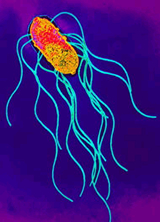
According to the Department of Food Safety in Ho Chi Minh City’s statistics, the bacterium Staphylococcus aureus (Staph) has caused 14 food poisoning cases accounting for 42 percent from 2010 to November, 2018.

The statistics showed that there has been 54 cases of food poisoning cases in the time.
Of these cases, 33 cases of food poisoning are caused by the organisms making up 61 percent, 14 cases are caused by toxic substances, two cases by chemicals accounting for 4 percent and two cases unverified equal to 4 percent.
People and animals have Staph on their skin and in their nose. Staph food poisoning is characterized by a sudden start of nausea, vomiting, and stomach cramps. Most people also have diarrhea. Symptoms usually develop within 30 minutes to 8 hours after eating or drinking an item containing Staph toxin,
To prevent food poisoning by the bacterium Staphylococcus aureus, the Department of Food Safety warned people with rhinitis or spots touch food materials.
Moreover, people should eat well-done food and drink boiled water; peel fruits before having and wash hand before and after toilets.
UK – Market Drayton man, 27, died eight days after being discharged from hospital – Food Poisoning

Shropshire Star

A Market Drayton man diagnosed at hospital and by Shropdoc with food poisoning died after days in agony due to complications from a twisted bowel, an inquest heard.

USA – Saranac Brand Foods Enjoined From Distributing Foods After Listeria Found in Plant

Food Poisoning Bulletin

A federal court has permanently enjoined Saranac Brand Foods of Saranac, Michigan from “preparing, processing, and distributing adulterated ready-to-eat foods,” according to a press release from the U.S. Department of Justice. The complaint was filed on November 29, 2018 at the request of the FDA, and the finding was entered today, Monday, December 3, 2018 by the United States District Court for the Western District of Michigan.

Canada – Updated Food Recall Warning – Soom brand tahini products recalled due to Salmonella

CFIA

Salmonella kswfoodworld

Recall details

Ottawa, November 29, 2018 – The food recall warning issued on November 28, 2018 has been updated to include additional product information. This additional information was identified during the Canadian Food Inspection Agency’s (CFIA) food safety investigation.

The Chef’s Warehouse is recalling Soom brand tahini products from the marketplace due to possible Salmonella contamination. Consumers should not consume the recalled products described below.

Recalled products

Brand Name Common Name Size Code(s) on Product UPC
Soom Chocolate Sweet Tahini Halva Spread 340 g 071318CH 7 91154 34932 8
Soom Sesame Premium Tahini 454 g 18-109, 18-121, and 18-123 7 18088 34741 1
Soom Sesame Premium Tahini 39.6 lb 18-109, 18-121, and 18-123 7 18088 34732 9

Research – Disposition of Salmonella and Escherichia coli O157:H7 following Spraying of Contaminated Water on Cucumber Fruit and Flowers in the Field

Journal of Food Protection cucumber

Cucumbers are frequently consumed raw and have been implicated in several recent foodborne outbreaks. Because this item may become contaminated at the farm, it is vital to explore the fate of attenuated Salmonella Typhimurium or Escherichia coli O157:H7 sprayed onto foliage, flowers, and fruit in fields and determine whether pre- or postcontamination spray interventions could minimize contamination. After spraying cucumber plants with contaminated irrigation water (3.8 log CFU/mL of Salmonella Typhimurium and E. coli O157:H7), 60 to 78% of cucumber fruit were not contaminated because the plant’s canopy likely prevented many of the underlying fruit from being exposed to the water. Subsequent exposure of contaminated cucumber plants to a simulated shower event did not appear to dislodge pathogens from contaminated foliage onto the fruit, nor did it appear to consistently wash either pathogen from the fruit. Spraying flowers and attached ovaries directly with a pathogen inoculum (4.6 log CFU/mL) initially led to 100% and 65 to 90% contamination, respectively. Within 3 days, 30 to 40% of the flowers were still contaminated; however, contamination of ovaries was minimal (≤10%), suggesting it was unlikely that internalization occurred through the flower to the ovary with these pathogen strains. In another study, both pathogens were found on a withered flower but not on the fruit to which the flower was attached, suggesting that this contaminated flower could serve as a source of cross-contamination in a storage bin if harvested with the fruit. Because pre- and postcontamination acetic acid–based spray treatments failed to reduce pathogen prevalence, the probability that fruit initially contaminated at 1.3 to 2.8 log CFU of Salmonella Typhimurium or E. coli O157:H7 per cucumber would be positive by enrichment culture decreased by a factor of 1.6 and 1.9 for Salmonella Typhimurium and E. coli O157:H7, respectively, for every day the fruit was held in the field (P ≤ 0.0001). Hence, to reduce the prevalence of Salmonella Typhimurium on cucumbers below 5%, more than 1 week would be required.

Research – Genetic Diversity of Salmonella and Listeria Isolates from Food Facilities

Journal of Food Protection

Food production–related facilities (farms, packing houses, etc.) are monitored for foodborne pathogens, and data from these facilities can provide a rich source of information about the population structure and genetic diversity of Salmonella and Listeria. This information is of both academic interest for understanding the evolutionary forces acting on these organisms and of practical interest to those responsible for controlling pathogens in facilities and to those analyzing data from facilities in the context of public health decision making. We have collected information about all positive isolates from facility inspections performed by the U.S. Food and Drug Administration for which whole genome sequencing data are available. The within- and between-facilities observed genetic diversity of isolates was computed and related to the common origin of isolates (as the common collected facility). This relationship provides quantification for assessing the relationship between isolates based on their genetic similarity quantified by single-nucleotide polymorphisms (SNPs). Our results show that if the genetic distance (D) between two isolates is low, then more likely than not they are from the same facility or have some overlap in their supply chain. For example, if the genetic distance is no more than 20 SNPs, the probability (P) that two isolates come from the same facility = 0.66 for Salmonella and 0.70 for Listeria. However, if two isolates come from different facilities, their genetic distance is likely large (for Salmonella, P(D > 20 SNPs) = 0.99982; for Listeria, P(D > 20 SNPs) = 0.99949); even if two isolates come from the same facility, their genetic distance is also very likely large (for Salmonella, P(D > 20 SNPs) = 0.794; for Listeria, P(D > 20 SNPs) = 0.692). These results provide insight into what SNP thresholds might be appropriate when determining whether two isolates are from the same facility and thus would be of interest to those investigating foodborne outbreaks and conducting traceback investigations.

Research – Study finds resistance levels not lower in antibiotic-free burger meat

CIDRAP

A new study by researchers with the US Department of Agriculture has found similar levels of antimicrobial resistance (AMR) in ground beef raised with and without antibiotics. The findings appeared in the Journal of Food Protection.

The authors of the study say the data, along with previous research they’ve done on AMR in conventionally raised and “raised without antibiotics” (RWA) cattle, suggest that antimicrobial use in US cattle production has “minimal to no impact on AMR in the resident bacteria.”

The finding comes at a time of heightened concern about the use of antibiotics in food-producing animals, who consume between 70% and 80% of medically important antibiotics sold worldwide, and how that use affects human health. The World Health Organization and other public health groups have called for limits on their use in livestock and poultry, arguing that widespread use of these drugs for growth promotion and disease prevention in healthy animals contributes to the emergence of drug-resistant pathogens, which can be transmitted to humans through meat.

Research – Characterization of Salmonella isolated from organically reared poultry located in the same longitude with three distinct seasonal characteristics

Wiley Online

Abstract

This study is designed to determine Salmonella prevalence in organic poultry farms and slaughterhouse in three different regions with distinct seasonal characteristics. Salmonella strains were isolated from organic reared poultry farm environment (water, feed, and feces) and poultry meat samples (neck skin and breast meat). Antibiotic resistance and 16S rRNA profiles were demonstrated with alignment scores. Salmonella spp. prevalences according to regions were, 51 of 200 (25.50%) samples taken from Region A, 77 of 200 (38.50%) samples taken from Region B, 105 of 200 (52.50%) samples taken from Region C. Serotyping of the strains revealed that S. Typhimurium and S. Enteritidis are the most dormant strains among all strains. Antibiotic susceptibility of the strains revealed that major resistance against ampicillin. This study is held for an awareness rising about the possible impact of seasonality related with food borne pathogens prevalence.

Practical applications

Poultry meat and meat products account for approximately one‐third of all Salmonella infections in humans. The relation between environmental temperature and foodborne pathogens is a complex matter, which has not been investigated widely and is hard to predict. The data obtained in this study indicate a significant high prevalence in warm region, which may be evaluated as a possible key for environmental temperature effect on foodborne pathogens distribution in organically reared poultry. In addition, this study provides important information to show the sources of contamination steps ranging from farm to fork in organically reared poultry

Research – Thermal Inactivation of Listeria monocytogenes in Crab Meat

Journal of Food Protection

Listeria monocytogenes is an important bacterial pathogen in seafood products, but limited information is currently available on the thermal resistance of relevant isolates in seafood. Thermal inactivation studies were undertaken (i) to provide much needed thermal inactivation data for L. monocytogenes in crab meat and (ii) to investigate whether tryptone soya broth (TSB) is representative of crab meat in thermal inactivation studies involving L. monocytogenes. D-values were obtained for a cocktail of two crab isolates (serotypes 1/2a and 4b) at 50, 55, and 60°C. In crab meat, D-values were 174.4, 28.2, and 1.6 min, respectively. Similar D-values of 176.4, 28.8, and 1.4 min were obtained in TSB. The corresponding z-values were 4.9°C (crab meat) and 4.8°C (TSB), respectively. The conclusions were that (i) current pasteurization conditions (e.g., 70°C for 2 min) would achieve complete destruction of any L. monocytogenes present in crab meat and (ii) TSB could be used as a model matrix for assessing the thermal inactivation of L. monocytogenes in crab meat.

Research – Analysis of Bacillus cereus cell viability, sublethal injury, and death induced by mild thermal treatment

Wiley Online Library bacillus

Abstract

As the most cost‐effective tool to ensure microbial safety, thermal processing induces a large portion of sublethal injury presenting a potential hazard to food safety. Thermal treatment at 63 °C for 1 min injured 2.22 log cfu/ml totally, half of which were sublethally injured using plate counting method. After 2 min, the inactivation log of Bacillus cereus reached 1.55 while the sublethally injured log even reached 2.16. As for the sublethally injured rate of the B. cereus, it was over 65% after 0.5 min and kept ever‐increase with time. In the end, the injured rate arrived at 99.30% after 2 min processing time. Partial esterase enzyme inactivation was found after 0.5 min heat treatment with flow cytometry combining carboxyfluorescein diacetate/propidium iodide (PI) double‐staining, but B. cereus was not dyed by PI at 63 °C. Comparing with the initial protein concentration of 0.57 ± 0.02 μg/ml, the leakage of the protein was not so notable though the general trend was increasing with duration of heat. Scanning and transmission electron microscopy analysis revealed that a portion of cells morphology and structure had changed after thermal process.

Practical applications

Bacillus cereus is an endospore forming pathogenic, causing foodborne illnesses and outbreaks all over the world. This research indicated that thermal treatment at 63 °C was a sublethal stress for B. cereus that a portion of cells were sublethally injured which could resume growth in suitable condition and might exist potential safety hazard if used for food pasteurization.