Category Archives: Technology

Research – The Bactericidal Efficacy and the Mechanism of Action of Slightly Acidic Electrolyzed Water on Listeria monocytogenes’ Survival

MDPI

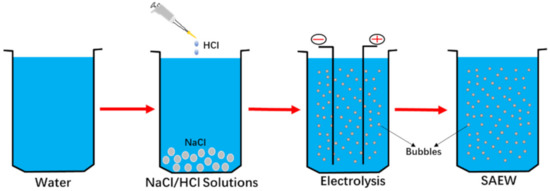
In the present work, the bactericidal efficacy and mechanism of slightly acidic electrolyzed water (SAEW) on L. monocytogenes were evaluated. The results showed that the strains of L. monocytogenes were killed completely within 30 s by SAEW whose available chlorine concentration (ACC) was higher than 12 mg/L, and it was confirmed that ACC is the main factor affecting the disinfection efficacy of SAEW. Moreover, our results demonstrated that SAEW could destroy the cell membrane of L. monocytogenes, which was observed by SEM and FT-IR, thus resulting in the leakage of intracellular substances including electrolyte, protein and nucleic acid, and DNA damage. On the other hand, the results found that SAEW could disrupt the intracellular ROS balance of L. monocytogenes by inhibiting the antioxidant enzyme activity, thus promoting the death of L. monocytogenes. In conclusion, the bactericidal mechanism of SAEW on L. monocytogenes was explained from two aspects including the damage of the cell membrane and the breaking of ROS balance. View Full-Text

Research – The combined effect of green tea and peppermint oil against pathogenic bacteria to extend the shelf life of eggs at ambient temperature and the mode of action

Wiley Online

This work investigated the antimicrobial activities of green tea (GT) at 5 and 10.0% wt/vol and peppermint oil (PP) at 0.1, 0.15, and 0.2% wt/vol against major pathogen bacteria (Escherichia coliSalmonella enteritidis, and Staphylococcus aureus) found on eggs at room temperature (30°C). The quality factors (weight loss, Haugh unit, albumen pH, egg yolk, and albumen index) of treated eggs were also measured while they were stored at room temperature for 14 days. A 9-point hedonic scale was used for sensory evaluation. Scanning electron microscopy was used to examine the morphology of bacteria cells to understand this study’s mechanism of action. It was found that combining 10% GT and 0.15% PP had complete antibacterial activity against all pathogenic bacteria investigated, and could extend the shelf life of treated eggs from 7 days (control) to at least 14 days. The treated egg’s coliforms (≤3.0 log10 colony-forming unit [CFU] g−1), Ecoli (≤1.8 log10 CFU g−1), TVC (≤4.3 log10 CFU g−1), Salmonella spp., (not detected in 25 g), and Saureus (not detected in 25 g) were better able to meet the microbiological criteria for egg after 14 days of storage, when compared to the control, which exceeded the criteria within 7 days. In addition, consumers rated egg acceptability as favorable by giving a sensory score ranging from like slightly to like moderately (~6.7). Furthermore, when compared to the control (6–7 days), all treated eggs retained their quality during storage for 14 days and met the microbiological criteria for egg in food standard (<4.7–6.0 log10 CFU g−1 for total visible count). Compound leakage from within the bacteria, which was the mode of action when GT and PP were combined, resulted in a wrinkled appearance of bacteria cells and serious defects in bacteria membrane morphology. These findings suggest that a sanitizing spray derived from GT and PP can extend the shelf life of eggs and ensure their safety for human consumption at room temperature without using a refrigerator.

Research – Survival of Salmonella enterica in Military Low Moisture Food Products during Long Term Storage at 4°C, 25°C and 40°C

Journal of Food Protection

Salmonella enterica  has been increasingly implicated in foodborne outbreaks involving low moisture foods (LMF) during the recent decade. This study aimed to investigate the potential for persistence of  Salmonella enterica  in a range of low moisture foods (LMF) during storage at 3 temperatures. LMF products, boil-in-bag eggs (freeze dried product), chocolate protein drink, cran-raspberry first strike bars, mocha dessert bar, and peanut butter, were inoculated with a five strain cocktail of S. enterica and stored at 4°C, 25°C, or 40°C for 36 mos. Salmonella populations remained above 7 log CFU/g in all products stored at 4°C and above 6 log CFU/g in products stored at 25°C excluding the cran-raspberry bars. Storage at 40°C resulted in Salmonella populations above 5.5 log CFU/g in boil-in-bag eggs after 36 mos and demonstrated survivability for 12 mos or less in the other five products.  Additionally, a mocha bar production temperature profile study identified rapid cooling of bars in which the temperatures reached would have no measurable impact on  Salmonella  populations. The results indicate the ability of  Salmonella  to survive in a variety of LMF category foods even under adverse storage conditions and identifies how the food matrix may affect  Salmonella  survivability. The data indicate the importance of establishing food processing procedures that adequately mitigate the presence of Salmonella throughout food processing systems while also increasing comprehensive understanding of Salmonella survivability mechanisms.

Research – Nisin-based antimircobial combination with cold plasma treatment inactivate Listeria monocytogenes on Granny Smith apples

Science Direct

Abstract

A nisin-based antimicrobial and cold plasma combination treatments in reducing Listeria monocytogenes inoculated on apple surfaces purchased from a New Jersey farm and a supermarket in Philadelphia area was investigated. All apples were spot inoculated or by submersion in 107 CFU/ml L. monocytogenes inoculum. Populations of L. monocytogenes recovered on farm and supermarket apples after spot inoculation averaged 5.8 ± 0.24 log CFU/g and 4.6 ± 0.12 log CFU/g, respectively and 4.1 ± 0.22 log CFU/g and 3.6 ± 0.12 log CFU/g, respectively on submerged apples. All apples were treated with antimicrobial solution for 30 s, 40 s, 3 min (180s) and 1 h (3600 s), cold plasma treatments for 30 and 40s, and a combination of antimicrobial and cold plasma treatments and the surface structure of apples were examined using scanning electron microscopy (SEM). Cold plasma treatment at 40s, followed immediately with antimicrobial treatments at 180s and 3600 s led to 2.5 and 4.6 log CFU/g inactivation of L. monocytogenes, respectively. SEM observation showed changes on apple surface structures but not on bacterial cell structure. This result suggests that this combination treatments is effective in killing L. monocytogenes on apple surfaces.

Research – Use of Acetic Acid to Partially Replace Lactic Acid for Decontamination against Escherichia coli O157:H7 in Fresh Produce and Mechanism of Action

MDPI

Escherichia coli O157:H7 is frequently detected in ready-to-eat produce and causes serious food-borne diseases. The decontamination efficacy of lactic acid (LA) is clearly established. In this study, LA was mixed with acetic acid (AA) to reduce costs while achieving consistent or better inhibitory effects. Time-kill curves and inoculation experiments using fresh-cut spinach and arugula indicated that 0.8%LA+0.2%AA shows similar antibacterial effects to those of 1%LA. To determine whether 1%LA and 0.8%LA+0.2%AA exert antibacterial effects by similar mechanisms, proteomics analysis was used. The proteins related to macromolecule localization, cellular localization, and protein unfolding were uniquely altered after the treatment with 1%LA, and the proteins related to taxis, response to stress, catabolic process, and the regulation of molecular function were uniquely altered after the treatment with 0.8%LA+0.2%AA. Based on these findings, combined with the results of a network clustering analysis, we speculate that cell membrane damage is greater in response to LA than to 0.8%LA+0.2%AA. This prediction was supported by cell membrane permeability experiments (analyses of protein, nucleotide, ATP, and alkaline phosphatase leakage), which showed that LA causes greater membrane damage than 0.8%LA+0.2%AA. These results provide a theoretical basis for the application of an acid mixture to replace LA for produce decontamination. View Full-Text

Research – A pilot-scale evaluation of using gaseous chlorine dioxide for decontamination of foodborne pathogens on produce and low-moisture foods

Wiley Online

Small-scale studies have shown that chlorine dioxide gas, ClO2(g), was effective for decontamination of produce, nuts, and spices. This study conducted a pilot-scale evaluation to identify effective ClO2(g) treatment parameters for commercial-scale applications. The gas was produced by a generator utilizing sodium chlorite and chlorine gas for decontamination of Shiga toxin-producing Escherichia coli (STEC), Listeria monocytogenes, and Salmonella inoculated on tomatoes, blueberries, baby-cut carrots, almonds, and peppercorns. Inoculated samples and 45 kg tomatoes in a 1,246-L treatment chamber were exposed to various ClO2(g) concentrations (mg/L) and times 9 (hr) at 70–95% RH to determine the treatment effects on the pathogen reductions. Results showed that the treatment caused higher reductions on produce. A ClO2(g) treatment of 1 mg/L-3 hr at 70% RH reduced 4.9–6.8, 5.1–5.6, and 4.2–6.3 log CFU/g of STEC, L. monocytogenes, and Salmonella, respectively, on produce, with the highest reductions on baby-cut carrots. For almonds and peppercorns, ClO2(g) treatments under higher RH caused higher reductions. The treatment of 2 mg/L-9 hr or 3 mg/L-4 hr at 95% RH reduced >4.0 log of STEC and Salmonella on almonds, and 1 mg/L-5 hr at 85% RH achieved >5.0 log reductions on peppercorns. Applying moisture to the surfaces of almonds caused >4.0 log reductions using 1 mg/L-5 hr at 95% RH. This study identified effective ClO2(g) treatment parameters for achieving >4.0 log reductions of common pathogens on tomatoes, blueberries, baby-cut carrots, almonds, and peppercorns and showed that ClO2(g) generator is suitable for large-scale decontamination. These findings can be used for pilot-scale ClO2(g) decontamination of these products and for testing using ClO2(g) for commercial-scale decontamination trials.

Research – Inactivation of Salmonella enterica serovar Typhimurium and Staphylococcus aureus in rice by radio-frequency heating 

Journal of Food Protection

The objectives of this study were to determine the effect of the milling degree (MD) of Oryza sativa L. (Korean rice) on the heating rate, pathogen inactivation (Salmonella Typhimurium and Staphylococcus aureus), and color change resulting from radio-frequency (RF) heating. Rice samples inoculated with pathogens were placed in a polypropylene jar and subjected to RF heating for 0-75 s. The heating rate of rice with a 2% MD was the highest during RF heating, followed by those with a 0, 8, and 10% MD, and the reduction of pathogens showed the same trend. The reduction of the levels of pathogens in rice with a MD 0 and 2% was significantly higher than that observed for rice with a MD of 8 and 10% under the same treatment conditions. For example, log reductions of S. Typhimurium in rice by 55 s RF heating were 3.64, 5.19, 2.18, and 1.80 for milling degree of 0, 2, 8, and 10%, respectively. At the same treatment conditions, log reduction of S. aureus were 2.77, 5.08, 1.15, and 0.90 for milling degree of 0, 2, 8, and 10%, respectively. The color of rice measured according to L*, a*, and b* was not significantly altered after RF heating, regardless of the MD. Therefore, the MD of rice should be considered before RF heating is applied to inactivate foodborne pathogens.

Research – Transfer of Salmonella from inert food contact surfaces to wheat flour, cornmeal and NaCl.

Journal of Food Protection

Salmonella contamination in a dry processing facility frequently requires removal methods that are non-aqueous. Removal of pathogens from food processing systems with a purge of uncontaminated dry food materials has been proposed, however, little is known with the respect to efficacy. In this study, survival of Salmonella on inert contact surfaces and transfer of Salmonella from inert contact surfaces to low-moisture foods was evaluated. Six stainless steel and polymeric food contact material types, in bead form, were contaminated at 11 log CFU/mL and then stored at two temperatures, 25°C and 4°C for six months. Simultaneously, three dry food materials/ingredients were used to remove Salmonella from contaminated beads. Wheat flour, cornmeal, and NaCl (1 g each) were mechanically mixed with 3 beads of each material type. The rate of microbial transfer from contaminated beads to food materials was measured. Further experimentation using multiple transfers were applied on two representative beads types, 316 stainless steel and polypropylene, representing common surface contact materials used in processing equipment. Survival of Salmonella on beads depended on storage temperature, surviving longer at 4°C compared to 25°C (p<0.05), but was not influenced by type of bead material. Transfer of Salmonella from stainless steel beads to flour was significantly greater than from plastic (p<0.05). Transfer rates from stainless steel to wheat flour, cornmeal, and NaCl were measured as -0.5713, -0.2592, and -1.4221 Log CFU Salmonella removed/cm 2 /g clean material used. Transfer rates for polypropylene to whole wheat flour, cornmeal, and NaCl were more than 10-fold lower at -0.0156, -0.0148, and -0.0129 Log CFU Salmonella removed/cm 2 /g clean material used. These results indicate that while material type may not influence Salmonella survival during storage, Salmonella is more easily removed from stainless steel than polyethylene.

Research – Evaluation of steam-ultrasound decontamination on naturally contaminated broilers through the analysis of Campylobacter, total viable count, and Enterobacteriaceae

Journal of Food Protection

Combined steam-ultrasound process was investigated for decontamination of freshly slaughtered broilers. Combined steam-ultrasound was delivered simultaneously through specially designed nozzles. The nozzles were installed inside of a constructed machine that allowed for continuous processing. The aim of this study was to evaluate the decontamination effect of the steam- ultrasound application with a capacity of 10,500 birds/hour on naturally contaminated broilers, using three different skin sampling areas for microbial analysis (back, breast and the neck skin). Microbial analysis of Campylobacter , Enterobacteriaceae and Total Viable Count (TVC), was performed pre- and -post steam-ultrasound treatment. A total of 648 skin samples were analyzed for Campylobacter and a total of 216 samples were analyzed for Enterobacteriaceae and TVC. R esults showed significant (p<0.001) Campylobacter reductions of 0.8 log, 1.1 log and 0.7 log, analyzed from skin samples taken from the back, breast and the neck, respectively. Significant reductions of Enterobacteriaceae (p<0.001) by 1.6 log, 1.9 log and 1.1 log and significant reductions of TVC (p<0.001) by 2.0 log, 2.4 log and 1.3 log were found on back, breasts and neck, respectively. Refrigeration effect on Campylobacter numbers pre- and post- steam-ultrasound treatment and incubation at 4°C for eight days was determined in a small trial with 12 samples. Results showed significant (p<0.01) reductions of 0.9 log analyzed on breast skin samples, and 0.7 log reduction (p<0.05) on neck skin samples. Results in this study showed that significant bacteria reduction was achieved on three different surface areas on broilers at a slaughter-speed of 10,500b/h with temperatures over 80°C. The rapid treatment of less than 1.5s exposure time per bird chamber, makes this technology potentially suitable for modern and fast poultry processing lines.

EU – EU-funded project targets produce safety

Food Safety News

A sensor is being developed by an EU-funded consortium to check for pesticides or bacteria in fruits and vegetables.

The project, called GRACED, is coordinated by the Cyprus Research and Innovation Centre and includes experts from across Europe.

The detector uses light particles to spot traces of pesticide or bacteria. From preparing a sample to detection, the system can give a result in 30 minutes.

It uses laser light to detect chemical or biological analytes. Called a plasmo-photonic bimodal multiplexing sensor, it can spot bacteria or pesticides without having to use chemicals or dyes as a marker.

Current safety checks on fruit and vegetables are made in random batches then sent to a laboratory for testing, a process that can take two to three days to get a result. Analyzing data from these checks can be time consuming and costly.