Archives
-
Join 342 other subscribers
KSWFoodWorld
Blog Stats
- 420,905 Views
Category Archives: Hurdle Technology
Research – Evaluating Chlorine Sanitization at Practical Concentrations for Controlling Listeria monocytogenes and Salmonella on Fresh Peaches
Recent foodborne outbreaks and recalls involving Listeria monocytogenes and Salmonella-contaminated peaches have caused significant economic losses to the peach industry. This study evaluated the effectiveness of chlorine, a commonly used sanitizer in the fresh produce industry, against L. monocytogenes and Salmonella and its ability to control cross-contamination in fresh peaches. Peaches inoculated with L. monocytogenes or Salmonella (~6 log10 CFU/peach) were treated with 50–150 mg/L of free chlorine (FC, pH6.8) 24 h post-inoculation. The results revealed that chlorine had similar efficacy against L. monocytogenes and Salmonella on peaches (p > 0.05). A 30 s treatment at 50, 100, and 150 mg/L FC resulted in dose-dependent reductions (p < 0.05), achieving reductions of 0.88–0.92, 1.54–1.61, and 1.73–1.79 log10 CFU/peach, respectively. Extending the contact time to 2 min slightly but significantly enhanced the chlorine efficacy (p < 0.05). Additionally, a 30 s to 2 min exposure to chlorine with 50–150 mg/L FC resulted in a 1.05–1.43 log10 CFU/peach reduction in yeasts and molds. Tap water exposure led to substantial cross-contamination between inoculated and uninoculated fruits and processed water, with Salmonella exhibiting higher transfer rates than L. monocytogenes. The application of chlorine mitigated the cross-contamination of both pathogens but did not entirely prevent it. These findings offer valuable insights for the peach and other stone fruit industries to verify process controls.
Research – Efficacy of organic acids, lactic and formic acid, and peracetic acid in decontaminating process water and carcasses in chicken slaughter
Abstract
Foodborne pathogens pose a persistent threat in broiler chicken production, particularly during the slaughter process, where contamination with zoonotic pathogens remains a concern. This study focuses on the potential of organic acids, such as formic and lactic acid, and the oxidizing agent peracetic acid, to decontaminate scalding water and enhance the hygiene of chicken carcasses. We conducted suspension tests introducing various organic loads to mirror the conditions of practical scalding water. Additionally, the surface tests were performed on chicken skin. Both methods were further tested in an experimental slaughtering facility. In suspension tests, the organic acids achieved impressive decontamination, with a 5-log10 reduction of the test organisms Enterococcus hirae, Salmonella Typhimurium and Campylobacter jejuni at minimal concentrations (between 0.04% and 2% for formic acid; between 0.1% and 4.5% for lactic acid). Peracetic acid also effectively sanitized model water and chicken skin, even when used in low concentrations (between 0.001% and 0.1%), both in the laboratory-based testing and in the experimental slaughtering facility. These results suggest that the tested disinfectants can effectively sanitize process water, even under conditions mimicking practical scalding water with organic matter. Peracetic acid, in particular, proved highly effective in improving chicken skin hygiene even at low concentrations.
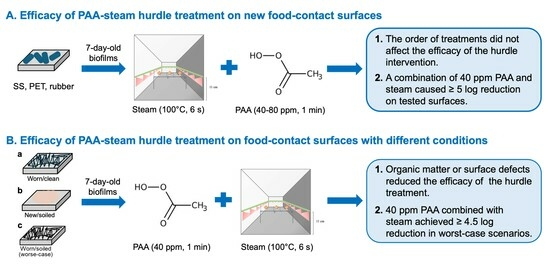
Research – Innovative Hurdle Strategies for Listeria Control on Food-Contact Surfaces: A Peroxyacetic Acid–Steam Approach

Abstract
The persistence of Listeria monocytogenes biofilms on equipment surfaces poses a significant risk of cross-contamination, necessitating effective surface decontamination strategies. This study assessed the effectiveness of hurdle treatments combining peroxyacetic acid (PAA) and saturated steam against 7-day-old L. innocua (a non-pathogenic surrogate for L. monocytogenes) biofilms on stainless steel (SS), polyester (PET), and rubber surfaces. Results demonstrated >6 log10 CFU/coupon L. innocua reductions on SS and PET surfaces after PAA (40 ppm, 1 min) followed by steam treatment (100 °C, 6 s). On rubber surfaces, PAA (80 ppm, 1 min) followed by steam treatment (100 °C, 6 s) resulted in ~5 log10 CFU/coupon L. innocua reduction. The presence of apple juice soil reduced the efficacy of hurdle treatments, with PAA (40 ppm, 1 min) and steam exposure (6 s) resulting in 5.6, 5.8, and 4.2 log10 CFU/coupon reductions of L. innocua on SS, PET, and rubber, respectively. The efficacy of this antimicrobial combination was further reduced by surface defects, especially in the presence of organic matter. Nevertheless, the treatment still achieved >5 log10 CFU/coupon reductions of L. innocua on worn SS and PET soiled with apple juice and ~4.5 log10 CFU/coupon reduction on worn, soiled rubber surfaces. These findings highlight that PAA treatments followed by a brief steam exposure are effective strategies for controlling Listeria on food-contact surfaces.
Research – Cold plasma processing for food safety
Cold plasma is an emerging food processing technology which has been shown to effectively inactivate pathogenic bacteria, viruses, parasites, and fungi. The process uses high-voltage electricity to ionize air and/or defined gas blends to create a mixture of ions, free electrons, ozone, radical species, and other reactive products. This energetic plasma, which operates near room temperature, has been tested with fruits, vegetables, nuts, meats, cheeses, poultry, seeds, powders, and other foods.
Once created at the high voltage electrodes, the cold plasma is applied to foods and food contact surfaces. Forced air can blow the cold plasma over products and surfaces, as with plasma jet systems. This allows for the varying treatment distances of irregularly shaped foods. The commodity may also be moved in and out of the plasma field, as with dielectric barrier (DBD) systems. In either case, reactive chemical species in the cold plasma break the cellular structures, DNA, and proteins of pathogens on foods, inactivating them. Efficacy is dependent on treatment intensity and duration. Combining cold plasma with chemical sanitizers, high intensity light, or other food safety interventions can provide enhanced, synergistic pathogen inactivation. Short treatments with cold plasma can induce sublethal injury in pathogens, rendering them more susceptible to another sanitizing processes.
Research – Acid Adaptation Enhances Tolerance of Escherichia coli O157:H7 to High Voltage Atmospheric Cold Plasma in Raw Pineapple Juice
Abstract
Pathogens that adapt to environmental stress can develop an increased tolerance to some physical or chemical antimicrobial treatments. The main objective of this study was to determine if acid adaptation increased the tolerance of Escherichia coli O157:H7 to high voltage atmospheric cold plasma (HVACP) in raw pineapple juice. Samples (10 mL) of juice were inoculated with non-acid-adapted (NAA) or acid-adapted (AA) E. coli to obtain a viable count of ~7.00 log10 CFU/mL. The samples were exposed to HVACP (70 kV) for 1–7 min, with inoculated non-HVACP-treated juice serving as a control. Juice samples were analyzed for survivors at 0.1 h and after 24 h of refrigeration (4 °C). Samples analyzed after 24 h exhibited significant decreases in viable NAA cells with sub-lethal injury detected in both NAA and AA survivors (p < 0.05). No NAA survivor in juice exposed to HVACP for 5 or 7 min was detected after 24 h. However, the number of AA survivors was 3.33 and 3.09 log10 CFU/mL in juice treated for 5 and 7 min, respectively (p < 0.05). These results indicate that acid adaptation increases the tolerance of E. coli to HVACP in pineapple juice. The potentially higher tolerance of AA E. coli O157:H7 to HVACP should be considered in developing safe juice processing parameters for this novel non-thermal technology.
Research – An In-Depth Study on the Inhibition of Quorum Sensing by Bacillus velezensis D-18: Its Significant Impact on Vibrio Biofilm Formation in Aquaculture
Abstract
Amid growing concerns about antibiotic resistance, innovative strategies are imperative in addressing bacterial infections in aquaculture. Quorum quenching (QQ), the enzymatic inhibition of quorum sensing (QS), has emerged as a promising solution. This study delves into the QQ capabilities of the probiotic strain Bacillus velezensis D-18 and its products, particularly in Vibrio anguillarum 507 communication and biofilm formation. Chromobacterium violaceum MK was used as a biomarker in this study, and the results confirmed that B. velezensis D-18 effectively inhibits QS. Further exploration into the QQ mechanism revealed the presence of lactonase activity by B. velezensis D-18 that degraded both long- and short-chain acyl homoserine lactones (AHLs). PCR analysis demonstrated the presence of a homologous lactonase-producing gene, ytnP, in the genome of B. velezensis D-18. The study evaluated the impact of B. velezensis D-18 on V. anguillarum 507 growth and biofilm formation. The probiotic not only controls the biofilm formation of V. anguillarum but also significantly restrains pathogen growth. Therefore, B. velezensis D-18 demonstrates substantial potential for preventing V. anguillarum diseases in aquaculture through its QQ capacity. The ability to disrupt bacterial communication and control biofilm formation positions B. velezensis D-18 as a promising eco-friendly alternative to conventional antibiotics in managing bacterial diseases in aquaculture.
Research – Investigating bacteriophages as a novel multiple-hurdle measure against Campylobacter: field trials in commercial broiler plants
Abstract
Campylobacter mitigation along the food production chain is considered effective for minimizing the public health burden of human campylobacteriosis. This study is the first combining different measures in a multiple-hurdle approach, using drinking water additives and feed additives in single and combined application schemes in commercial broiler plants. Broiler chickens in the study groups were naturally contaminated with Campylobacter. Application of an organic acid blend via drinking water, consisting of sodium propionate, potassium sorbate, and sodium diacetate, resulted in significant reductions of up to 4.9 log10 CFU/mL in fecal samples and in cecal samples at slaughter. The application of a phage mixture, consisting of Fletchervirus phage NCTC 12673 and Firehammervirus phage vB_CcM-LmqsCPL1/1, resulted in reductions of up to 1.1 log10 CFU/mL in fecal samples 1 day after dosing. The sole administration of curcumin via feed resulted in small and inconsistent reductions. In the group receiving a combination of all tested measures, reductions of up to 1.1 log10 CFU/mL were observed. Based on the results of our field trials, it was shown that both the sole application and the combined application of mitigation measures in primary production can reduce the Campylobacter load in broiler chickens, while no synergism could be observed.
Research – The Survival of Salmonella enterica Strains in Ready-to-Eat Fruit Purees under Different Storage Temperatures
Salmonella enterica, known for its resilience to acidic environments, has been linked to foodborne outbreaks of illness from fruit derivatives. This study aimed to assess the survival of five serovars of Salmonella enterica subsp. enterica in various fruit purees subjected to different storage temperatures. Among the studied serovars, S. enteritidis exhibited the most significant population decrease in all fruit purees. In contrast, S. Agona, S. Gaminara, S. Michigan, and S. Montevideo survived in peach puree at 4 °C for at least 3 days, and S. Agona, S. Gaminara, and S. Montevideo maintained their initial levels in pear puree under the same time/temperature conditions. However, none of the strains were detectable in plum and black currant purees after 2 days at 4, 15, or 25 °C. These findings highlight variations in the behaviour of S. enterica serovars within different fruit purees. Likewise, low-temperature conditions prolonged the survival of the tested strains in all fruit purees analysed.
Research – Evaluation of the Effectiveness of Aeration and Chlorination during Washing to Reduce E. coli O157:H7, Salmonella enterica, and L. innocua on Cucumbers and Bell Peppers
Abstract
The attachment strength of bacteria to surfaces can affect the efficacy of sanitizers during washing. This study aimed to determine the effectiveness of chlorination and aeration in the removal of pathogens from the surface of produce. Cucumbers and bell peppers were inoculated with Listeria innocua, Escherichia coli O157:H7, or Salmonella enterica; afterwards, the produce was washed with or without chlorinated water (100 ppm) for 3 min in combination with or without aeration. Cucumbers washed with chlorinated water, with or without aeration, presented significant reductions of L. innocua (3.65 log CFU/cm2 and 1.13 log CFU/cm2, respectively) (p < 0.05). Similarly, bell peppers washed in chlorinated water with aeration (1.91 log CFU/g) and without aeration (2.49 log CFU/g) presented significant reductions of L. innocua. A significant reduction of L. innocua was observed on bell peppers washed with non-chlorinated water with aeration (2.49 log CFU/g) (p < 0.05). Non-chlorinated water was also effective in significantly reducing the level of Salmonella enterica (p < 0.05) on cucumbers and bell peppers. Washing with chlorinated water with aeration reduced Salmonella enterica levels from 4.45 log CFU/cm2 on cucumbers to below the detectable limit (0.16 log CFU/cm2). The highest reduction of Salmonella enterica from bell peppers occurred after washing with chlorinated water with aeration (2.48 log CFU/g). E. coli O157:H7, L. innocua, and Salmonella enterica levels present in non-chlorinated water after washing contaminated produce with or without aeration were significantly greater than those in chlorinated water (p < 0.05). After treatment, the population levels of all pathogens in chlorinated water with or without aeration were below the detectable limit for bell peppers (<1.10 log CFU/mL) and cucumbers (<1.20 log CFU/mL). Using chlorine in combination with forced aeration during washing minimizes cross-contamination of bacterial pathogens.
Research – Safety Properties of Escherichia coli O157:H7 Specific Bacteriophages: Recent Advances for Food Safety
Abstract
Shiga-toxin-producing Escherichia coli (STEC) is typically detected on food products mainly due to cross-contamination with faecal matter. The serotype O157:H7 has been of major public health concern due to the severity of illness caused, prevalence, and management. In the food chain, the main methods of controlling contamination by foodborne pathogens often involve the application of antimicrobial agents, which are now becoming less efficient. There is a growing need for the development of new approaches to combat these pathogens, especially those that harbour antimicrobial resistant and virulent determinants. Strategies to also limit their presence on food contact surfaces and food matrices are needed to prevent their transmission. Recent studies have revealed that bacteriophages are useful non-antibiotic options for biocontrol of E. coli O157:H7 in both animals and humans. Phage biocontrol can significantly reduce E. coli O157:H7, thereby improving food safety. However, before being certified as potential biocontrol agents, the safety of the phage candidates must be resolved to satisfy regulatory standards, particularly regarding phage resistance, antigenic properties, and toxigenic properties. In this review, we provide a general description of the main virulence elements of E. coli O157:H7 and present detailed reports that support the proposals that phages infecting E. coli O157:H7 are potential biocontrol agents. This paper also outlines the mechanism of E. coli O157:H7 resistance to phages and the safety concerns associated with the use of phages as a biocontrol.
