Category Archives: Food Inspections

Information – Blame the consumer, cruise edition

Barf Blog

The simple fact is that if people washed their hands, there would be no norovirus,’ that’s what Royal Caribbean CEO Michael Bayley said in an  interview in Business Insider published this week.

Nope. It’s not that simple. Handwashing is a factor, but so is showing up ill, so is how surfaces are cleaned and sanitized (and with what compound). Norovirus isn’t just a handwashing or cruise patron problem. And if it was, and  was so simple we wouldn’t see 20 million + illness annually in the U.S.


Hong Kong- Suspension of import and sale of raw oysters harvested in Cancale, France – Norovirus

CFS logo

Issue Date 6.4.2018
Source of Information Rapid Alert System for Food and Feed (RASFF) of the European Commission
Food Product Raw oysters
Product Name and Description Raw oysters harvested in Cancale, France
Reason For Issuing Alert
  • The Centre for Food Safety (CFS) received a notification from the Rapid Alert System for Food and Feed of the European Commission that a local importer, Saison Food Service Limited, had imported raw oysters which were suspected to be contaminated with norovirus. The CFS immediately contacted the importer concerned for follow-up and the importer confirmed that it had imported the affected oysters from the Cancale, France.
  • According to information provided by the importer, around 5 kilograms of the affected oysters were sold in Hong Kong and a recall has been initiated according to the CFS’ advice.
Action Taken by the Centre for Food Safety
  • For the sake of prudence, the CFS has immediately suspended the import into and sale within Hong Kong of all raw oysters harvested in Cancale, France.
  • The CFS will inform the French authorities of the import suspension and notify the local trade.
  • The CFS will continue to follow up on the incident and take appropriate action to safeguard food safety and public health.
Advice to the Trade
  • Stop selling the affected product.
Advice to Consumers
  • Regardless of the season or the region in which the oysters are harvested, consuming oysters, particularly raw or partially cooked ones, carries an inherent food safety risk..
  • Susceptible groups, such as pregnant women, young children, the elderly and people with weakened immune systems or liver diseases, should avoid eating raw oysters.
  • Members of the public may call the importer’s hotline at 2537 8080 during office hours to enquire about the recall.
Further Information The CFS press release

Canada – Herring eggs, water samples collected from French Creek to Qualicum Bay test positive for Cholera

Chek News

Island Health and the First Nations Health Authority have confirmed that the herring eggs and water samples collected from the French Creek and Qualicum Bay areas have tested positive for Vibrio cholerae bacteria.

In March, there was a small outbreak of cholera in the area with four cases of Vibrio cholere infection associated with eating herring eggs. The public was warned not to consume herring eggs that were harvested from French Creek to Qualicum Bay.

Since that time, there have been no further confirmed cases of Vibrio cholerae infection and no changes to the current fishery harvest area closures. Fisheries and Oceans Canada had closed Pacific Fishery Management Areas 14-1, 14-4, and 14-5 to fishing for herring eggs by handpicking at the end of March after the outbreak.

USA – Pelleh Farms Whole Organic Milk Recalled for Improper Pasteurization

Food Poisoning Bulletin

According to a notice posted by New York State Agriculture Commissioner Richard A. Ball, Whole Organic Milk Non-Homogenized, that was produced by Pelleh Farms, has been voluntarily recalled due to improper pasteurization. No illnesses have been reported to date in connection with this problem.

USA – The Latest – Salmonella on Coconut Smiles Sicken 13 in 8 States

The Food Poison Journal

As of March 20, 2018, 13 people infected with the outbreak strain of Salmonella Typhimurium have been reported from 8 states. A list of the states and the number of cases in each can be found on the Case Count Map page. WGS performed on bacteria isolated from ill people showed that they were closely relatedly genetically. This means that people in this outbreak are more likely to share a common source of infection.

Illnesses started on dates ranging from September 22, 2017 to February 26, 2018. Ill people range in age from 1 to 73 years, with a median age of 40. Sixty-seven percent are female. Three hospitalizations have been reported. No deaths have been reported.

USA – Salmonella Infections Linked to Chicken Salad – Case Count Maps

CDC

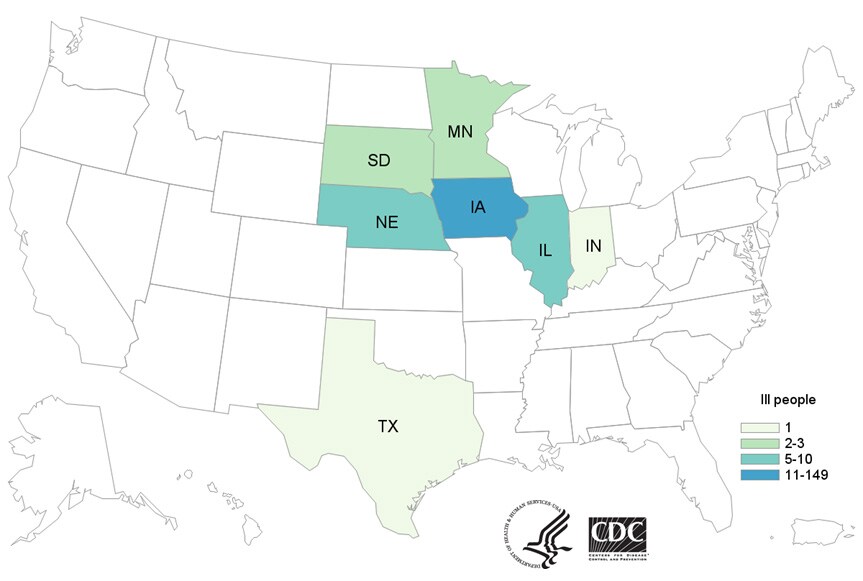
People infected with the outbreak strains of Salmonella Typhimurium, by state of residence, as of March 7, 2018 (n=170)

People infected with the outbreak strain of Salmonella Typhimurium, by state of residence, as of March 7, 2018


RASFF Alert – Stpahylococcus aureus – Cheese

kswfoodworld food safety poisoning

RASFF-coagulase-positive Staphylococcus (25000; 200000 CFU/g) in cheese from Poland in the UK

RASFF Alert – Cronobacter sakazakii in Infant Formulae

kswfoodworld food safety poisoning

RASFF-Cronobacter sakazakii in infant formulae from Germany, with raw material from France in Germany

RASFF Alert – Moulds – Chilled Lizard Fish

kswfoodworld food safety poisoning

RASFF-chilled lizzard fish from Vietnam and the United Kingdom infested with moulds in the Netherlands

RASFF Alerts – E.coli – Live Clams – Raw Milk Camembert

kswfoodworld food safety poisoning

RASFF-too high count of Escherichia coli (1700 MPN/100g) in live clams (Tapes semidecussatus) from Italy in Italy

RASFF-high count of Escherichia coli (1300000 CFU/g) in raw milk camembert from France in Austria