Category Archives: Campylobacter

Research – Campylobacter contamination in broiler meat

Poultry World

Campylobacter in broiler meat is one of the leading foodborne pathogens associated with health risks and negative economic impacts worldwide. Campylobacter has several adaptive responses throughout the broiler production chain. Thus, it survives from broiler farm to slaughterhouse and processing plant.

Research -France publishes 2021 Campylobacter data

Food Safety News

Data from Campylobacter surveillance in 2021 confirmed trends seen in previous years, according to the most recent statistics published by Santé Publique France.

Findings are based on the National Reference Center (CNR) for Campylobacter and Helicobacter and mandatory declaration of outbreaks. Past data from 2020 showed Campylobacter infections were not impacted by public health measures taken because of the COVID-19 pandemic.

Campylobacter has been increasing since 2013 when online data entry was introduced. Scientists said this could reflect an actual rise in infections or it may be because of other factors such as better detection methods.

Research – Surveillance of Human Cases of Salmonellosis, Campylobacteriosis, Listeriosis, and Hepatitis A in Campania (Southern Italy): Seven-Year Monitoring (2013–2019)

MDPI

Abstract

Foodborne infections cause illness and death every year worldwide. The aim of this study was to describe trends in 2013–2019 in the occurrence of human cases of salmonellosis, campylobacteriosis, listeriosis, and hepatitis A in the Campania region. Human case data were provided by the National Surveillance System of disease and were grouped by year, province, age group, and sex. Moreover, the number of people hospitalized was recorded. In the Campania region, the total number of confirmed human cases for the diseases investigated was 1924, with Hepatitis A and the Salmonellosis as the first most reported (1009 and 825 cases, respectively). The incidence rates of gastroenteritis under study were lower than those in Italy and European Union in the same period, with the exception of Hepatitis A whose incidence was higher than that recorded in Italy. Data on hospitalizations pointed out the onset of severe forms of infection also for listeriosis and campylobacteriosis, whose incidence was very low (27 and 63 cases, respectively). Unfortunately, no information on the foods implicated is available. Although probably underestimated, gastroenteritis due to foodborne agents still represents a burden in Campania, and continuous monitoring and implementation of the currently available regional surveillance system is required.

Research -Monitoring the incidence and causes of disease potentially transmitted by food in Australia: Annual report of the OzFoodNet network, 2017

Health Au

Abstract

In 2017, 47,652 notifications of enteric diseases potentially related to food were received by state and territory health departments in Australia. Consistent with previous years, the majority of all notified infections were either campylobacteriosis (n = 28,432; 60%) or salmonellosis (n = 16,416; 34%). A total of 206 gastrointestinal outbreaks, including 179 foodborne outbreaks, were reported in 2017. The remaining 27 outbreaks were due to environmental or probable environmental transmission (22 outbreaks), animal-to person or probable animal-to-person transmission (three outbreaks), and waterborne or probable waterborne transmission (two outbreaks). Foodborne outbreaks affected 2,130 people resulting in at least 290 hospital admissions and five deaths. Eggs continue to be a source of Salmonella Typhimurium infection across the country, with 49 egg-related outbreaks affecting at least 746 people reported across six jurisdictions in 2017.

Research – Lowest number of recorded Hepatitis A cases, five other food and waterborne diseases rising towards pre-pandemic levels

ECDC

Hepatitis A cases in 2021 were at their lowest levels since EU-level hepatitis A surveillance began in 2007, while five other food and waterborne diseases are rising towards pre-pandemic levels. The information is revealed in the Annual Epidemiological Report 2021, of which six chapters are published today by ECDC.

The chapters cover diseases causing  the highest number of  food- and waterborne infections in the EU/EEA, namely campylobacteriosis, salmonellosis, yersiniosis, shigatoxigenic Escherichia coli infection, listeriosis, and hepatitis A.  

In the EU/EEA, the hepatitis A notification rate was exceptionally low in 2021, with 0.92 cases per 100 000 population, compared to 2.2 in 2019. This can be attributed primarily to the COVID-19 pandemic and restrictions, including reduced international travel.  

However, a sharp decline in the trend of hepatitis A cases has also been evident in the EU/EEA over the last five years. Additional factors contributing to this may be the heightened awareness of hepatitis A transmission, increased preventive measures such as practising good hygiene and increased vaccine uptake among at-risk groups. Increased natural immunity in at-risk groups following a large multi-country outbreak occurring in 2017 and 2018 may also be of importance.  

In 2020, the number of cases of campylobacteriosis and salmonellosis, the two most commonly reported gastrointestinal infections in the EU/EEA, decreased notably due to the COVID-19 pandemic. Unlike hepatitis A, these appeared to increase in 2021, but the levels are still well below those of the pre-pandemic years. This could partly be an effect of reduced travel as travel-related infections were at their lowest in 2021. 

Listeriosis, shigatoxigenic Escherichia coli infections and yersiniosis trends decreased less notably in 2020 and the number of cases returned to the pre-pandemic levels in 2021. This might be due to the more severe symptoms caused particularly by listeriosis and shigatoxigenic Escherichia coli infections, which are then more likely to be diagnosed and reported. Additionally, many of the cases are acquired  within the EU/EEA, and the numbers are not as affected by international travel restrictions.  

In 2021, although the COVID-19 pandemic was still ongoing, the gradual reduction of COVID-19 restriction measures, along with the return to normal daily life (social events, doctor’s visits, travel), the reopening of bars, restaurants and catering facilities (i.e. schools, workplaces), may explain the increase in cases of the five food- and waterborne diseases.   

Research – Campylobacteriosis – Annual Epidemiological Report for 2021

ECDC

The notification of campylobacteriosis is mandatory in 22 EU Member States, Iceland, Liechtenstein, and Norway. In five EU Member States (Belgium, France, Greece, Italy, and the Netherlands) notification is voluntary. The surveillance systems for campylobacteriosis have full national coverage in all EU Member States except four (France, Italy, the Netherlands, and Spain). The coverage of the surveillance system in 2021 is estimated to be 20% in France and 64% in the Netherlands. These proportions were used when calculating notification rates for these two EU Member States. No estimate of population coverage in Italy and Spain was provided, so notification rates were not calculated for these two countries. The drop in cases in Luxembourg in 2019 is a surveillance artefact caused by a change to non-culture-based methods (PCR) in private laboratories, resulting in a reduced number of isolates sent to the national reference laboratory. From 2020, laboratory confirmation with PCR is included in the notification system which, along with a new electronic laboratory notification system, is expected to result in an increase in Campylobacter notifications. Greece has reported data on laboratory-confirmed cases collected from public hospitals from 2018 onwards. For 2020 and 2021, Spain has not yet received data from all regions normally reporting and the case numbers are therefore lower than expected. All countries reported case-based data except Belgium, Bulgaria, and Greece, which report aggregated data. Both reporting formats were included to calculate numbers of cases, notification rates, disease trends, and age and gender distributions.

Click to access campylobacteriosis-annual-epidemiological-report-2021.pdf

New Zealand – Don’t contaminate your plate this summer – be a Chicken Scene Investigator – Campylobacter

MPI

It would be a crime for your whānau and friends to come down with foodborne illness this festive season – so New Zealand Food Safety and the Chicken Scene Investigators have got your back.

“Each year, over our summer, there is a rise in cases of foodborne illness and hospitalisations,” says New Zealand Food Safety deputy director-general Vincent Arbuckle.

“The most commonly reported illness is campylobacteriosis – caused by Campylobacter bacteria – with our youngest and oldest having the highest rates of infection.

“There were 5,729 confirmed cases of campylobacteriosis in 2021, with 846 people needing hospital treatment, up from 718 in 2020. And 2022 looks set to follow a similar trajectory, with more than 5,300 cases nationally so far.

“The most common source of Campylobacter from food is raw or undercooked chicken.

“So, one big thing you can do this festive season to keep your whānau and friends healthy is to make sure you handle raw chicken safely. Cook it properly and use separate utensils and chopping boards, and, as with all food, don’t leave it out in the heat of the day, both before cooking and after you’ve finished eating.”

To help you with this, New Zealand Food Safety today launches a new food safety campaign. In a series of videos, our 2 Chicken Scene Investigators invite you to join them to spot the chicken-handling crime.

“Campylobacteriosis symptoms are nasty. They include diarrhoea, fever, headache, muscle aches, abdominal pain, and vomiting. It may also develop into more severe illness such as Guillain-Barré Syndrome, a disorder in which the body’s immune system attacks its nerves, sometimes resulting in permanent paralysis,” says Mr Arbuckle.

If you have symptoms, you can call Healthline for free anytime on 0800 61 11 16, or contact your doctor or practice nurse for advice.

“So, wherever you’re gathering – from BBQs to work do, beach parties to kai at the marae, Christmas lunch or potluck dinner – make sure you don’t contaminate your plate this summer.”

Te Whatu Ora medical officer of health Jay Harrower adds: “Every year thousands of people are diagnosed as being infected with Campylobacter, and for some it can be very serious. Across New Zealand Campylobacter cases are spiking once again this summer, but there are simple steps everyone can take to reduce the risk to them and their whānau.”

Chicken Scene Investigator tips to keep your whānau and friends safe:

  • Keep your raw chicken separate from ready-to-eat and fresh foods, using separate chopping boards, plates, and utensils. Alternatively, wash them properly with hot soapy water before using for other foods.
  • Don’t wash the chicken. Rinsing it will just spread the bacteria to other surfaces. Pat it dry with a paper towel instead, if needed.
  • Wash your hands in warm soapy water after handling raw chicken.
  • Make sure the chicken is fully cooked before serving – it can’t be pink and the juices should run clear. Or use a meat thermometer, if you have one, to ensure the chicken is steaming hot (over 75°C) all the way through.
  • Use a different plate for raw and cooked chicken.
  • If in doubt, clean surfaces and utensils some more, cook your chicken some more.

Safe barbecuing of food

Campylobacter infection: symptoms and advice

Watch the Chicken Scene Investigators on YouTube

The tea towel (15 seconds) 

The knife (15 seconds) 

England – Differential impact of the COVID-19 pandemic on laboratory reporting of Norovirus and Campylobacter in England: A modelling approach

PLOS One

CDC Campy

The COVID-19 pandemic has impacted surveillance activities for multiple pathogens. Since March 2020, there was a decline in the number of reports of norovirus and Campylobacter recorded by England’s national laboratory surveillance system. The aim is to estimate and compare the impact of the COVID-19 pandemic on norovirus and Campylobacter surveillance data in England.

EFSA- Campylobacter Story Map

EFSA

The most clinically relevant  species  are Campylobacter jejuni (C. jejuni) and C. coli, which are responsible for almost 95% of Campylobacter-associated diarrheal diseases. Other emerging species have been recently identified as human or animal pathogens. The involvement of some of these species in human disease is still unclear.

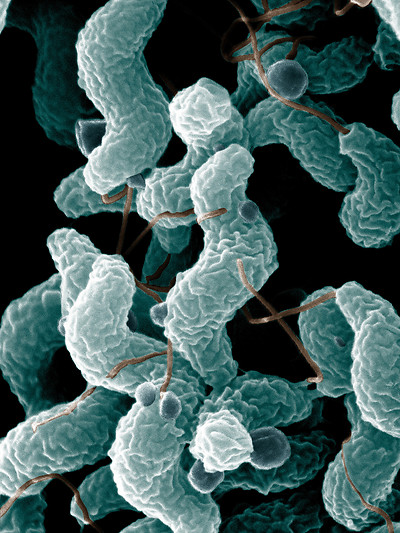
Campylobacter are a group of small, curved, gram-negative, non-spore-forming, motile bacteria with a single polar flagellum or bipolar flagella.

Thermotolerant Campylobacter species (e.g. C. jejuni, C. coli) are able to grow at temperatures between 37° and 42˚C but not below 30˚C, while strains of non-thermotolerant Campylobacter species (e.g. C. fetus subsp. venerealis, C. fetus subsp. fetus) may not grow at 42˚C. Generally, they are highly sensitive to oxygen, desiccation, osmotic stress, and low  pH , and they cannot grow in foods during handling or storage at room temperature in moderate climates. Freezing reduces the number of viable Campylobacter, but it must nevertheless be stressed that the bacteria can survive extended periods of refrigeration and freezing.

EFSA – Campylobacter Dashboard

EFSA

The EFSA dashboard on Campylobacter is a graphical user interface for searching and querying the large amount of data collected each year by EFSA from EU Member States and other reporting countries based on Zoonoses Directive 2003/99/EC. The Campylobacter dashboard shows summary statistics for the monitoring results of the pathogen with regard to major food categories, Campylobacter-positive official samples exceeding the Process Hygiene Criterion limit of 1,000 CFU/g for chilled broiler carcases and the occurrence of Campylobacter in major food categories. The Campylobacter data and related statistics can be displayed interactively using charts, graphs and maps in the online EFSA dashboard. The main statistics can also be viewed and downloaded in tabular format. Detailed information on the use and features of the Campylobacter dashboard can be found in the present user guide that can also be downloaded from the online tool.