Monthly Archives: January 2024

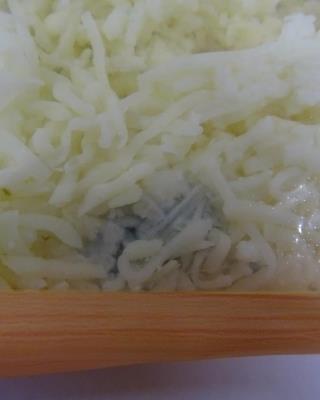
Czech Republic – Pilos Eidam grated, 200g – Visible Mold/Mould

Potravinynapranyri

Illustrative photo #4

Place of inspection:
Veselí nad Moravou ( class Masarykova 170, 698 01 Veselí nad Moravou )
ID: 26178541
Food group: Milk and milk products Cheese

Pilos Eidam grated, 200g
Category: Dangerous foods
Invalid parameter:

fungi visible to the eye

In some of the inspected packages, the occurrence of mold was detected on the food under the intact packaging. Food is not considered safe if it shows signs of spoilage.

Unsuitable storage temperatures of this product were not detected during the inspection. The food did not have an expired minimum durability date.

Batch: DMT: 12/01/2024
Best before date: 12/01/2024
Packaging: plastic bag printed, sealed
Quantity of the product in the package: 200 g
Manufacturer: Milchwerke Oberfranken West eG, Sulzdorfer Straße 7, 96484 Meeder, Germany
Date of sample collection: 12/12/2023
Reference number: 24-000056-SZPI-CZ
The sample was detected by the official control of the State Agricultural and Food Inspection.

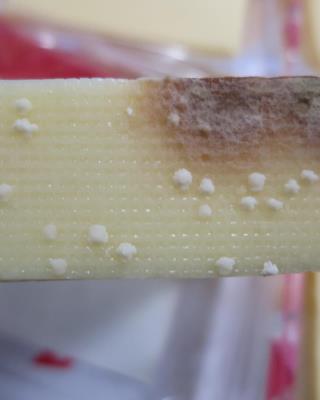
Czech Republic – K CLASSIC fine-aromatischer Edamer am Stück – Visible Mould/Mold

Potravinynapranyri

Illustrative photo #5

Place of inspection:
Brno ( Řípská 1476/27, 627 00 Brno )
ID: 25110161
Food group: Milk and milk products Cheese

K CLASSIC fine-aromatischer Edamer am Stück
Category: Dangerous foods
Invalid parameter:

fungi visible to the eye

In some of the inspected packages, mold colonies were present on the surface of the cheese under the intact packaging. Food is not considered safe if it shows signs of spoilage.

Unsuitable storage temperatures of this product were not detected during the inspection. The food did not have an expired minimum durability date.

Best before date: 07/02/2024
Packaging: PET/PE
Quantity of the product in the package: 0.25 kg
Distributor: supplier: Milkpol spol. sro, Reinerova 1657/23, 163 00, Prague 6
Country of origin:  Czechia
Date of sample collection: 20/12/2023
Reference number: 24-000055-SZPI-CZ
The sample was detected by the official control of the State Agricultural and Food Inspection.

Research -EFSA – Persistence of microbiological hazards in food and feed production and processing environments

EFSA

Listeria monocytogenes (in the meat, fish and seafood, dairy and fruit and vegetable sectors), Salmonella enterica (in the feed, meat, egg and low moisture food sectors) and Cronobacter sakazakii (in the low moisture food sector) were identified as the bacterial food safety hazards most relevant to public health that are associated with persistence in the food and feed processing environment (FFPE). There is a wide range of subtypes of these hazards involved in persistence in the FFPE. While some specific subtypes are more commonly reported as persistent, it is currently not possible to identify universal markers (i.e. genetic determinants) for this trait. Common risk factors for persistence in the FFPE are inadequate zoning and hygiene barriers; lack of hygienic design of equipment and machines; and inadequate cleaning and disinfection. A well‐designed environmental sampling and testing programme is the most effective strategy to identify contamination sources and detect potentially persistent hazards. The establishment of hygienic barriers and measures within the food safety management system, during implementation of hazard analysis and critical control points, is key to prevent and/or control bacterial persistence in the FFPE. Once persistence is suspected in a plant, a ‘seek‐and‐destroy’ approach is frequently recommended, including intensified monitoring, the introduction of control measures and the continuation of the intensified monitoring. Successful actions triggered by persistence of L. monocytogenes are described, as well as interventions with direct bactericidal activity. These interventions could be efficient if properly validated, correctly applied and verified under industrial conditions. Perspectives are provided for performing a risk assessment for relevant combinations of hazard and food sector to assess the relative public health risk that can be associated with persistence, based on bottom‐up and top‐down approaches. Knowledge gaps related to bacterial food safety hazards associated with persistence in the FFPE and priorities for future research are provided.

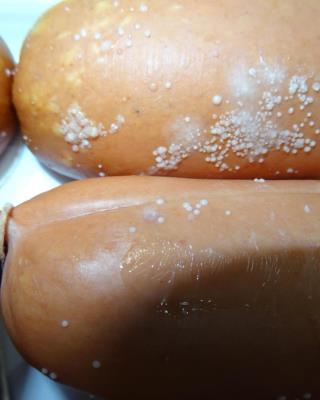
Czech Republic – MÚÚÚ FARMERS SPECÁCKY 600 g, HEAT PROCESSED MEAT PRODUCT – Visible Mould/Mold

Potravinynapranyri

Illustrative photo #4

Place of inspection:
Doksy ( Zámecká 186, 47201 Doksy )
ID: 26178541
Food group: Meat and meat products Heat-treated perishable products

MÚÚÚ FARMERS SPECÁCKY 600 g, HEAT PROCESSED MEAT PRODUCT
Category: Dangerous foods
Invalid parameter:

fungi visible to the eye
surface appearance

Colonies of mold were present on the surface of the food under the intact packaging. Food is not considered safe if it shows signs of spoilage. 

Unsuitable storage temperatures of this product were not detected during the inspection. The food did not have an expiration date.

Batch: L590060126
Expiration date: 14/12/2023
Packaging: PE tub with pap. data label
Quantity of the product in the package: 600 g
Manufacturer: MASO UZENINY PÍSEK, as, Novodvorská 1062/12, 142 00 Prague 4
Country of origin:  Czechia
Date of sample collection: 12/12/2023
Reference number: 24-000054-SZPI-CZ
The sample was detected by the official control of the State Agricultural and Food Inspection.

UK – Research – Risk assessment for vulnerable consumers from Listeria monocytogenes in blue cheese

FSA

This risk assessment was commissioned to assess the risk to vulnerable groups in the UK from blue cheese contaminated with Listeria monocytogenes. Blue cheese is defined as cheese internally ripened with Penicillium mould.

Listeria monocytogenes are bacteria that cause listeriosis, a disease which is very severe in vulnerable people. Vulnerable people include pregnant women, people over 65 years of age, infants, and those with a weakened immune system. While most semi-soft cheeses do not let L. monocytogenes grow, blue cheeses may be an exception, and pose a risk to vulnerable groups.

L. monocytogenes is widespread in the environment and can grow at refrigeration temperatures. This makes it a particular problem in ready-to-eat foods such as cheese. It can also remain in the environment in food factories for several years as it can be difficult to remove.

Foodborne listeriosis is a relatively rare illness in comparison to other foodborne diseases. A search found two potential listeriosis outbreaks and one individual case may have been caused by blue cheese worldwide. No listeriosis illnesses due to blue cheese were identified in the UK.

Blue cheese is not frequently consumed by vulnerable consumers. When consumed, it is usually in low amounts.

Published data from Scottish local authorities and the Food Standards Agency suggest that overall percentage of blue cheeses contaminated with L. monocytogenes in the UK is low. A search of the scientific literature on contamination in blue cheese from European countries found that most of these studies examined Gorgonzola cheese. The rinds of Gorgonzola were much more likely to be contaminated than the centre of the cheese. Research also shows that the acidic levels and levels of moisture in blue cheese can support L. monocytogenes growth. Most of these studies showed only a small amount of bacterial growth in the centre of the cheese.

Outcome

The risk assessment concludes that the severity of Listeria monocytogenes infection in vulnerable people is high (severe illness: causing life-threatening or substantial chronic complications or illness of long duration), with a significant mortality rate. There is a low level of uncertainty due to the strong evidence.

The frequency of occurrence of listeriosis in vulnerable people from consumption of blue cheese is considered very low (very rare but cannot be excluded), based on the evidence gathered for blue cheese including outbreaks, typical L. monocytogenes contamination levels, typical consumption levels and typical L. monocytogenes growth. The uncertainty of occurrence is considered to be medium.

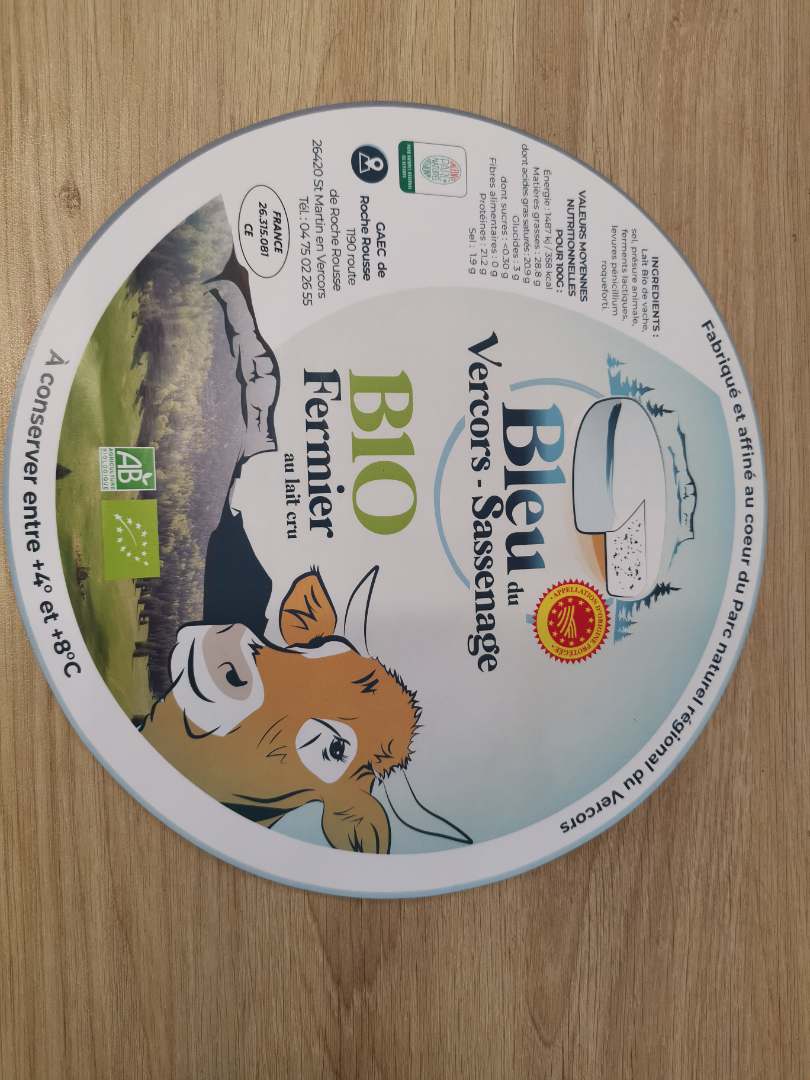
France – Bleu du Vercors Sassenage – Listeria monocytogenes

Gov France

Product category
Food
Product subcategory
Milk and dairy products
Product brand name
Roche Rousse farm
Model names or references
Bleu du Vercors Sassenage
Product identification
Batch Date
Lot number 0712 Minimum durability date 02/07/2024
Packaging
piece
Start/end date of marketing
From 12/27/2023 to 02/22/2024
Storage temperature
Product to keep in the refrigerator
Geographical sales area
Departments: ISERE (38)
Distributors
LA FERMIERE 38250 LANS EN VERCORS

France – Sheep’s Tomme, Tommette, soft pasta with raw sheep’s milk – Listeria monocytogenes

Product category
Food
Product subcategory
Milk and dairy products
Product brand name
Bergerie du Tilh
Model names or references
Tomme, Titou, Bichon, Arriel
Product identification
Batch Date
Lots of 1 to 10 Recommended consumption date 02/18/2024
Start/end date of marketing
From 01/11/2023 to 18/01/2024
Storage temperature
Product to keep in the refrigerator
Health mark
64,059,100
Geographical sales area
Artigueloutan
Distributors
Farm sale

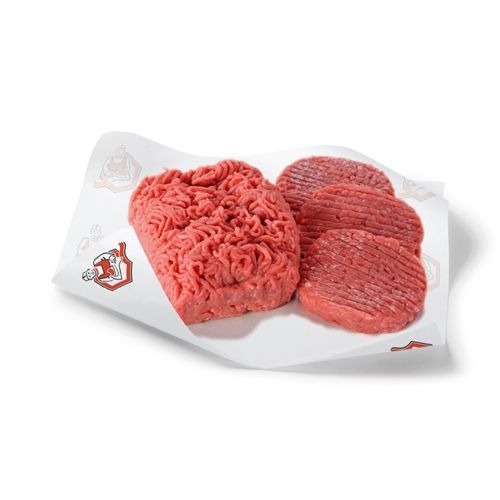
France – Preparation of seasoned ground beef 5% mg portioned and bulk – Listeria monocytogenes

Gov France

Product category
Food
Product subcategory
Meats
Product brand name
unbranded
Model names or references
Preparation of seasoned ground beef 5% mg portioned and bulk
Product identification
Batch
Manufacture and sale between 01/16/2024 and 01/17/2024
Packaging
counter sales
Start/end date of marketing
From 01/16/2024 to 01/17/2024
Storage temperature
Product to keep in the refrigerator
Geographical sales area
Henri Boucher, 9 avenue François Mitterrand 59400 Cambrai
Distributors
Henri Boucher, 9 avenue François Mitterrand 59400 Cambrai

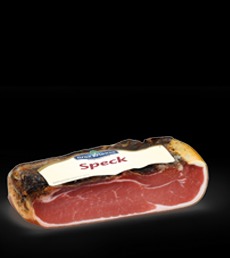
France – SPECK ITALIANO OPTIMA CARTA – Listeria monocytogenes

Gov France

Product category
Food
Product subcategory
Meats
Product brand name
BRIANZA SALUMI di Vismara Luigi & CSrl
Model names or references
SPECK ITALIANO OPTIMA CARTA
Product identification
GTIN Batch Date
8033928598108 29234 Use-by date 03/26/2024
Packaging
Sale in the TRADITIONAL CUT department
Start/end date of marketing
From 01/19/2024 to 01/26/2024
Storage temperature
Product to keep in the refrigerator
Geographical sales area
GREZIEU-LA-VARENNE
Distributors
E. Leclerc GREZIEU-LA-VARENNE

Belgium shares benefits of food safety barometer

Food Safety News

A food safety barometer in Belgium has found improvements in the country during the past decade.

The purpose is to measure food safety and enable evidence-based risk management and policy decisions. It consists of 30 indicators that cover various aspects of food safety from farm to fork.

It relies on data collected from the Belgian Federal Agency for the Safety of the Food Chain (FASFC) control programs and the National Reference Center for Disease data. Indicators are expressed as positive or negative changes compared to the previous year and compared to a reference year to assess long-term progress.