Category Archives: Uncategorized

USA -Organic Almond, Peanut, and Tahini Butters recalled over Listeria

Food Poisoning Journal

Inspired Organics, LLC has issued a voluntary recall of Organic Almond, Peanut, and Tahini Butters due to potential contamination of Listeria monocytogenes. Listeria monocytogenes is an organism, which can cause serious and sometimes fatal infections in young children, frail or elderly people, and others with weakened immune systems. Although healthy individuals may suffer only short- term symptoms such as high fever, severe headache, stiffness, nausea, abdominal pain and diarrhea, Listeria infection can cause miscarriages and stillbirths among pregnant women.

The product was distributed exclusively by Lipari Foods. LLC in Warren, Michigan to food service and retail stores throughout Florida, Illinois, Indiana, Iowa, Kentucky, Maryland, Michigan, Minnesota, Missouri, New York, Ohio, Pennsylvania, Tennessee, West Virginia, Wisconsin, and Ontario, Canada.

USA – Cauliflower Rice, Veggie Cauliflower Rice Blend and Stir-Fry Mix with Cauliflower recalled over E. coli

Food Poisoning Journal

Wegmans Food Markets, Inc. has issued a voluntary recall of fresh Cauliflower Rice, Veggie Cauliflower Rice Blend and Stir-Fry Mix with Cauliflower, sold in the produce department between 12/7/18 and 12/18/18, because it may be contaminated with Escherichia coli O157:H7 bacteria (E. Coli O157:H7). E. coli O157:H7 causes a diarrheal illness often with bloody stools. Although most healthy adults can recover completely within a week, some people can develop a form of kidney failure called Hemolytic Uremic Syndrome (HUS). HUS is most likely to occur in young children and the elderly. The condition can lead to serious kidney damage and even death.

USA -Outbreak of Multidrug-Resistant Salmonella Infections Linked to Raw Turkey Products – Investigation Notice

CDC

  • Since the last update on November 8, 2018, 52 ill people from 26 states and the District of Columbia have been added to this investigation.
  • As of December 18, 2018, 216 people infected with the outbreak strain of Salmonella Reading have been reported from 38 states and the District of Columbia.
    • 84 people have been hospitalized, and one death has been reported from California.
  • Epidemiologic and laboratory evidence(https://www.cdc.gov/foodsafety/outbreaks/investigating-outbreaks/index.html) indicates that raw turkey products from a variety of sources are contaminated with Salmonella Reading and are making people sick.
  • In interviews, ill people report eating different types and brands of turkey products purchased from many different locations. Three ill people lived in households where raw turkey pet food was fed to pets.
  • The outbreak strain has been identified in samples taken from raw turkey pet food, raw turkey products, and live turkeys.
    • On November 15, 2018, Jennie-O Turkey Store Sales in Barron, Wisconsin recalled approximately 91,388 pounds of raw ground turkey products.
    • On December 21, 2018, Jennie-O Turkey Store Sales, LLC, in Faribault, Minnesota recalled approximately 164,210 pounds of raw ground turkey products.
    • A single, common supplier of raw turkey products or of live turkeys has not been identified that could account for the whole outbreak.
  • The Public Health Agency of Canada has identified ill people infected with the same DNA fingerprint of Salmonella Reading bacteria in Canada.
  • The outbreak strain of Salmonella Reading is present in live turkeys and in many types of raw turkey products, indicating it might be widespread in the turkey industry. CDC and USDA-FSIS have shared this information with representatives from the turkey industry and asked about steps that they may be taking to reduce Salmonella contamination.


Norway – Reports increase in Listeriosis in December

Outbreak News Today

Officials with the Norwegian Institute of Public Health report seeing an increase in listeriosis cases in December, prompting a warning for high-risk groups.

According to an official notice Friday (computer translated), six cases were reported this month when the country typically sees 1-2 cases a month.

Four of the six patients reported in December are from Hedmark and Oppland.

Health officials are working to identify if their is a common food source linked to the increase in cases.

Research – Growth potential of Listeria monocytogenes in ready‐to‐eat Feta cheese‐based sauce stored at 4°C

Wiley Online Library

Abstract

Listeria monocytogenes is now a well‐known foodborne pathogen of particular importance in ready‐to‐eat (RTE) refrigerated foods given the psychrotrophic character and ubiquitous nature of the bacterium. The objective of the current research was to assess the growth potential of L. monocytogenes in RTE cheese‐based (Feta) sauce. For this to occur, samples of Feta cheese‐based sauce (ca. 1% NaCl, pH = 4.6, 900 ppm sorbic acid) were artificially contaminated with a mixture of two L. monocytogenes strains and were stored aerobically at 4°C for 30 days. Growth potential (δ) of L. monocytogenes in Feta cheese‐based sauce was calculated at −1.2 log CFU/g for the 30‐day shelf‐life (i.e., δ < 0.5 log CFU/g). Findings of this study indicate that Feta cheese‐based sauce containing 900 ppm of sorbic acid as preservative is unable to support the growth of L. monocytogenes, thus the food safety criterion for pathogen enumeration not exceeding the limit of 100 CFU/g should apply during the shelf‐life of the product, as stated by Commission Regulation (EC) No. 2073/2005.

Practical applications

Contamination of acidic cheese‐based spreadable products, with pH ≤ 4.6 and/or water activity (i.e., Aw) > 0.94, with different bacterial species during the manufacturing process, could limit considerably the shelf‐life of these RTE products. Moreover, among other possible contaminants, the ubiquitous psychrotrophic pathogen L. monocytogenes may pose a serious threat for the microbiological safety of such products, like a Feta cheese‐based sauce with the aforementioned characteristics. Challenge testing for assessing the risk from L. monocytogenes presence during shelf‐life of this product is, therefore, deemed necessary and can provide us with useful information regarding possible pathogen containment due to product’s composition and characteristics. Conclusively, even if the Feta cheese‐based sauce described in this study is contaminated with low numbers of L. monocytogenes at levels below the limit of detection (i.e., absence in 25 g), then the organism will not exceed 100 CFU/g by the end of product’s shelf‐life.

Research -Prevalence, antimicrobial susceptibility, and virulence of Campylobacter jejuni isolated from chicken meat

Wiley Online Library

campy2

Abstract

The aim of this study was to determine the prevalence and antimicrobial resistance of Campylobacter jejuni isolated from retail chicken meat. The identification of Campylobacter isolates and the presence of virulence factor were evaluated by polymerase chain reaction (PCR). Furthermore, clove oil, cinnamon, and turmeric extracts were evaluated for the antimicrobial potential against Campylobacter isolates. Out of 200 chicken meat samples, 80 (40%) samples were found contaminated with Campylobacter jejuni. Antibacterial susceptibility testing indicated that out of 80 isolates 60 (75%) were resistant to tetracycline followed by 31 (38.75%) to ciprofloxacin, 12 (15%) to ampicillin, 8 (10%) to erythromycin, and 2 (2.5%) were resistant to chloramphenicol. Clove oil and cinnamon extract showed antibacterial potential against Campylobacter isolates. Furthermore, all the 80 isolates (100%) were found positive for virulence genes (cadF, flaA, and dnaJ). The presence of antibacterial resistance and virulence factors in C. jejuni highlighted the risk associated with retail poultry meat.

Practical applications

Campylobacter jejuni is associated with foodborne illnesses such as gastrointestinal intestinal complications. This study demonstrated that raw chicken meat should be subjected to pretreatment to avoid the foodborne illnesses associated with multidrug‐resistant (MDR) Campylobacter jejuni. Moreover, the use of antibiotics should be strictly monitored in developing countries to avoid the emergence of multidrug‐resistant pathogens.


USA -Jennie-O – 216 with Salmonella, 175 Hospitalized with 1 Death from Ground Turkey

Food Poisoning Journal 

Since the last update on November 8, 2018, 52 ill people from 26 states and the District of Columbia have been added to this investigation. As of December 18, 2018, 216 people infected with the outbreak strain of Salmonella Reading have been reported from 38 states and the District of Columbia. A list of the states and the number of cases in each can be found on the Map of Reported Cases page.

Illnesses started on dates from November 20, 2017, to December 6, 2018. Ill people range in age from less than 1 year to 99, with a median age of 40. Fifty-five percent of ill people are female. Of 175 people with information available, 84 (48%) have been hospitalized. One death has been reported from California.

USA – Final Update – Burien Fresh Smoothies Salmonella Outbreak

Food Poison Journal

SummaryPublic Health investigated an outbreak of salmonellosis (caused by Salmonella bacteria) associated with Burien Fresh Smoothies in Burien. The exact food or drink item that caused the illnesses has not been identified.

Since August 15, 2018, eleven people from six separate meal parties reported becoming ill after consuming food and beverage from Burien Fresh Smoothies from August 6–8, 2018. Two of the ill people were hospitalized and have since recovered. There is no indication that any employees of the restaurant have had any symptoms consistent with salmonellosis.

Eight of the eleven people who got sick tested positive for Salmonella Braenderup with the same genetic fingerprint, suggesting that they have a common source of infection.

Food samples collected from the establishment tested negative for salmonella. We were not able to confirm which food or beverage caused these illnesses.

Research – Pathogen predicament: How bacteria propel themselves out of a tight spot

Science Daily Salmonella kswfoodworld

Scientists have deciphered how some types of ‘swimming’ bacteria have evolved to be able to escape when trapped in small spaces. The discovery could pave the way to finding new methods to stop the spread of certain bacteria, including species that cause food poisoning and stomach ulcers.

Many bacteria can swim, allowing them to seek out new sources of nutrients, or in the case of pathogenic bacteria, infect and spread.

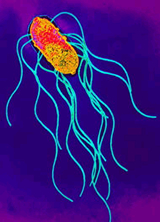
Almost all swimming species of bacteria propel themselves forward using corkscrew-like propellers called “flagella.” Bacterial flagella are composed of thousands of protein building blocks arranged in spiralling chains.

A multidisciplinary team of scientists, including researchers from the University of York, has discovered that some types of bacteria have evolved complex flagella made up of many different types of proteins to enable them to manoeuvre themselves out of small spaces.

The scientists looked at a soil-dwelling species of bacteria called Shewanella putrefaciens and found that when they get stuck in a tight space their multi-component flagella buckle, wrapping around the cell bodies and allowing them to corkscrew free.

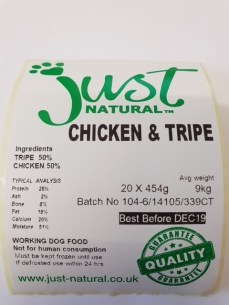
UK – Avondale Pet Foods Ltd recalls Just Natural Chicken & Tripe because Salmonella has been found in the product

FSA  Just_Chicken__Tripe

Avondale Pet Foods Ltd recalls Just Natural Chicken & Tripe because salmonella has been found in the product. This product has been sold in Scotland and England only.

Product details

Just Natural Chicken & Tripe

Pack size 20 x 454g and 8 x 1kg
Batch code 104-6/14105/339CT
Best before December 2019

No other Avondale Pet Foods Ltd products are known to be affected.


Food Standards Scotland

Risk: The presence of salmonella in the product listed above. Salmonella is a bacteria that can cause illness in humans and animals. The product could therefore carry a potential risk, because of the presence of salmonella, either through direct handling of the pet food, or indirectly, for example from pet feeding bowls, utensils or contact with the faeces of animals. In humans, symptoms caused by salmonella usually include fever, diarrhoea and abdominal cramps. Infected animals may not necessarily display signs of illness, but symptoms can include diarrhoea.

Our advice to consumers (pet owners):

When handling and serving raw pet food it is always advised to clean utensils and feeding bowls thoroughly after use. Consumers should wash hands thoroughly after handling raw pet food, bowls, utensils or after contact with the faeces of infected animals. Raw pet food should be stored separately from any food (especially ready to eat foods). Care should be taken when defrosting to avoid cross contamination of foods and surfaces. If you have bought any of the above product, return it to the store from where it was bought for a full refund.

Action taken by the company:  

Avondale Pet Foods Ltd is recalling the above product. Point of sale notices will be displayed in all retail stores that are selling this product. These notices explain to customers why the product is being recalled and tell them what to do if they have bought the product.