Category Archives: Salmonella

UK – Northern Ireland – Galmere Fresh Foods recalls Pestle and Mortar Fresh Green Basil Pesto and Pestle and Mortar Fresh Red Sundried Tomato Pesto due to the possible presence of Salmonella

FSA

Galmere Fresh Foods is recalling Pestle and Mortar Fresh Green Basil Pesto and Pestle and Mortar Fresh Red Sundried Tomato Pesto because they might contain Salmonella.

Product details

Pestle and Mortar Fresh Green Basil Pesto

Pack size 140g
Use by All use by dates
Pestle and Mortar Fresh Red Sundried Tomato Pesto

Pack size 140g
Use by All use by dates

No other Galmere Fresh Foods products are known to be affected.

Risk statement

Salmonella

The products listed above might be contaminated with Salmonella. Symptoms caused by Salmonella usually include fever, diarrhoea and abdominal cramps.

Action taken by the company

Galmere Fresh Foods is recalling the above products. Point of sale notices will be displayed in all retail stores that are selling these products. These notices explain to customers why the products are being recalled and tell them what to do if they have bought any of the products.

Our advice to consumers

If you have bought any of the above products do not eat them. Instead, return them to the store from where they were bought for a full refund.

Research – Prevalence, genotyping, serotyping, and antibiotic resistance of isolated Salmonella strains from industrial and local eggs in Iran

Wiley Online Library

Abstract

This present study aimed to evaluate prevalence and characterization of serotypes, antimicrobial resistance (AMR) and genotypic profiles of Salmonella isolates in industrial and local eggs from Zanjan province of Iran. A total of 120 egg samples were collected and processed according to bacteriological analytical manual to isolate Salmonella strains from both eggs surface and contents. PCR method and genotyping were used to verify, identification and classification of isolates by screening invA genes and 16 s‐rRNA gene sequencing. Salmonella contamination rate in eggshell and contents of industrial and local eggs were 0% and 1.66%, respectively. High degree of AMR was observed to nalidixic acid and erythromycin. Gene sequencing for each isolates showed more similarity with Salmonella enterica subsp. enterica serovar Enteritidis and Salmonella enterica subsp. enterica serovar Typhimurium strains.

Practical applications

Salmonella contamination in eggs and the role of healthy chickens as reservoir and distributer of Salmonella in poultry farms can be a common food safety concern for public health. Therefore, Continuous monitoring of presence Salmonella and their antimicrobial resistance is of critical importance. Present study gives an insight of the current statues of egg’s contamination with Salmonella isolates, their antimicrobial resistance, genotupic profile, and epidemiological relationship in Iran.

UK – Northern Ireland – Lidl recalls Meadow Fresh Green Pesto due to the possible presence of Salmonella

FSA

Lidl has taken the precautionary step of recalling all batches of Meadow Fresh Green Pesto because the product might contain Salmonella. This product has been distributed in Northern Ireland (and Republic of Ireland) only.

Product details

Meadow Fresh Green Pesto

Pack size 140g
Batch code all
Use by All Use By dates

No other Lidl products are known to be affected.

Risk statement

The product listed above might be contaminated with Salmonella. Symptoms caused by Salmonella usually include fever, diarrhoea and abdominal cramps.

Action taken by the company

Lidl is recalling the above product. Point of sale notices will be displayed in all retail stores that are selling this product. These notices explain to customers why the products are being recalled and tell them what to do if they have bought the product. Please see the attached notice.

Research – Validation of a Simulated Commercial Frying Process to Control Salmonella in Donuts

Mary Anne Leibert

Salmonella kswfoodworld

This study validated a typical commercial donut frying process as an effective kill-step against a 7-serovar Salmonella cocktail (Newport, Typhimurium, Senftenberg, Tennessee, and three dry food isolates) when contamination was introduced through inoculated flour. The bread and pastry flour mix (3:1) was inoculated with the Salmonella cocktail, and subsequently dried back to original preinoculation moisture content, achieving a Salmonella population of 7.6 log CFU/g. Inoculated flour was used to prepare a typical commercial donut batter, which was fried using 375°F (190.6°C) oil temperature. No viable Salmonella was detected using an enrichment plating protocol in the donuts after 2 min of frying, resulting in >7-log reduction in Salmonella population. The internal donut temperature increased from ∼30°C to ∼119°C at the end of 2 min of frying. The water activities of the donut crumb and crust after 2 min of frying, followed by 30 min of ambient air cooling, were 0.944 and 0.852, respectively. The donut pH after ambient-air cooling was 5.51. The D- and z-values of the Salmonella cocktail in donut dough were determined using thermal-death-time disks and temperature-controlled water baths. The D-values of the cocktail were 8.6, 2.9, and 2.1 min at 55°C, 58°C, and 61°C, respectively, whereas the z-value was 10°C. This study validated that >7-log reduction could be achieved if donuts are fried for at least 2 min in the oil at 190.6°C, and calculated D- and z-values present the heat resistance of Salmonella in donut dough at the start of the frying processes. However, results from this study should not be extrapolated when donut composition and frying parameters are changed significantly.

RASFF Alerts – Animal Feed – Salmonella – Meat Meal – Soybean Meal – Extruded Rapeseed Meal – Dog Chews (Lambs Ears)

RASFF-Logo

RASFF-Salmonella enterica ser. Infantis (presence /25g) in mixed meat meal for petfood from Ireland in Italy

RASFF-Salmonella (presence /25g) in soybean meal from Italy in Germany

RASFF-Salmonella enterica ser. Montevideo (present /25g) in extruded rapeseed meal from the Czech Republic in the Czech Republic

RASFF-Salmonella ( c = 1, O:3,10,15) in dog chew (lamb ears) from Turkey in Germany

USA – Food Safety Tips for your Holiday Turkey

CDC

CDC and its partners are investigating a multistate outbreak of multidrug-resistant Salmonella infections linked to raw turkey products(https://www.cdc.gov/salmonella/reading-07-18/index.html). This outbreak is a reminder that raw turkey products can have germs that spread around food preparation areas and can make you sick.

Food handling errors and inadequate cooking are the most common problems that lead to poultry-associated foodborne disease outbreaks in the United States. Follow these four food safety tips at the link above to help you safely prepare your next holiday turkey meal.

Poland – Epidemiological update: Salmonella in eggs from Poland

ECDC

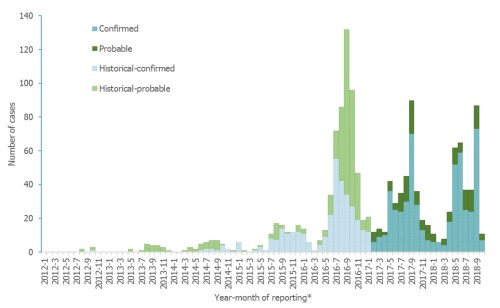
Since the joint ECDC-EFSA rapid outbreak assessment ’Multi-country outbreak of Salmonella Enteritidis infections linked to Polish eggs’ published on 12 December 2017, 15 EU/EEA countries (Belgium, Czech Republic, Denmark, France, Hungary, Iceland, Ireland, Italy, Luxembourg, Netherlands, Norway, Poland, Slovenia, Sweden and United Kingdom) have reported 336 confirmed, 94 probable and 3 new historical-confirmed cases associated with this ongoing multi-country outbreak of Salmonella Enteritidis in the EU/EEA. In the same period, seven historical probable cases were reclassified as excluded.

Overall, 1 412 cases have been found associated with this outbreak: 532 confirmed and 166 probable cases since 1 February 2017 and 343 historical-confirmed and 367 historical-probable cases between 2012 and 31 January 2017. In addition, no dates have been reported for four outbreak-confirmed cases, so they are unclassifiable as current or historical cases (Table 1).

Table 1. Distribution of cases by case classification and country, EU/EEA, February 2012 to November 2018 (n=1 420; 4 cases missing date of onset or sampling or receipt at reference laboratory), as of 12 November 2018

Reporting country Confirmed cases Probable cases Historical-confirmed cases Probable-confirmed cases Total number of cases
Belgium 0 46 14 127 187
Croatia 0 0 4 0 4
Czech Republic 0 6 0 3 9
Denmark 16 0 6 2 24
Finland 0 0 0 1 1
France 21 0 8 0 29
Greece 0 0 0 2 2
Hungary 0 29 0 5 34
Ireland 12 0 4 4 20
Ireland 1 0 0 0 1
Italy 0 12 1 19 32
Luxembourg 4 0 5 0 9
Netherlands 8 25 90 164 287
Norway 22 18 11 32 83
Poland 25 0 0 0 25
Slovenia 0 7 3 0 10
Sweden 11 20 12 2 45
United Kingdom 412 3 185 6 606
Total 532 166 343 367 1408
              698                 710


Most outbreak cases were reported during the summer months (Figure 1). Due to reporting delays, additional cases are expected to be reported with onset in recent months.

A total of 112 confirmed or historical-confirmed cases were reported with travel history in an EU country during the incubation period and therefore were likely infected there. Countries where infections likely took place were Poland (25 cases identified from 2016 to 2018), Bulgaria (22 cases from 2015 to 2018), Cyprus (14 cases in 2016 and 2018), Portugal (11 cases from 2015 to 2017) and Hungary (10 cases from 2016 to 2018). Additional travel-associated cases were also reported (<10 cases per country) with travel history to Austria, Belgium, Greece, Italy, the Netherlands, Romania, Slovenia and Spain.

Figure 1. Distribution of cases by month of onset* and case classification (n=1 412; 4 cases missing any date of report), EU/EEA, January 2012 to October 2018, as of 12 November 2018

aaaaa

The 2016 and 2017 European outbreak investigations identified eggs originating from Poland as the vehicle of infection in this outbreak (ECDC/EFSA rapid outbreak assessments published in March and December 2017). Outbreak-confirmed cases belong to four different WGS clusters.

Assessment

As reported in the previous ECDC/EFSA rapid outbreak assessment, in 2016 and 2017, evidence from epidemiological, microbiological, environmental and tracing investigations identified eggs originating from Poland as the vehicle of infections in this multi-strain outbreak. Control measures were implemented following these investigations. However, new outbreak cases were notified in 2017 and in 2018 with similar magnitude and temporal patterns. Based on the analysis of the travel-associated cases, it is likely that more countries where molecular typing is not performed routinely for human S. Enteritidis isolates are affected by the outbreak, including Bulgaria, Cyprus and Portugal.

Actions

ECDC monitors the occurrence of human cases associated with this threat and offers sequencing services for countries reporting probable cases of human S. Enteritidis isolates with MLVA profile 2-9-7-3-2 or 2-9-6-3-2 or
2-9-10-3-2 or 2-10-6-3-2 or 2-10-8-3-2 or 2-11-8-3-2. EU/EEA countries should consider interviewing new outbreak-confirmed cases.

South Africa – Durban eatery confirms Salmonella poisoned its patrons

Times Live

Old Town Italy confirms salmonella poisoning of more than 20 patrons two weeks ago .

A Durban eatery has confirmed that certain food samples submitted for laboratory testing have emerged positive for traces of salmonella.

Two weeks ago at least 20 people were hospitalised with suspected salmonella poisoning after eating at the popular Old Town Italy restaurant in Umhlanga.

Salmonella is most often contracted by eating raw or undercooked meat, poultry and eggs and causes diarrhoea, fever, chills and abdominal pain.

The restaurant has since completely removed hollandaise sauce – a mixture of egg yolk,melted butter and lemon juice – from its breakfast menu. In a statement posted on its Facebook page on Friday the restaurant said test results from two independent laboratories had been submitted to them.

“We can confirm the samples taken from our restaurant for the period 03 November 2018 to 09 November 2018 have tested positive for salmonella.

“However, it is important to highlight that the positive salmonella test results were limited to the hollandaise sauce, rocket and egg mix only.”

Ireland – Recall of a Batch of The Deli Green Pesto Due to Detection of Salmonella

FSAI

Summary
Category 2: For Information
Alert Notification: 2018.48
Product: The Deli Green Pesto; pack size: 140g
Batch Code: ‘Use-by’ date: 23.11.2018
Country Of Origin: Ireland

Message:

Aldi is recalling the above batch of its The Deli Green Pesto due to the detection of Salmonella. Point-of-sale recall notices will be displayed in Aldi stores.

Aldi The Deli Green Pesto

USA – Cap’n Crunch: Peanut Butter Crunch sold in select Target stores recalled due to Salmonella

Outbreak News Today

kswfoodworld Salmonella

The Quaker Oats Company, a subsidiary of PepsiCo, Inc., today announced a voluntary recall of a small quantity of Cap’n Crunch’s Peanut Butter Crunch cereal due to the potential presence of Salmonella.

While the potentially affected product only reached five specific Target stores and is limited to 21 boxes of one variety with two Best Before Dates, Quaker is initiating the voluntary recall to protect public health.

The recall was initiated as the result of a routine sampling program by the company, which revealed the finished product may contain bacteria.

For full details seethe link above