Category Archives: Salmonella

RASFF Alerts – Animal Feed – Salmonella – Dog Chews – Chilled Chicken Necks and Livers- Organic Sunflower Cake – Rapeseed Extraction Meal – Toasted Soja

RASFF-Logo

RASFF – Salmonella enterica ser. Johannesburg (in 5 out of 5 samples /25g) in dog chews from Germany in Austria

RASFF – Salmonella enterica ser. Enteritidis in chilled chicken necks and livers from the Netherlands in the Netherlands

RASFF – Salmonella enterica ser. Senftenberg (presence /25g) in organic sunflower cake from the Netherlands, via Lithuania in Germany

RASFF – Salmonella enterica ser. London (presence /25g) in rapeseed extraction meal from Germany in Germany

RASFF – Salmonella enterica ser. Agona (presence /25g) in toasted soja from Belgium in Belgium

USA -Outbreak Investigation of Salmonella Javiana Potentially Linked to Tailor Cut Produce Fruit Mix, Winter 2019

FDA Salmonella kswfoodworld

FDA, CDC and state and local partners are investigating an outbreak of illnesses caused by Salmonella Javiana. Epidemiologic and traceback evidence indicate that fruit mix with cantaloupe, honeydew, pineapple, and grapes from Tailor Cut Produce of North Brunswick, New Jersey, is a potential source of this outbreak.

The firm recalled the fruit mix, called Fruit Luau, as well as cut honeydew, cut cantaloupe and cut pineapple products on December 7. Food service and institutional food operators should not sell or serve the recalled products.

Tailor Cut Produce reports that their products may be found in restaurants, banquet facilities, hotels, schools, long-term care facilities and institutional food service establishments in Delaware, New Jersey, New York, and Pennsylvania.

Because the recalled products may have been distributed to nursing homes, schools, hospitals and other facilities that cater to vulnerable populations, it is important that these facilities do not sell or serve them. Please consult with your distributor to confirm the source of the fruit mix and cut fruit used in your operation.

Background

According to CDC, there are currently 11 illnesses confirmed by Whole Genome Sequencing (WGS) in Pennsylvania and Minnesota. The person from Minnesota traveled to New York at the time of infection.  CDC reports only cases confirmed by WGS, and these numbers may differ from the numbers that states are investigating but are awaiting WGS confirmation to be included in the outbreak.

FDA has initiated an inspection at Tailor Cut Produce and is currently collecting records to support a traceback investigation. FDA will continue its investigation and provide updates as more information becomes available.

Case Counts

Total Illnesses: 11
Hospitalizations: 8
Deaths: 0
Last illness onset: November 28, 2019
States with Cases: PA (10), MN (1)*
*This case was a MN resident who travelled to NY.

Research – Evaluating the Antimicrobial Efficacy of White Mustard Essential Oil Alone and in Combination with Thymol and Carvacrol against Salmonella

Journal of Food Protection

ABSTRACT

It is estimated that nontyphoidal Salmonella causes approximately 1 million illnesses and 378 deaths per year in the United States. Reduction of Salmonella-related foodborne infections can be achieved through application of food antimicrobials. Essential oils in combination with other antimicrobials can be added to food products to reduce the levels of the organism below the infectious dose for healthy individuals. The purpose of this study was to investigate the antimicrobial efficacy of white mustard essential oil (WMEO) against serovars of Salmonella and its potential to be used with carvacrol or thymol to control Salmonella. Results showed that WMEO at the highest concentration of 0.84% (v/v) compared with the positive control had approximately a 6- to 7-log reduction for all serovars. It was found that no difference in susceptibility existed among the serovars tested (P > 0.05). In addition, the MICs were determined to be 0.5, 0.02, and 0.02% for WMEO, carvacrol, and thymol, respectively, against Salmonella Typhimurium. The fractional inhibitory concentration index was calculated. A score of 1 indicated an additive effect occurred when WMEO was combined with thymol or carvacrol. Combining WMEO with carvacrol or thymol indicated that the concentration of individual essential oils needed to inhibit Salmonella can be reduced using these combinations and warrants further study to determine potential use in controlling Salmonella in commercial food products.

HIGHLIGHTS
  • WMEO showed no significant difference in antimicrobial activity between Salmonella serovars.

  • The MIC of WMEO against Salmonella Typhimurium was 0.5%.

  • Combination with thymol or carvacrol had an additive effect on the antimicrobial activity of WMEO.

USA -Outbreak Investigation of Salmonella Potentially Linked to Tailor Cut Produce Fruit Mix, Winter 2019

FDA

FDA and the Pennsylvania Department of Health (DOH) are investigating an outbreak of illnesses caused by Salmonella Javiana in Pennsylvania. Epidemiologic and traceback evidence indicate that fruit mix with cantaloupe, honeydew, pineapple, and grapes from Tailor Cut Produce of North Brunswick, New Jersey, are a potential source of this outbreak.

Total Illnesses: 31

Recommendation

Food service and institutional food operators should not sell or serve the fruit mix with cantaloupe, honeydew, pineapple, and grapes prepared by Tailor Cut Produce.

Tailor Cut Produce reports that their products may be found in restaurants, banquet facilities, hotels, schools and institutional food service establishments in New Jersey, New York, and Pennsylvania.

Because this fruit mix may have been distributed to nursing homes, schools, hospitals and other facilities that cater to vulnerable populations, it is important that these facilities do not sell or serve this fruit medley. Please consult with your distributor to confirm the source of the fruit mix used in your operation.

Background

The Pennsylvania Department of Health (DOH) reports that it is investigating 31 laboratory-confirmed illnesses of Salmonella at four healthcare facilities in southeast Pennsylvania. Salmonella Javiana has been identified among cases at three of four facilities. According to the Pennsylvania DOH the epidemiologic evidence collected thus far indicates that this fruit mix is a potential source of the illnesses. The state’s review of invoices shows that a common food eaten by many case patients was the fruit mix with cantaloupe, honeydew, pineapple, and grapes from Tailor Cut Produce.

FDA has activated a team to coordinate its outbreak investigation.  On December 6, 2019, the FDA and the Pennsylvania DOH shared the results of the investigation thus far with the firm, and the firm’s leadership stated that they would work with FDA to implement a recall of this product.

FDA will continue its investigation and provide updates as more information becomes available.

Research – Combined Effect of Cold Atmospheric Plasma and Hydrogen Peroxide Treatment on Mature Listeria monocytogenes and Salmonella Typhimurium Biofilms

Frontiers IN

Cold Atmospheric Plasma (CAP) is a promising novel method for biofilm inactivation as log-reduction values up to 4.0 log10 (CFU/cm2) have been reported. Nevertheless, as the efficacy of CAP itself is not sufficient for complete inactivation of mature biofilms, the hurdle technology could be applied in order to obtain higher combined efficacies. In this study, CAP treatment was combined with a mild hydrogen peroxide (H2O2) treatment for disinfection of 1 and 7 day(s) old Listeria monocytogenes and Salmonella Typhimurium biofilms. Three different treatment sequences were investigated in order to determine the most effective treatment sequence, i.e., (i) first CAP, then H2O2, (ii) first H2O2, then CAP, and (iii) a simultaneous treatment of CAP and H2O2. Removal of the biofilm, induction of sub-lethal injury, and H2O2 breakdown due to the presence of catalase within the biofilms were investigated in order to comment on their possible contribution to the combined inactivation efficacy. Results indicated that the preferred treatment sequence was dependent on the biofilm forming species, biofilm age, and applied H2O2 concentration [0.05 or 0.20% (v/v)]. At the lowest H2O2 concentration, the highest log-reductions were generally observed if the CAP treatment was preceded by the H2O2 treatment, while at the highest H2O2 concentration, the opposite sequence (first CAP, then H2O2) proved to be more effective. Induction of sub-lethal injury contributed to the combined bactericidal effect, while the presence of catalase within the biofilms resulted in an increased resistance. In addition, high log-reductions were partially the result of biofilm removal. The highest overall log-reductions [i.e., up to 5.42 ± 0.33 log10 (CFU/cm2)] were obtained at the highest H2O2 concentration if CAP treatment was followed by H2O2 treatment. As this resulted in almost complete inactivation of the L. monocytogenes and S. Typhimurium biofilms, the combined treatment of CAP and H2O2 proved to be a promising method for disinfection of abiotic surfaces.

RASFF Alerts – Salmonella- Raw Poultry Meat – Cooked and Frozen Crawfish – Black Pepper – Crayfish – Moringa Powder – Frozen Beef Trimmings – Spicy Chicken Burger – Sesame Seeds

RASFF-Logo

RASFF – Salmonella enterica ser. Enteritidis (present /25g) in frozen raw poultry meat from Poland in Poland

RASFF – Salmonella enterica ser. Newport (presence /125g) in cooked and frozen crawfish from China in dill brine from China in Sweden

RASFF – Salmonella enterica ser. Saintpaul (presence /25g) in black pepper from Brazil in Germany

RASFF – Salmonella enterica ser. Poona (presence /25g) and Salmonella enterica ser. Saintpaul (presence /25g) in black pepper from Brazil in Germany

RASFF – Salmonella (present /25g) in frozen pre-cooked crayfish. from China in Sweden

RASFF – Salmonella enterica ser. Enteritidis (presence /25g) in chilled raw poultry meat from Poland in Poland

RASFF – Salmonella enterica ser. Poona (presence /25g) in moringa powder (Moringa oleifera) from Burkina Faso in Luxembourg

RASFF – Salmonella enterica ser. Enteritidis (presence /25g) in frozen beef trimmings from Poland in Sweden

RASFF – Salmonella (presence /25g) in black pepper from Brazil in Germany

RASFF – Salmonella enterica ser. Morehead (presence /25g) in black pepper from Brazil in Germany

RASFF – Salmonella (presence /25g) in frozen spicy chicken burger from the Netherlands in the Netherlands

RASFF – Salmonella (presence /25g) in sesame seeds from Sudan in Greece

Bulgaria -Chicken meat infected with Salmonella from Poland

Poultry Med 

At least 100 tons of chicken infected with salmonella has reached the Bulgarian market. Some of the meat, imported from Poland, has been seized and so far there are no reporters of consumers infected with salmonella. Poland is the major producer of poultry meat in the European Union. the majority of poultry meat exports are directed to the internal EU market.
This is not the first time that poultry products imported from Poland are contaminated with Salmonella. Salmonella has been detected in 16 tons of poultry imported to the Czech Republic from Poland in April-May 2019.
In 2018 The EU has reported  almost 1,500 people sickened by Salmonella linked to Polish eggs in an outbreak that has lasted more than six years and affected 18 countries.

Research – Exploitation of plant extracts and phytochemicals against resistant Salmonella spp. in biofilms

Science Direct

Salmonella is one of the most frequent causes of foodborne outbreaks throughout the world. In the last years, the resistance of this and other pathogenic bacteria to antimicrobials has become a prime concern towards their successful control. In addition, the tolerance and virulence of pathogenic bacteria, such as Salmonella, are commonly related to their ability to form biofilms, which are sessile structures encountered on various surfaces and whose development is considered as a universal stress response mechanism. Indeed, the ability of Salmonella to form a biofilm seems to significantly contribute to its persistence in food production areas and clinical settings. Plant extracts and phytochemicals appear as promising sources of novel antimicrobials due to their cost-effectiveness, eco-friendliness, great structural diversity, and lower possibility of antimicrobial resistance development in comparison to synthetic chemicals. Research on these agents mainly attributes their antimicrobial activity to a diverse array of secondary metabolites. Bacterial cells are usually killed by the rupture of their cell envelope and in parallel the disruption of their energy metabolism when treated with such molecules, while their use at sub-inhibitory concentrations may also disrupt intracellular communication. The purpose of this article is to review the current available knowledge related to antimicrobial resistance of Salmonella in biofilms, together with the antibiofilm properties of plant extracts and phytochemicals against these detrimental bacteria towards their future application to control these in food production and clinical environments.

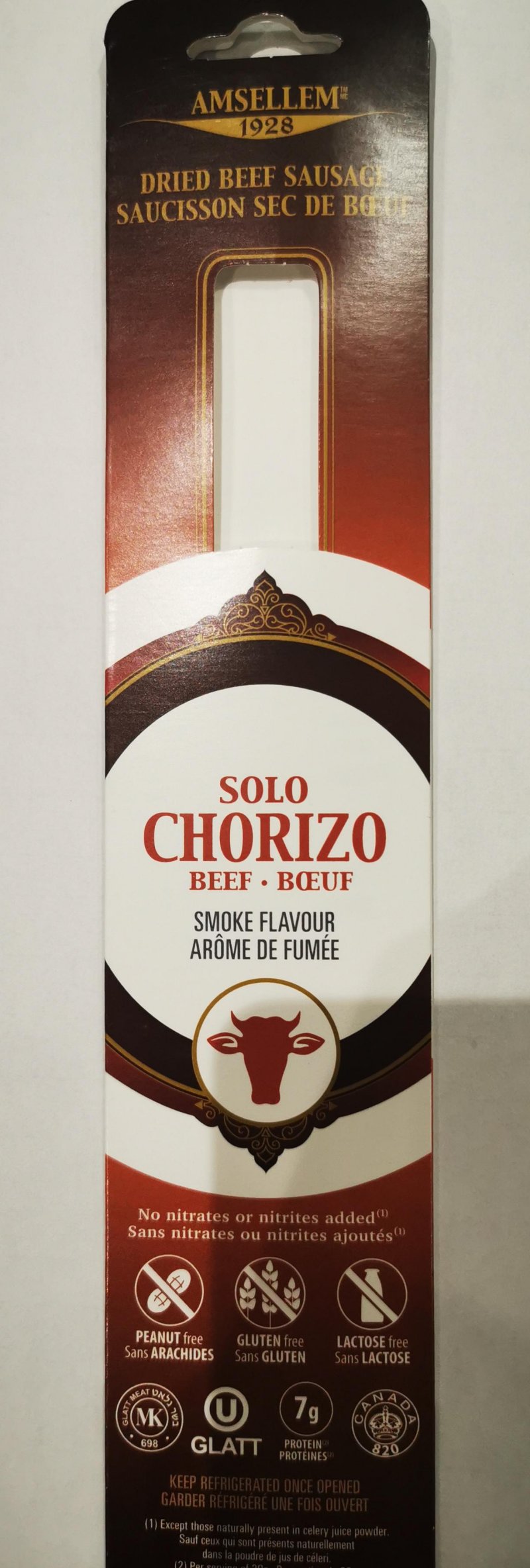
Canada – Food Recall Warning – Amsellem brand Solo Chorizo – Dried Beef Sausage recalled due to Salmonella

CFIA

Recall details

Ottawa, December 4, 2019 – Usine Amsellem Inc. is recalling Amsellem brand Solo Chorizo – Dried Beef Sausage from the marketplace due to possible Salmonella contamination. Consumers should not consume the recalled product described below.

Recalled product

Brand Product Size UPC Codes
Amsellem Solo Chorizo – Dried Beef Sausage 28 g 6 28055 38930 9 91002DC-707
BB 2020 AVR 08

Illnesses

There have been no reported illnesses associated with the consumption of this product.

Product photos

Printer ready version of photos

  • Amsellem - Solo Chorizo – Dried Beef Sausage

Canada -Food Recall Warning – President’s Choice brand Coleslaw recalled due to Salmonella

CFIA

Recall details

Ottawa, December 3, 2019 – Loblaw Companies Ltd. is recalling President’s Choice brand Coleslaw from the marketplace due to possible Salmonella contamination. Consumers should not consume the recalled product described below.

Recalled product

Brand Product Size UPC Codes
President’s Choice Coleslaw 397 g 0 60383 22267 3 Best Before 2019 DE 04 – B318005 and
Best Before 2019 DE 04 – B318006

Background

This recall was triggered by Canadian Food Inspection Agency (CFIA) test results. The CFIA is conducting a food safety investigation, which may lead to the recall of other products. If other high-risk products are recalled, the CFIA will notify the public through updated Food Recall Warnings.

The CFIA is verifying that industry is removing the recalled product from the marketplace.

Illnesses

There have been no reported illnesses associated with the consumption of this product.

Product photos

Printer ready version of photos

  • President's Choice - Coleslaw
  • President's Choice - Coleslaw - code