Category Archives: Foodborne Illness

Research – What do Consumers need to know about Salmonella and Cantaloupe

Food Poison Journal

In the United States, the Salmonella Sundsvall outbreak linked to cantaloupe from Mexico has been declared over.  The outbreaks sickened 407 people in 44 states. Six deaths were reported. The Centers for Disease Control and Prevention first reported the outbreak on November 17.

Of the 362 patients with information available, 158 were hospitalized.

Canadian officials have posted their final update on the Salmonella outbreak traced to cantaloupe, adding two deaths to the toll. There were 190 laboratory-confirmed cases of Salmonella Soahanina, Sundsvall, Oranienburg, and Newport illnesses associated with the nationwide outbreak. Sixty-eight patients were hospitalized, and nine died.

Read more at the link above.

USA -Listeria Outbreak Linked to Queso Fresco and Cotija Cheese

CDC

What You Should Do
  • Do not eat any recalled cheeses or dairy products.
    • Throw them away or return them to where you bought them.
  • Clean the refrigerator, containers, and surfaces that may have touched the recalled products.
    • Listeria can survive in the refrigerator and can easily spread to other foods and surfaces.
  • Call a healthcare provider right away if you have these symptoms after eating recalled products:
    • Pregnant people usually have fever, muscle aches, and tiredness.
    • People who are not pregnant usually have fever, muscle aches, and tiredness. They may also get a headache, stiff neck, confusion, loss of balance, or seizures.
What Businesses Should Do
Fast Facts
  • Illnesses: 26
  • Hospitalizations: 23
  • Deaths: 2
  • States: 11
  • Recall: Yes
  • Investigation status: Active
Round block of cheese on a wooden cutting board

Queso fresco

Recalled Food

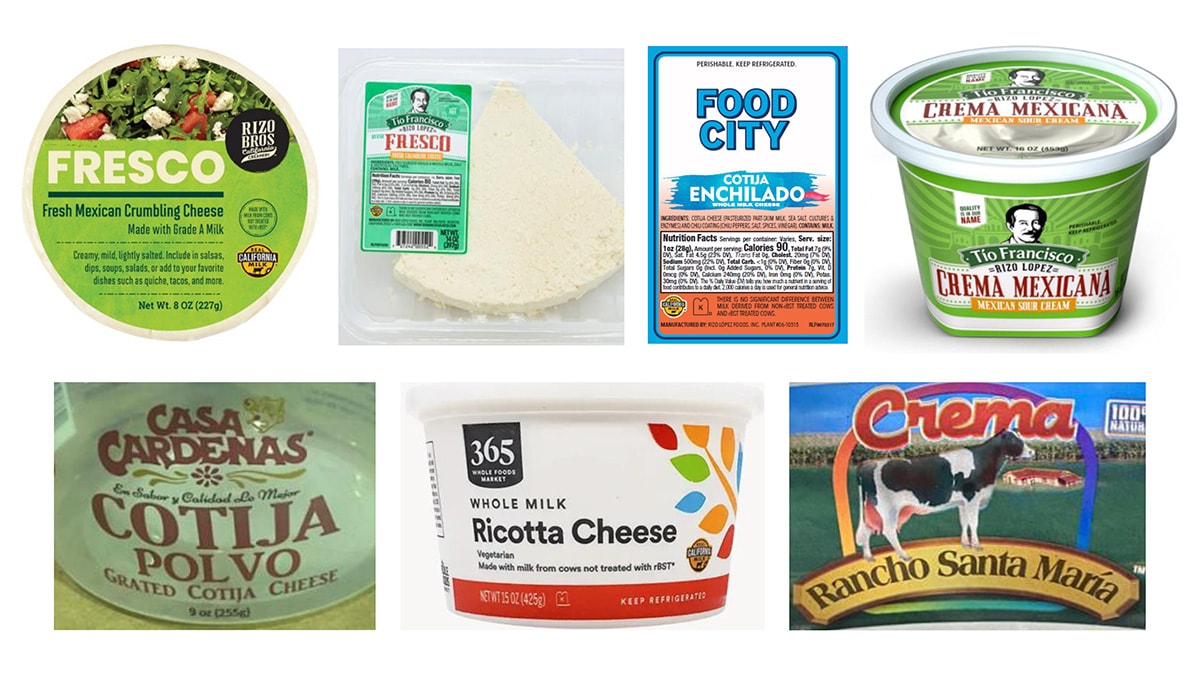
Cheeses, crema, and yogurt made by Rizo-López Foods

  • On February 6, 2024, Rizo-López Foods recalled all cheeses and other dairy products made in their facility.
  • Products were sold nationwide under these brands and at deli counters:
    • Campesino
    • Casa Cardenas
    • Don Francisco
    • Dos Ranchitos
    • El Huache
    • Food City
    • La Ordena
    • Rio Grande
    • Rizo Bros
    • San Carlos
    • Santa Maria
    • Tio Francisco
    • 365 Whole Foods Market

USA – FDA – Investigations of Foodborne Illness Outbreaks

FDA

What’s New

  • An outbreak advisory was issued for the outbreak of Listeria monocytogenes (ref #1214) linked to Queso Fresco and Cotija Cheese manufactured by Rizo Lopez Foods, Inc. On 2/5/2024, Rizo Lopez Foods, Inc. expanded their voluntary recall for Cotija Mexican Grating cheese to cover all dairy products manufactured in their Modesto, California, facility.
  • For the investigation of elevated lead levels in Cinnamon Applesauce Pouches (ref # 1198) the advisory was updated to include investigation updates.

Norway – Toxins in products from Den Sorte Havre a possible reason why several infants have fallen ill – Bacillus cereus

FHI

Toxins may have been the cause of several infants aged 5–6 months becoming ill after eating products from Den Sorte Havre between November and January. The products were withdrawn from the market in January.

At the beginning of January, the Norwegian Food Safety Authority was notified that several infants aged 5–6 months had become ill after eating products from Den Sorte Havre. The investigations of the products show the discovery of toxins produced by the bacterium Bacillus cereus.

The Norwegian Food Safety Authority has collaborated with the Norwegian Veterinary Institute (VI), the Norwegian University of Environmental and Biosciences (NMBU) and the Norwegian Institute of Public Health (FHI), and carried out extensive mapping and analysis work to find a possible reason why the children fell ill.

FHI has interviewed twelve of the guardians who have notified the Norwegian Food Safety Authority about this.

– The observed course of the disease in the children is typical of food poisoning caused by a toxin produced by the bacterium Bacillus cereus, says senior researcher Umaer Naseer at FHI.

Usually this type of food poisoning causes vomiting and vomiting shortly after ingestion (0.5-6 hours), and lasts for a day or less. 

The Norwegian Food Safety Authority has a close dialogue with the business in the work to investigate where in the production process bacterial toxins may have been formed and will have further follow-up of the business.

About the outbreak

The children live in eight different counties. The children had eaten three of the five products aimed at children from Den Sorte Havre; Starter porridge, Adaptation to solid food and Oatmeal with banana, from the end of November 2023 until the beginning of January 2024. All but one of the children were aged 5-6 months, and all had repeated bouts of vomiting 1-2 hours after ingestion. One of the children was a few months older than the others, and did not vomit but had diarrhea after eating the product. Few of the children developed a fever, but several parents reported a shorter period when it was difficult to get in touch with the child.

Ten of the children have had contact with the health service due to the symptoms, but none of them have been admitted to hospital. The children with vomiting became symptom-free after a few hours or up to a day, and the child with diarrhea was ill for a week. All the children are now healthy.

VI and NMBU have carried out laboratory analyzes of samples taken from products at the homes of the affected families. Some of the samples show traces of a toxin produced by the bacterium Bacillus cereus . In some of the samples, the concentration was high enough to cause illness in young children.

Advice for preventing infection

Bacillus cereus is usually transmitted through the consumption of contaminated food containing bacteria (diarrhea type) or toxins (vomiting type). Traditionally, starchy foods, such as rice and pasta, have been associated with the type of vomiting.

To prevent infection from bacillus cereus bacteria (diarrhea type), hot food should be kept piping hot (higher than 60°C) until serving. If the food is to be cooled, this should be done quickly and in small volumes. Leftovers should be heated sufficiently before serving.

Toxins produced by bacillus cereus bacteria (vomiting type) can withstand heat and boiling. Heating food containing such bacteria will therefore not prevent infection.

Research – The financial impact of foodborne illness outbreaks at restaurants: Chipotle Mexican Grill

Wiley Online

As demand for food away from home increases, outbreaks at restaurants become an important source of food-related illness. In the United States, over 60% of foodborne illness outbreaks occur at restaurants and 97% of outbreaks are limited to a single state. Despite this, we currently know little about restaurant outbreaks and in particular, single-state outbreaks are not well understood. We use Chipotle Mexican Grill’s eight outbreaks (2015–2018) to evaluate the media and stock market responses to both single and multistate outbreaks. Using news and stock market data, we provide evidence that multistate outbreaks brought swift stock price declines and single-state outbreaks’ impact depended on their timing, rather than their severity. Before Chipotle’s more well-known, multistate outbreaks, the firm’s single-state outbreaks brought little reporting and no financial losses, whereas after the multistate food safety events, single-state events resulted in national media coverage and large financial impacts. Our findings are consistent with the literature on food scares that can result in chronic low-level anxiety, which can bring about a large resurgence of concern for smaller outbreaks. The lessons learned from Chipotle’s case underscore the importance of investment in outbreak prevention. [G14 (Information and Market Efficiency, Event Studies, Insider Trading)].

Research – USA – Study: Multistate foodborne illness outbreaks change public perception of restaurants

The Packer

Multistate foodborne illness outbreaks bring swift financial losses to restaurants, increased media attention and an environment that makes subsequent smaller outbreaks more financially damaging, a new study says.

The research, from University of Illinois Urbana-Champaign’s consumer economics professor Maria Kalaitzandonakes, said that more than 60% of foodborne illness outbreaks in the U.S. occur at restaurants, according to a news release.

Most of those outbreaks are confined to a single state, however, when restaurants experience multistate outbreaks — as did the fast-casual chain Chipotle Mexican Grill in 2015 — that can lead to a stock market penalty, substantial negative news media coverage and a discernible change for the worse in how investors and the public view the company’s smaller outbreaks, according to Kalaitzandonakes.

India – 50 Students Suffer Food Poisoning Following Dinner At Girls’ Hostel In Koraput

Odishhabhaskar

Koraput: Around 50 hostel borders of Kasturba Gandhi Girls Hostel in Lamtaput area of Odisha’s Koraput district became sick after having dinner on Sunday night.

According to sources, these girl students developed symptoms of diarrhoea, vomiting, nausea and stomachache after having their dinner at the hostel at around 9 pm.

After receiving information, a team of five doctors from the Lamtaput Community Health Center (CHC) rushed to the hostel to treat the ailing students. Later on, the students suffering from food poisoning were admitted to the Lamtaput CHC.

It is alleged that poor quality of food led to their food poisoning.

USA – Outbreak Investigation of Listeria monocytogenes: Queso Fresco and Cotija Cheese (February 2024)

FDA

Image 2 – Labeling, Rizo Bros Cojita, front of label

Products:

Recalled products include all “Sell By” dates of cheese, yogurt, and sour cream (crema) sold under the brand names:

  • Tio Francisco
  • Don Francisco
  • Rizo Bros
  • Rio Grande
  • Food City
  • El Huache
  • La Ordena
  • San Carlos
  • Campesino
  • Santa Maria
  • Dos Ranchitos
  • Casa Cardenas
  • 365 Whole Foods Market

Product description, size, and UPCs are listed below. Additional information is also available in the firm’s recall notice.

Symptoms of Listeriosis (Listeria Infection)

Symptoms usually start within two weeks after eating food contaminated with Listeria but may start as early as the same day or as late as 10 weeks after. Mild symptoms may include a fever, muscle aches, nausea, tiredness, vomiting, and diarrhea. If the more severe form of listeriosis develops, symptoms may include headache, stiff neck, confusion, loss of balance, and convulsions.

Stores Affected

  • Sold Nationwide

Status

Ongoing; updates will be provided as they become available.

Recommendations:

  • Do not eat, sell, or serve recalled brands of cheeses, sour creams (cremas), or yogurts manufactured by Rizo Lopez Foods, Inc.
  • Check your refrigerators and freezers for any recalled products and throw them away. If you froze a product without the original packaging and can’t tell if it is part of the recall, throw it away.
  • Consumers, restaurants, and retailers who purchased or received recalled products, including wholesale products, should carefully clean and sanitize any surfaces or containers that it touched. Follow FDA’s safe handling and cleaning advice to reduce the risk of cross-contamination. Listeria can survive in refrigerated temperatures and can easily spread to other foods and surfaces.
  • If you have symptoms of listeriosis you should contact your health care provider to report your symptoms and receive care.

Recommendations for At-Risk Groups

  • Listeria is most likely to sicken pregnant people and newborns, adults aged 65 or older, and people with weakened immune systems. Other people can be infected with Listeria, but they rarely become seriously ill.
  • Pregnant people typically experience only fever, fatigue, and muscle aches. However, Listeria infection during pregnancy can lead to miscarriage, stillbirth, premature delivery, or life-threatening infection of the newborn.
  • Call your healthcare provider right away if you have symptoms of a Listeria infection.

South Africa – Eastern Cape authorities on high alert after over 300 pupils treated for suspected food poisoning

News 24

The Eastern Cape Department of Health and Alfred Nzo District Municipality are on high alert after more than 300 pupils were rushed to healthcare facilities between Thursday and Friday.

The pupils, all from KwaBhaca High School, in the town formerly known at Mount Frere, started vomiting and suffering from diarrhoea.

According to the provincial health department, the pupils were treated at healthcare facilities – and four have been admitted to hospital.

On Thursday, 274 pupils who experienced diarrhoea and vomiting were rushed to the clinic and a further 50 pupils from the same school were treated on Friday.

Research – Characteristics of Gastroenteritis Outbreaks Investigated in Singapore: 2018–2021

MDPI

Abstract

There is a need to study the characteristics of outbreaks via Singapore’s outbreak surveillance system to understand and identify the gaps in food safety for targeted policy interventions due to the increasing trend in gastroenteritis outbreaks and consequential increase in foodborne-related deaths and economic burden on public health systems worldwide. A total of 171 gastroenteritis outbreaks were investigated in Singapore from January 2018 to December 2021. This study analyzed the annual trend of investigated gastroenteritis outbreaks, the proportion of outbreaks by implicated sources of food, and the proportion of the type of pathogens identified from human cases, food samples, and environmental swabs collected from outbreak investigations. Among the foodborne gastroenteritis outbreaks (n = 121) investigated in Singapore, approximately 42.1% of the outbreaks had food prepared by caterers, 14.9% by restaurants, and 12.4% had food prepared by in-house kitchens. Clostridium perfringens and Salmonella were the most common causative pathogens in foodborne outbreaks throughout the analysis period. The food samples and environmental swabs collected were mostly detected for Bacillus cereus. Norovirus was the most common causative pathogen in non-foodborne outbreaks and was mainly attributable to preschools. This highlights the importance of monitoring and educating the catering industry and preschools to prevent future outbreaks.