Category Archives: Food Technology

Research – Sustainable food packaging that keeps harmful microorganisms away

ACS

Abstract Image

Active food packaging materials that are sustainable, biodegradable, and capable of precise delivery of antimicrobial active ingredients (AIs) are in high demand. Here, we report the development of novel enzyme- and relative humidity (RH)-responsive antimicrobial fibers with an average diameter of 225 ± 50 nm, which can be deposited as a functional layer for packaging materials. Cellulose nanocrystals (CNCs), zein (protein), and starch were electrospun to form multistimuli-responsive fibers that incorporated a cocktail of both free nature-derived antimicrobials such as thyme oil, citric acid, and nisin and cyclodextrin-inclusion complexes (CD-ICs) of thyme oil, sorbic acid, and nisin. The multistimuli-responsive fibers were designed to release the free AIs and CD-ICs of AIs in response to enzyme and RH triggers, respectively. Enzyme-responsive release of free AIs is achieved due to the degradation of selected polymers, forming the backbone of the fibers. For instance, protease enzyme can degrade zein polymer, further accelerating the release of AIs from the fibers. Similarly, RH-responsive release is obtained due to the unique chemical nature of CD-ICs, enabling the release of AIs from the cavity at high RH. The successful synthesis of CD-ICs of AIs and incorporation of antimicrobials in the structure of the multistimuli-responsive fibers were confirmed by X-ray diffraction and Fourier transform infrared spectrometry. Fibers were capable of releasing free AIs when triggered by microorganism-exudated enzymes in a dose-dependent manner and releasing CD-IC form of AIs in response to high relative humidity (95% RH). With 24 h of exposure, stimuli-responsive fibers significantly reduced the populations of foodborne pathogenic bacterial surrogates Escherichia coli (by ∼5 log unit) and Listeria innocua (by ∼5 log unit), as well as fungi Aspergillus fumigatus (by >1 log unit). More importantly, the fibers released more AIs at 95% RH than at 50% RH, which resulted in a higher population reduction of E. coli at 95% RH. Such biodegradable, nontoxic, and multistimuli-responsive antimicrobial fibers have great potential for broad applications as active and smart packaging systems.

Research – Detrimental Effect of Ozone on Pathogenic Bacteria

MDPI

Background: Disinfection of medical devices designed for clinical use associated or not with the growing area of tissue engineering is an urgent need. However, traditional disinfection methods are not always suitable for some biomaterials, especially those sensitive to chemical, thermal, or radiation. Therefore, the objective of this study was to evaluate the minimal concentration of ozone gas (O3) necessary to control and kill a set of sensitive or multi-resistant Gram-positive and Gram-negative bacteria. The cell viability, membrane permeability, and the levels of reactive intracellular oxygen (ROS) species were also investigated;

Material and Methods: Four standard strains and a clinical MDR strain were exposed to low doses of ozone at different concentrations and times. Bacterial inactivation (cultivability, membrane damage) was investigated using colony counts, resazurin as a metabolic indicator, and propidium iodide (PI). A fluorescent probe (H2DCFDA) was used for the ROS analyses;

Results: No reduction in the count colony was detected after O3 exposure compared to the control group. However, the cell viability of E. coli (30%), P. aeruginosa (25%), and A. baumannii (15%) was reduced considerably. The bacterial membrane of all strains was not affected by O3 but presented a significant increase of ROS in E. coli (90 ± 14%), P. aeruginosa (62.5 ± 19%), and A. baumanni (52.6 ± 5%);

Conclusion: Low doses of ozone were able to interfere in the cell viability of most strains studied, and although it does not cause damage to the bacterial membrane, increased levels of reactive ROS are responsible for causing a detrimental effect in the lipids, proteins, and DNA metabolism. View Full-Text

Research – The Application of Bacillus subtilis for Adhesion Inhibition of Pseudomonas and Preservation of Fresh Fish

MDPI

Inhibiting the growth of spoilage bacteria, such as Pseudomonas spp., is key to reducing spoilage in fish. The mucus adhesion test in vitro showed that the adhesion ability of Bacillus subtilis was positively correlated with its inhibition ability to Pseudomonas spp. In vivo experiments of tilapia showed that dietary supplementation with B. subtilis could reduce the adhesion and colonization of Pseudomonas spp. in fish intestines and flesh, as well as reduce total volatile basic nitrogen (TVB-N) production. High throughput and metabolomic analysis showed treatment with B. subtilis, especially C6, reduced the growth of Pseudomonas spp., Aeromonas spp., Fusobacterium spp., and Enterobacterium spp., as well as aromatic spoilage compounds associated with these bacteria, such as indole, 2,4-bis(1,1-dimethylethyl)-phenol, 3-methyl-1-butanol, phenol, and 1-octen-3-ol. Our work showed that B. subtilis could improve the flavor of fish by changing the intestinal flora of fish, and it shows great promise as a microecological preservative. View Full-Text

Research – Role of blue light in bactericidal effect against meat-borne pathogens and freshness maintaining of beef 

Journal of Food Protection

Beef is rich in various nutrients while easily spoils due to contamination by pathogens, thus it is of great significance to develop a bactericidal method to inactivate meat-borne pathogens and meanwhile maintain the freshness of beef. For the first time, the present study investigated the bactericidal effect of blue light (BL) at 415 nm against four meat-borne pathogens (methicillin-resistant Staphylococcus aureus , Escherichia coli , Salmonella Typhimurium and Listeria monocytogenes ) in vitro and inoculated on the surface of fresh beef, respectively. When the non-illuminated beef was used as control, the population of the four pathogens did not change significantly ( P > 0.05), while BL-illuminated beef showed dose-dependent inactivation effect in both in vitro and in vivo studies. The experiments on beef cuts showed that 109.44 J/cm 2 of BL inactivated 90% of inoculated cells for the tested strains ( P < 0.05), and the impact of BL inactivation could be sustained in 7 days of cold storage. Notably, changes of lipid oxidation rate, water holding capacity and cooking loss value between the control and beef illuminated by 109.44 J/cm 2 at the same time were scarcely detected during the storage. BL had a minor but insignificant influence on surface color and free amino acid content. Moreover, the pH of illuminated beef increased slower ( P < 0.05) than that of non-illuminated beef. The present work demonstrated that BL could be a novel bactericidal and freshness-maintaining method for fresh beef.

Research – Effect of Plasma-Activated Solution Treatment on Cell Biology of Staphylococcus aureus and Quality of Fresh Lettuces

MDPI

This study aimed to investigate effects of plasma-activated solution (PAS) on the cell biology of Staphylococcus aureus and qualities of fresh lettuce leaves. PAS was prepared by dielectric barrier discharge plasma and incubated with S. aureus for 10–30 min or with lettuces for 10 min. Effects on cell biology were evaluated with microscopic images, cell integrity, and chemical modification of cellular components. Effects on lettuce quality were estimated with the viable microbial counts, color, contents of vitamin C and chlorophyll, and surface integrity. PAS reduced S. aureus population by 4.95-log and resulted in increased cell membrane leakage. It also resulted in increased contents of reactive oxygen species in cells, C=O bonds in peptidoglycan, and 8-hydroxydeoxyguanosine content in cellular DNA, and reduced ratios of unsaturated/saturated fatty acids in the cell membrane. PAS treatment reduced bacterial load on fresh lettuce and had no negative effects on the quality. Data suggest that PAS can be used for the disinfection of ready-to-eat fresh vegetables. View Full-Text

Research – Differential Survival of Generic E. coli and Listeria spp. in Northeastern U.S. Soils Amended with Dairy Manure Compost, Poultry Litter Compost, and Heat-Treated Poultry Pellets and Fate in Raw Edible Radish Crops

Journal of Food Protection

Composted or heat-treated Biological Soil Amendments of Animal Origin (BSAAO) can be added to soils to provide nutrients for fresh produce. These products lower the risk of pathogen contamination of fresh produce when compared with use of untreated BSAAO; however, meteorological conditions, geographic location, and soil properties can influence the presence of pathogenic bacteria, or their indicators (e.g., generic E. coli) and allow potential for produce contamination. Replicated field plots of loamy or sandy soils were tilled and amended with dairy manure compost (DMC), poultry litter compost (PLC), or no compost (NoC) over two different field seasons, and non-composted heat-treated poultry pellets (HTPP) during the second field season. Plots were inoculated with a three-strain cocktail of rifampicin-resistant E. coli (rE.coli) at levels of 8.7 log CFU/m2. Direct plating and most probable number (MPN) methods measured the persistence of rE.coli and Listeria spp. in plots through 104 days post-inoculation. Greater survival of rE. coli was observed in PLC plots in comparison to DMC plots and NoC plots during year 1 (P < 0.05). Similar trends were observed for year 2, where rE. coli survival was also greater in HTPP amended plots (P < 0.05). Survival of rE. coli was dependent on soil type, where water potential and temperature were significant covariables. Listeria spp. were found in NoC plots, but not in plots amended with HTPP, PLC or DMC. Radish data demonstrate that PLC treatment promoted the greatest level of rE.coli translocation when compared to DMC and NoC treatments (P  < 0.05). These results are consistent with findings from studies conducted in other regions of the US and informs Northeast produce growers that composted and non-composted poultry-based BSAAO supports greater survival of rE. coli in field soils. This result has the potential to impact the food safety risk of edible produce grown in BSAAO amended soils as a result of pathogen contamination.

Research – Bioactivity of Essential Oils for Mitigation of Listeria monocytogenes Isolated from Fresh Retail Chicken Meat

MDPI

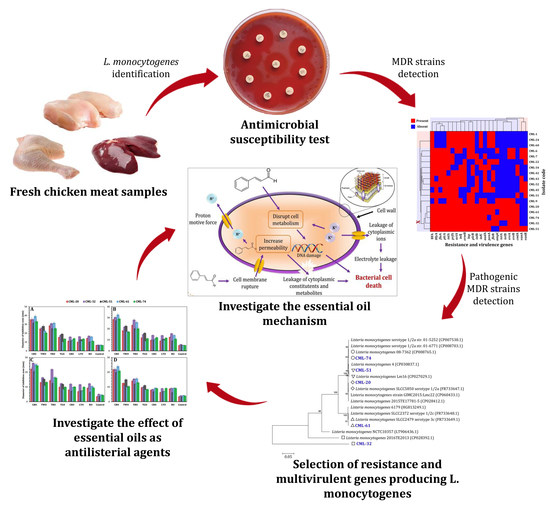
Listeria monocytogenes is one of the most severe foodborne pathogens found in several habitats. Therefore, this study aims to investigate the antilisterial activity of different essential oils (EOs) against multidrug-resistant (MDR) L. monocytogenes strains isolated from fresh chicken meat. Our results showed that the prevalence of L. monocytogenes in the examined samples was 48%. Seventy-eight isolates were identified as L. monocytogenes. Out of these, 64.1% were categorized as MDR and were categorized in 18 patterns with 50 MDR isolates. One isolate was selected randomly from each pattern to investigate their biofilm-forming ability, resistance, and virulence genes incidence. Out of 18 MDR isolates, 88.9% showed biofilm-forming ability. Moreover, the most prevalent resistance genes were ermB (72%), aadA (67%), penA (61%), and floR genes (61%). However, the most prevalent virulence genes were inlA (94.4%), prfA (88.9%), plcB (83.3%), and actaA (83.3%). The antilisterial activity of EOs showed that cinnamon bark oil (CBO) was the most effective antilisterial agent. CBO activity could be attributed to the bioactivity of cinnamaldehyde which effects cell viability by increasing the bacterial cell electrical conductivity, ion leakage, and salt tolerance capacity loss. Therefore, CBO could be an effective alternative natural agent for food safety applications. View Full-Text

Research – High-Pressure-Induced Sublethal Injuries of Food Pathogens—Microscopic Assessment

MDPI

High Hydrostatic Pressure (HHP) technology is considered an alternative method of food preservation. Nevertheless, the current dogma is that HHP might be insufficient to preserve food lastingly against some pathogens. Incompletely damaged cells can resuscitate under favorable conditions, and they may proliferate in food during storage. This study was undertaken to characterize the extent of sublethal injuries induced by HHP (300–500 MPa) on Escherichia coli and Listeria innocua strains. The morphological changes were evaluated using microscopy methods such as Scanning Electron Microscopy (SEM), Transmission Electron Microscopy (TEM), and Epifluorescence Microscopy (EFM). The overall assessment of the physiological state of tested bacteria through TEM and SEM showed that the action of pressure on the structure of the bacterial membrane was almost minor or unnoticeable, beyond the L. innocua wild-type strain. However, alterations were observed in subcellular structures such as the cytoplasm and nucleoid for both L. innocua and E. coli strains. More significant changes after the HHP of internal structures were reported in the case of wild-type strains isolated from raw juice. Extreme condensation of the cytoplasm was observed, while the outline of cells was intact. The percentage ratio between alive and injured cells in the population was assessed by fluorescent microscopy. The results of HHP-treated samples showed a heterogeneous population, and red cell aggregates were observed. The percentage ratio of live and dead cells (L/D) in the L. innocua collection strain population was higher than in the case of the wild-type strain (69%/31% and 55%/45%, respectively). In turn, E. coli populations were characterized with a similar L/D ratio. Half of the cells in the populations were distinguished as visibly fluorescing red. The results obtained in this study confirmed sublethal HHP reaction on pathogens cells. View Full-Text

Research – Inactivation of Salmonella spp., Escherichia coli O157:H7 and Listeria monocytogenes in Tahini by Microwave Heating

MDPI

Tahini (sesame paste) is a traditional food. Numerous foodborne outbreaks have been associated with it. This study aimed to (i) explore the efficiency of 2450 MHz microwave heating at 220, 330, 440, 550, and 660 W on the inactivation of Salmonella spp, Escherichia coli O157:H7, and Listeria monocytogenes in tahini; (ii) determine the impact of desiccation and starvation stresses on pathogen survival; (iii) assess the impact of microwave heating on the physicochemical characteristics of tahini. The inoculated microorganisms in tahini were reduced with higher microwave power levels (p < 0.05) and longer exposure times. The D-values of unstressed Salmonella spp., Escherichia coli O157:H7, and L. monocytogenes ranged from 6.18 to 0.50 min, 6.08 to 0.50 min, and 4.69 to 0.48 min, respectively, at power levels of 220 to 660 W, with z-values of 410, 440, and 460 W, respectively. Generally, desiccation and starvation stress levels prior to heating increased microbial resistance to heat treatment. Microwave heating did not affect acid, peroxide, p-anisidine, or color values of tahini up to 90 °C. These findings reveal microwave heating as a potential method for lowering the risk of Salmonella spp., E. coli O157:H7 and L. monocytogenes in tahini with no compromise on quality. View Full-Text

Research – Impact of gas ultrafine bubbles on the potency of chlorine solutions against Listeria monocytogenes biofilms

Ultrafine bubble technology is a novel concept in food safety that can improve the potency of antimicrobials against biofilms. This study was conducted to evaluate the impact of gas (air, CO2, or N2) ultrafine bubbles incorporation in 100 and 200 ppm chlorine (Cl2) solutions to inactivate fresh Listeria monocytogenes biofilms on stainless steel. Listeria monocytogenes biofilms were grown on stainless steel coupons through static incubation at 37°C for 72 hr by immersing in L. monocytogenes inoculated brain heart infusion (BHI) broth. The coupons were treated by dipping in water or Cl2 solutions with or without ultrafine bubbles for 1 min. Random pre-determined areas on coupons were swabbed into Dey–Engley neutralizing broth before and after treatments and enumerated using BHI agar. Air and CO2 nanobubbles in 100 ppm Cl2 resulted in greater log reductions (5.0 and 4.9 log CFU/cm2, respectively) in L. monocytogenes biofilms compared with 100 ppm Cl2 without gas ultrafine bubbles (3.7 log CFU/cm2). Incorporation of air, CO2, and N2 ultrafine bubbles in water and 200 ppm Cl2 did not have any impact on the efficacy of biofilm inactivation.