Category Archives: Food Technology

Research – Researchers study use of blue light technology for foodborne outbreaks

National Hog Farmer

Researchers from the University of Georgia Center for Food Safety are beginning a new study to investigate the effectiveness of antimicrobial blue light technology to reduce the foodborne pathogens that cause food poisoning.

When used as a means of disinfecting surfaces in a hospital setting, antimicrobial blue light technology has shown promising results, but little research has yet been done to explore its potential efficacy to control foodborne pathogens.

Through a three-year, $599,900 grant awarded by the U.S. Department of Agriculture’s National Institute of Food and Agriculture, UGA College of Agricultural and Environmental Sciences researchers will test the technology to uncover possible applications in the food production process.

Despite industry efforts, the number of foodborne infections has remained steady and, in some cases, has increased in recent years according to the Centers for Disease Control and Prevention (CDC).

Large-scale outbreaks and recalls still occur, particularly due to environmental contamination — like food preparation and processing surfaces — with Salmonella enterica and Listeria monocytogenes, both of which can cause illness and even death.

Most food manufacturers use chemical sanitizers on food preparation surfaces to help control the spread of foodborne pathogens.

This is typically effective in easy-to-reach areas, but areas that are hard to reach may not receive the same degree of sanitation.

These hard-to-reach places sometimes harbor biofilms, which are clusters of microorganisms such as bacteria that are hard to eliminate. The inadvertent spread of these microorganisms can occur during food production both by humans and machinery. Viruses pose a further challenge as many, such as norovirus, can survive on a variety of surfaces for long periods of time.
Research – Unraveling the Antimicrobial Effectiveness of Coridothymus capitatus Hydrolate against Listeria monocytogenes in Environmental Conditions Encountered in Foods: An In Vitro Study

MDPI

The increased resistance of bacteria to antimicrobials, as well as the growing interest in innovative and sustainable alternatives to traditional food additives, are driving research towards the use of natural food preservatives. Among these, hydrolates (HYs) have gained attention as “mild” alternatives to conventional antimicrobial compounds. In this study, the response of L. monocytogenes ATCC 7644 exposed to increasing concentrations of Coridothymus capitatus HY (CHY) for 1 h at 37 °C was evaluated by means of Phenotype Microarray, modelling the kinetic data obtained by inoculating control and treated cells into GEN III microplates, after CHY removal. The results revealed differences concerning the growth dynamics in environmental conditions commonly encountered in food processing environments (different carbon sources, pH 6.0, pH 5.0, 1–8% NaCl). More specifically, for treated cells, the lag phase was extended, the growth rate was slowed down and, in most cases, the maximum concentration was diminished, suggesting the persistence of stress even after CHY removal. Confocal Laser Scanner Microscopy evidenced a diffuse aggregation and suffering of the treated cells, as a response to the stress encountered. In conclusion, the treatment with HY caused a stressing effect that persisted after its removal. The results suggest the potential of CHY application to control L. monocytogenes in food environments.

Research – Effect of Pulsed Light on Quality of Shelled Walnuts

MDPI

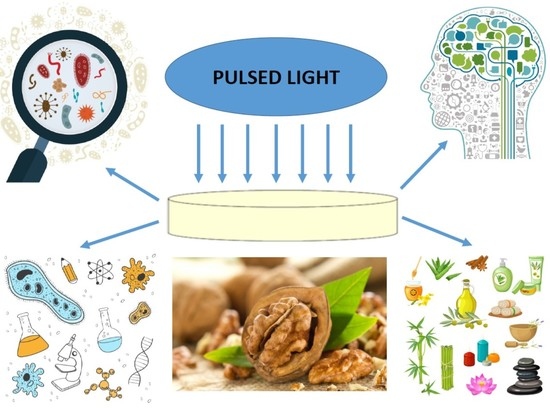
Shelled walnuts are considered a microbiologically low-risk food but have been linked to some outbreaks, and a treatment aiming to decrease this risk is desirable. Pulsed light (PL) may be an alternative, providing it does not seriously impair their quality. This work assessed the impact of PL on some quality attributes of walnuts. To do this, measurements of rancidity, volatiles, total phenols, antioxidant activity, and descriptive sensory analysis were carried out on untreated and PL (43 J/cm2)-treated kernels. PL had no statistically significant (p > 0.05) effects on TBARS, peroxide value, total phenols, and antioxidant activity but significantly increased the concentration of volatiles related to green/herbaceous odors and decreased compounds related to fruity and citrus odors. The descriptors nut overall, walnut odor and flavor, and aftertaste were given statistically significantly (p < 0.05) higher scores, while descriptors woody odor and sweet received lower scores; 16 other traits such as all those related to color, texture, and rancidity were unaffected. No significant (p > 0.05) effects on total phenols and antioxidant activity in general were observed during the course of PL treatment. It can be concluded that PL technology may be used in shelled walnuts with only mild effects on their quality; a storage study must be carried out in order to determine the effect of PL treatment on its shelf-life. View Full-Text

Research – Preservation of cut fruit and use of a technological adjuvant for washing certain vegetables

ACSA

The Spanish Agency for Food Safety and Nutrition has published two new reports from its Scientific Committee:

  • Report on the storage conditions of fruit cut in half in retail establishments.
  • Report on the safety of the use of an aqueous solution of sodium lauryl ether sulfate as a processing aid for washing apples, peaches, bananas, tomatoes, peppers and citrus in processing plants .      

Report on the storage conditions of fruit cut in half in retail establishments

The AESAN Scientific Committee has assessed whether it is possible to keep melon, watermelon, pineapple and papaya cut in half at room temperature in retail establishments for a limited time, ensuring consumer safety.

The Scientific Committee has concluded that, on the basis of the information

  • Storage at room temperature of melon, watermelon, papaya and pineapple cut in half can pose a health risk as the physicochemical conditions (pH, water activity, total soluble solids, nutrient availability, etc.) are compatible with growth. of foodborne pathogens, such as Salmonella , E. coli verotoxigenic or L. monocytogenes .
  • In order to make the storage conditions of melon, watermelon, papaya and pineapple cut in half more flexible, temperatures below 25 ºC for a time of less than 3 may be allowed, as they do not pose a significant microbiological risk. hours in a place sufficiently ventilated and preserved from sunlight, followed by continuous refrigerated storage at temperatures below 5 ºC.
  • To minimize the health risk that these practices may pose, it is recommended to discard for cutting fruits with an excessive degree of ripeness, or that have wounds or cracks on their surface, as they can be a source of contamination.

Report on the safety of the use of an aqueous solution of sodium lauryl ether sulfate as a processing aid for washing apples, peaches, bananas, tomatoes, peppers and citrus in processing plants

The AESAN Scientific Committee has evaluated the safety of using an aqueous solution of sodium lauryl ether sulfate (27%) as a technological aid for washing apples, peaches, bananas, tomatoes, peppers and citrus in processing plants. request of a company request.

Sodium lauryl ether sulfate (LESS) is not authorized for human consumption.

As the presence of residues in the final products (fruits and vegetables) after the use of this aqueous solution cannot be ruled out, the technology adjuvant is classified as an unauthorized substance in human food whose Admissible Daily Intake (ADI) is not established and whose use may lead to the presence of technically unavoidable waste.

The Scientific Committee concludes that, based on the information provided by the applicant and taking into account the proposed composition and conditions of use, the use of the technology adjuvant does not imply a risk to the health of the consumer.

The conclusions of this report refer exclusively to the solution under evaluation as a technological aid in the proposed conditions of use and its composition, and may not be extended to formulations or conditions other than those evaluated, including joint use with other substances.

This evaluation does not imply an authorization for use or affect uses other than use as a technological aid in the process of washing apples, peaches, bananas, tomatoes, peppers and citrus in the processing plants. This use involves a final rinsing with drinking water, following the application of the washing water with the technological adjuvant, so that the possible residues in the fruits and vegetables are eliminated.

Click to access FRUTAS_CORTADAS.pdf

Click to access COADYUVANTE_LAURIL_ETER.PDF

Research – Evaluation of Hygiene Indicators and Sampling Plan for Detecting Microbial Contamination in Health Functional Foods

Journal of Food Protection

This study aimed to monitor microbial contamination level in a variety of health functional foods and to establish new microbial criteria. Indicator organisms (i.e., aerobic bacteria, coliform bacteria, and Escherichia coli ) were monitored in 10 health functional food categories (743 items, 3,715 samples). The mean total aerobic counts of ginseng and Korean red ginseng were -0.35 and -0.74 log10 CFU/g; and their mean total coliform counts were -1.4 and -1.39 log10 CFU/g, respectively. In addition, the mean total coliform counts of fiber and protein products were -1.34 and -1.22 log10 CFU/g, respectively. However, no aerobic or coliform cells were detected in any other health functional food products (vitamins, minerals, probiotics, milk thistle extract, propolis, eicosapentaenoic acid, docosahexaenoic acid, or lutein products), and no E. coli was detected in any of the categories. These results can potentially be used to update the microbial criteria of the Health Functional Food Code.

Research – Inhibition of Listeria monocytogenes by Phage Lytic Enzymes Displayed on Tailored Bionanoparticles

MDPI

The high mortality rate associated with Listeria monocytogenes and its ability to adapt to the harsh conditions employed in food processing has ensured that this pathogen remains a serious problem in the ready-to-eat food sector. Bacteriophage-derived enzymes can be applied as biocontrol agents to target specific foodborne pathogens. We investigated the ability of a listeriophage endolysin and derivatives thereof, fused to polyhydroxyalkanoate bionanoparticles (PHA_BNPs), to lyse and inhibit the growth of L. monocytogenes. Turbidity reduction assays confirmed the lysis of L. monocytogenes cells at 37 °C upon addition of the tailored BNPs. The application of BNPs also resulted in the growth inhibition of L. monocytogenes. BNPs displaying only the amidase domain of the phage endolysin were more effective at inhibiting growth under laboratory conditions (37 °C, 3 × 10⁷ CFU/mL) than BNPs displaying the full-length endolysin (89% vs. 83% inhibition). Under conditions that better represent those found in food processing environments (22 °C, 1 × 10³ CFU/mL), BNPs displaying the full-length endolysin demonstrated a greater inhibitory effect compared to BNPs displaying only the amidase domain (61% vs. 54% inhibition). Our results demonstrate proof-of-concept that tailored BNPs displaying recombinant listeriophage enzymes are active inhibitors of L. monocytogenesView Full-Text

Research – Enhanced antimicrobial effectiveness of synergistic mixtures of rambutan peel extract and cinnamon essential oil on food spoilage bacteria and bio-based food packaging

Wiley Online

Staph

This research aims to enhance antimicrobial activity of rambutan peel extract (RPE), by mixing with cinnamon essential oil (CEO). The mixture of RPE and CEO with different weight ratios (10:0, 9:1, 8:2, 7:3, 6:4, 5:5, 4:6, 3:7, 2:8, 1:9, and 0:10) had been prepared and the antimicrobial efficacy was tested. Nine strains of bacteria: Gram-positive bacteria (Bacillus sp., Enterococcus faecalisLeuconostoc sp., Micrococcus luteusStaphylococcus aureus, and Streptococcus sp.) and Gram-negative bacteria (Escherichia coliPseudomonas fluorescens, and Salmonella typhimurium) were selected as the representative of pathogenic and food spoilage bacteria. Mixing RPE with CEO in a ratio of 5:5 showed the best synergistic effect against those bacteria. Addition of RPE/CEO in a weight ratio of 5:5 improved the antimicrobial activity of whey protein isolated (WPI) films, and enhanced strength, stiffness, and water resistance of the film.

Research – Novel Salmonella Phage, vB_Sen_STGO-35-1, Characterization and Evaluation in Chicken Meat

MDPI

Salmonellosis is one of the most frequently reported zoonotic foodborne diseases worldwide, and poultry is the most important reservoir of Salmonella enterica serovar Enteritidis. The use of lytic bacteriophages (phages) to reduce foodborne pathogens has emerged as a promising biocontrol intervention for Salmonella spp. Here, we describe and evaluate the newly isolated Salmonella phage STGO-35-1, including: (i) genomic and phenotypic characterization, (ii) an analysis of the reduction of Salmonella in chicken meat, and (iii) genome plasticity testing. Phage STGO-35-1 represents an unclassified siphovirus, with a length of 47,483 bp, a G + C content of 46.5%, a headful strategy of packaging, and a virulent lifestyle. Phage STGO-35-1 reduced S. Enteritidis counts in chicken meat by 2.5 orders of magnitude at 4 °C. We identified two receptor-binding proteins with affinity to LPS, and their encoding genes showed plasticity during an exposure assay. Phenotypic, proteomic, and genomic characteristics of STGO-35-1, as well as the Salmonella reduction in chicken meat, support the potential use of STGO-35-1 as a targeted biocontrol agent against S. Enteritidis in chicken meat. Additionally, computational analysis and a short exposure time assay allowed us to predict the plasticity of genes encoding putative receptor-binding proteins.

Research – High-pressure processing: food safety without compromising quality

EFSA

High-pressure processing (HPP) of food is effective at destroying harmful microorganisms and poses no more food safety concerns than other treatments. These are two of the conclusions of a scientific opinion published by EFSA today.

EFSA experts assessed the safety and efficacy of HPP of food and, more specifically, whether it can be used to control Listeria monocytogenes in ready-to-eat (RTE) foods and as an alternative to thermal pasteurisation of raw milk.

HPP is a non-thermal food preservation technique that kills microorganisms that can cause diseases or spoil food. It uses intense pressure for a certain time and has minimal effects on taste, texture, appearance, or nutritional values.

HPP can be used at different steps of the food chain, usually on pre-packed products. It can be applied to raw materials such as milk, fruit juices, and smoothies but also to products that have already been processed, such as sliced cooked meat products and RTE meals. In the latter case, it reduces the contamination originating from the manufacturing environment, for example during slicing and manipulation of the products.

This processing method reduces levels of Listeria monocytogenes in RTE meat products, at specific time-pressure combinations defined in the scientific opinion. In general, the longer the duration and intensity of the pressure, the more reduction is achieved. This is an important finding because L. monocytogenes contamination of RTE foods is a public health concern in the EU. HPP also proved to be effective at decreasing the levels of other pathogens, such as Salmonella and E. coli.

For raw milk, experts identified the time-pressure combinations that can be considered to have the same effect as thermal pasteurisation. These vary depending on the pathogen considered.

HPP is not specifically regulated at EU level and EFSA’s advice will inform the possible decisions of risk managers in this field.

Research – The Efficacy of Conventional Spray, Electrostatic Spray, and Dip with a Combination of Hydrogen Peroxide and Peroxyacetic Acid to Inactivate Listeria monocytogenes on Apples

Journal of Food Protection

This study aimed to evaluate the efficacy of a and hydrogen peroxide (H 2 O 2 ) and peroxyacetic-acid (PAA) mixer delivered by conventional garden sprayer (GS), electrostatic sprayer (ES) and dip methods to inactivate Listeria monocytogenes on apples. Organic Honey Crisp ( HC ), Fuji ( FJ ), and Pink Lady ( PL ) were dip-inoculated with Listeria monocytogenes (2-strain, serotype 1/2b), which were then kept untreated (control), sprayed with water only, or treated with the H 2 O 2 -PAA mixer (0.0064, 0.1, 0.25 and 0.50%) for 20 s via GS, ES, or dip, followed by draining (2 min) on aluminum foil. Surviving bacteria were recovered on Modified Oxford agar. Atomic force microcopy was used to detect the structural changes of inactivation of L. monocytogenes in broth medium by the H 2 O 2 -PAA mixer solution. Data (2 replicates/6 samples/replicate) were analyzed using the Mixed Model Procedure of SAS ( P =0.05). Initial counts of L. monocytogenes on untreated apples were 6.80 to 6.90 log CFU/apple. The dip method was the most effective treatment (P<0.05) on pathogen reductions (2.31-2.41 log CFU/apple) followed by GS (1.44-1.70 log CFU/apple) and then ES (0.84-1.20 log CFU/apples). Reductions of L. monocytogenes were greatest ( P < 0.05) when apples were treated with H 2 O 2 -PAA mixer -0.25 and -0.50%. Atomic force microscopy analyses indicated that inactivation of L. monocytogenes cells in H2O2-PAA mixer solutions resulted from disruption of the outer membrane. The H 2 O 2 -PAA mixer treated cells had increased width, height and decreased roughness when compared to the untreated cells. Results suggested that applying a H 2 O 2 -PAA mixer by dip or GS methods is better for pathogen reduction than ES on apples.